Orheiul Vechi, Țipova, Saharna, Rezina, Bălți, Soroca · Nord
When
2 Jan 2007 – 7 Jan 2007 6 days · trip of 2007
Who
Alfredo Ferrari · @alfredito · Chisinau
How
Travel diary
The story · 1 days
Many who think for the first time of taking a trip to the Republic of Moldova wonder what is really worth seeing beyond Chisinau and the wonderful tunnels of the underground city of Cricova... The attractions are indeed not as numerous as in the neighbouring and splendid Romania, but with a little spirit of adventure and a good map even little Bessarabia can offer the visitor some enchanting corners, especially from late spring through to the beginning of autumn. In this virtual tour I want to suggest an itinerary that I did by car in the spring of 2004 and that I am only now recounting after gathering all the material I had kept from that trip, which after my last move I could no longer find.
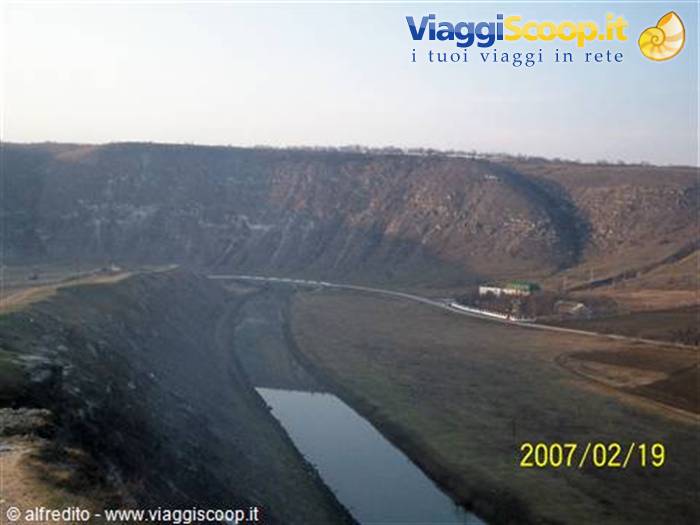
Shall we begin? Come on, off we go! Having left the capital I took the road leading towards Orhei (and therefore north), and after passing the Cricova roundabout I drove another thirty kilometres or so to the height of Ivancea, where you turn off following the tourist signs for the “Complexul Muzeal Orheiul Vechi”, which lies between the villages of Trebujeni and Butuceni. This is perhaps the largest and most interesting open-air museum complex in all of Moldova, made up of archaeological monuments, fortifications and ethnographic features from various eras reaching back to the Palaeolithic.
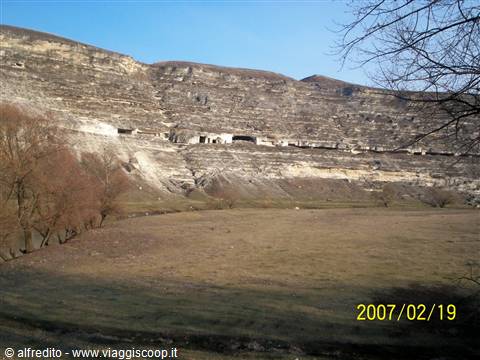
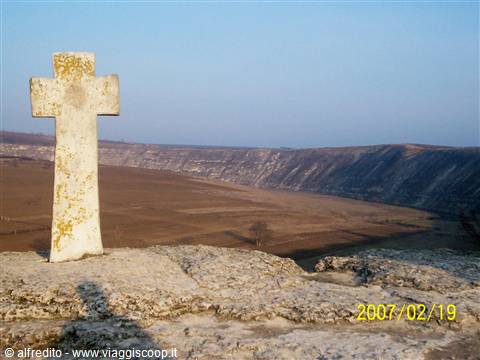
From the top of the highest promontory set among these little valleys stands out the bell tower (clopotnita) of the Pestera rock monastery, dating from the 15th-16th century (a short distance away a massive stone cross from the 18th century is also visible); it is carved entirely into the bowels of the rock and, precisely, only the bell tower remains visible from the outside. About a kilometre from Pestera rises another rock monastery, that of Bosie, entirely hollowed out of the rock and particularly interesting for the votive inscriptions carved on the walls in the ancient Slavonic language, dating from the 15th-16th century.
In the central body of this monumental area lies the actual citadel of Old Orhei, where in the 14th century nomadic tribes from Mongolia settled and turned the pre-existing local settlement into a truly oriental one, renaming it “Sehr-al-Jedid”, which meant “New City”. Of all this, today only the ancient fortifications remain, along with part of a mausoleum and a mosque, as well as the necropolis. In 1368, after a terrible flood caused by the overflowing of the Prut and Nistru rivers, the Mongols abandoned the area, which was once again occupied by the local population, who restored Old Orhei to its Moldovan character. To visit this enormous museum complex it is advisable to contact one of the guides found at the entrance itself, near the car park.
I still remember a very kind middle-aged lady who for a modest sum took me right round the complex for a few hours, providing me with every kind of information... After leaving Orhei Vechi, a few kilometres further on you reach the little town of Orhei; there is absolutely nothing worth mentioning there, but it remains a compulsory stop, especially if you are hungry and want to fortify yourself before setting off again even further north... Leaving Orhei you take the R20 highway towards Rezina and, on reaching the village of Cogilniceni, turn right following the signs for Tipova (...if you can see them!!!), better still if you ask the peasants you find working in the fields now and then!!! This road as far as Tipova is a fairly good dirt track when it is dry but absolutely inadvisable when it rains, unless you have a four-wheel drive...
then you'll have fun, it will be like doing the Camel Trophy!!!... I still remember the skids with my poor Punto. When you arrive in the village of Tipova it feels as though you have been transported by a time machine into a medieval era, a bit like what happened to Benigni and Troisi in that film they made together... Here you find the “Adormirea Maicii Domnului” monastery, made up of two different sections: the new one, which is not of particular interest, and the old one, which is a true marvel! It is a construction entirely carved out of the rock like the Bosie monastery, with the difference that this one is not carved from top to bottom into the rock but is rather recessed into a vertical rock face overlooking the Nistru river.
To be able to descend all the way down there you have to follow a path with very steep gradients, so let the monks who live in the new part of the monastery accompany you. They are extremely kind and very helpful with foreign guests!!! They will certainly invite you to taste their home-made wine, as happened to me!!! Excellent wine. One of the legends circulating about the Tipova monastery is that it was precisely in this place that the mythical poet Orpheus, considered the father of poetry, ended his life. His tomb lies a short distance from the rock monastery. But the most important legend is the one linked to the great lord and saint Stefan cel Mare, who was married right here to one of his wives, Maria Voichita, in the middle of the 15th century.
As you descend the rock face that leads you to the monastery you can admire from above the splendid landscape that opens up before you over the Nistru river and the immediately facing Transnistrian region. I noticed that at this point people calmly cross the Nistru aboard small rowing boats... perhaps to do a bit of smuggling... After Tipova I set off towards the most beautiful monastery in all of Moldova, that of Saharna... just think, I followed the “tips” of a priest from Tipova (a monk) and got there by following a track that runs along the Nistru and is NOT marked on any map!!! I won't tell you what those 15 kilometres were like because it is incredible... Anyway, after two and a half hours of manoeuvring in the mud I arrived at Saharna!!! In my opinion that monk thought I had a ZIL 130 of the Red Army and not a Punto 1200 eight-valve.
Anyway, when the going gets tough the tough get going!!! Saharna is not only a complex of monasteries but a true nature reserve that also includes the stream of the same name which, along its winding course, forms a total of 22 waterfalls of rare beauty!!! The largest of them is called “Groapa Tiganului”, translated as the Gypsies' Pit... 4 metres high, 6 wide, with a whirlpool of water 10 metres deep! In the monastic area of Saharna you find the “Sfintul Treime” monastery and the rock monastery “Bunavestirea”, as well as a Geto-Dacian acropolis dating from the 6th-3rd centuries BC; to reach it, follow the path that, along the stream, passes a few waterfalls and you will find it after a good half hour's walk... if you go in summer, take a dip under the waterfalls, they tell me it is a delight;) (perhaps avoid bathing in the Gypsies' Pit so as not to have unpleasant encounters...).
From Saharna to the nearby Rezina the distance is short. This town, which overlooks the Nistru river, is connected by a bridge to the Transnistrian town of Ribnitsa, which you can comfortably admire from the edge of the river itself, but if you decide to go beyond the bridge too, remember that you are subject to checks by the Transnistrian militia, so avoid staying more than 24 hours so as not to have to register at the OVIR office in Ribnitsa as well... Returning to Rezina, that
Day 17 Jan 2007
Returning to Rezina, what struck me most was the tidiness I noticed in the town and the very well-kept flowerbeds full of flowers, as well as the extreme kindness of its citizens!!! It was evening and I still had to reach Balti, my destination for the night where I would be staying that night at the Hotel Besarabia right in the city centre. The 100 km separating Rezina from Balti are covered in about 90 minutes, passing through the towns of Soldanesti and Floresti. (main road R13) In Soviet times Balti was a city with flourishing industrial development, especially in the textile sector; today unfortunately all of that has miserably disappeared under the harsh law of the market, which has shut down almost all the city's industries.
Very nice to see is the city centre with its pedestrian "promenade", truly very long considering the size of the city…Balti is mentioned as the first capital of the principality of Moldova and for this reason it displays a very recent statue of Stefan cel Mare right in front of the "primaria" (town hall). The Hotel Besarabia, in the heart of the city, is an old hotel of Soviet heritage with several renovated rooms of acceptable standard. (Price 35-40 euros for a double with breakfast included). In the evening it's pleasant to visit the "Patria" entertainment complex, made up of a multiplex cinema, some bars and restaurants, an internet room and a disco with great music where to get in you have to pass under a metal detector like at the airport.
In Balti, incredible but true, few people speak Romanian…it's a largely Russian-speaking city and to be honest I don't find the inhabitants of Balti very likeable…even though I know many people from Balti who live in Chisinau and are exquisite! Let's forget these out-of-place disquisitions and continue… The next day from Balti, crossing Drochia, I arrived at Soroca in the extreme north of Moldova, a city that, lying along the course of the Nistru, looks out over Ukraine.
Here the main attractions are: the "Cetate", a fortified medieval castle…the long Nistru, a "promenade" that runs along the whole river surrounded by a very well-kept park full of flowers and…hear, hear…the hill of the local Gypsies of Moldova!!! Soroca is the Moldovan capital of the Gypsies; most of them live here or have origins in this city…in their neighbourhood you can admire luxurious villas worthy of the best neighbourhoods of our metropolises like the Olgiata in Rome, but decidedly out of place there!!! Talking with a local policeman, the question came naturally to me: but what do these people do to drive around in Mercedes and BMWs and have such beautiful houses? Answer: They do drug trafficking between Pakistan, Afghanistan and the former Central Asian Soviet republics and Western Europe, but they do it all abroad so we can't intervene…Me, inwardly:…I DON'T BELIEVE IT!!! After S
oroca I also visited Otaci, a border town with Ukraine, and Edinet, another largely Russian-speaking town…both without any mention-worthy merit. Interesting, however, was the border crossing at Costesti towards Romania. After the exit passport check you cross a road built in the mid-1970s on a dam connected to a hydroelectric plant that crosses the Prut river…one of the few Soviet-Ceaușescu joint ventures of the time!!! I hope you enjoyed my account. If you decide to retrace it yourselves and have questions or doubts, I'll be glad to answer you. See you soon
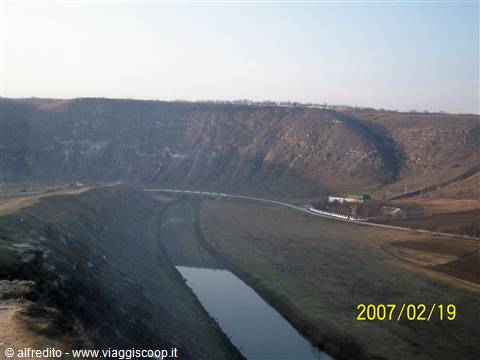
The Răut river winds between limestone hills at Orheiul Vechi
0 reader comments