The story
Not everyone knows that, in the heart of what in 2006 were called the Olympic mountains, a treasure of inestimable beauty lies hidden, given the name of the Piedmontese Great Wall. An enormous cultural heritage that bears witness to the glorious past of this area and to the importance the Chisone Valley has had over the course of history. And it is precisely about seventy kilometres from Turin, in the heart of the Chisone Valley, that this majestic example of military architecture stands: the Fortress of Fenestrelle.
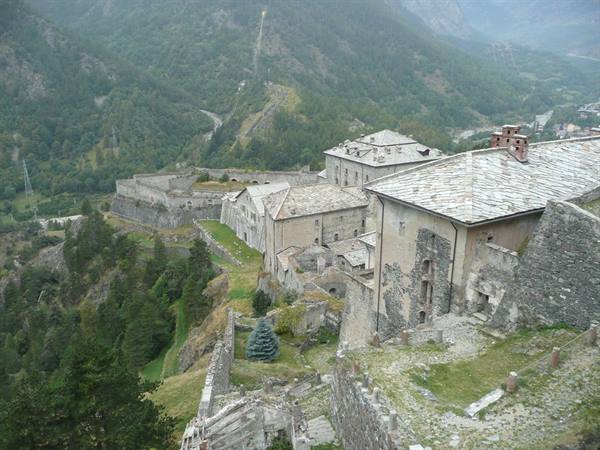
The Fortress of Fenestrelle, the largest fortress not only in Italy but also in Europe, with its 635 metres of elevation gain and its 3 km of length, has rightly earned the name of the Piedmontese Great Wall. You only have to see it to understand how fully this name describes it.
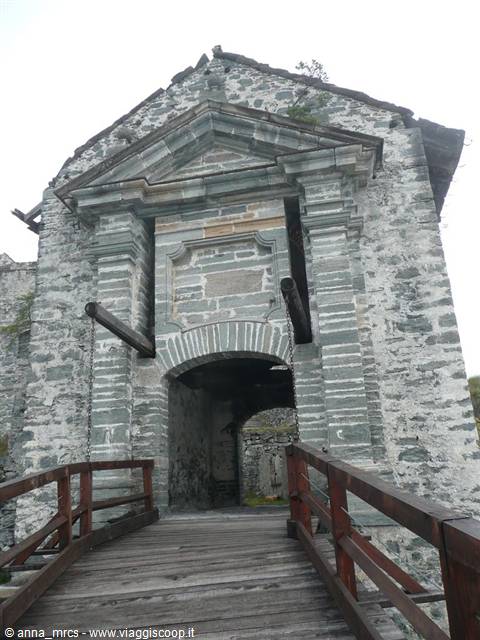
Describing its size is not easy; the numbers speak but are nothing compared with the vastness of this fortress and with what our eyes can see. It extends over a full 1,300,000 square metres of land, and is made up of three forts, 7 redoubts and a full 28 salients. Particular and unique is the covered staircase, which has a full 4000 steps and is still visitable today, and the royal staircase, which has 2500 steps instead, an open-air staircase from which, among other things, you enjoy a beautiful panorama. Inside there are 5 drawbridges, a full 14 connecting bridges, and it took 122 years to build this imposing defensive colossus.
It was Louis XIV, the Sun King, in 1694, who ordered the construction of the first fort making up the whole fortress, the Fort Mutin, now partly destroyed. The aim was to defend these territories, then French, from the Savoy armies of Victor Amadeus II. In 1713, with the Treaty of Utrecht, the upper Chisone Valley (Fenestrelle and Pragelato) and therefore the fort too passed under the Kingdom of Sardinia, which considered the fortress built by the Sun King insufficient for the defensive role it was to have. The construction was therefore commissioned of a larger fortress, but above all one that would be impregnable. And so the present forts of San Carlo, Tre Denti and delle Valli were built, along with the redoubts of Santa Barbara, Carlo Alberto and delle Porte.
All these buildings were and are linked by a covered staircase where men could move quickly even in the event of a siege without running serious risks. Many were the engineers of the age and the men who took turns in the works to build this enormous defensive work.
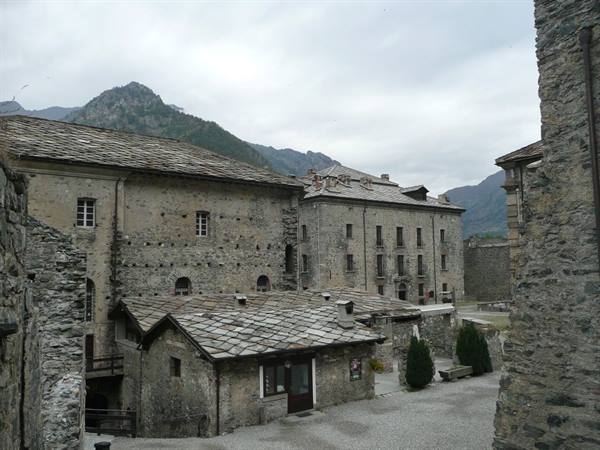
The San Carlo fort, today the most visited, is also the best preserved. It is the fort at the foot of the whole complex. Onto its Parade Ground, which is also the first place the visitor is projected into on entering the complex, looked what were the important buildings of the age: the Governor's Palace, the officers' pavilion and the church. A little further on are the powder magazines, the clock tower, the artisans' workshops, the storehouses and the arms depots. There are the prisons too. Imagining life in those times is not easy, and imagining the life of an ordinary soldier even less so: the cold suffered in winter, the barely heated buildings, the unsuitable clothing of the age, the hard guard shifts compared with the officers' quarters, which might even have seemed a luxury.
But even harder and more bitter is to imagine the life of the prisoners, many of whom found death in these places. Cramped, cold, damp, overcrowded rooms, where there was not enough space to house the prisoners, and so little room to move that there was not even the chance to lie down and rest; hunger, cold — it is hard to imagine all that criminals, deserters or political prisoners suffered and often paid for with their lives in these places.
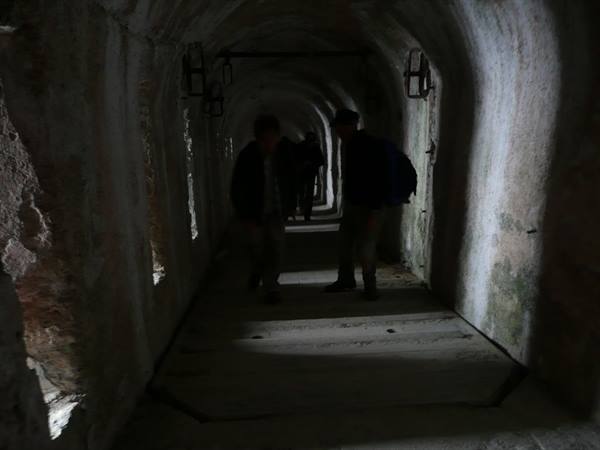
To be precise, the steps making up the covered staircase are exactly 3996, and this makes it unique of its kind not only in Italy but in all of Europe. It winds for a full 2 km, with small loopholes that guarantee the passage of light and the renewal of the air. Walking along it in the half-light that reigns there is something special: to imagine men in heavy armour, horses and mules going up and down these steps, to imagine the noise of their footsteps, of their weapons — a little dip into a past we know only from school books. Curious are the trapdoors found inside, shown to you by the guide who accompanies you along the whole route of the visit. The purpose of these trapdoors was, once again, to annihilate the enemy should he manage to enter the covered staircase.
Two museums are permanently housed inside the fort: the museum of the 3rd Alpini and that of the governor's animals. The fort often hosts temporary exhibitions or historical re-enactments. On the website the events that from time to time take place at the fort are publicised.
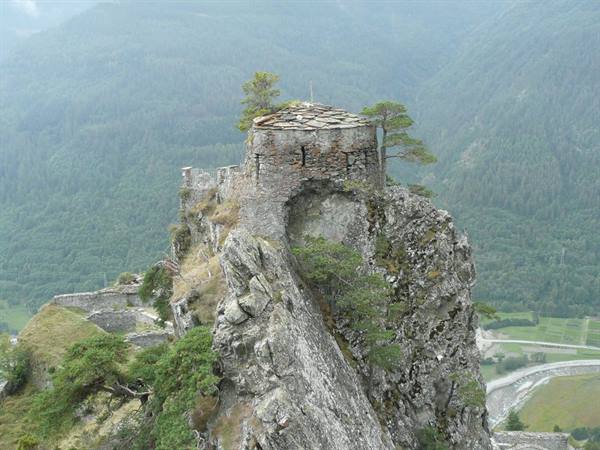
Three types of visit are offered. A short one of an hour, for those with little time, for a quick acquaintance with this majestic place; a more in-depth visit of the San Carlo fort, covering part of the covered staircase up to the Devil's Sentry Box, lasting 3 hours; and finally a fascinating journey inside the fort lasting a whole day. From the San Carlo fort, passing by the Devil's Sentry Box to the Forte della Valle. A visit that covers the 635 metres of elevation gain of the fort, where you walk not only the covered staircase but also the royal staircase; a journey of discovery of the places and buildings that make up this great fortress, its history and its secrets. The return is along the mule track that runs beside the fort, through a suggestive wood.
Truly an itinerary and a trip that will have made you familiar with this fortress, its history, its anecdotes, and for a day made you a little part of it too. For obvious reasons winter limits the visit of the fort to the San Carlo fort alone, but the mere sight of the whole fortress under snow is of equally evocative beauty.
Countless restoration works have given back light and splendour to this immense and precious complex. There are still many works to be done to prevent time from deteriorating and taking away with it the enormous architectural and cultural heritage of these places. In Italy we know that funds for this kind of work certainly don't rain down from heaven, and trying to bring this enormous complex of buildings back to its original splendour is, on the one hand, desirable and, on the other, perhaps utopian; but believing and dreaming that it can happen is granted to everyone, and perhaps, with our visit and a little word of mouth, we can help this fortress to live and ensure that this heritage is handed down and preserved for future generations.
Edmondo de Amicis said «One of the most extraordinary edifices that a painter of fantastic landscapes could ever have imagined: a sort of titanic stairway, like an enormous cascade of terraced walls, a gigantic and sad mass of constructions, offering I know not what appearance, mixed of sacred and barbaric, like a war necropolis or a monstrous stronghold, raised to halt an invasion of peoples, or to contain millions of rebels by terror. A strange thing, great, truly beautiful. It was the fortress of Fenestrelle».
The fortress of Fenestrelle is exactly this: a set of extraordinary buildings, a place where history has left its mark, where life and death have often mingled, a place where not going would be a shame!
The journey's photographs
8 photographs · click to open them full screen


0 reader comments