The story
So much dedication and hard work, so much care and so much heat from the sun are needed to produce tasty Sicilian vegetables — the farmers who work these lands steeped in history know this well. The vivid colours of the aubergines, courgettes, peppers and the famous Pachino cherry tomato recall those of the finest Sicilian mosaics, from Piazza Armerina to Monreale, and in turn embody the creative soul of the Sicilians. A people who, through art, can even express their own longing for legality — a sublime goal, hard to achieve, but one that in Pachino, an ancient town about fifty kilometres from Syracuse, returns with great relevance every year through Inverdurata, an event that is colourful and tasty through and through, and with important content.
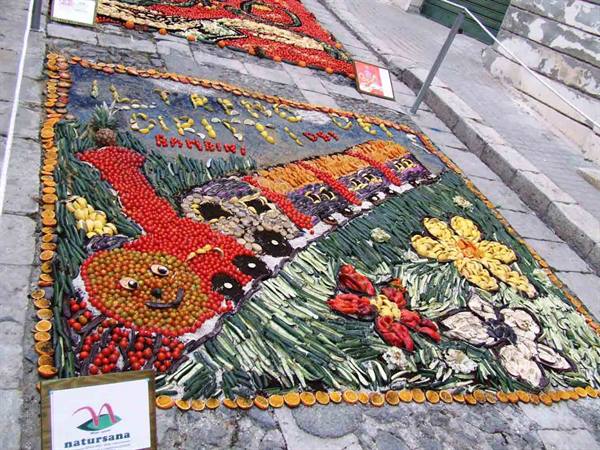
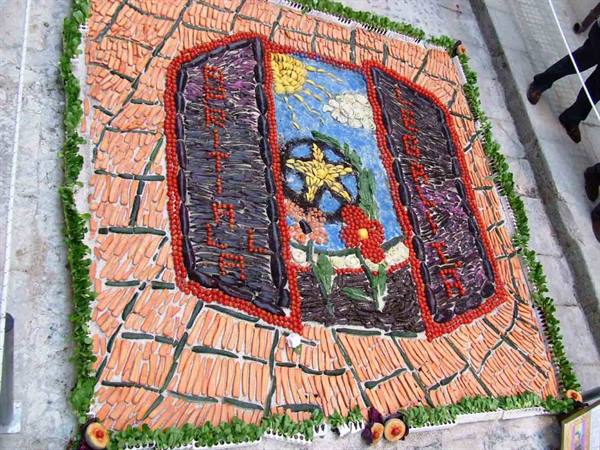
It's a competition and open-air exhibition of artistic mosaics made using only fruit and vegetables: last year, during our trip, the event was dedicated to a theme deeply felt by Sicilians — emigration and immigration — while this year, from 8 to 10 May, the mosaics will pay tribute to the 250th anniversary of the founding of Pachino, with works devoted to the theme "Sea, land and cherry tomato, together with the famous wine, make Pachino irresistible".
In Pachino, the birthplace of the great writer Vitaliano Brancati, tourists arrive for many reasons, among them to taste the typical PGI cherry tomato, an excellence of local farming, but also to admire the Arab village called Marzamemi, the ancient walls that have inspired several directors including the Taviani brothers, but also Gabriele Salvatores, who chose Pachino for the set of Sud, a 1993 film, and Giuseppe Tornatore, who set The Star Maker there, a 1995 film that won three David di Donatello awards. Many tourists also go to Pachino to play sports; in fact the shores of the area are considered by many a true paradise for surfers.
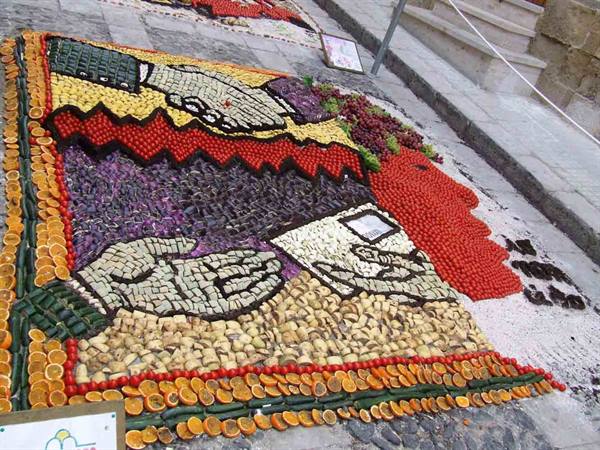
We didn't challenge the wind and waves; we preferred to enjoy the original spectacle of the large mosaics covering Via Roma, each more beautiful and surprising than the last. The face of a man, half black and half Sicilian, representing the soul of an emigrant people and consequently welcoming towards immigrants; a white dove beneath a sun made of Sicilian oranges and lemons, symbolising that a lawful, peaceful world is possible — you just have to commit to building it.
The event, today one of the area's main tourist attractions, was born in 2004 on the initiative of the Pachinese Anti-Crime Association APAC, precisely with the aim of getting the message of legality, in its many aspects, across to as many people as possible. It's no coincidence that Inverdurata takes place in May: it's to remember Giovanni Falcone and the victims of the Capaci massacre. Over the years the event has dedicated mosaics to harsh themes such as racketeering, a burden on development, or corruption, as well as celebrating southern Sicily through themes linked to the beauty of the area — an idea that also enthused artists from the nearby towns of Noto, Avola and Rosolini.
The trip to Pachino to admire mosaics made of fruit and vegetables is a unique experience, fun and full of life, and it's also a chance to reflect on the most important issues of today's society. Admiring the brightly coloured mosaics of Inverdurata, you appreciate the creativity and love of beauty that lie behind the determination to defeat crime and truly win legality.
The journey's photographs
5 photographs · click to open them full screen


0 reader comments