The story
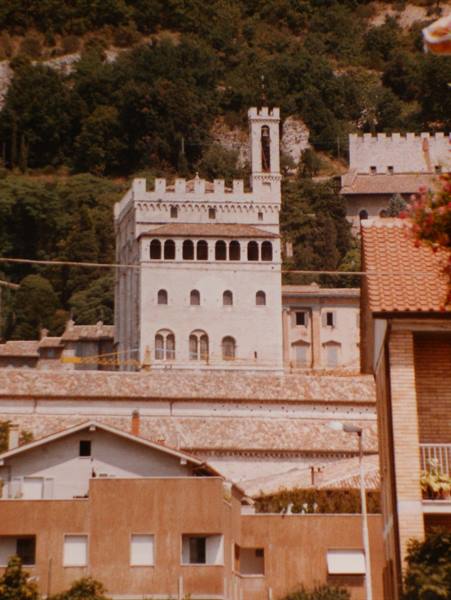
Nestled at the foot of Monte Ingino, Gubbio is among the oldest cities of Umbria, wonderfully preserved through the centuries and rich in monuments testifying to its glorious past. Evidence of its ancient origins are the Eugubine Tables, one of the most important Italic documents, and the Roman Theatre located just outside the walls. Overlooked from above by the monumental Basilica of Sant'Ubaldo, which guards the incorrupt remains of the patron saint, Gubbio hosts architectural masterpieces that symbolise and evoke the power of this medieval city-state. To the early 14th century dates the superb urban complex formed by the Palazzo dei Consoli, which has become the symbol of the city, by the Piazza Pensile and by the Palazzo Pretorio.
Also worth remembering are the palazzi Beni, del Bargello with its famous fountain, and del Capitano del Popolo; of pure Renaissance lines is the Palazzo Ducale by Francesco Giorgio Martini, which recalls and documents the significant period lived under the lordship of the Montefeltro, of whose duchy the city was an integral part. Of great interest too are the Cathedral (12th century), Santa Maria Nuova (inside which one admires the Madonna del Belvedere painted by Ottaviano Nelli in 1413), the Church and convent of Sant'Agostino (13th century) with frescoes by Nelli inside, the Church and Convent of San Francesco (13th century), San Giovanni (12th century) characterised by its Romanesque facade and bell tower, San Pietro enlarged in 1505 and San Domenico enlarged in the 14th century.
Among the most important events organised in the city, particular mention undoubtedly deserves the Corsa dei Ceri and the historical re-enactment of the Palio della Balestra.
The journey's photographs
3 photographs · click to open them full screen

0 reader comments