The story
Half a day wandering about, and to avoid going too far from home we circle around Milan, and what could be better than going to visit 2 splendid abbeys: Chiaravalle and Viboldone. The monastic complex of the Abbey of San Pietro in Viboldone stands on the outskirts of Milan, in the municipality of San Giuliano Milanese, amid a green expanse, and today it is an enchanting place of peace and tranquillity. Although still little known, the church opens its doors to anyone who wants to immerse themselves in meditation and get away from the chaotic city life. The Abbey was built by the Humiliati friars, whose order is characterised by a strong desire for spiritual and moral renewal, as well as by the hope of a return to an uncorrupted Christianity, starting from 1176, and it represented one of the best-known Humiliati houses in all of Lombardy.
The period of greatest fortune coincided with the end of the construction work on the building in 1348, while its decline began to show its first signs in the fifteenth century and ended in February 1571, when Pope Pius V issued the Bull Quemadmodum, which decreed the suppression of the order. The church then became the property of the Benedictine monks of Monte Oliveto. During the Cisalpine Republic there was a total dispersal of its assets, in 1916 Count Aldrighetto di Castelbarco Albani, after ordering its restoration, placed the Abbey at the disposal of the Cardinal of Milan and it was subsequently entrusted to a community of Benedictine nuns. The span of time in which the Abbey was erected runs from the second half of the twelfth century to the second half of the fourteenth century, so the architecture shows both Romanesque and Gothic elements.
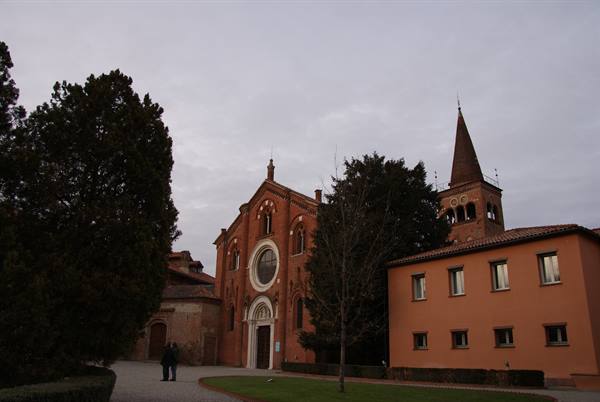
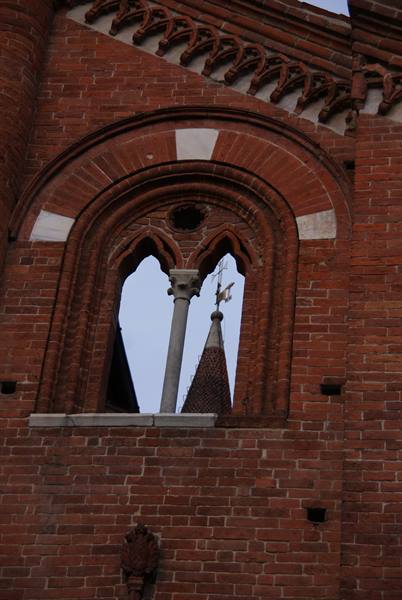
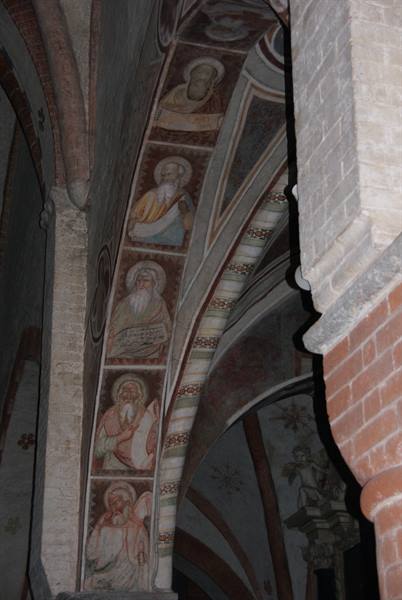
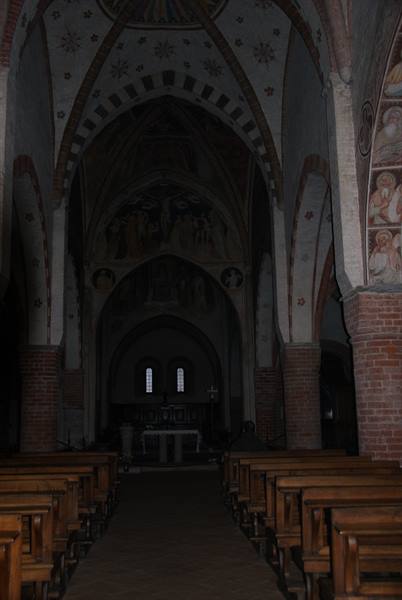
The architectural style is simple and the construction of the monastery is the work of a Lombard architect and of a Tuscan architect and sculptor. The gabled facade is in terracotta, though with marble inserts, and features pointed arches and half-columns that echo the internal division into three naves. The portal, in white marble and with various sculptures, stands out against the terracotta of the facade while the bell tower has two- and three-light windows. Inside, the three naves are separated by circular pillars and longitudinal and transverse pointed arches and are covered by cross vaults with multicoloured circles at the centre. The frescoes inside, among the most important of the fourteenth century and discovered and restored in the 1930s, follow a complex iconographic programme and are an important testimony of painting in the Lombard area.
These frescoes are attributed to artists belonging to Giotto's school, who fled from Florence following an outbreak of plague. Not to be forgotten are the splendid gardens cared for by the nuns.
The journey's photographs
5 photographs · click to open them full screen
0 reader comments