The story
Superga hill and basilica:
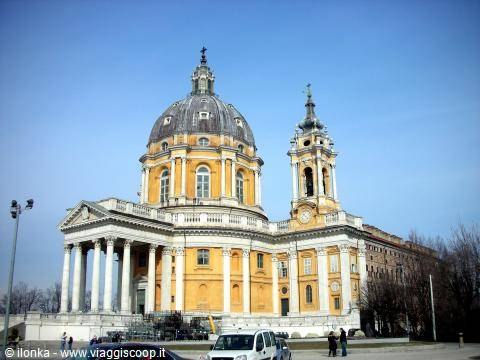
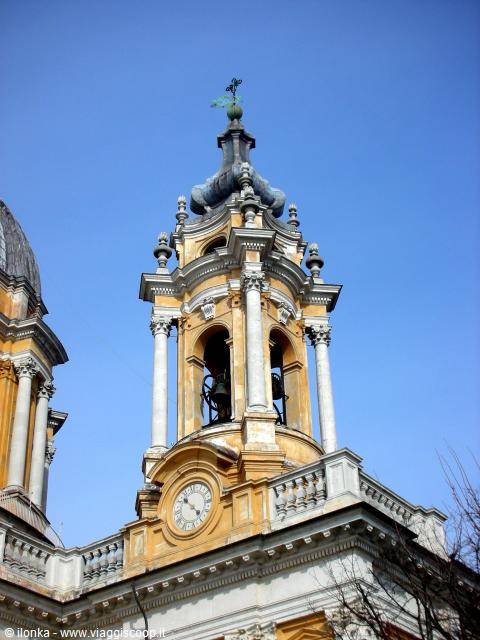
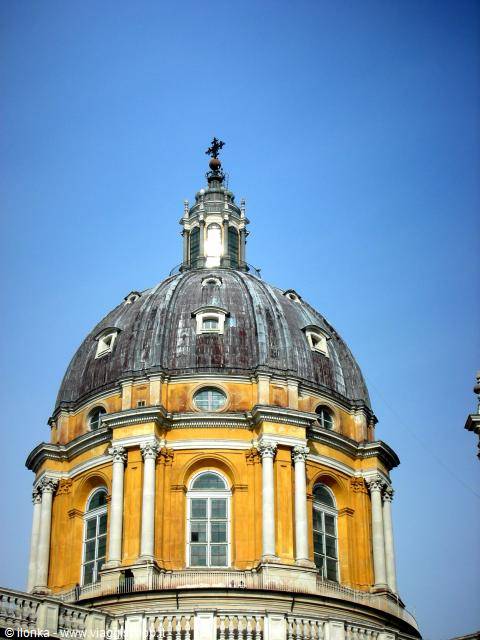
The basilica of Superga, known and dear to the Savoy family, stands on a strategic hilltop spot in Turin; high above the city it offers a view over the whole of Turin, provided the smog doesn't cloud your sight,.......... Sunday 22 February, a beautiful sunny day, I keep to the right bank of the river Po heading for Turin and, passing through C.so Moncalieri and C.so Casale, all at once on my right I find the turning for the basilica. The little road climbs, not too narrow, and you reach a large unpaved car park next to the basilica, which is very beautiful and towers on the top of the hill. Outside it is well preserved and restored, standing out with its light colours, the colonnade, the bell tower, the dome, the cloister and the buildings at the back.
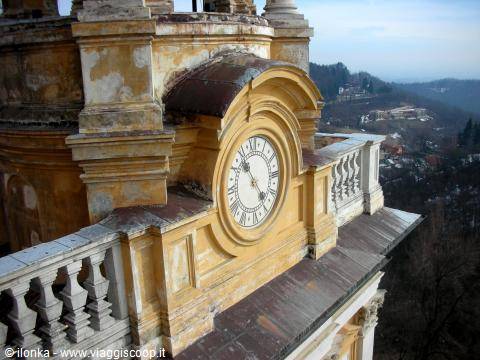
For 4 euros you can go up to the little terrace below the dome; with well over a hundred tiny steps on a spiral staircase, you reach the top where there is a beautiful view. Inside the basilica is not accessible at this time as it is in the middle of a full interior restoration, so it's one big scaffold.....a real shame!! There are two possible visits, at the tourist office on the left of the basilica: the visit to the tombs of the Savoy royals (recommended) and the one to the royal apartments (which I didn't do). The visit to the royal tombs of the Savoys lasts about 50 minutes and is truly interesting; the luck also lies in having a guide who makes you appreciate the explanation, which in itself is purely historical.....
All visits are guided, 5 euros each to enter; groups of 10/15 people are formed and you enter from the cloister, where the guide gives you a general grounding on the basilica, its construction, the historical periods and the figures of the time. From here you then enter the hall of the popes; this hall is extremely interesting and contains all the portraits hung on the walls of all the popes of Rome that have existed so far, from the ancient known ones to the current one, a hall that arouses curiosity with ( if I'm not mistaken) something like 270 paintings. From here we went down a light marble staircase leading to the royal tombs and during the descent we were given clarifications and explanations about statues and crowns, depictions and symbolism.....
The crypt is very large and consists of several rooms; the central and largest one has the tombs and commemorative plaques of the greatest kings of Italy and Sardinia, dukes and princes, queens and children of the rulers of the time. The tombs are of marble in colours from white to pink, green and brown, with draperies, depictions, putti and statues, rich and finely decorated tombs; the most sumptuous is certainly that of the last king. The guide knew how to hold the attention of the interested group and skilfully gave a great deal of information that might have seemed tedious but was not so. In the room with the children's tombs, all children of the various kings who succeeded one another, are all the little princes and princesses who unfortunately passed away at a tender age; there are many of them given the high rate of infant mortality of the time.
A crucial year was 1855, which saw the death of queens, a king and princes, a year of illness and heavy losses in the House of Savoy. Some are to be found in the Pantheon in Rome and at Superga have only a commemorative plaque; others are at Superga because they are merely consorts of the rulers but are in truth foreigners by birth (Portugal, Austria, Germany.....). Every self-respecting king has his statues depicting: piety, magnanimity, science, fortune, wisdom, hope, war........ The Superga guides are volunteers while the cloister and the church are run by just 4 friars of the order of Mary; religious services are currently interrupted because of the restoration works. Interesting is the history of the basilica's construction; the first stone was laid in 1713 at the wish and vow of the king of that time, who won the battle against the French.
About an hour's visit in an environment whose climate and temperature are not too healthy given the cold and the underground humidity; certainly in summer the visit is slightly more pleasant from this point of view. I think the royal apartments, which I did not visit, are equally interesting; here too the visit lasts about 50 minutes. I recommend the visit to the basilica and the royal tombs, on a sunny day and perhaps in spring; the hill offers an excellent panorama. The basilica can also be reached by a little train that leaves from C.so Casale in Turin, where there is a small and very pretty colourful little station; the view on the way up the hill is very beautiful.
The journey's photographs
9 photographs · click to open them full screen




0 reader comments