The story
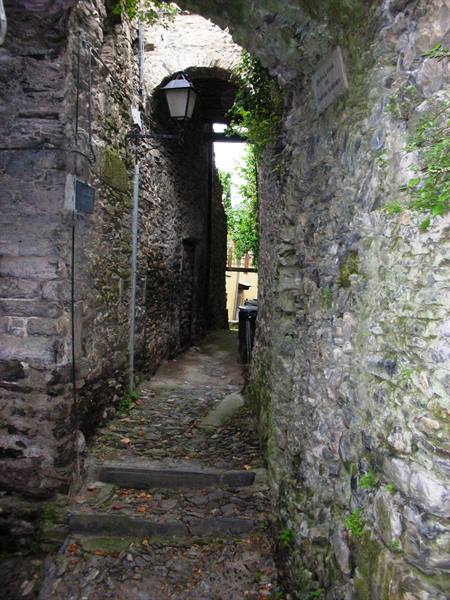
If you want to take a dip into the most remote and characteristic antiquity of the Ligurian villages, then you must not miss a visit to the ancient village of Triora. It's quite an effort to get there, among mountain curves and hairpin bends, up the mountain, and finally Triora. Two parts of the town: Triora old village (1200-1300) Triora new. We park on the road below and climb up a stepped street made of stones that, just to look at them, are calmly from the period, like everything else around us. Everything is from the period: houses, remains, walls; the village is high, fortified and tremendously ancient, unfortunately little restored but in the process of being restored. Certainly there's a great deal to do, it's all old and ancient, but of a charm without limits.
What struck us very much is that on practically every house, every wall, every stone there's a little plaque describing the place and its inhabitants. Climbing up the winding lane, after 10 minutes of breathlessness and aching muscles, we reach a fork: here we are among the very ancient carruggi of the village, one of the most beautiful in Italy. Cost of the visit: 0. In fact, as things stand there's no reason to pay...... if you're able to appreciate all that remains — the little streets and the porticoes, the little squares, the church.......and much more — then it would make sense to pay, because it is of the highest beauty and curiosity. The village is an endless maze of stone carruggi, uphill and downhill, narrow and wide, ending in nothingness or connecting with other carruggi.
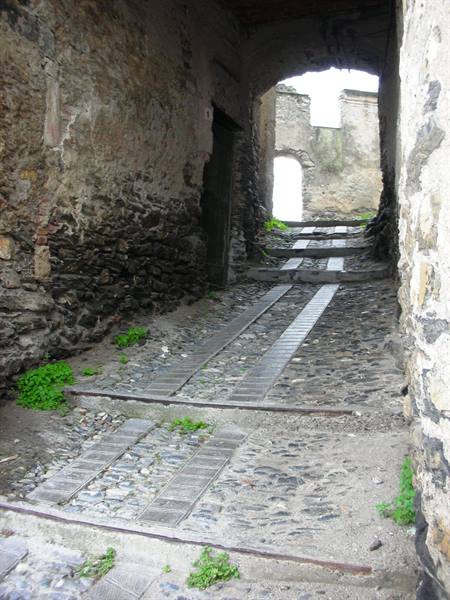
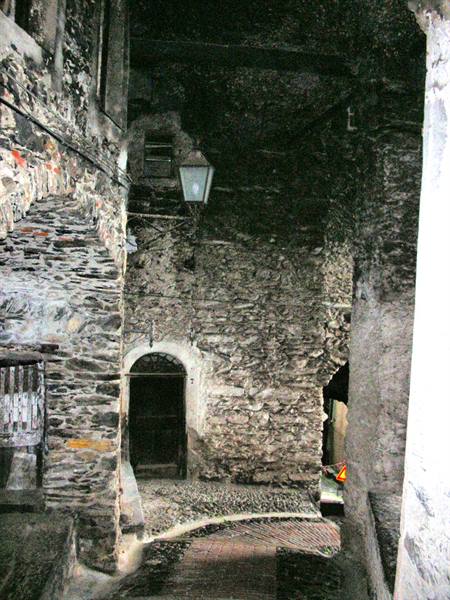
It's thrilling to climb up those little streets in a very particular atmosphere, to be savoured down to the last breath of wind that blows fresh among the porticoes and half-ruined houses. It's a fascinating and mystical village with a history kilometres long... witches, goblins, houses, characters, squares, an old oven, terraces, grass growing among the remains of an ancient castle of which only one wall is left........ and the inhabitants of Triora are super proud of the village that is slowly rising again between the mountain and the modern life developing below it. Some low stretches of the village, some passages, have no lighting, immersed in shadow, cold and damp; it's there that you feel most immersed in the age when the village was alive and thriving and inhabited by Ligurians of the 1200s.
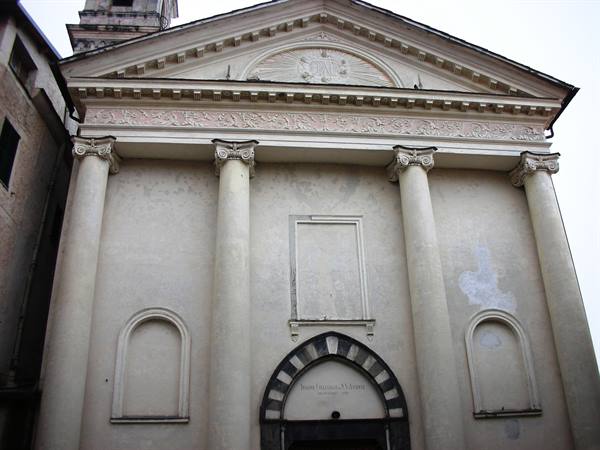
At some focal meeting points between 2/3 carruggi, small covered squares develop and survive, with large openings to the outside looking onto the green valley; some spots are really for a caver, and all worth observing. A large church stands in a wide square, well lit by natural light, and some small and tiny dwellings are still inhabited by who-knows-whom but they are... courageously. Entire ancient palazzi, made of grey stone, with the only renovation being the drains with old plastic pipes visible from below. It's all very evocative, of an almost squalid charm; the old and the charm.... a fitting pairing! Up and down the little streets we reach a place called the Witches' Cabotina; yes, because Triora was inhabited by witches who were once put on trial but, even today, no one knows whether they were killed or simply let go from the place.
A tiny little house is dedicated to them and, almost like an ancient cavern, behind metal bars, there's a re-enactment of the witch and her mystical cauldron, a mannequin and a real setting done very well, complete with explanations alongside to speak and inform about the witches of Triora. The old oven is another re-enactment, with a mannequin pretending to take bread out of the very ancient stone ovens of the place. Today there are bakeries, grocery shops, souvenir shops where fairies, goblins and little witches are sold... witch hats and gift items. But what can I say about the village? Well, it fascinated me, amazed me in its simple compactness and smallness. All as it was then....... and so photo after photo of every single particular corner of the village that gives off history and evokes a time now unknown to us that will not return.
In a little over an hour you see it all, fountain stop included. The inhabitants are quiet, small-town people, kind and nature-loving. And so in a little shop I buy my classic souvenir and, going down, I start heading towards my car. How many people, how many tourists we met; the village is anything but unknown — Germans, French and English, Italians and..... who said villages aren't a source of enthusiasm and tourism? In a few years many parts will be restored, while respecting the originality of the place; maybe it's worth going back....... it's worth saying that I recommend you poke your nose into the village, because I don't think a place like this exists in any other region of Italy. The village lies along the famous and rich Olive Roads in the Ligurian interior, among olive trees, villages, little towns, nature and oil mills.
Along the way there are many things to visit, from the mills to the small towns that sell local specialities.
The journey's photographs
9 photographs · click to open them full screen



0 reader comments