The story
I have come to Umbria several times and on many other occasions I have passed through it on my way to other regions. As a child I came here twice, on two school trips. Back then Perugia was the favourite destination of children; Gardaland and Mirabilandia did not exist yet, and the "City of Sunday" was the amusement park easiest to reach from most of Italy. It was wonderful for us children to plunge into that fantastic world where, among other things, we could play in a Wild West fort, see a replica of a rocket from the earliest space missions, walk into the mouths of huge concrete monsters through revolving tunnels, see the fairy-tale castle, cross a suspension bridge. At the park entrance there were tanks, machine guns and wartime aircraft you could play with, and even an old steam locomotive.
On one of those two organised trips we went to see the Perugina factory, and that too was astonishing for us children: seeing how treats such as chocolates and the Rossana sweet were made. As we all walked in a line along a gangway, I was fascinated by a big machine kneading an enormous sweet that would later be cut into hundreds of pieces and packaged. Many years later, towards the mid-1980s, passing through Perugia with a friend, I climbed out of curiosity up the hill that overlooks the city where the amusement park stands, but I did not go in. Shortly afterwards, however, I returned to Umbria with a couple of friends, and on that occasion we did enter the park.
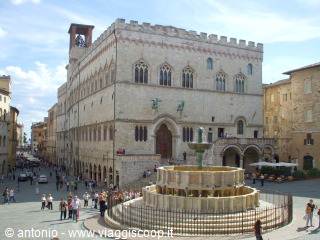
Both because I was no longer a child and because by then I had seen Gardaland, the "City of Sunday" struck me as very disappointing: it no longer offered the magic of former times, and its shabby, unspectacular structures made it look pathetic in my eyes. During that short tour we stopped at Assisi for a few minutes in front of the Church of St Francis, then continued to Terni. The idea was to see the Marmore Falls, but unfortunately they were switched off. The Marmore is an artificial waterfall, visible only at certain times of the year and at certain hours. In the mid-1990s I came to Umbria with a friend, visiting for the first time the historic centre of Perugia with its great square, where the Town Hall and the Cathedral face each other and in the middle stands the splendid fountain, on that occasion enclosed in a glass casing because it was being restored.
The centre of Perugia, like that of many Umbrian towns, sits on the top of a hill, but the peculiar thing is that you can get there by outdoor escalators too, after leaving the car in the car park. From the regional capital we went to nearby Assisi, visiting the Church of St Francis, which shortly afterwards would be hit by a violent earthquake that destroyed part of its vault. We also visited the medieval historic centre with traces of Roman archaeology, the Church of Santa Chiara, and, on a hill not far away, the Eremo delle Carceri, a Franciscan place of spiritual retreat. We then continued to Gubbio and its fine Palazzo with a staircase. I returned to Perugia with my partner, as guests of friends.
With them I went back to the historic centre, this time not by the escalators that had so surprised me in the 1990s but by a brand-new minimetro, just inaugurated and unique of its kind in Europe. It consists of small computerised carriages that, with no driver, climb the hill from the car park up to the city centre. Near the little arrival station I gladly saw the beautiful square again, this time in its evening guise and with its fountain freed from the glass casing.
We strolled along Corso Vannucci, lined with medieval and Renaissance palazzi, as far as Piazza Italia, which hides beneath it the remains of a fortress, where you go in not only to see temporary exhibitions but also to take the escalators leading down to the valley — a real surprise! Before visiting the centre we had made a short morning tour of the surroundings, which also allowed me to return to Assisi to pray in the Church of St Francis and stroll through the streets of the old town. Below Assisi lies Santa Maria degli Angeli, where inside a large church you find a much smaller, plainer one from the time of St Francis, as well as a humble chapel recalling the place where the saint died. Leaving the Assisi area we headed for Spello, a medieval town considered by some to be the centre of Italy.
It preserves an ancient walled settlement and, in a couple of churches, works by Pintoricchio. After a few kilometres we stopped at Foligno to see the main square with its civic tower, under restoration for years after the collapse caused by the violent earthquake that struck the area in the 1990s. Umbria, considered the heart of Italy, is an inland region; it does not face the sea but contains the shallow Lake Trasimeno, which you skirt every time you head for Perugia. On this latest occasion I had the chance to spend more time by the lake, visiting among other things its most important centre, the walled Castiglione del Lago. In the surroundings we drove through Panicarola and Panicale and stopped at Castiglione Fosco, a small hamlet with an ancient cylindrical tower.
Some time later we went back to visit these friends in Perugia for Eurochocolate, the most important European event devoted to chocolate. The city's streets were lined with food stalls offering all sorts of cocoa-based delicacies. We also watched a demonstration on how chocolates are made. Perugia is home to Perugina, Italy's most important chocolate manufacturer. One morning we went to visit their plant, a pleasant guided tour through a museum exhibition but also a peek into the production areas, where modern machines turn out tens of thousands of chocolates. At the end of the visit we were even offered a generous tasting. A well-organised, enjoyable and free visit. During that stay we also went to Todi and Spoleto. Medieval Todi has a fine Piazza del Popolo overlooked by, among others, the Cathedral preceded by a wide staircase, the Palazzo dei Priori and the Palazzo del Capitano.
Near the square is the entrance to underground Todi, that is, the cisterns that for centuries supplied the city with water. Disused and left to themselves, they have in recent years been partly restored and opened to visitors. In Spoleto, once we had walked the streets of the historic centre, we reached the Cathedral, which we also visited inside. In Umbria I have also been twice to Orvieto, an ancient town that strikes you above all for its splendid polychrome Cathedral and for the curious St Patrick's Well, reached by a staircase. The first time I came here was on a tourist trip as a boy, the second for work in 1990, when as a journalist I attended the press conference presenting an international tennis tournament. On that last occasion lunch was offered by the organisers inside a fine medieval hall owned by the municipality, a stone's throw from the Cathedral.
Recently I returned to Perugia and Lake Trasimeno for the Christmas festivities, which allowed me to see the city lit up. A later trip took me back to the "City of Sunday" to show my little boy the park of my childhood. The play area is ever more neglected, so much so that it looks like a poor imitation of what it was in its heyday. Thanks to the presence of a small zoo, my son was thrilled.
The journey's photographs
1 photographs · click to open them full screen
0 reader comments