The story
Montepulciano is built along a narrow ridge of limestone, at an altitude of 605 metres above sea level. The town is surrounded by a wall and by fortifications designed by Antonio da Sangallo the Elder in the 1500s by order of Cosimo I. Montepulciano is known mainly for the grandeur of its Renaissance palaces, for the elegant beauty of its churches and for the "Vino Nobile", one of the most internationally appreciated Tuscan wines. The town centre develops along a main street that climbs up the hill reaching the central square, Piazza Grande, which lies at its summit.
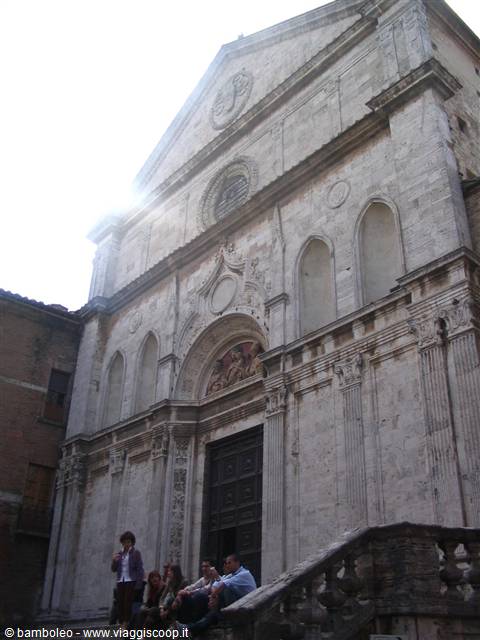
What to see: Starting from the lower part of the town, outside the walls, there are the Church of Sant'Agnese with its original Gothic portal (14th c.) and balzana façade by Viviani (1926), the Medici fortress by Sangallo and the 14th-century gate of Gracciano restored by Sangallo himself in the early 1500s. We enter the old town through the Porta di Gracciano: a little further on, to the left of the Colonna del Marzocco, in Piazza Savonarola we can see the little church of San Bernardo (18th c.) by the architect Andrea Pozzo. On the right side of the street is the Palazzo Avignonesi by Vignola. Other Renaissance palaces follow until we reach the Palazzo Bucelli, in whose base are walled numerous cinerary urns and various Etruscan and Latin stones and inscriptions. We then come to P.za Michelozzo where the beautiful church of S. Agostino stands with its façade by Michelozzo.
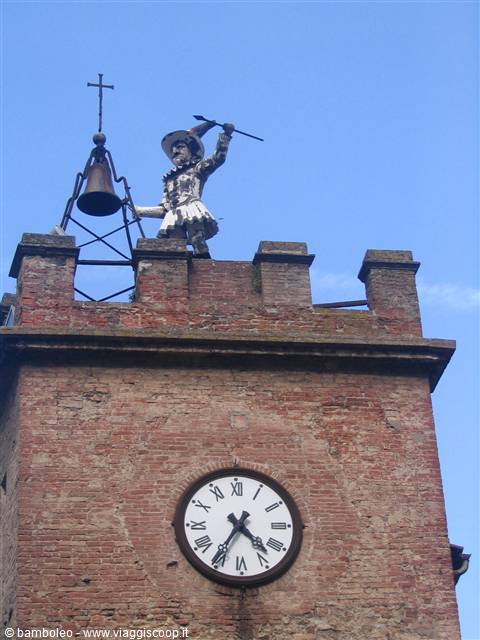
In the same square you notice the Torre di Pulcinella (about 16th c.) with the characteristic mask that strikes the hours.
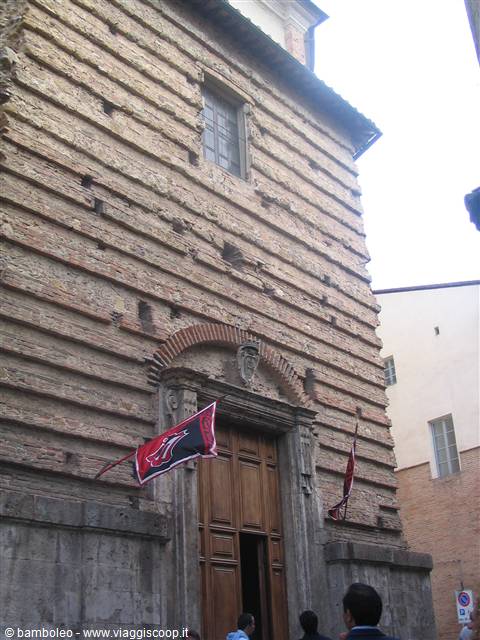
Continuing upwards we find the Logge del Grano or del Mercato, by Vignola, then the Palazzo Cervini by Giuliano da Sangallo, with its characteristic U-shaped plan and external courtyard. We then come to Palazzo Grugni and the Church of Gesù, with its rough façade, a beautiful work of Italian Baroque by Andrea Pozzo. Then follows the straight stretch of Via dell'Opio as far as the crossroads of Via delle Farine. We have thus arrived in Via del Poliziano with the 14th-century house of the Poet, followed by some 17th-century palaces. At the end of the tree-lined avenue we find the Church of Santa Maria dei Servi (14th c.) with a Tuscan-Gothic façade and an artistic portal. Inside, on the third altar on the left, we can admire a precious painting on panel by Duccio di Boninsegna da Siena: the Madonna with Child.
Immediately after the church two streets open up: the one on the left is via di Collazzi, from which you discover, below, the stupendous Tempio di S. Biagio; the street on the right is Via di San Donato, which runs alongside the Fortress climbing towards Piazza Grande, the monumental centre of the town. We have thus arrived in the highest part of Montepulciano. The first building that strikes our attention in the square is certainly the town hall. Its construction, begun in the second half of the 1300s, continued until the mid-1400s; the renovation and the final design are by Michelozzo. Clad in travertine, it is Florentine in taste both in the general layout of the façade and in the details, and bears a remarkable resemblance to the Palazzo Vecchio in Florence.
Inside, through the portal, a courtyard opens up with two beautiful opposing loggias with slightly lowered arches. It is possible to access the tower, from which you embrace one of the most beautiful panoramas in the world. On clear days you can see, on the Val di Chiana side, distant mountain ranges such as the Catria, the Sibillini, the Cimone, the highest peaks of the Gran Sasso and, beyond the pre-Apennine peaks, Perugia, the Subasio and Assisi; on the other side Monte Amiata, the Val d'Orcia, Pienza, Monticchiello and in the distance, on the clearest days, the towers of Siena. You can admire, at the foot of the Apennines, the long strip of Lake Trasimeno with its islands, and the two lakes of Montepulciano and Chiusi.
The other buildings in the square are: opposite the Pozzo dei Grifi e dei Leoni, the Palazzo del Capitano del Popolo, one of the examples of Gothic art remaining in Montepulciano; immediately after, the Palazzo Tarugi by Sangallo; opposite the town hall, the Palazzo Contucci, also by Sangallo and with the last terracotta corner by Baldassarre Peruzzi; finally the Duomo, inside which is the triptych by the Sienese Taddeo di Bartolo.
Continuing along Via Ricci where, immediately on the right, is the Palazzo Neri-Orselli, in pure Sienese Gothic style; opposite, Palazzo Ricci by Baldassarre Peruzzi. At the end of Via Ricci we come to the Church of San Francesco with a beautiful Gothic portal; from the little square in front you enjoy a beautiful panorama. From here we continue along via del Poggiolo and find, at the far left, the Church of Santa Lucia, in 17th-century Baroque style. Finally, about 1 km from the wall, on the two opposite sides of the town, are the Tempio di San Biagio and the church of Santa Maria delle Grazie. Oratorio di S.Antonio Chiesa di San Bernardo San Francesco
The journey's photographs
8 photographs · click to open them full screen


0 reader comments