The cypress in the popular imagination is inextricably linked to cemeteries, and consequently this tree has, for many, a meaning that is both sacred and mournful. It had already taken on this meaning in antiquity; in Greek mythology we find the figure of Cyparissus who, having accidentally killed his deer, had himself transformed by the god Apollo into a cypress, with resin on the trunk forming drops like tears, and the Romans hung its branches on the house where a deceased person lay. In reality its use in cemeteries may have a scientific rather than historical explanation, since the plant's root penetrates the ground like a spindle only downwards instead of spreading horizontally, with the risk of damaging the surrounding tombs.
Only in Tuscany (and partly on Lake Garda) does this tree lose this meaning and become a distinctive element of the landscape, thanks to the undoubted ornamental effects of the cypress in the decoration of avenues, hills and private villas. Elsewhere people have tried to export this ornamental use, but only in Tuscany is the cypress inextricably linked with its surroundings, made of soft, rolling hills, with a truly incomparable scenic effect.
WHEN TO GO
Tuscany is a land for all seasons, but the spring landscape has a quite particular charm, the fruit of hills cloaked in stretches of grass in different shades of green that, on the rolling hills, give a feeling of softness and harmony.
In reality, being one of everyone's favourite destinations during public-holiday weekends, it would be preferable to choose other dates to avoid having to deal with the considerable influx of tourists and the consequent queues at museums and car parks. Not everyone can make this choice, and in my case they set off around the 1 May long weekend.
WHERE TO GO
It's hard to recommend a particular itinerary for visiting Tuscany, since there is no other region in Italy with so many treasures, all worth seeing. Particular attention must be paid to choosing the place to use as a base, since travel times are linked to a road network that isn't exactly optimal. In fact, most Tuscan roads (except those of the main network: motorways and dual carriageways) are particularly winding, tied to the hilly landscape and the rough terrain to be overcome in moving from one valley to another, and so travel times obviously suffer.
In reality (thinking positively) this aspect of the roads lets you fully savour the surrounding landscape and plan several stops, also to capture the spectacular surroundings that present themselves to your view: the scenic rows of cypresses, the muffled hills fading to the horizon, the rows of vines in the Chianti area and the views in the coastal and mountain zones.
In my case the itinerary was built backwards, having oriented the choice of base towards the area where some friends of mine live.
From the base (CAVRIGLIA – AR, near San Giovanni Valdarno) I started planning the itinerary with a few fixed points: stops to dedicate to the children, a visit to Florence (I never tire of going there) and a visit to San Galgano, which I hadn't managed to make on previous trips to the Siena area — a personal fixation of mine because of the two-star Touring listing (a surely reliable parameter, and the only one still to see in Tuscany). In reality, given the distance to travel, it wasn't exactly an ideal choice, but fixations are fixations
WHERE TO SLEEP AND EAT (In the "treating yourself really well" series)
No guide will ever be able to advise you like people who live in an area and have had the chance to try all the local places over the years. So in my case I went with certainty, excellently advised by my friends from San Giovanni Valdarno. To sleep I was directed to VILLA BARBERINO, Viale Barberino, 19, hamlet of Meleto • Cavriglia - AR, Tel. + 39 055.96.18.13 - Fax + 39 055.96.10.71 (watch out for the two fixed speed cameras located in the hamlet of Santa Barbara on the road to the villa).
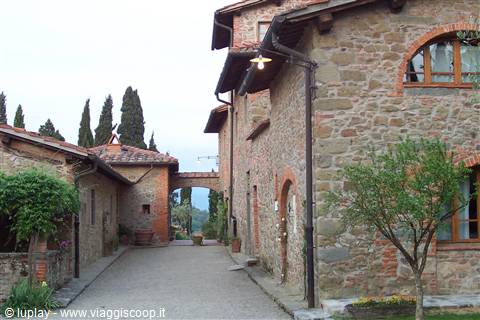
The terracotta building is remarkable and certainly to be recommended, try it to believe it. I stayed in a nicely renovated little apartment with kitchen, bathroom, bedroom and small terrace. The building is set in greenery and in the morning you're woken by birdsong. Internal parking and breakfast included in the room price. The building also has a restaurant which, given the beauty of the site, is often used for wedding banquets.
To eat I was directed to two truly excellent restaurants, among the very best in the area: • For fish: La Valle dell’Inferno, Loc. Acquaborra – Terranova Bracciolini (AR) +39 055 9180031 (near the river, truly unmissable cooking, and not by chance frequented by all the local VIPs); • For meat: Osteria dell'Acquolina (Loc. Paterna - Terranuova Bracciolini (AR) 055 9652028). Being an osteria it has a different style from the previous place, but the quality of the food is truly excellent and the legendary fiorentina is truly sensational (the best I've ever tried).
WHAT TO BUY
In the area there's the PRADA outlet (Pellettieri d'Italia - Levanella, Montevarchi (AR) Km 100 Tel. 055.91901) and the IVV one (Industria Vetraria Valdarnese, Lungarno Guido Reni 60, San Giovanni Valdarno (AR) Tel.: (+39) (0)559 426 19 Fax: (+39) (0)559 444 47 (the second is decidedly better value). However, for anyone in danger of chianina steak withdrawal (unfindable elsewhere in Italy), I recommend going to Macelleria Giaccherini Franco, Via Roma, 79/A - Terranuova Bracciolini, tel. 055 973340. They prepare vacuum-packed travel portions, and perhaps it's no coincidence that it's the butchers of the VIPs (from Ferilli to the Luna Rossa crew)
Day 128 Apr 2007
cavriglia park
FIRST DAY (April 28, 2007): dedicated to the children with the visit to the Cavriglia nature park (The park is very beautiful, it is located at an altitude of 800 meters on the road that connects the Valdarno (S. Giovanni, etc.) with the Chianti area (Radda, Gaiole, etc.). The road to get there is truly killer (you go from one valley to another), but the pleasantness of the place, the fact that it's free, the possibility (outside the summer months) of using the barbecue facilities, the presence of animals (mouflons, fallow deer, roe deer, wild boars, llamas, bears, bison, donkeys, etc.) make it a stop worth noting for those traveling with children.
We obviously weren't equipped so we settled for sandwiches from the refreshment place, but the children's enthusiasm at having a picnic just steps from the llamas roaming freely through the park and from the birds of the little lake is an experience I'm pointing out so that other parents can enjoy it too (actually my neighbors biting into a killer steak just cooked on the coals were enjoying it for other reasons!). Some of the animals are completely free, while others (bears, monkeys, bison, etc.) are closed in cages, but perhaps with the exception of the bears' cage they are very large structures, scattered over the mountainous terrain that give no impression at all of a zoo. To visit all the animals you have to walk a bit along dirt paths and even slightly steep trails (for example to see the donkeys and monkeys).
At the center of the park there's a little lake where the waterfowl make an incredible racket. All in all 15.7 km of road (Yahoo maps), partly decidedly winding, from the San Giovanni Valdarno highway exit are a detour that can be recommended to everyone.
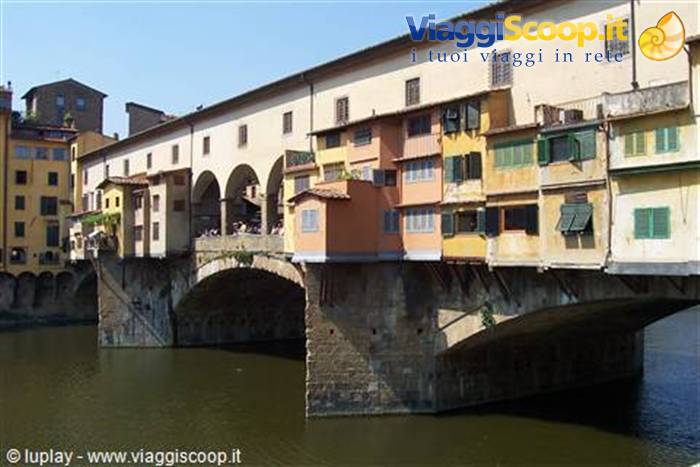
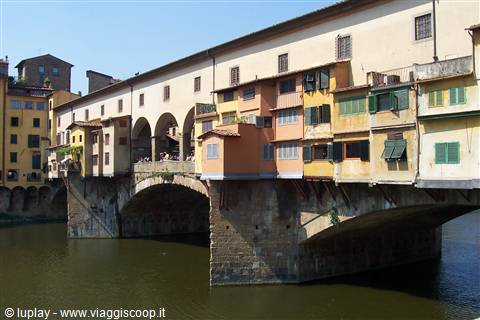
ponte vecchio
Day 229 Apr 2007
florence
SECOND DAY: dedicated to the parents with the visit to Florence. In the past it was a mandatory stop on school trips. Over time the trips have shifted to foreign destinations so I don't think I'm wrong in saying that many Italian kids don't know one of the most beautiful cities in the world. No Italian city, moreover, turns out to be more easily visitable than Florence: station in the city center and a pedestrian route with the main attractions enclosed within a truly limited radius. For this reason in Florence it's preferable to go by train; in about 20 minutes from the San Giovanni Valdarno station you're in the city center (Santa Maria Novella) with no parking problems and avoiding city traffic. Traveling with children I preferred to tour the city, going in depth only with the visit of the monumental complex of the Basilica of Santa Croce.
With the entrance ticket (5 euros) you visit the entire monumental complex made up of the Basilica, the Museum of the Opera, the cloister and the Pazzi Chapel The Basilica is one of the most admirable examples of Gothic architecture present in Italy and its imposing dimensions — 20 meters wide and 34 high — make it very similar to the majestic cathedrals of Northern Europe. It was built at the end of the 1200s by one of the most famous architects of the time: Arnolfo di Cambio. The basilica is famous because over time it has transformed into a sort of Pantheon with inside it the burial monuments of some illustrious figures (Foscolo, Alfieri, Michelangelo, etc.) present mainly in the right nave.
Also precious are the extraordinary stained-glass windows typical of Gothic architecture and the two chapels on the right of the central one respectively named Bardi and Peruzzi (after the names of the banking families who had commissioned them). Both chapels were frescoed by Giotto. Continuing toward the cloister you visit the adjacent Pazzi Chapel by Brunelleschi and the Museum of the Opera in which the famous crucifix by Cimabue is conserved, gravely damaged by the 1966 flood.
The rest of the city's pedestrian itinerary is amply reported in every guide so I won't dwell on it further.
As everyone will have been able to notice the city is very expensive, but knowing how to choose you can find truly economical solutions. In my case I had lunch in a historic wine shop on the route between Ponte Vecchio and the Basilica of Santa Croce. We spent for a single dish (first course, second course and side dish on the same plate) 7.90 euros for more than acceptable quality.
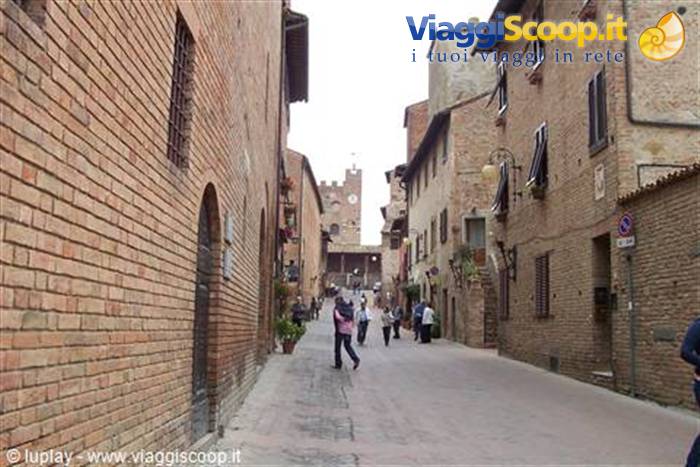
certaldo
Day 330 Apr 2007
Certaldo, San Gimignano and Volterra
THIRD DAY: Certaldo, San Gimignano and Volterra. Three magnificent medieval stops that you reach from Cavriglia by traveling the winding and scenic road that crosses the Chianti area. The kilometers aren't that many, but the travel time is fairly high. If you want, you can stop at the numerous wineries for tastings, without overdoing it though, otherwise the road could become dangerously straight. Certaldo has a medieval historic center in the upper part of the town and precisely for this reason it's called Certaldo Alta. The medieval village of Certaldo Alta is easily reached by a funicular (round trip 1.20 euros) that departs from the main square of Certaldo Bassa.
For free parking continue past the central square and take the first left, the parking lot is on the right.
The truly intact medieval village is packed with truly fascinating glimpses, from the squares, to the little alleys, to the artisan workshops. At any rate the main attraction is the Palazzo Pretorio at the top of Via Boccaccio. You visit the cloister, the prisons, the audience halls, etc. On the facade of the palace and inside it numerous coats of arms are visible that represent the effigy of the family of each Vicar who had governed and lived in the city. San Gimignano certainly needs no introduction, in fact and not by chance its historic center was declared in 1990 a World Heritage Site by UNESCO. In the Middle Ages San Gimignano developed also because agricultural trade was favored by the city's position along the Via Francigena. The main characteristic are the towers (13 of the 72 existing in the Middle Ages have remained standing.
Besides the towers the town certainly doesn't lack other attractions. First of all the medieval charm of its well-preserved whole: from the stupendous Piazza della Cisterna to that of the Duomo to Via San Matteo. Among the monuments to visit, the Duomo (also called the Collegiate Church) certainly deserves a mention; built in the mid-12th century, it preserves valuable frescoes inside. Adjacent to the Duomo you visit the Palazzo Comunale with the picture gallery that preserves works by Pinturicchio and B. Gozzoli. For enthusiasts there's also the torture museum that preserves the instruments used for that purpose in the Middle Ages.
Obviously traveling during a long-weekend period (in my case Monday, April 30) I found some difficulty in finding parking, not being able to choose the most convenient one (P2), obviously full, but having to settle for the P1 (Giubileo) one with the historic center reachable by minibuses or with a few hundred meters on foot. In any case it's advisable to use the paid parking lots since the traffic wardens are particularly efficient and even equipped with a portable printer for the fines, which they had handed out in quantity to the cars parked along the sides of the road, even if outside the roadway.
Volterra is not only a jewel of Etruscan and medieval art, but also the city of alabaster with the numerous workshops and obviously the shops for buying this product of artistic craftsmanship.
Fulcrum of the city is the magnificent medieval Piazza dei Priori with the palace of the same name, seat of the Municipality of Volterra. Bad luck had it that a session of the City Council was underway so visits to the palace were not allowed. Also to be seen is the Duomo which on Piazza San Giovanni faces the imposing baptistery. At that point a torrential rain prevented the continuation of the visit of the city and in particular to the fortress above.
I'll definitely have to come back to enjoy it fully.
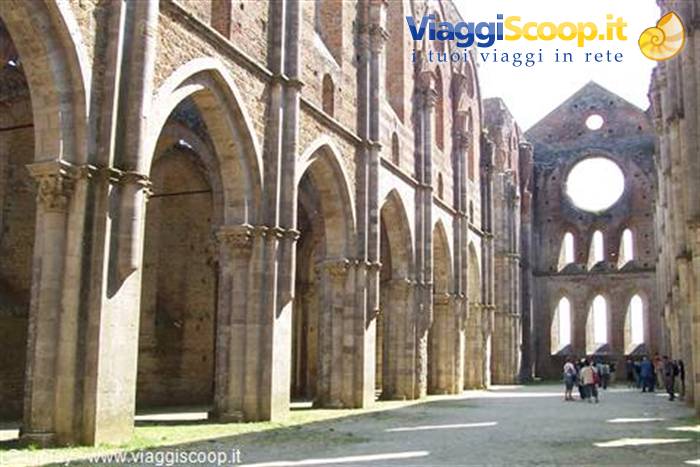
san galgano
Day 41 May 2007
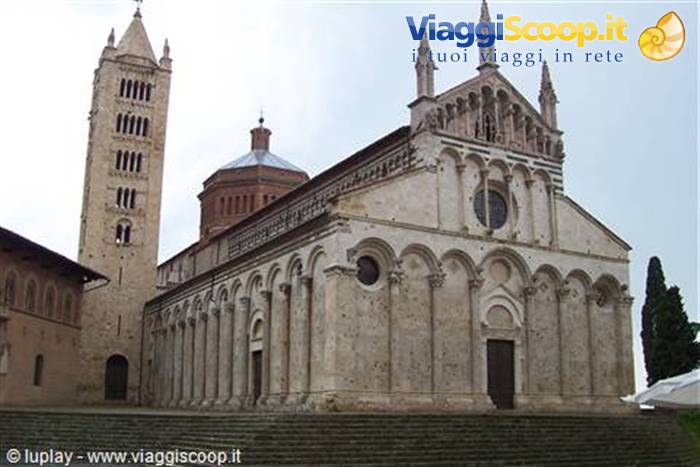
San Galgano and Massa Marittima
FOURTH DAY: San Galgano and Massa Marittima.
The stop of my obsession. To go to San Galgano you have to follow the signs from Siena toward Follonica traveling along the Merse valley. The San Galgano complex is made up of the Abbey and the Hermitage of Montesiepi above it, reachable by car or with a short uphill path from the abbey. The choice fell on San Galgano in the awareness that it could be a stop enjoyed by the children too because of the presence of the sword in the stone. That's exactly how it is, the legend of King Arthur becomes reality in Italy and right in this area you'll find, enclosed in a glass dome, a real sword stuck in the rock. The legend tells that a dissolute young man from nearby Chiusdino (Galgano Guidotti) decided to change his life, dedicating it to meditation and the worship of God and Nature.
So he began his life as a hermit and as a symbolic gesture he stuck his sword into the rock to disdain every form of war and to adore the hilt as if it were the cross of Christ. In the hermitage of Montesiepi, besides the sword, are conserved the bone remains of two hands which legend has it belonged to a person who had tried to steal or break the hilt and for this had been attacked by the wolves, friends of San Galgano. Having finished this part of the trip, certainly interesting for the children, we moved on to the thrilling spectacle offered by the Cistercian abbey of San Galgano. A further confirmation that the two Touring stars are certainly a reliable reference. The church is a Latin cross with three naves and the lack of a roof (long since completely collapsed) makes this abbey truly unique of its kind (just see the attached photos).
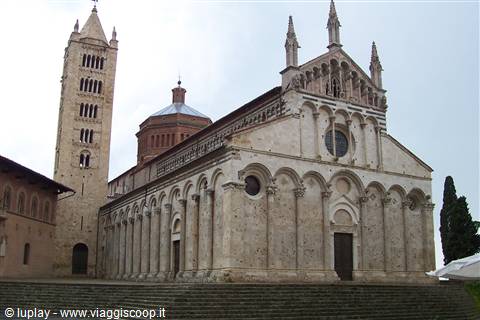
In the month of June there will be a charity concert by Battiato and it could be a truly unique experience. From San Galgano you can continue to Massa Marittima in the province of Grosseto where you visit the Duomo in Pisan style placed diagonally and on a stepped base raised relative to the square. Walking along the narrow streets that lead to the upper part of the town you reach the Clock Tower. Right while we were near the tower it started to rain with a certain intensity and so we opted for the visit of the mines (5 euros), to be recommended only if you have children or if you are truly passionate about life inside a mine. It is a reconstruction of a mining tunnel of about 700 meters with the original tools used by the miners (the visit is guided).
I strongly advise against parking in the paid area near the main square considering that in front of the entrance of the mines (about 100 meters away) there is a completely free parking lot (if I had known earlier I would have saved 4 euros).



0 reader comments