The story
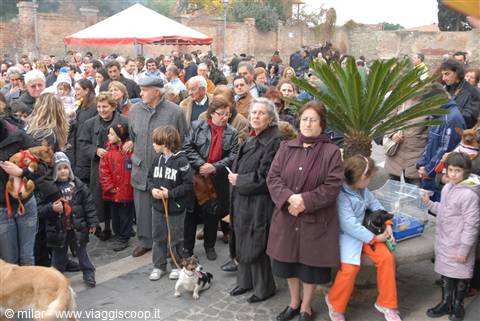
On Sunday 21 January, the blessing of the animals took place in the historic centre of Montalto di Castro (VT). It was the occasion to taste some local products offered by the organisers: bread and sausage, cheese with honey, wine....... A day organised by the riding schools of the area. Some tourist information about the lovely little town. Small squares, alleys overlooked by arches, encircling walls, the very urban layout of the historic centre highlight its medieval origin with particular charm.
The built-up area is dominated by the Guglielmi Castle, whose oldest core is the imposing quadrangular tower. Probably built in the 15th century by the Orsini, as recalled by the plaque on the tower, the castle later underwent numerous renovations. At the end of the 18th century it was raised by one storey and in the last century the loggia and the present crenellation were added. Walking along Via Vulci you reach a gate cut into the northern stretch of the walls; from here you enter Piazza Felice Guglielmi, overlooked by the neoclassical facade of Santa Croce. The interior has a single nave and above the altar, kept inside a glass case, a valuable painting is preserved, depicting "The Madonna of the Victory".
Walking along Via Soldatelli you reach the beautiful 18th-century facade of the parish church of Santa Maria Assunta. Above the travertine portal the building shows the coat of arms of Pope Pius VI Braschi, who promoted its complete remodelling in 1783. The interior, with a single nave, is decorated with interesting paintings from the late 18th century. In a case, on the right, the relics of Quirinus and Candida, patron saints of Montalto, are kept. In Piazza Giacomo Matteotti stands the Town Hall. The structure, originally founded as a Franciscan convent, was later turned into a fortress by the Farnese and enclosed within the city walls.
Outside the historic centre, near the Via Aurelia, you come across the 18th-century fountains of the Tre Cannelle and the Mascherone, both with long inscriptions surmounted by the town's coat of arms. Along the road to Marina di Montalto you can notice, on the left, the church of San Sisto, built by the Augustinian friars perhaps in the 13th century, and later converted first into a lazaretto and then into a hospital. Following the Aurelia, after passing the hamlet of Pescia Romana, you reach the Palazzo del Chiarone, the former papal customs house. Provided with about 90 rooms, complete with a papal apartment, stables and prison, it stands today, unfortunately, completely abandoned. Around the built-up area you can admire the 18th-century Archi di Pontecchio.
Finally, near the Castello della Badia (Vulci) the Casale dell'Osteria is preserved, a valuable example of farmhouse architecture dating from the time of the land reform.
The journey's photographs
5 photographs · click to open them full screen




0 reader comments