The story
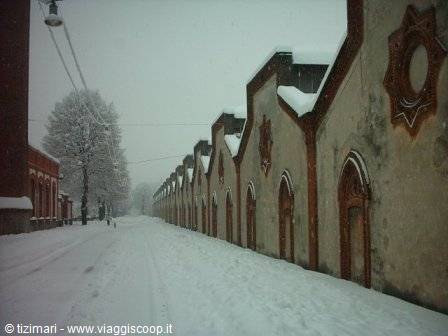
A UNESCO World Heritage Site, a remarkable example of an industrial village, of symbiosis between a great company and its territory, of an exchange of energy and care between owners and workers, Crespi d'Adda dozes in the rainy afternoon, its little houses all alike, its great chimneys silent. Below, the Adda murmurs, pleased with the rains that give it new breath. No worker will return to Crespi's weaving mill after the Christmas holidays; the sheds will stay there, empty, waiting. For what? The parish priest, Don Luigi Cortesi, author of an exhaustive volume on the history of Crespi d'Adda, says: “From the point of view of employment, of work, the closure and the transfer of the workers to the Ponte San Pietro facility doesn't mean much. The problem is broader, it's a negative historical event for the whole of the Crespi Village.
Also because nothing is known about the future, only vague ideas. The fear is that we risk losing a cultural and architectural heritage that UNESCO itself defines as important for all humanity. The problem is that UNESCO grants us this recognition, gives us this affirmation, but then it's the bodies, the territory, that have to step in — from the State to the Region, the Province, the Municipality. And private individuals too, of course.” And, in a certain sense, private individuals are doing their part. The little houses are all well kept, because in the mid-1970s they were sold off by the company. By then the owners were no longer the Crespis, who had left the scene in 1930, after the great world crisis. Explains Alberico Crotti, who is 66 and who stayed in the factory for half the years of his life: “My dad used to tell me that the Crespis didn't want to lay anyone off.
Back then there were about four thousand employees, and 1,250 people lived in the Village. All the others came from the surrounding villages. The Crespis committed too much with the banks and had to give it up.” The manufactory passed to STI, then to Rossari and Varzi, which was put into liquidation in 1972. That was when the Village's assets were sold. Almost all the little houses went to those who lived in them. Parts of the building heritage are in serious decline. The wash-house, for example. The shared parts of the “big blocks”, for example. And parts of the great factory. Adriana D'Adda is 63, and worked for 37 years in the offices of the weaving mill. Here her father and mother worked, and before them her grandparents. She says: “This place got into my blood. The abandonment gives me a sense of sadness. After all, things had been heading in this direction for years.
But we still had hope, because there have been deep crises in the past too, and all of them were overcome well. I clearly remember the crisis of 1972-73, for example; even then it seemed over, yet we recovered. And so we still had hope. Now we don't know what the future holds, but we hope this heritage will be saved. It isn't just a heritage of walls. Inside there is history, the toil of many people.” Inside there is a great idea, says Don Luigi, a vision of the world, a sense of solidarity between different social classes, an ethic. This one of Crespi is a testimony that speaks more than many words and many books. A sick testimony: over the years the butcher, the greengrocer, the cobbler have all gone. The last to close its doors was the tobacconist. Holding out is the little shop of Giuseppina Colombo, who is 75 and doesn't want to give in.
Her father was Crespi's carpenter, her grandmother was Silvio Crespi's wet nurse. “I believe in this ‘industrial tourism’.” Alberto Enzler's grandfather came here from Switzerland to assemble the looms. He never left again. Today Alberto Enzler is 61, lives here, but works elsewhere as a chemical expert: “I hope this heritage will be saved. My fear is that this great reality will also end up like so many examples of industrial archaeology, like the Cesalpinia, like the factory in via Daste e Spalenga in Bergamo. I fear total abandonment, decay, destruction. But perhaps here it will go differently: are we or aren't we a cultural heritage of humanity?”
How do you visit Crespi? The workers' Village of Crespi is an inhabited town. There are no formal entrances and no opening hours. The Village of Crespi can be visited and appreciated both WITH A GUIDE and INDEPENDENTLY, but always with due care (see the recommendations on the side).
And the factory? The historic Crespi factory operated until 2004, and now production has ceased.
How do you get to Crespi? You can reach Crespi by car, by public transport or, better still, on foot or by bicycle! We recommend that those who wish to visit Crespi make use of the guided tour service, which is the most satisfying way to get to know the complex but fascinating reality of the Crespi Village.
Two types of guided tour are available:
PRIVATE GUIDED TOURS BY BOOKING (The visitor — or the group of visitors — chooses the date and time by booking on 02 90987191)
SUNDAY GUIDED TOURS WITHOUT BOOKING (Departure at 16.00: only in the months of April, May and September)
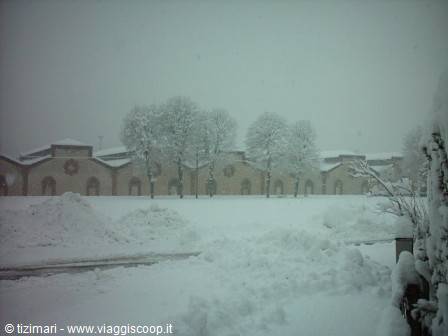
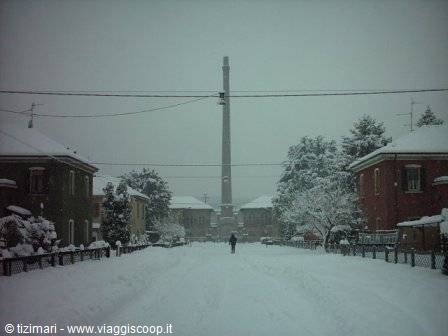
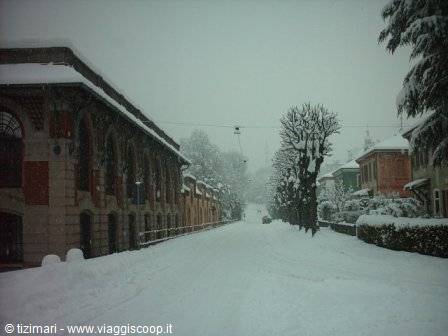
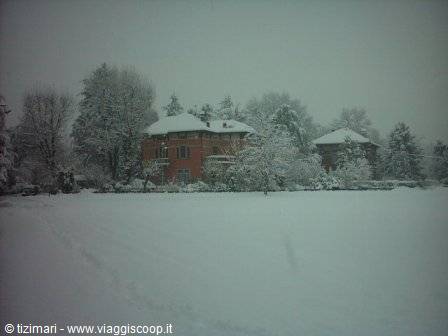
The journey's photographs
6 photographs · click to open them full screen

1 reader comments
Qui siete a 1 km da dove sono nato....e cresciuto...