Tripscoop›Europe›ITALY›City, sea, art and good food along the ancient Via Emilia: a trip to Imola – Part I
ITALY · Europe
The story
Imola's name is known around the world to tens of millions of Formula 1 fans, but few know that the town's first track dates back to the 5th century BC. Of course, it wasn't a track for motor racing but a foothill road built by the Etruscans to link the territory of present-day Rimini with that of Bologna. That road, paved by the ancient Romans, became the Via Emilia, the main artery of the Imola area, where agriculture and trade began to develop significantly. So, while the struggles between Guelphs and Ghibellines raged in the town and its surroundings, in Imola's lagoon port at Conselice a corner of peace and prosperity had grown up precisely thanks to trade. The surplus agricultural produce of Imola was carried to the port along a navigable canal and from there, via the Po, it set out for distant lands.
Many centuries ago Imola was also visited by an illustrious "traveller": St Francis of Assisi, who came to the town to preach peace and brotherhood. In those years work was under way on the cathedral dedicated to San Cassiano, while the saint may already have visited the town's oldest religious building, the abbey of Santa Maria in Regola, mentioned as early as 998. That Imola was in God's favour is also shown by a miraculous episode that occurred in 1483. It was Maundy Thursday and a pilgrim stopped near Imola to recite a prayer before a votive shrine next to a small pear tree ("piradèl" in Romagnol). At that point he had a vision of the Virgin, who told him to ask the authorities of Imola to build a sanctuary dedicated to her at that spot. It was March, and all around a beautiful rose garden suddenly blossomed.
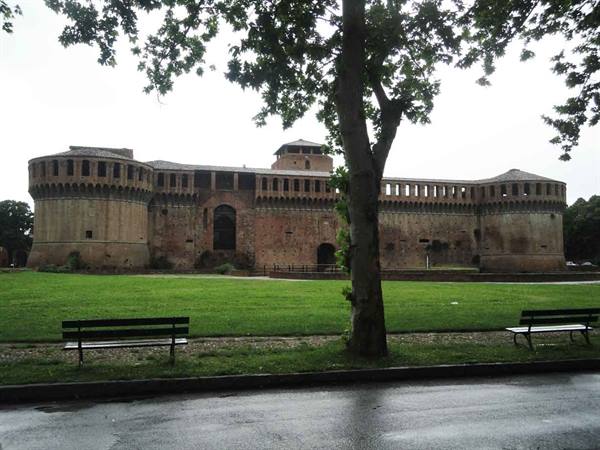
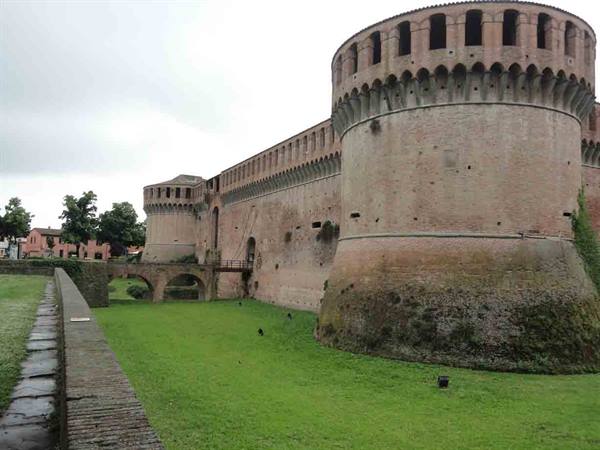
He took the flowers to the city's lords, who, seeing the evidence of the Marian miracle, granted the request, erecting the sanctuary of the Beata Vergine del Piratello. Our stroll through the stories of the past brings us before the town's most significant monument, the spectacular Rocca Sforzesca. Built from 1332 on the remains of an eleventh-century keep, the castle is very well preserved. In 1502, at the request of Cesare Borgia, who had conquered the fortress three years earlier, it was none other than Leonardo da Vinci who designed some of the reinforcement works.
The journey's photographs
6 photographs · click to open them full screen
0 reader comments