Tripscoop›Europe›ITALY›The Melody of Silence Ringing Through the Langhe: a Farm-Stay Holiday in Cessole – Part I
ITALY · Europe
The story
In the same years in which Dante was beginning to work on the Divine Comedy, a few hundred kilometres further north, in a little village of the Asti Langhe set among hills that had nothing to envy in the beauty of those of Tuscany, a Dominican friar was occasionally to be seen strolling, lost in his thoughts. Anyone who stopped to talk with him did not only gain reflections on the faith, but also left with some chess puzzle entrusted to them by the curious friar. He was none other than Jacopo da Cessole, who became famous for writing Ludus scacchorum, a treatise that partly uses the metaphor of chess to discuss moral questions, and is partly a true chess manual. The book was an immense success and was translated into numerous other languages.
Today, those who visit Cessole are often the distant descendants of the people who, over the course of the 1400s, read Jacopo's work in English, German, Dutch, French and Swedish; indeed, the village is one of the favourite Langhe destinations for tourists who love slow travel, tranquillity and a natural lifestyle. Chatting with some of the village elders, we discover that one of the first "tourists" who loved to spend time in Cessole, free from commitments and duties and devoting himself to outings as well as to the pleasures of good food with no formality at all, was the future king Vittorio Emanuele II, whose presence there is also recalled by a plaque of 1856, placed on a "humble house", as the inscription reads.
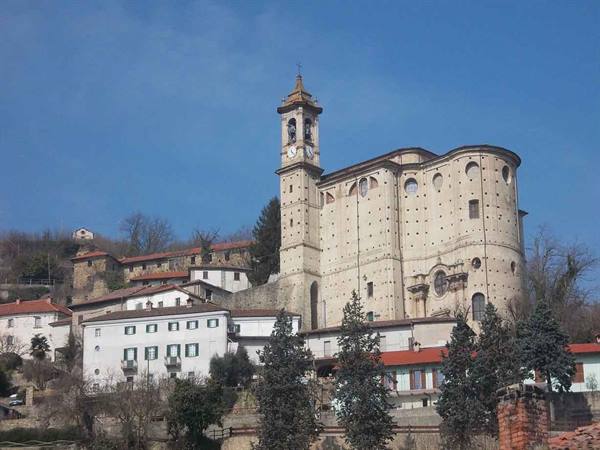
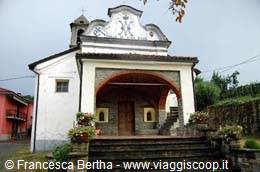
In the years in which the king rested in this corner of peace, the imposing sacred building of the parish church of Nostra Signora Assunta, also known as Santa Maria del Castello, was considered a relatively recent construction. Designed by Giacomo del Carretto, a pupil of the famous Filippo Juvarra, the church was finished in 1784, and its particular structure, inspired by that of the basilica of Assisi, is an excellent compromise between the wishes of those who wanted to build it near the destroyed castle and those who imagined it instead on the site of the small oratory of the Disciplinati. To please everyone, the architect created two churches, one above the other: the upper one is the parish church, while below is the oratory of the Disciplinati, also known as the church of the Battuti.
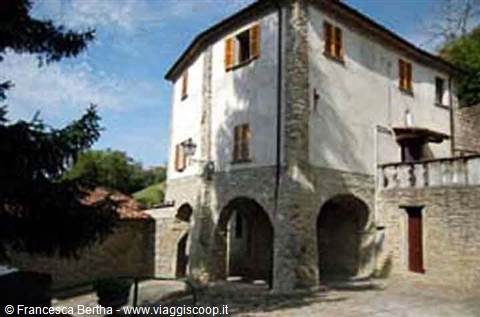
Not far from the church we reach a place that did not yet exist in the time of Jacopo da Cessole, while Vittorio Emanuele II will probably have seen it in the full vigour of its life: the porticoes of San Rocco, under which in 1640 the first market of the Val Bormida was held.
Of the ancient castle that once dominated the valley, today the remains of the tower and traces of walls remain, as well as a long series of mysteries that intertwine like the secret tunnels full of deadly traps that apparently linked the manor with some houses of the village. Not only that: they say that some underground corridors even led well outside the historic centre; indeed, between the late 1700s and the early 1800s a sleepwalker discovered a secret gallery near the Madonna della Neve hamlet where gold coins were clandestinely minted. Since then, people have never stopped whispering about the existence of a treasure hidden in the bowels of the earth, but so far these legends have never been confirmed.
The journey's photographs
6 photographs · click to open them full screen
0 reader comments