The story
Tour made with two fellow villagers in my car as part of an itinerary also including the Province of Bari in Apulia and the Molise region. For the record, on previous trips I had crossed Basilicata six times while going on three different journeys towards Sicily. We entered Basilicata near Melfi, where we stopped in front of the Castle of Frederick II of Swabia. Here the Constitution of Melfi was promulgated and several important papal councils were held, including the one that launched the First Crusade. Melfi, moreover, was first the capital and then one of the main cities of southern Italy. The Castle is located on a hill dominating the old town. The historic centre is a dense cluster of houses separated by steep alleys so narrow that our car, wedged between two buildings, is forced to reverse back out.
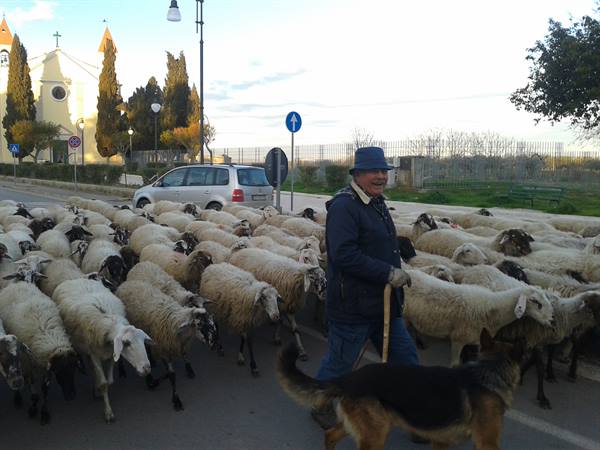
Having left Melfi, we cover a short stretch of Apulia to re-enter Basilicata and stop at Venosa. This is an ancient city where history has left various marks, such as the remains of the Roman forum and those of old churches, one of which, left unfinished, shows parts of the walls and the bell-gable but not the roof. Near this archaeological area we meet a friendly shepherd with his flock and his faithful dog. The man tells us he is one of the last to practise traditional herding and recites a poem of his. We gladly listen to these simple verses declaimed in the city of Horace, one of the greatest poets of ancient Rome. In Venosa there is also a Castle, which we limit ourselves to observing from the outside. We head for Matera, where we arrive in the evening at the Hotel Caveoso.
The lobby is located inside one of the so-called sassi, while our room rests on the rock but is built with the fill material from the underground excavations. We are right in the “sassi” area; opposite our room there is a church set on a limestone spur. We dine at the Ristorante Caveoso with local cuisine: a pasta seasoned with pistachios and crunchy pepper (they look like crisps) and lamb cooked with various vegetables in a special terracotta pot. We end the meal with a liquorice distillate. We return to the hotel for the night. The next morning an abundant breakfast awaits us in the lobby with cappuccino and pastries filled with cream and chocolate. At the nearby information centre we book a guide, with whom we take an excursion into the “sassi”. The tour lasts about two hours and is very interesting.
The young man acting as our cicerone is very knowledgeable; we visit caves that over the centuries have had various purposes: Greek Orthodox monks who fled the Middle East during the iconoclast period made them into rock churches in the style of those in Cappadocia, then they were converted to Catholicism, then they became cellars for storing wine and finally dwellings. In fact, however, the history of the “sassi” is even older; it goes back to prehistory, so much so that one can say Matera is the third-oldest city in the world among those still inhabited. In recent history the “sassi” were evacuated in the 1950s because of the dreadful hygienic conditions (men and animals lived together in the caves and infant mortality was four times higher than the national average) after the exposé book “Christ Stopped at Eboli”.
Those who lived in the caves were forced to move to the council houses of the new town and the “sassi” were abandoned to themselves for years. At the end of the 1980s there was a partial recovery of the area, not yet completed, which led to its recognition by UNESCO as a world heritage site. Thanks to the location of Mel Gibson's film about the Passion of Christ, Matera and its “sassi” became known throughout the world. For someone like me who has travelled a lot, the “sassi” are a pleasant surprise; they recall Cappadocia (though there are no fairy chimneys) but also Jerusalem as it must have been a few centuries ago. They also have many of the architectural and hydraulic techniques of Petra.
Coming to Matera, in a single place you find something closely connected with Anatolia, Jordan and Israel!! The “sassi” in their entirety are a monument for which it is impossible to see everything; we visit a cellar, a dwelling and three small convents located next to one another. In fact, however, they are all former churches later turned into dwellings. A façade resting against the mountain wall and built with material removed from the cavity precedes it. Inside there are always the water cisterns, some dug on purpose, others created from the transformation of the ossuaries when the churches were converted into dwellings. The cisterns are connected to one another by the communicating vessels technique; the water used was rainwater channelled by inertia through grooves in the rock.
The dwellings are set one on top of another, so that the roof of one often becomes the access road for another. Inside there are some traces of Byzantine frescoes, sometimes even overlaid on older ones. One “sasso” has been preserved with its original furnishings: one room used as a “snow pit” for storing food, another with the bed and the loom, another still with another bed, the little corner for the chamber pot and the kitchen corner with the large fireplace. From the central room a steep descent leads to two lower floors, the first used as a storehouse for tools, the second as a cellar. The hill opposite, separated by a canyon crossed by a stream, is equally full of holes but not inhabited. The last guided visit is to a cave housing a shop of typical Matera foods, where they offer us a small promotional tasting.
At the end of the very interesting excursion my friends go and eat a soup, I a piece of toasted bread with oil. Together with one of my friends I climb the steep stairs leading to the Cathedral, from which one enjoys a beautiful view both of the Caveoso and the Barisano districts. Having come back down, we continue towards the seventeenth-century centre of the city, along the Corso as far as Piazza Vittorio Veneto, where in a well-stocked pastry shop we taste a local delicacy called “sospiri”. We return to the car and leave Matera and Basilicata, entering Apulia. I cannot give an exact assessment of Matera, but it is certainly worth the trip, since it presents an aspect of uniqueness at least at a European level. I feel I can put it on the same level as Fez, Jerusalem, Cappadocia and Petra.
The journey's photographs
1 photographs · click to open them full screen
0 reader comments