A description of a week wandering around Iceland. 2,200 km in 7 days to get a taste of this land that leaves tourists breathless and its inhabitants proud to live there. Never mind African nostalgia, I still have Iceland nostalgia.
Day 14 Sep 2010
4 September – Arrival – Keflavik – Reykjiavik – Km traveled 72
Ready, set, go! Alitalia flight Rome–Amsterdam and from there a connection with Icelandair to Reykjavik. There’s a couple of hours’ wait and the arrival, amid a few grumbles of complaint, happens right on time. The weather at Keflavik airport isn’t the best: rain, wind and 14°C after Rome’s 28°C isn’t bad. But we’re absolutely prepared, we know the weather factor must absolutely not influence us. So we head first to the airport ATM to withdraw 20,000 ISK. Let’s talk about money for a second: in Iceland the credit card is essential and when I say essential I mean that if you don’t have one then give up on the trip. To pay for petrol, many service stations are completely automated and so filling up can be rather difficult without the precious card. Moreover, Icelanders use it for all expenses, even to buy a litre of milk, it’s always preferred to cash and accepted everywhere.
We just take a few coins out of tradition and for small needs that we’ll discover during our tour, which we could really have handled with the cc as well. The exchange rate is 150 ISK = €1 so we withdraw about €133. We then head to the AVIS desk to pick up the car booked from Italy: 7 days’ rental for a VW Golf 1.4 TSI around €300 to which we added about €80 for Super CDW insurance, that is, an extension of the basic one. Here too, a brief but necessary aside: insurance in Iceland has a rather high excess: in our case it was €800, with damage to glass excluded.
Reading travel websites and various reports from other tourists, we convinced ourselves to take this supplementary insurance because of the Icelandic roads, which aren’t exactly motorways, and because of unforeseen events that in such an impervious country could happen (sheep on the road, a rock falling from a cliff, a rough road, etc.). So with our supplementary insurance we reduced the excess to €130, also including cover for glass with a maximum outlay of €150. Let’s say it’s rather disappointing by European standards but certainly necessary. Let me say in advance that at the end of the trip we’ll bring our Golf back untouched but, as everyone knows, if we hadn’t done it… we probably would have brought it back wrecked! We’re immediately told to check the condition of the car before leaving.
A quick lap under the mother of all downpours and then we’re off, our on-the-road holiday begins. We take Route 41 towards Reykjavik and clock up the first kilometres trying to get used to the vehicle, the road and the weather. We’re aiming for Hafnarfjordur, the fjord before Reykjavik where we’ve booked our hotel that will host us for the first Icelandic night. The hotel is called Viking and we took a double with breakfast included for €55. The price really enticed us, also because in the capital we hadn’t found anything under €90 and the distance from Hafnarfjordur, about 10 km, didn’t seem that terrible to us. Hotel Viking is a few hundred metres from the Route 41 exit for Hafnarfjordur.
The hotel is obviously in Viking style, with a wooden construction housing Viking art objects such as wooden statues, stuffed bears (we imagine fake ones), birds of various sizes and natures, small Viking ships hanging on the walls. Yes, indeed a bit kitsch, but the price enticed us too much. We then discover that this hotel hosts the Viking culture festival every year and in the restaurant across from the hotel people dance, drink and sing until late at night dressed like their Icelandic ancestors. Quick check-in and we go to our room on the first floor: tiny! Two small beds, there’s no wardrobe but there’s a TV hanging on the wall and a wooden chair. Sure, it’s rather depressing, it looks like a 1960s boarding school, but we only have to spend one night there. The bathroom is clean even if its dimensions, especially the sink’s, match those of the room.
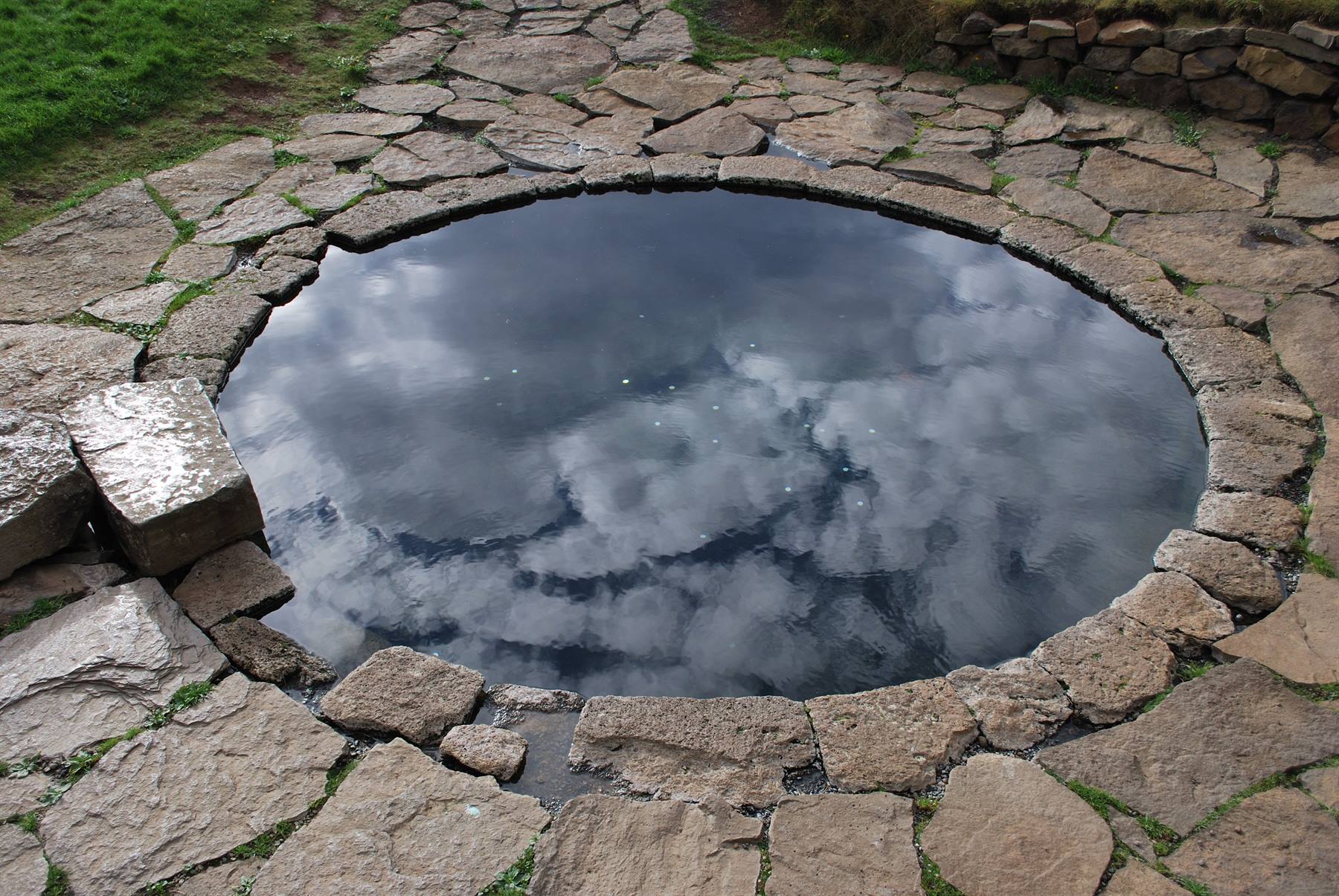
The small-sink thing will be a constant that we’ll carry with us throughout our visit to Iceland, and we never found any explanation for it! This one, though, will be the smallest of all, also because it was placed under the glass shelf and so to wash your face you had to do contortionist exercises! Below our room there’s also an outdoor thermal pool, something very common all over Iceland because of the thermal springs that are everywhere on the island. The downside is that the chatter of the bathers will go on until late in the evening even though there’s a notice that you can’t bathe after 8 p.m… One last note, which anyway we’ll find in all the other accommodations: free wi-fi internet throughout the property, rooms included. A nice sign of civilisation! It’s 6 p.m.
(we also have a -2 hour time difference from Italy) and so we head towards the capital to visit the city, without great expectations. We take Route 41 and have a slight sense of anxiety because the Lonely Planet points out that entering the city “is complicated”. Well, never have I seen a simpler city than this: just stay on Route 41 and in the end you’ll arrive along the seafront, turn left and you’ll reach the city centre. If instead you pay more attention, turn two crossroads earlier onto Laugavegur, always on the left. This is Reykjavik’s Via del Corso: in the end there are some shops, a few little places, ten cars driving around and several tourists trying to find attractions… in reality in Reykjavik there isn’t much to see apart from a few museums and the concrete church called Hallgrímskirkja. Unfortunately we arrive after 5 p.m. and the 75 m high tower is closed.
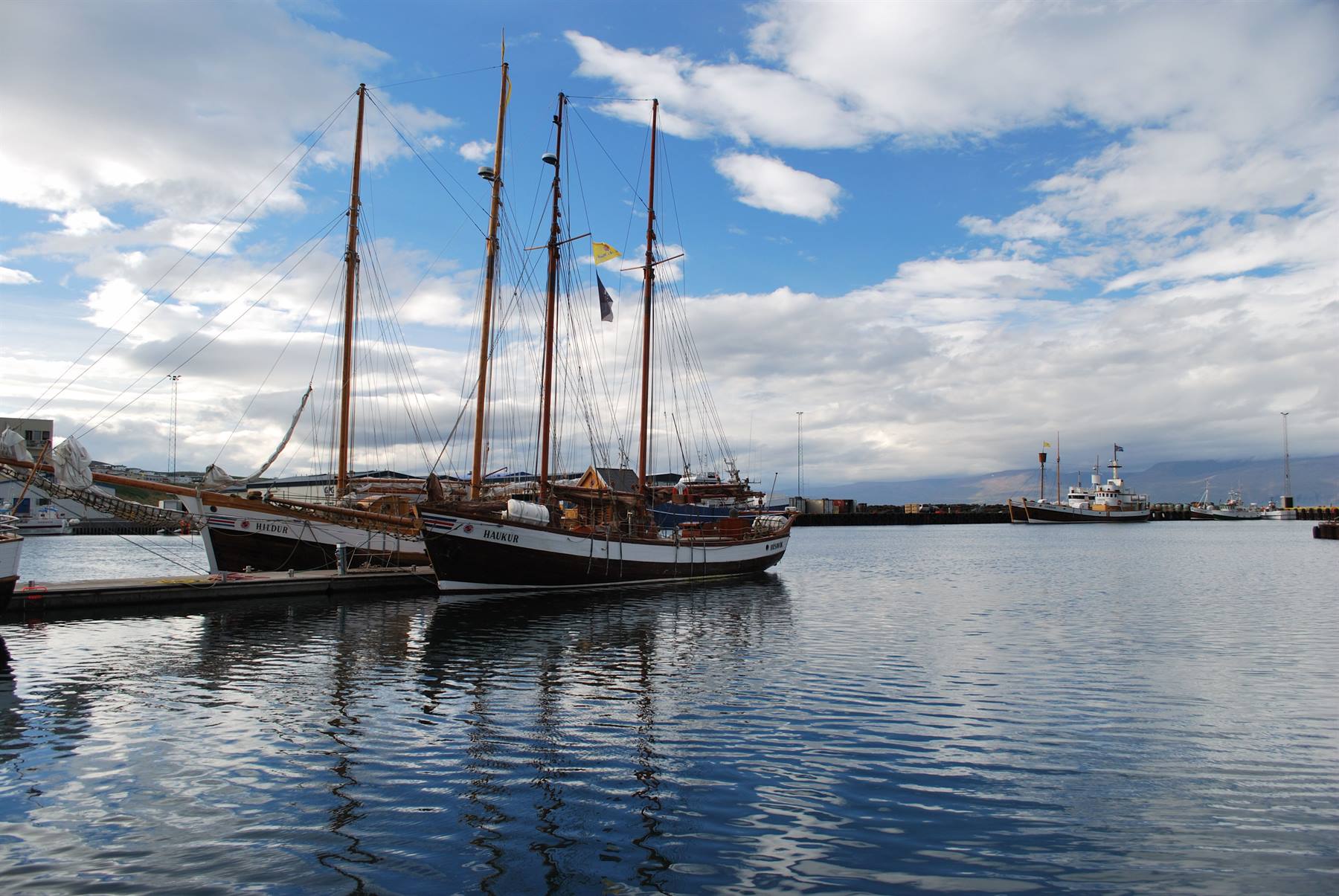
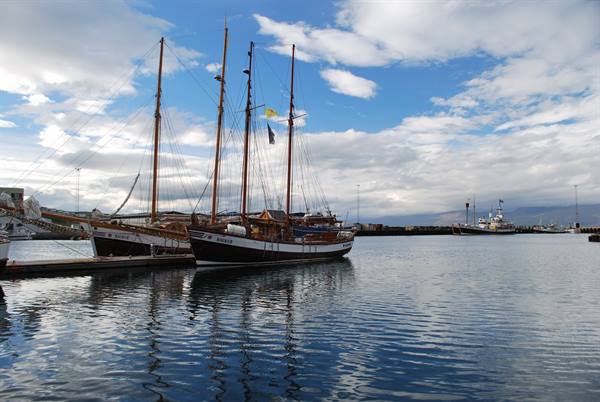
We’ll get over it. Another place in our opinion worth seeing is Hofði House, that is, the historic building where in 1986 Gorbachev and Reagan put an end to the nuclear arms race between the two world superpowers. For the rest, Reykjavik doesn’t seem to offer much. We take a little stroll in the harbour, where there are fish restaurants, gazebos offering whale watching tours, and then we head towards the centre. The weather gives us a break and we manage to take a walk without the risk of a storm even though the temperature stays cool at around 14°C. We go towards the Tjörnin pond, very pretty and frequented by hordes of restless gulls. Nearby we stop to eat at a place called Cafè Paris; it’s a very nice place, frequented by young people but without much chaos.
Besides typical bar dishes there are also some fish and meat dishes that seem inviting even if the prices are rather high, but we’ll have to get used to it. Both to the prices and to the menu, which in the end boils down to fish and lamb, lamb/sheep which is always served with vegetables. Two lamb dishes and a beer cost us €52, not bad as a baptism of fire! The time difference and tiredness make themselves felt and so we decide to go back to our Viking hotel where we fall asleep in a flat 20 seconds, despite the thermal pool still being frequented by tipsy, fat guests.
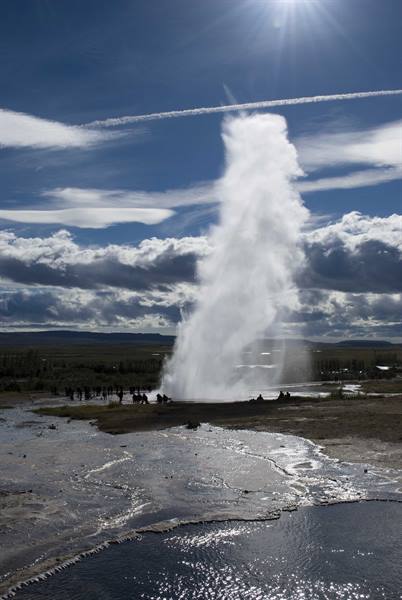
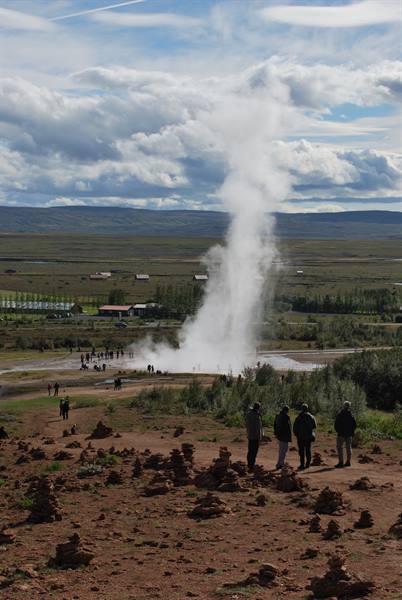
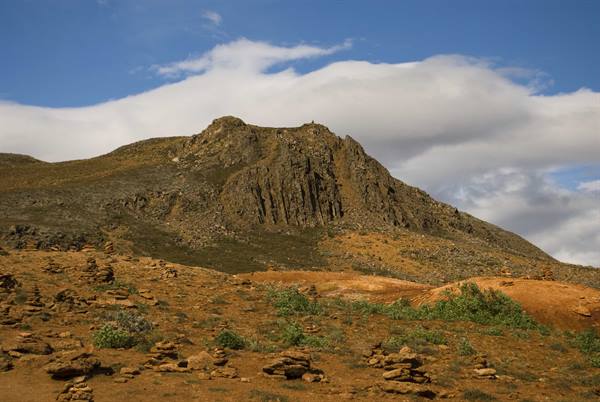
The Geysir area in the Golden Circle
Day 25 Sep 2010
Keflavik – Golden Circle – Vik – Km traveled 372
After a hearty breakfast at 8.30 we’re in the car. We again take Route No. 41 towards the capital but then turn off onto the legendary Route No. 1, that is, the road that follows the whole circuit of the island. Today it’s almost entirely asphalted and is a reference point for tourists and inhabitants given its important connecting function. During the winter it seems to be one of the few roads kept constantly clear of snow and, apart from some stretches in the north and west, it’s entirely asphalted and in good condition. The limit on this artery is the maximum allowed by Icelandic limits, that is, 90 km/h.
Be careful because in two weeks we saw one fixed speed camera and two police patrols that, hidden behind barns, speed bumps, bends or road workers’ huts, clock the speed of passing cars, and we even witnessed a chase right in front of us complete with siren and flashing lights (US style), car pulled over and a mega fine. On this they’re really strict and fines reach €1,900 with immediate payment by credit card. Don’t press on the accelerator even when the road allows it with long and boring straight stretches, and not even when nothing has surrounded you for an hour. We found the police right in the moments of maximum relaxation. Some locals whizz along at full speed but most tourists follow the rules even though the very victim of the chase was a rental car.
Also: why rush? Didn’t you come to Iceland to admire the landscape, savour the slow rhythm of the days and see wild nature? If you rush you enjoy nothing! We follow Route No. 1 to Selfoss and then turn north onto Route 35 towards the Golden Circle, made up of the attractions of Gullfoss, Geysir and Þingvellir. The landscape immediately becomes enchanting, the road runs along the Icelandic tundra and we immediately realise that sheep and goats will keep us company throughout the trip. There are really many of them, free to graze almost anywhere, they even climb up the mountains without any fear. It’s easy to see Icelandic horses too, smaller and stockier than ours with a blond mane, and cows. These animals are a central part of Icelanders’ diet, that is, you’ll find sheep, horse and cow meat on quite a few menus.
We don’t have time to stop at Þingvellir National Park but we promise ourselves that on the way back we’ll make a quick trip there. Our destination is certainly Geysir, the area of the most famous geysers in the world. But along the road we stop several times to photograph the landscape which during Route 35 suddenly becomes barren, made up of magnificent lava flows covered in moss: the contrast of the black lava with the green of the vegetation that has grown over it is truly incredible. We won’t easily forget Iceland’s colours. The weather isn’t the best: we encounter thick fog and then a light drizzle accompanies us for about an hour. The sky, however, promises well and as we go inland it improves and we head towards Geysir with a smile plastered on, looking at the patches of clear sky right in our direction of travel.
Before reaching the Geysir area, though, we stop at Kerio: it’s a crater that formed over 3,000 years ago with a lake of emerald green colour inside, rather evocative and also eerie I’d say, given the climate and the wind blowing. The Icelandic singer Björk held a concert on this lake, setting up the stage on a raft. A good place to take a few shots. We arrive at Geysir around 12.30. The weather is definitely on our side. The area has a large car park on the right, where there’s also an inevitable service station with attached snack bar and diner, and a little further on a mega restaurant and hotel, the Hotel Geysir, suited to the groups of Germans and Japanese on coaches, who are present anyway.
After parking (for free) the car we walk towards the geyser area and we’re immediately struck by the area around us: pools of steaming water along the path, you hear a constant noise of water and mud boiling, every now and then some crackling: the atmosphere is truly electrifying and while we’re busy looking at it all we hear a roar!! It’s the geyser that has exploded in its force and beauty, spraying vaporised water, a little further on. We’re like kids in the chocolate factory: going crazy!! We run, literally run towards the geyser as if it were about to emit the last spurt of its life but then we realise we’re really overdoing it, yet such is the emotion that we find it hard to calm down. We arrive in front of this geyser called Strokkur, marked by a wooden sign. Strokkur is the largest active Icelandic geyser there is and has supplanted Geysir.
The latter was the largest geyser in Iceland and one of the largest in the world, capable of emitting a jet of water up to 80 metres high, until, in the 1950s, reckless visitors threw stones into it, clogging its jet. In 2000, however, Mother Nature came back with force with strong earthquakes that partially reopened the hole at its depth and now it’s capable of emitting jets of vaporised water, though not 80 metres high, 2 or 3 times a day.
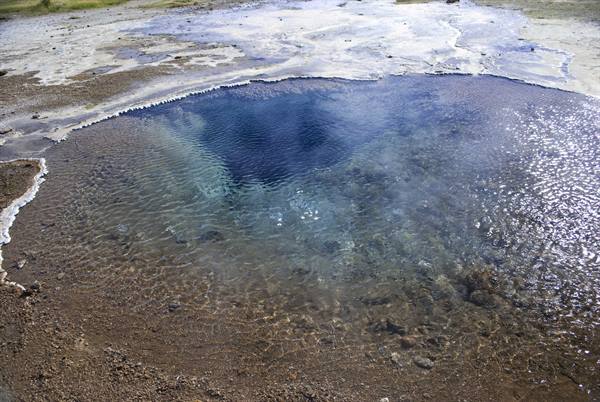
Luckily there’s Strokkur which instead emits jets of steam between 15 and 30 metres high every 6-8 minutes and so brings joy to all visitors, ourselves included! Be careful because the water that’s violently thrown out well exceeds 100°C and there’s a danger of burns, also don’t stand downwind or you’ll take a bath! The area anyway, Strokkur aside, is fascinating since there are numerous greenish pools boiling with hot water, very evocative for taking photographs and being fascinated for a couple of hours, also considering the luck of having a magnificent sunny day. The whole area is free and this is a constant throughout Iceland: natural attractions are never paid for (tell that to our Norwegian cousins who charge you access to the North Cape island!!).
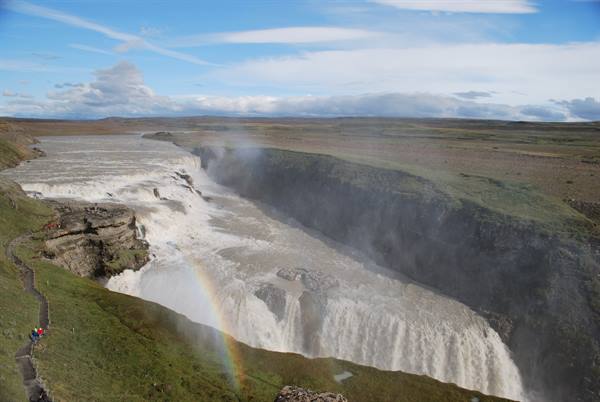
We eat a quick sandwich from the petrol station and then fly north, still continuing on Route 35 to reach Gullfoss: it’s the most famous waterfall in Iceland thanks to its height (32m) but above all to the double drop as it descends into a narrow canyon. The force of the waterfall is incredible and the water flow is such that it’s vaporised into the air and you inevitably get wet, moreover the wind, which is always tense, does the rest, causing spectacular but annoying swirls of vaporised water that also produce magnificent rainbows. There’s a path to follow to reach the mouths of the Gullfoss waterfalls and it’s beautiful even if you get a little wet. Don’t miss the spectacular view from above either, just follow the road that passes to the left of the souvenir shop, heights from which you’ll take beautiful photos. It’s getting late and we still have a lot of road ahead of us.
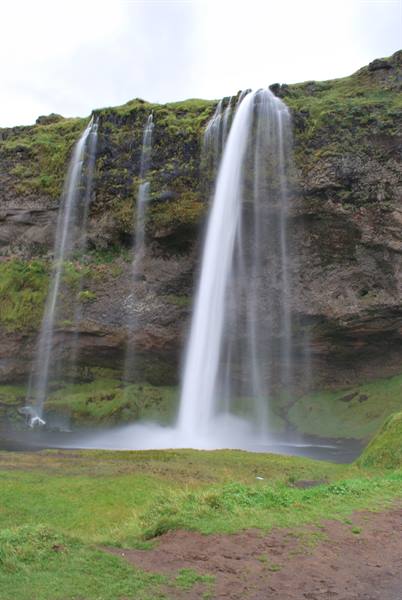
The annoying thing is that to get back onto Route No. 1 heading north you have to retrace the whole of Route 35 and get back to Selfoss (how boring!) and then take Route No. 1 again towards Vik, where we’ll be staying. We stop several times but the most important stop is Seljandsfoss waterfall. The Seljalandsá river falls 60 metres once directly into the ocean, today instead it remains very distant. The beauty of the waterfall isn’t the water flow but the walking path that lets you pass behind it (!). I’ll tell you in advance that
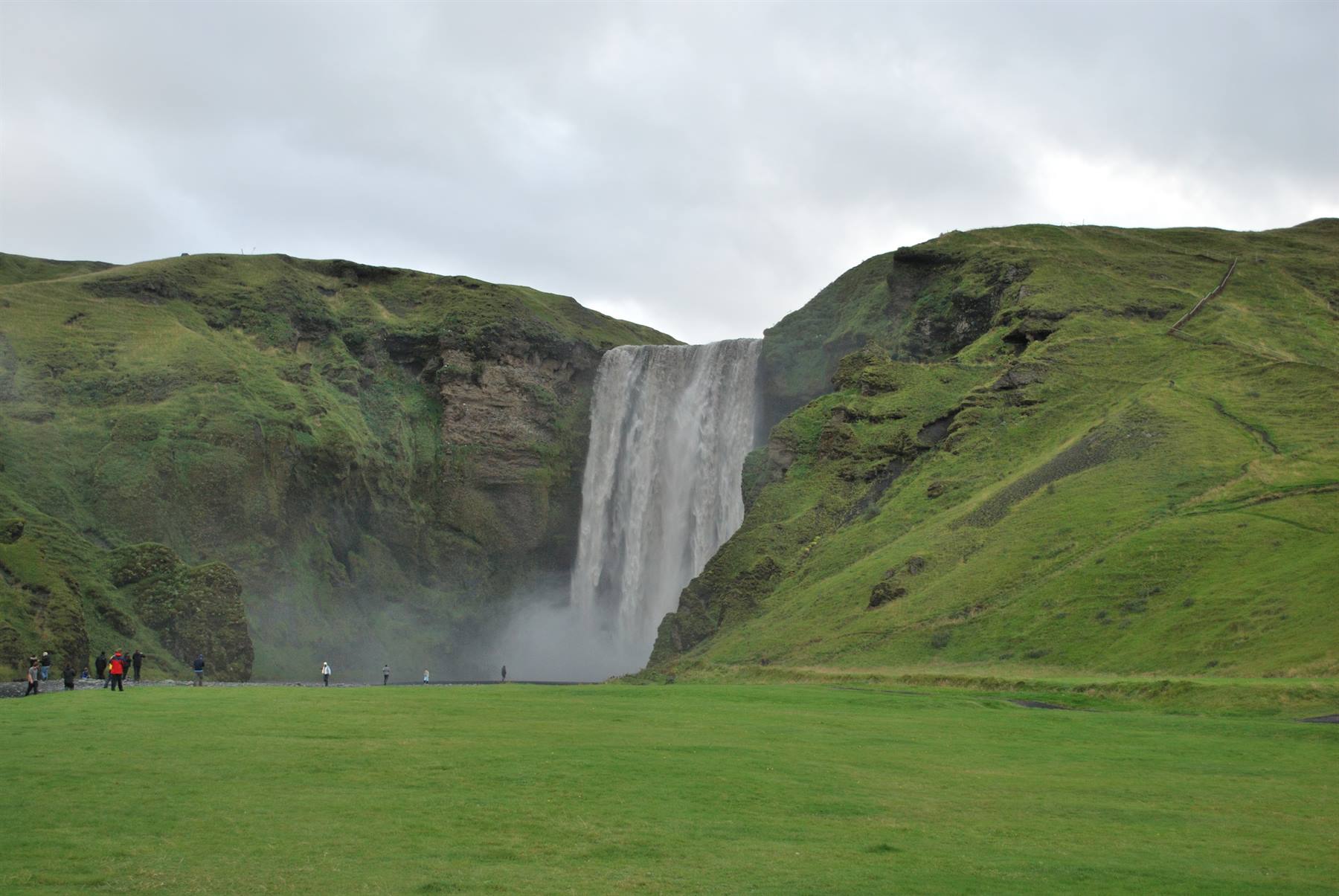
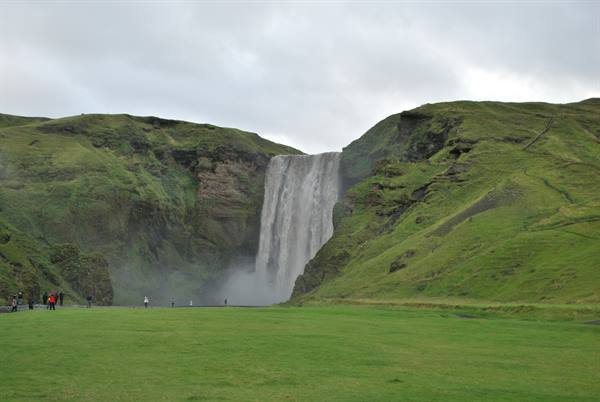
The 62 metres of the Skógarfoss waterfall
Day 35 Sep 2010
Again
But it won’t be the last waterfall we see today because Skógarfoss waterfall awaits us, right after the village of Skógar from which it takes its name. It’s truly very spectacular both for its 62-metre drop and for its water flow… it’s truly incredible, you get right beneath it with the feeling of being overwhelmed and crushed… it’s beautiful and we have to be careful of the wind which, being very strong, risks sweeping us away with the side spray. Time is pressing, we have to arrive by 7 p.m. at our place, the Country Hotel Hofdabrekka as the reservation made on booking.com states. The weather obviously worsens (when does it not!) and so it takes us much longer to do the last 40 km. At Vik, in fact, a rainstorm awaits us, low clouds that are frightening and obviously lots of wind. Unbelievable but it takes us a long time to find this country hotel.
We stop both at a service station and at a campsite but it takes us over 20 minutes also because the directions we got from the booking.com map are too generic. In the end we make it and arrive at Country Hotel Hofdabrekka over 45 minutes late, fearing the worst. The lady, however, doesn’t seem at all agitated and gives us our key and points out that the restaurant kitchen will stay open until 8.30… we dash to the rooms which are housed in a prefab adjacent to the main building, perhaps once the hayloft or the stable… just time to realise that the room is spartan but rather clean and sufficiently large, and we go back to the restaurant to eat. We’re two couples and then a third joins us. The food is good with a menu restricted to a fish dish and a lamb dish, but we’re too tired and the weather is too bad to think of going to Vik to look for something different.
We also taste for the first time the famous Skyr, that is, an Icelandic yoghurt, mixed with ice cream and fruit (usually berries like blueberries). Very good but also rather calorific. Under heavy rain we regain our room and only have time to realise that there are pools with whirlpools and thermal water available to guests but we think “are we crazy with this weather?” and we fall asleep hoping for decidedly kinder weather the next morning.
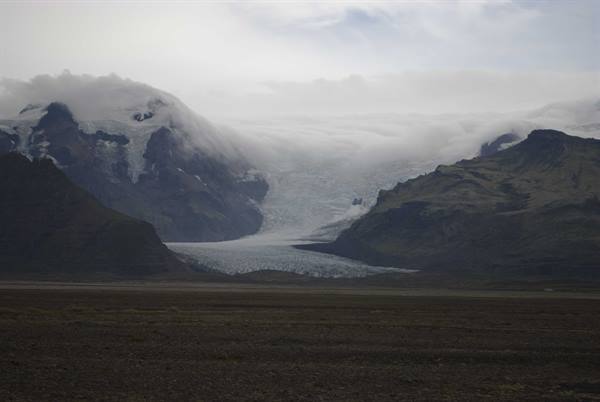
Glimpses of the Skaftafellsjokull glacier
Day 46 Sep 2010
Vik - Höfn í Hornafirði - km 308
In the morning, weather-wise, it doesn’t seem to differ from the previous evening. Strong wind, rain and low clouds. We’re quite discouraged because today should be the day of the glaciers and so we risk seeing nothing… damn it, let’s hope the weather changes. We defy the bad weather and go back to take a look at the Reynisdrangur sea stacks that rise at the western end of the beach in front of Vik, a black-sand beach. The wind is tense and we manage to take literally two shots of the sea stacks and, without being swallowed by the stormy sea, we head north, still on Route No. 1, with final destination Skaftafell and the Vatnajökull glacier. The weather, as we move away from Vik, seems to improve and the road seems to want to leave the worst behind.
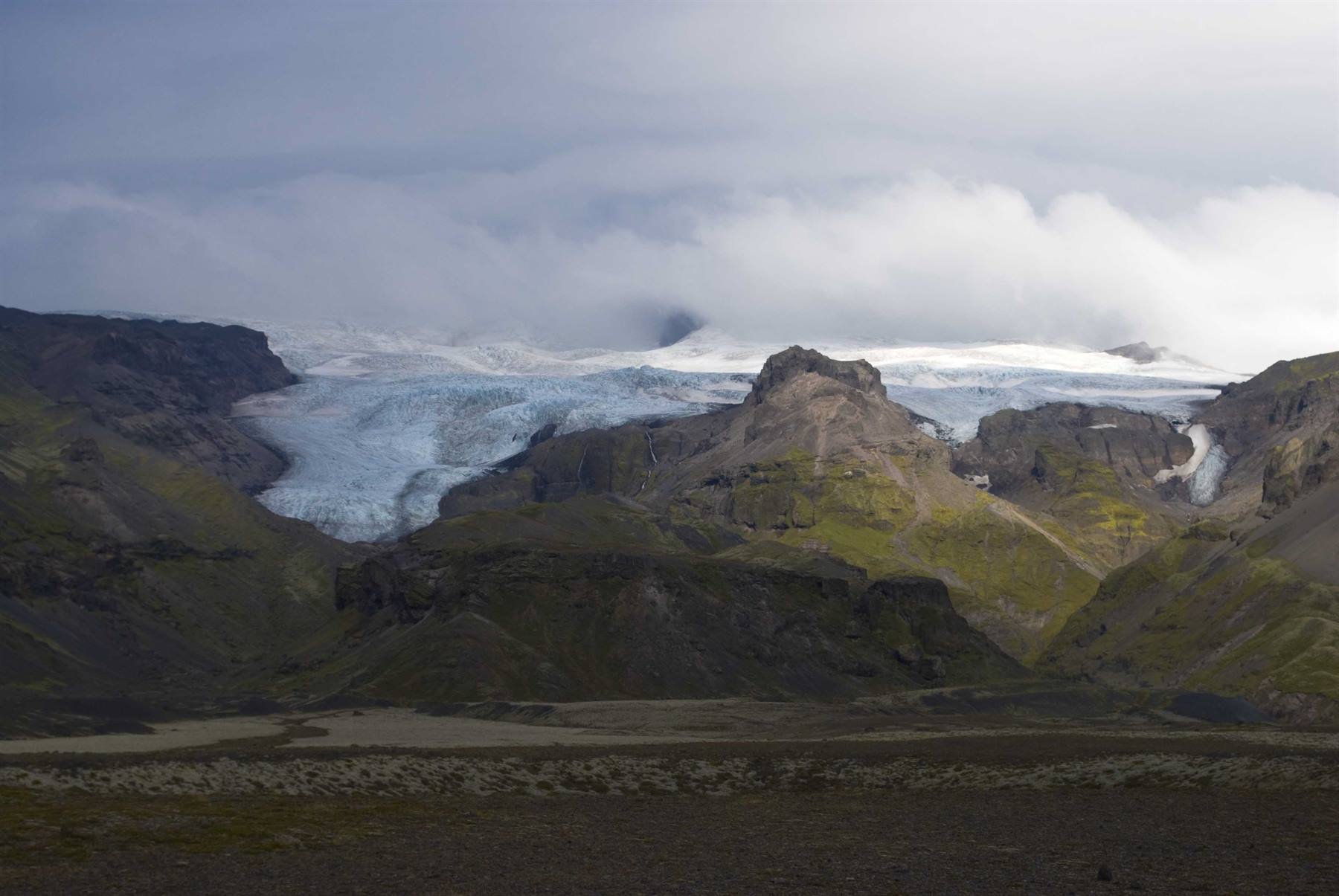
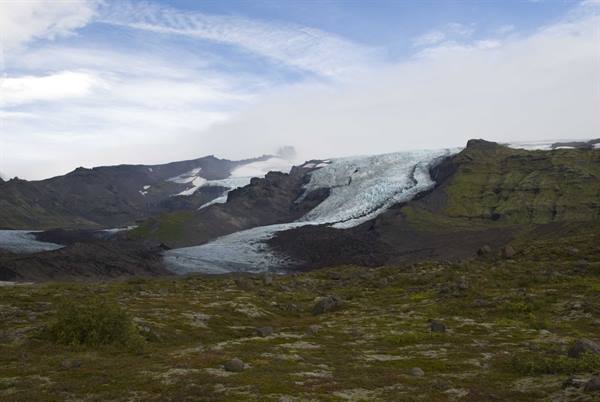
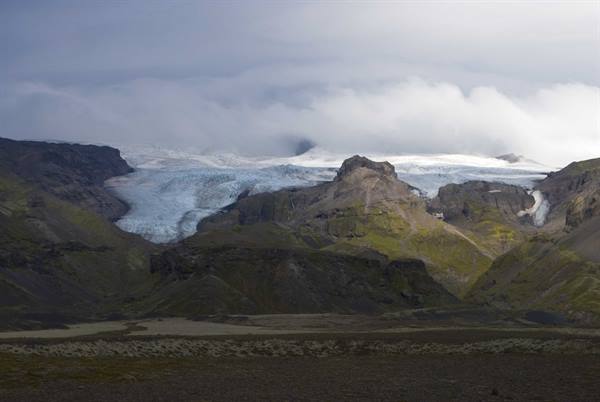
There are over 120 km separating us from the Vatnajökull glacier where we have planned a double excursion, a walk with crampons on the ice cap and a visit to the Jökulsárlón glacial lagoon. On the internet we knew that glacier excursions are operated by two local tour operators and we had seen that Glacier Guide offers four daily excursions, one at 9.00 – 10.30 – 12.00 – 14.00 but we’ve also learned that weather conditions can certainly blow any plan and for this reason we go straight there to try not to miss the 12.00 one. The Vatnajökull glacier suddenly appears before us, this tongue of ice wrapped in clouds that descends menacingly towards the sea, truly takes your breath away. It’s a spectacle that’s hard to describe, it absolutely requires a visit.
Vatnajökull is the most extensive glacial expanse in the world after the poles and covers a territory almost as large as Umbria and has a thickness of almost 1 km! Within this glacier there’s also Iceland’s highest peak, Mount Hvannadalshnùkur at 2,119 metres, and a nameless glacial valley that lies 300 metres below sea level (crazy!). From this enormous ice cap tongues of ice descend towards the sea such as the Skaftafellsjokull which comes to within 1.5 km of Skaftafell National Park (where we’re going) and the Breidamerkurjokull which shatters into marvellous icebergs inside the Jökulsárlón lagoon. We arrive at Skaftafell National Park and present ourselves at the Glacier Guide box.
The nice guide tells us that today there’s been a lot of wind on the glacier and that all the morning excursions have been cancelled (!!) but we’re lucky because the weather is improving and it will probably be possible to do one shortly. She tells us to come back around 1 p.m. and so we take the opportunity to eat a hot soup in a small diner next to the Skaftafell campsite. While we’re outside writing postcards the guide reaches us together with a colleague of hers (French) named Laurence. They tell us that the excursion is confirmed and that we leave in 15 minutes. Since, however, they’re accompanying a group that then continues to the Jökulsárlón lagoon, they suggest we wait at least for the next excursion, at 2 p.m.
We ask them if we can follow them with our car so as not to wait uselessly for an hour and not to have to come back (from the Skaftafellsjokull glacier to Jökulsárlón there’s almost an hour’s drive). They accept and so we head towards their box, where they provide us with crampons and an ice axe. We pay our fee (5,990 ISK each) for a trip that promises 1.5 hours on the glacier for a total of almost 3 hours of excursion. There are about ten of us in all, some in truly unthinkable clothing: an English couple is even indecent (she in a fuchsia coat with Superga shoes to match, he even in jeans and a cotton jumper!) and the guides, Laurence in particular, insist that they at least rent trekking shoes (500 ISK) but they refuse. Incredible!! How does it occur to them that they can even do a simple walk in the mountains in those conditions? Well, the best part we’ll see later.
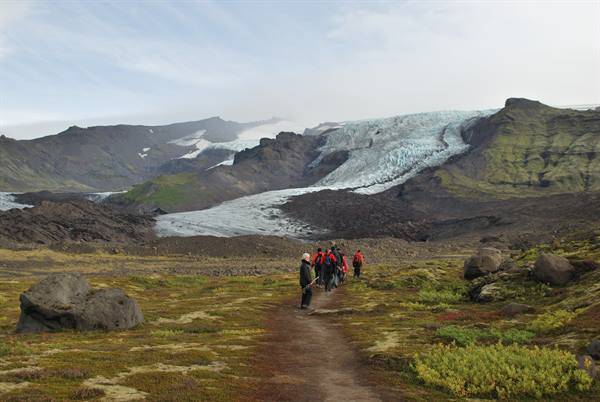
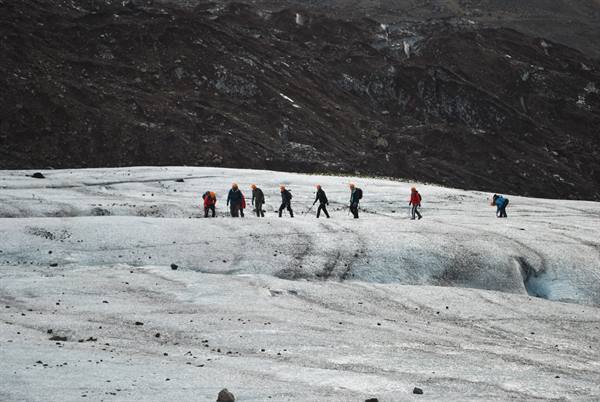
I follow the bus that takes the group to the base camp below the Skaftafellsjokull glacier; the bus is rather unusual, being an old American school bus. From there, we put on our crampons and take our ice axes and do a twenty-minute walk at a decidedly brisk pace and arrive right at the base of the Skaftafellsjokull. There Laurence makes us understand that she’s an alpine guide and not a babysitter and so she shows us how to put on the crampons: yes, you read that right, she shows us and doesn’t put the crampons on us. Obviously she repeats the movements explaining them in understandable English but she also tells us that up there (on the glacier) everyone must be able to manage on their own. So she patiently waits for everyone to put on their crampons but then (as is right) makes sure to check they’re properly fitted.
The two clever English ones only understand the insistence about trekking shoes: the crampons, all completely made of iron, have 3-centimetre spikes that serve to pierce the ice and give stability but which, tightened by the strap to the shoe, are painful if the shoe’s sole is that of a… Superga! Moreover the strap has a safety system that the more the shoe moves the tighter it gets in order to prevent the crampon from coming off the shoe. We start the climb, at first rather difficult because we advance on the mixed ice-pebble part, a derivation of the moraine produced by the Skaftafellsjokull. When we get onto the live ice, though, it’s definitely better and Laurence stops and shows us how to walk, how to move, how to stop and how to overcome minimal panic situations.
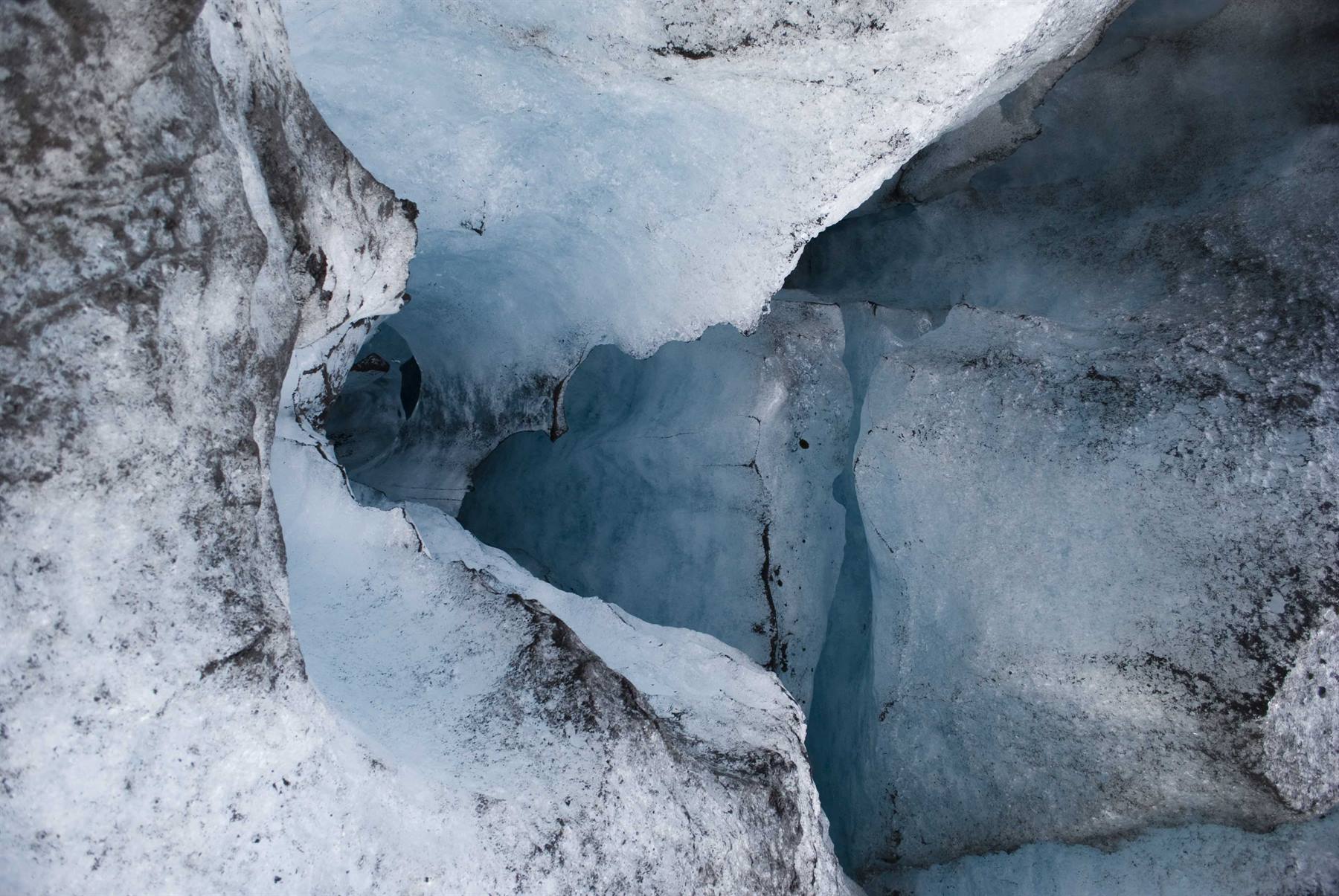
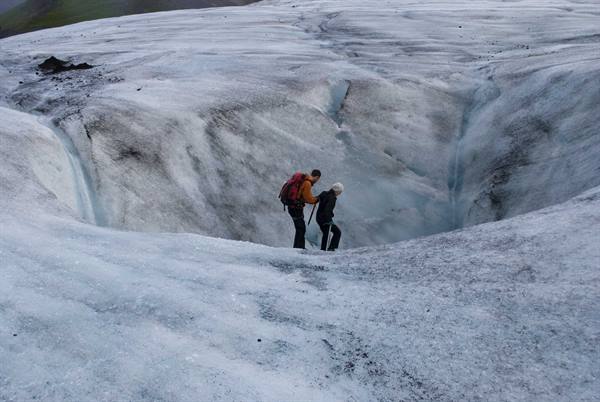
She’s very good and patient and has us try going up and down several times and especially recommends using the ice axe in the most appropriate way, that is, only as a support stick and not as an “ice breaker” or as a “mace”. She explains that improper use of the ice axe can also be very dangerous especially for the climber himself because it can slip and cause deep wounds to the knees. Throughout the excursion nobody started playing with the ice axe except a clumsy Englishman who nearly planted it (by mistake) in the guide’s head while going down an icy step. The excursion is very pleasant and the weather good: it’s not raining, but obviously there isn’t much sun, the temperature is pleasant, indeed even too hot. Laurence shows us how to climb over a crevasse, drink from a stream, explains the movements of the ice and many interesting things.
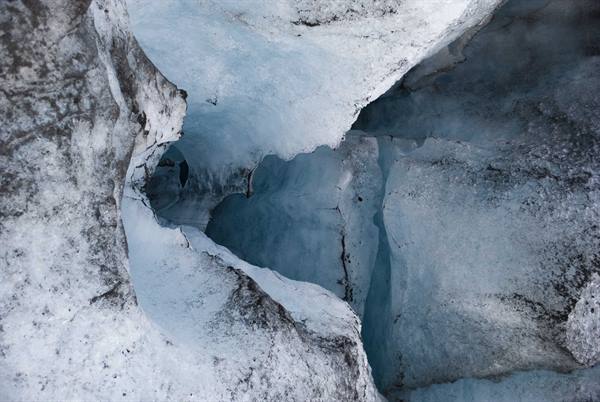
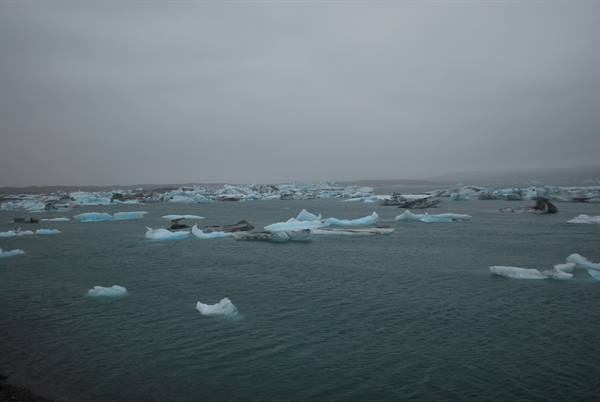
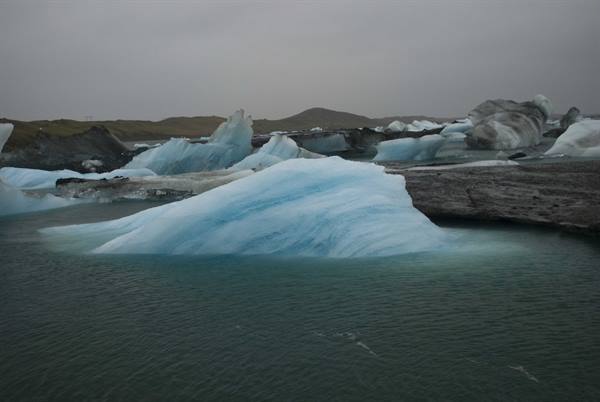
She shows us (with a shiver) a very large and very deep gorge in the ice, a small waterfall. All very interesting but unfortunately the tour ends after about 1.5 hours and we retrace the route in reverse and we all find ourselves very enraptured at the school bus, unable to stop taking photos of the Skaftafellsjokull. Ah, I forgot the two little English ones: she’s in the grip of stabbing pains, he practically no longer speaks, stunned by the wind and soaked to the knees. Two complete idiots. From there we take the car and head towards the Jökulsárlón glacial lagoon which is surely one of Iceland’s most seen attractions after the Blue Lagoon and the Strokkur geyser. The icebergs break off from the Breidamerkurjokull glacier, an offshoot of the Vatnajökull ice cap, to go into this lagoon which is connected to the Atlantic ocean.
The icebergs can take up to 5 years to leave this lagoon which is 600 metres deep and has an area of 17 sq km. They explained to us
The Vatnajökull is impressive
Day 56 Sep 2010
Again
The price is 6,000 ISK each and the tour lasts about 45 minutes and we manage to book the last tour of the day, departing at 6 p.m. Honestly it seems a little late to us and the weather is rapidly worsening but we hold on and think about enjoying the trip. Meanwhile we take photos of these drifting icebergs that have incredible colours from green to deep blue even if the lack of direct light dampens the beauty and spectacularity of the place, unfortunately. The moment comes to board the vessel and we put on very wet life jackets…. damn! Cover up well because it’s freezing cold and above all the amphibious vehicle is open (obviously!). No sooner are we in the water than heavy rain starts… between the rain and the wet life jacket after a few minutes we’re completely soaked.
We just can’t enjoy our excursion to the fullest also because it’s rather dark due to the time, the low clouds and the heavy rain… the colours of the ice gradually fade and we remain rather disappointed and wet. The guide on board the vessel has us taste a piece of 1,000-year-old ice and that’s the last memory of our Jökulsárlón excursion. Then we get in the car and, soaked like seals, we head straight to our hotel which we booked in the fishing village of Höfn í Hornafirði; our little hotel is called Arnanes Country Hotel and is located at Arnanes, five kilometres before Höfn. This accommodation too turned out to be truly very expensive, 20,900 ISK but thanks to the web booking the owner grants us a fantastic 15% discount, leaving breakfast included. The place is actually a group of very nice little wooden bungalows, even if spartan and certainly not up to the price paid.
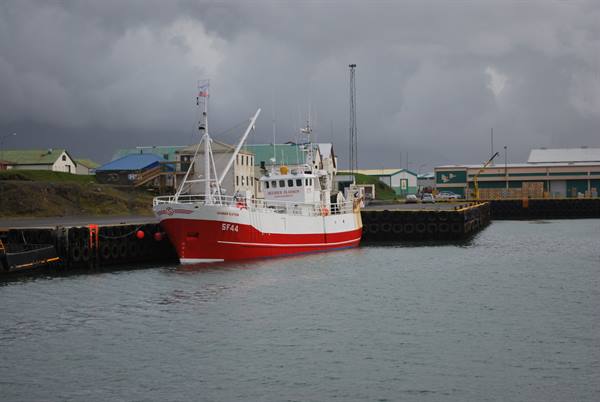
In this case wi-fi internet is free only in the breakfast area anyway, while there’s no connection in the little apartments. Be careful when you book, specify that you want the bungalow (cottage) because they tend to give you the basement of the main house, where the owner’s family actually lives. He’s definitely a man of few words but also very serious and professional. We put all our clothes out to dry and head towards Höfn to eat something, since at Arnanes it’s not possible to have dinner except at the service station. We read about the port of Höfn but since it’s dark and we can’t see anything we head towards the place flagged by the Lonely Planet, Kaffi Hornio. A nice quiet wooden building and strangely cheap. It has a decent fish menu but doesn’t have lobster and suggests a place right there where you can eat lobate.
We appreciate the frankness but we’re too tired and too wet to get back in the car and so we take a mixed fish grill for two, very good, abundant (even too much) and also cheap. There are also meat dishes (lamb obviously) or hamburgers and chips, in short for all tastes. We eat well and have fun watching a little group of Asian Americans who pester the waitress about the genuineness of the dishes, insisting on knowing whether the mushrooms are gathered or from a jar… the waitress is clearly amused but at the 20th question she loses patience and tells them everything is fresh with an air of “enough now”. The first irritated Icelander we see (but she was perfectly right). To make up for the outburst, when we pay she offers to check tomorrow’s weather forecast for us, since we’re going to the eastern fjords region.
Very nice! The weather seems to be rather decent and we, amazed and almost moved, pay all the more happily and satisfied. We just have time to reach the Country Hotel, take the clothes off the radiators, take a shower and faint into the bed with a duvet. The bed isn’t very comfortable but we really don’t have a chance to notice. Good night.
Weather in Höfn: chilling!
Day 67 Sep 2010
Höfn – Seyoisfjorour – km 310
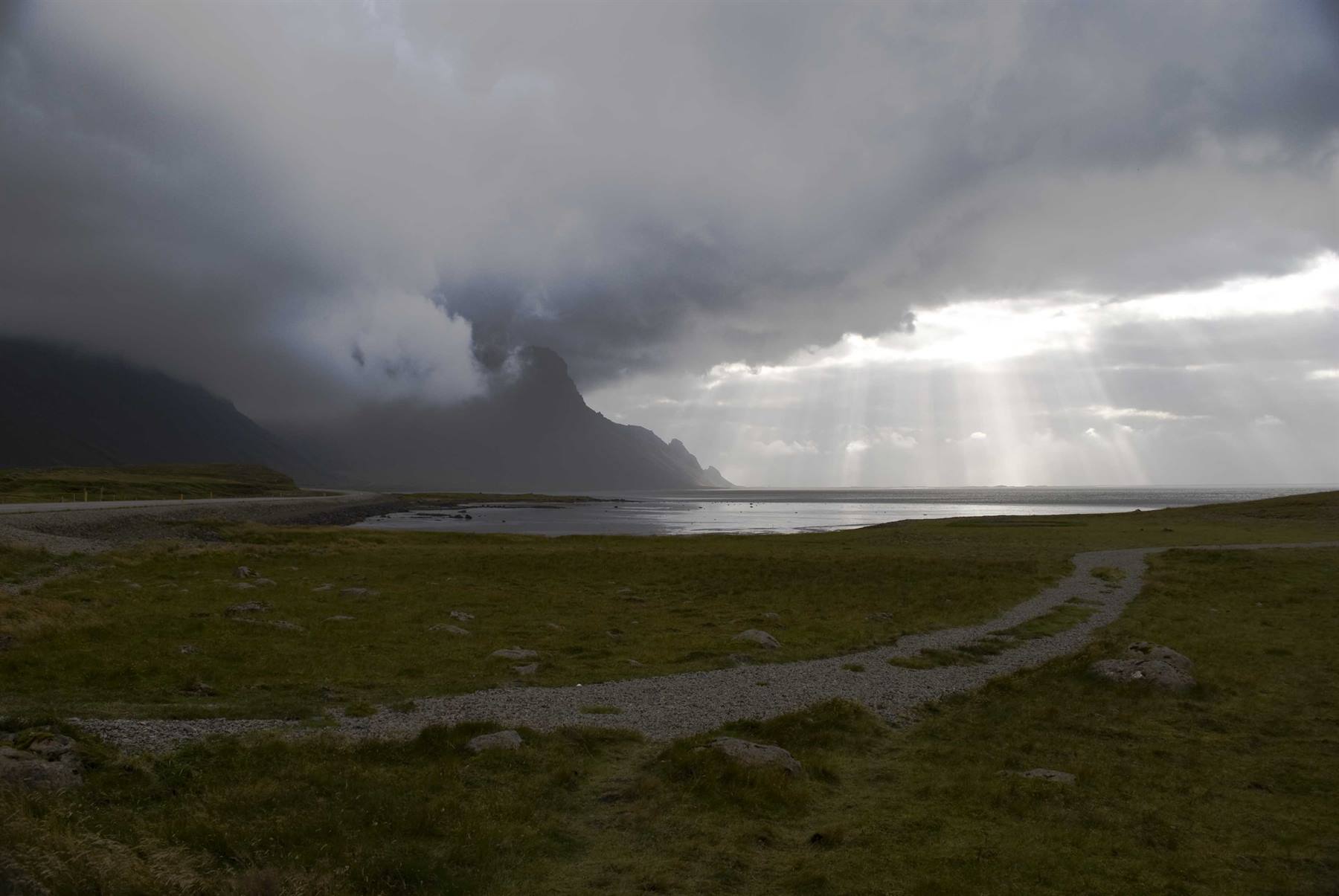
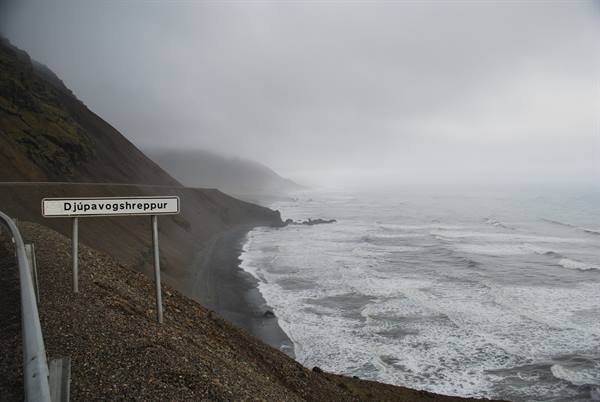
A very encouraging morning. We have an average breakfast at the Country Hotel, pay and thank them. At the end of the valley we notice that the sun is lighting up the Vatnajökull and the temptation is to go back to admire the spectacle in the sun but we can’t allow ourselves that, today’s stage is also demanding, and so we go to Höfn to admire the small but pretty little harbour, take a few shots and then off, again on Route No. 1 heading north. The kilometres pass slowly, the road becomes very winding and starts to run alongside the first part of the Icelandic eastern fjords. You climb along breathtaking roads from which you can see a stormy sea whose waves crash violently on the rocks. In many stretches the road has no guardrail and gives you the shivers but luckily we don’t meet a single car over almost 100 kilometres so we’re rather relaxed.
We stop often to take photos also considering the day which, however, goes from deep blue to overcast, even if the rain doesn’t seem about to visit us. In some points the road becomes dirt but without any concern we continue our march until the junction with Route No. 96 where we have to make our decision: continue on Route 1 which, however, cuts inland through the fjords, or proceed along the coast on Route No. 96 which on the maps is marked as yellow… we know that the ban on travelling on roads with non-4x4 cars concerns the roads marked with an “F” and this isn’t one. So we decide to take it because it seems to be very scenic. The spectacle indeed doesn’t disappoint expectations and in this case too we see a wonderful coast with an increasingly rough sea that gives us shiver-inducing views.
In some stretches and for a few kilometres the road becomes unpaved with some potholes but nothing particularly demanding even if this forces us to proceed with caution, slowing our average speed, but we’re not in a hurry because we want to enjoy the spectacle. We arrive at the small fjord of Stöðvarfjörður where we stop in the fishing village of Brekkan to eat at a small local fast food place, run by two elderly but rather nice ladies. The attraction of this place, besides the enchanting landscape, is the Steinasafn Petru, that is, the house of an eighty-year-old woman passionate about geology, Petra Sveinsdóttir, who over her lifetime collected thousands of stones that she has now displayed in this incredible house museum.
Honestly we didn’t go in because the sprightly old lady has set a compulsory €5 donation to enter and honestly, in the middle of nowhere, it seemed excessive to us, also considering our lack of passion for such extreme geology. We continue on and arrive at the fjord of Fáskrúðsfjörður, where the village of the same name is located, very small and which today, instead, is registering strong population growth thanks to the nearby Alcoa aluminium smelter. Here they’ve started building housing units for the workers and even a long tunnel to let them reach the factory without having to travel too many kilometres. The factory is in the next fjord called Reyðarfjörður where in the gorge there’s the locality of the same name, home to this important Icelandic industrial centre.
The activity began on 9 June 2007 with a big town celebration that inaugurated this industrial building which, with its 2 km length, completely dominates the valley floor. The local population is ecstatic about this new activity which has given vital energy to a depressed place in Iceland that risked complete abandonment by the population after the fish resources had almost run out, which, given the morphology of the area with very high mountains and endless sheer drops, was certainly not suited to agriculture. Environmental associations protested but the Icelandic people went ahead without care, proceeding with the initial plan. Today the population has gone from 700 to 2,000 souls and what seemed a desolate place is today inhabited by many people.
Honestly it didn’t seem to us a particularly devastated area by the construction but, not living there, we can’t give a final judgement, neither for nor against because one also has to understand the resident population and not that of transit. Because believe me, in this fjord in particular there’s nothing and so visitors can be considered only in transit. From here we leave Route 96 because it would then end in nothing, that is, it doesn’t reach the next fjord, the final destination of the day, where our hotel booked from Italy awaits us. So we take Route 92 and meet Route No. 1 again which, without particular emotions, takes us to Egilsstaðir, a rather large town that also has a small airport and a hospital, the fruit of the progress demanded precisely by the nearby Alcoa smelter. From there we take Route 93 to head towards the Seyoisfjorour fjord and the village of the same name.
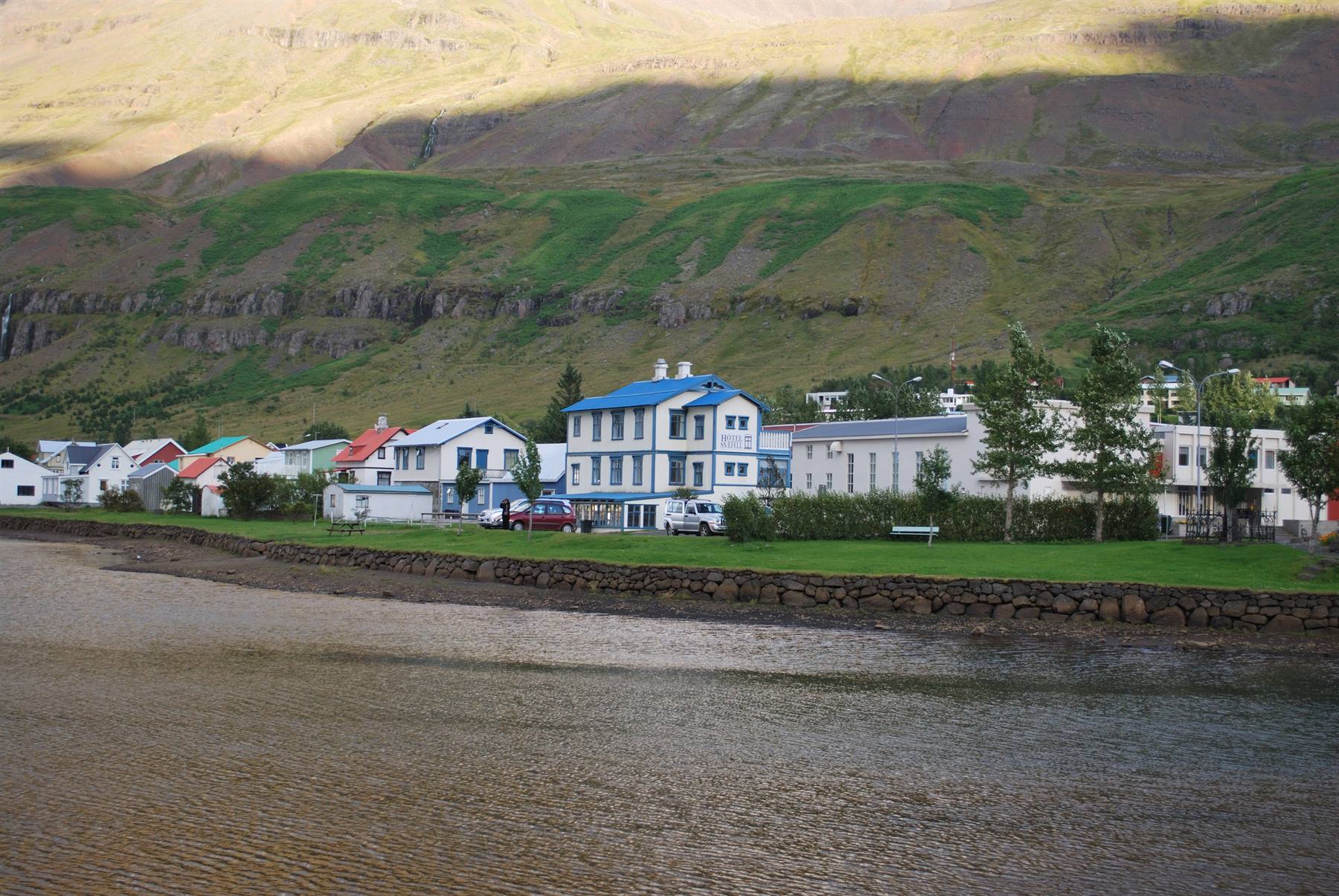
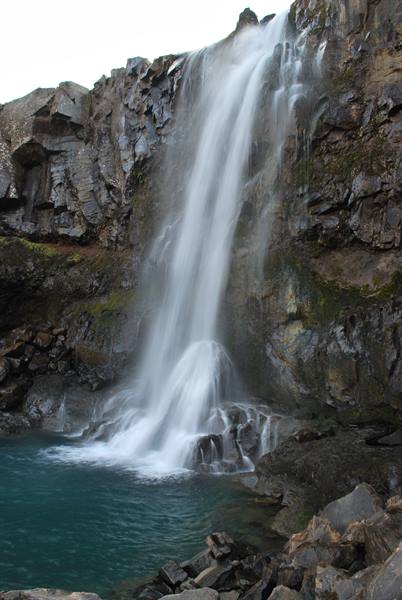
The road climbs to cross the mountain that separates the interior from this fjord, deep and distant, that throws itself violently into the Atlantic ocean. After a climb and a beautiful plateau we descend rapidly towards the sea and we can’t help but stop to take photos of a magnificent waterfall located on your right as you descend, not flagged by the guides but truly impetuous. We arrive at Hotel Snæfell, our final destination. The hotel is the less noble version of Hotel Aldan but the management is the same. I say less noble because the cost is lower but the rooms are definitely smaller, so much so that the lady who answered us and then confirmed the booking spoke of a “small double room” which indeed turned out to be so. The price was 16,900 ISK including breakfast.
The only negative note, besides the Smurf-like dimensions of the room and bathroom, was that breakfast was eaten at Hotel Aldan about 200 metres from Snæfell and so in the morning there’s a nice coming and going of people. The lady, very energetic but definitely efficient, tells us that if we want to have dinner we have to tell her right away because in the morning the ferry’s departure is scheduled and so a “full house” is expected. Worried, we book for 8.30 but she immediately tells us that for that time there’s no problem… she thought we wanted to have dinner at 6.30!! So we leave our bags in the room and take a nice walk around the village and some hills around there, given the wonderful sun keeping us company in this late September afternoon. The Smyril Line ferry towers in the small harbour and operates connections with the Faroe Islands and then with Denmark.
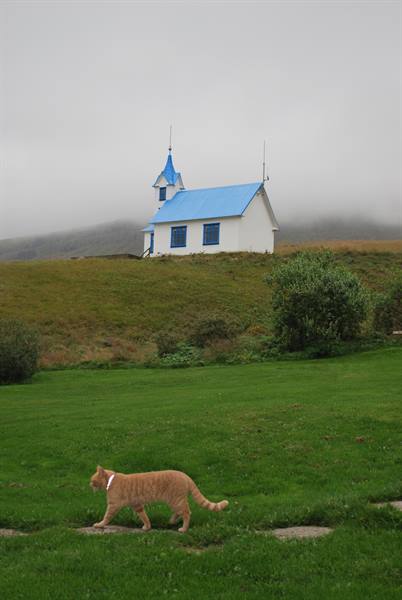
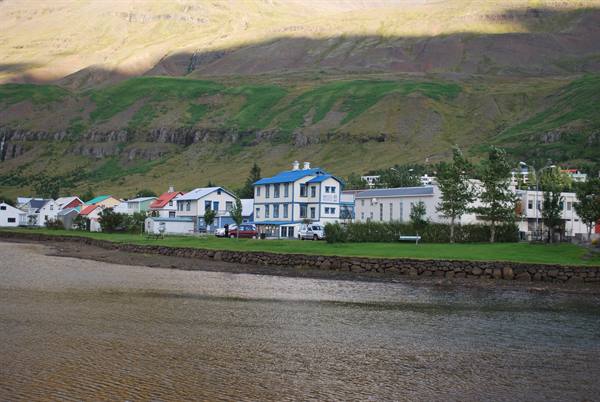
There are many cars and campers ready to board, many Germans and Dutch who decide to come to Iceland with their cars. On our walk in the hills, admiring waterfalls and bucolic landscapes, we come across a big black dog that gives us an incredible scare because we thought it wanted to attack us whereas only later do we discover it belonged to a boy who was taking a walk with him! Seyoisfjorour is famous for its coloured wooden buildings, very pretty, I especially recommend the little church, truly characteristic. There’s also a municipal thermal pool but it closes at 8.30 and obviously a supermarket. We realise that besides Hotel Aldan and Snæfell there are no other accommodations and there’s also only a second restaurant, a little outside the village centre. At 8.30 we go to dinner and the house offers a couple of fish menus and two meat ones. I must say the fish is very fresh
Seyoisfjorour
Day 78 Sep 2010
Seyoisfjorour – Húsavík - Km 330
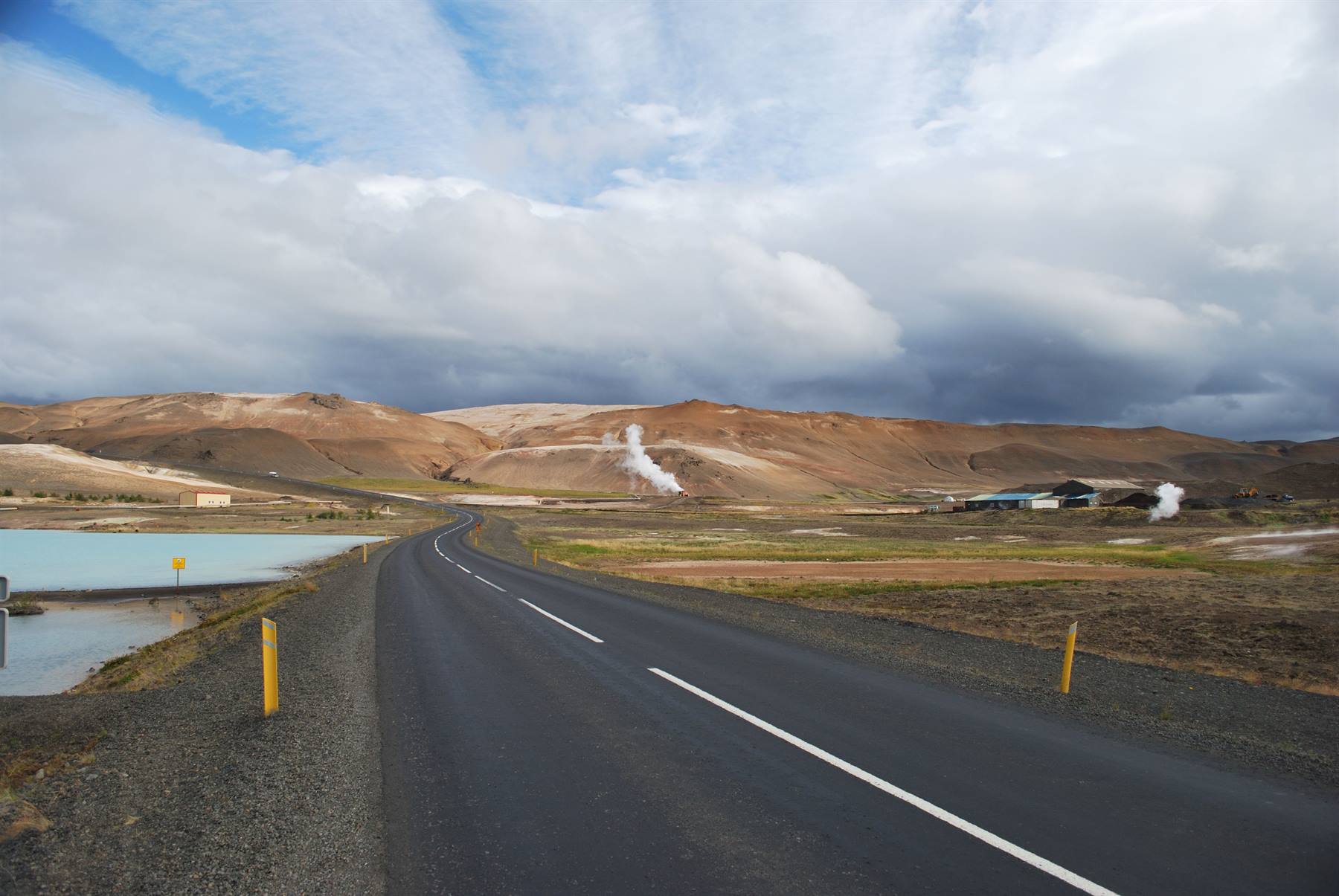
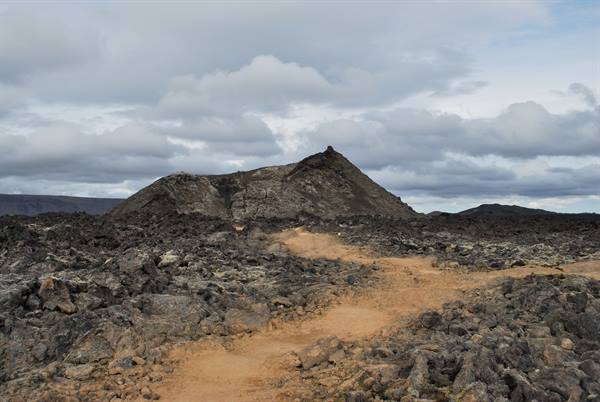
The day is intense and so we get up at 7 and go to have breakfast under heavy rain. We’ve understood that Iceland, every time it lets us see the sun, must then remind us that we’re almost at the North Pole and so give us the lash of the next day. We go up with our Golf to return to Egilsstaðir and take Route No. 1 but we run into a bank of clouds so low that they reduce visibility to a few metres. We go at 20 km/h and turn on all possible lights, we spend about ten kilometres of rather high tension also because it doesn’t stop raining and the temperature has plummeted to 9 degrees. Finally the descent begins and the situation improves and finally, after an infinite time, we arrive at Egilsstaðir, take Route No. 1 and head with great determination towards the Mývatn lake area and the Krafla volcanic area.
The road isn’t very interesting so we never stop, we’re determined to arrive in the area as soon as possible, there are so many things to see. The weather improves definitely or at least so it seems to us because everything
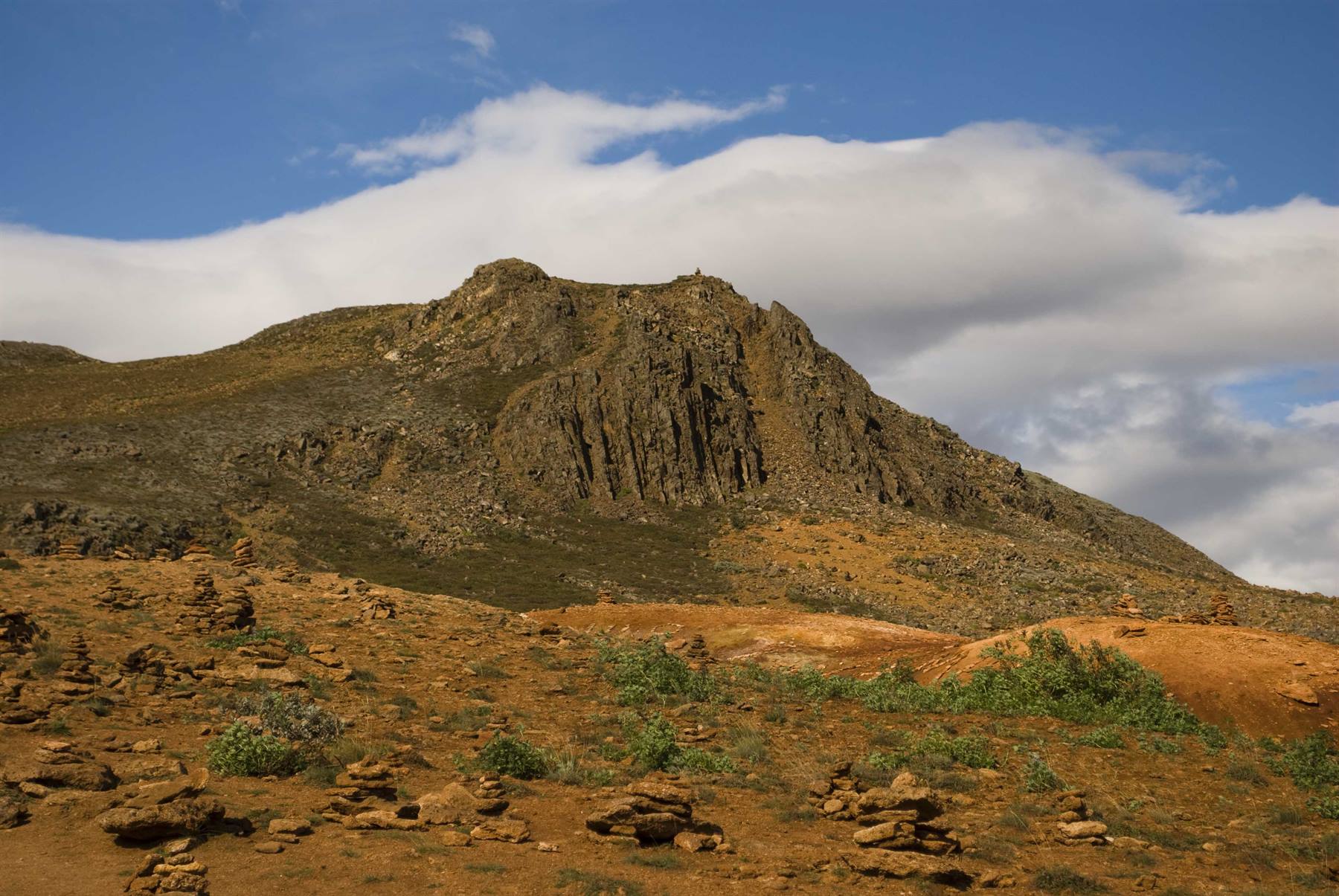
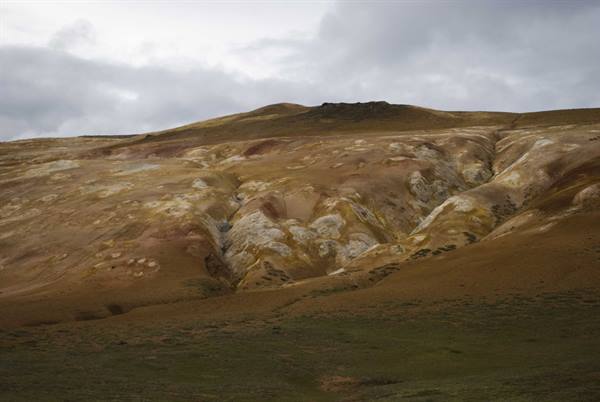
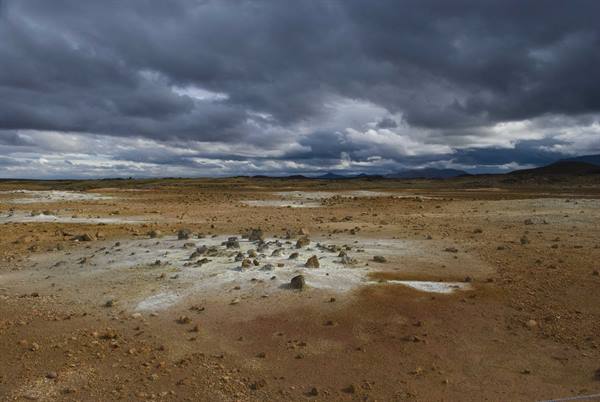
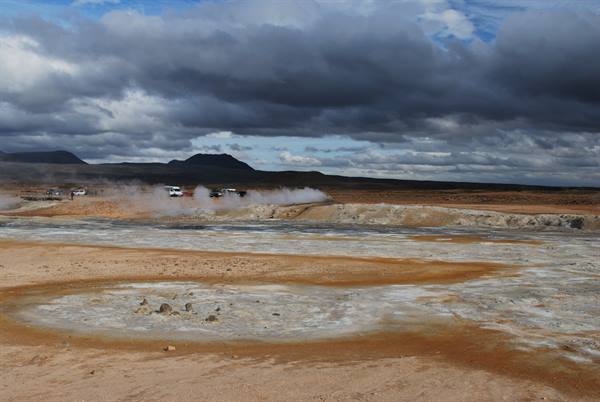
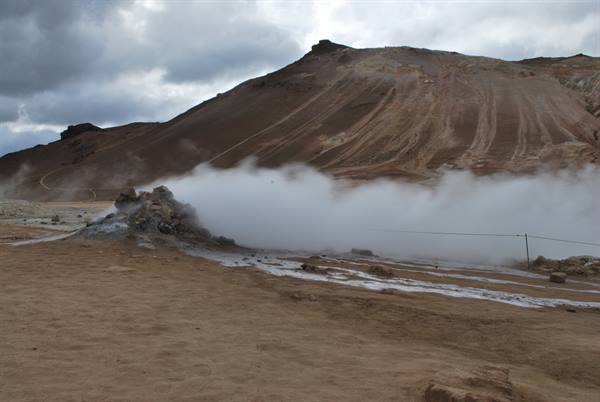
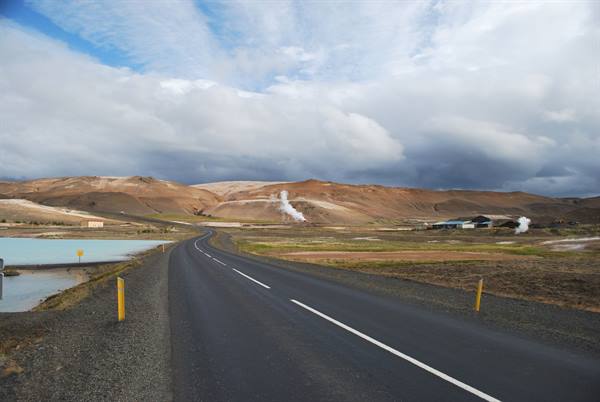
The slopes of Hverir
Day 88 Sep 2010
Again
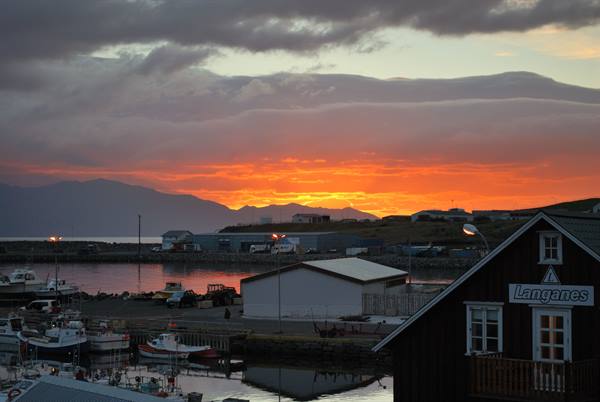
And here's the unwelcome surprise since the site mentioned a bathroom in the room...oh well, no problem because we immediately realise we're the only guests in the guesthouse. He asks us what time we want breakfast and we tell him we'd like it no later than 8, then the guy makes sure to give us some advice on places to have dinner and we say goodbye. The evening is still very bright due to the latitude and it's 8 pm and there's still a lot of light, the sun will set spectacularly behind the rock ridge around 9.45 pm with an intense red that gives us good hope (red sky at night, shepherd's delight, who knows if it holds in Iceland too!). For dinner there are several little fish restaurants but a small bar catches our eye, it's on a terrace over the harbour next to the whale watching tour operator called Gentle Giants.
This place is run by the same guys and we get something to drink on the outdoor terrace (incredible but it's not that cold). We soon discover that they also serve food and between indecision and tiredness we decide to stay there also because the owner shows us a big polystyrene box full of ice with very fresh fish! He lights the gas barbecue and starts cooking. Other guests arrive, a group of Germans, a couple of Italians and two couples of English. We settle though under the heated mobile veranda with gas mushrooms and we're really comfortable. We get two mixed fish grills, with turbot, cod and halibut with a side of potatoes and salad. We drink beer and spend 9,900 ISK, really well spent, the food was excellent and very fresh.
When we ask for brenne vin instead of coffee to digest, the girl who had served us brings the big boss who brings us a clandestine bottle with some homemade brenne vin (!) and of course he offers it to us, congratulating us on the choice (tourists, he tells us, only ask for Scotch whisky!). We make friends and discover that the waitress is Spanish and the guy's wife is from Peru and she also works in the little bar-trattoria.
Incredible, it feels like we've been around the world in a few metres, among Germans and English, Italians, Spaniards and Peruvians and with a single Icelander! How wonderful travelling is! The evening is very pleasant but towards 11 tiredness takes over and so we go to sleep because tomorrow the whales await us! On the way to the guesthouse we also notice the presence of a rather strange and bizarre museum: it's the Hið Íslenzka reðasafn, that is, the Icelandic museum of the...phallus! I swear it's really like that! It's a museum that houses a collection of animal phalluses of every shape and size and there are over 180 of them. It seems there are already 4 donors for the only missing specimen: the human one!. Crazy, goodnight
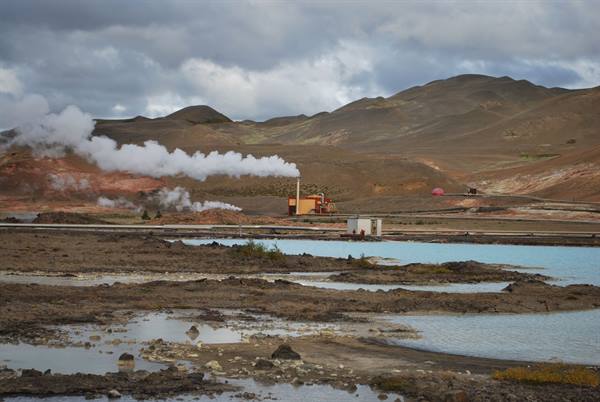
Area of lake Mývatn
Day 99 Sep 2010
Húsavík – Reykholt – km 425
Here we are. At 7.30 we get up, up and down the stairs for the bathroom and shower and then we're ready. We go to the dining room but there's no one in sight. 8.00...8.10...8.20 no one...the house seems abandoned! Incredible, what do we do? I ring the bell that's in front of a door with "staff only" written on it, a tremendous sound echoes through the whole house and suddenly from the door next to the staff one the guy comes out breathless...apologising and running to the kitchen...HE HADN'T WOKEN UP! Standing ovation for the halfwit of Húsavík!! He quickly prepares a slapdash breakfast with no rhyme or reason, sweet and savoury to the max...to make amends he brings out jars of improbable pâtés and curious homemade jams with incomprehensible handwritten labels.
Well, but we're in a big hurry and so we eat a few little things and a couple of toasts and then, after paying and saying goodbye to sleepyhead, we go to the harbour. As I said there are two tour operators: Gentle Giants and Húsavík Whale Watching. The first, blue, leaves at 9.45 and costs €47 each and the second leaves at 10.00, is yellow and costs two euros more. The tour is the same, the boats are the same. We went to the first not because of the 2 € but because we had contacted them online and they had replied immediately and then because of the dinner the night before. I'm rather worried about the sea conditions which they on the boat of course play down (I suffer quite a bit from seasickness). The weather seems decent, it's not raining but around us it's rather black and there isn't even much wind.
The boats are wooden and rather classic Norwegian fisherman style, obviously all open. They advise us to wear the warmest clothes we have because at sea it will be rather cold and then they make thermal and waterproof suits available to customers in case the weather turns bad. Of course they're suits that are worn over your own clothes and are made precisely with this aim thanks to complete side openings with big zips. Rather nervous I take a preventive travelgum and off we go.
The trip, which lasts about 3 hours, is always done inside the fjord, the sea seems calm but in reality even when it seems flat there's the long ocean swell coming in from outside towards the inside of the fjord, so there's a nice rocking...moreover on the boat you can move anywhere even on the high tower used as an lookout point, something I absolutely don't recommend to anyone who gets seasick because from there it's impossible to hold out. In any case the travelgum does its job and I don't feel sick at all and this means the trip becomes interesting for me too. The captain is at the helm and the guide climbs up on the crow's nest to spot the whales and direct the boat's captain.
Moreover the guide has a microphone through which she explains in comprehensible and simple English the area, the wildlife, how to look for whales and the types of cetaceans that can be found in the Húsavík fjord depending on the time of year. All very interesting and right after 10 minutes we see our first minke whale... mink whale in English. She tells us they're about 10 metres long and continuing the tour we see about ten of them, a couple of times very close to the bow of the boat. It's great fun chasing them and hoping it might leap out of the water...the birds that land on the water are indicators of their presence and everything flies by amid excitement, fun and interest. The cold is indeed intense because of the wind that funnels into the fjord and we put on both gloves and hat.
On the way back a cup of hot chocolate and an Icelandic treat (like a frappe) are offered to warm and refresh people. Was it worth it? I don't know what to tell you, maybe, as someone said, paying €47 to see the back of a fish is too much but I must say the trip was interesting anyway. Right in the middle of the return it starts raining heavily and I imagine those who chose to go in the afternoon at 13.45, there's a second shift because spending 3 hours of heavy rain outdoors in the middle of the sea isn't exactly the best thing in life. Once we get off, we go again to the bar with the terrace over the harbour to eat a couple of sandwiches and drink a hot tea because we're really chilled. At 13.30 after saying goodbye to our Latin American friends from the bar, we set off south, the road ahead is really long because this is the longest leg, the one approaching the capital and the return.
We have to reach the Fosshotel in Reykholt which is 425 km from Húsavík. Golf with a full tank and off we go, retracing the 45 kilometres of route 85 and then taking route 1 west and then south. Maximum speed 100 km/h and we go straight on. The landscape is rather monotonous and uninteresting, we had certainly planned well also by reading the accounts of other people's trips and also the Lonely Planet which indeed highlighted the scarcity of attractions on this side of the island. Desolate moors, sheep and rams, hardly anyone on the road and your eye closing now and then from boredom...we stop a couple of times for a coffee...the absolute nothing on the road where we also come across a police chase that caught a careless tourist speeding.
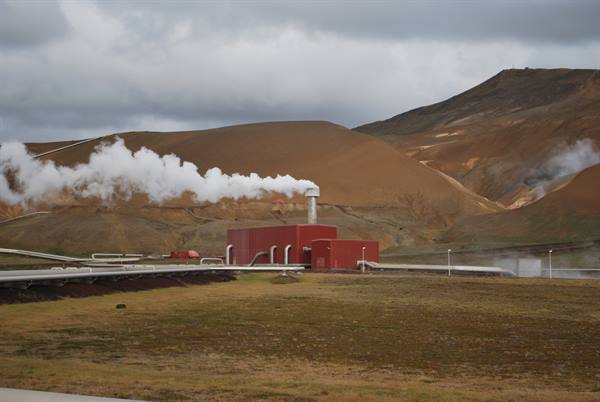
We arrive near Reykholt and make a short stop at Deildartunguhver, the largest hot water spring in Europe which emits 180 litres of boiling water every second. Incredible the force of nature that can be seen at this site, the water gushes out under pressure and all around is a swarm of pipes that trap this heat to give relief and energy to this area, as far as Borgarnes and Akranes 64 km from the spring. We arrive in Reykholt around 20.30; this is a particular place because it's one of the most important medieval settlements in Iceland and it's really hard to imagine it crowded with thousands of people since today there are 4 houses and a recently built church (1996). The Fosshotel Reykholt that we booked online for €75 (for a double with breakfast instead of the €190 requested on site, and this confirms the need to book in advance to avoid the gouging) is the only hotel in the area.
A rather anonymous structure, extensively renovated recently with outdoor thermal pools available to guests. We eat at the hotel restaurant for 9,380 ISK where we have a fish dish and a lamb dish worthy of applause, plus a dessert and a starter shared between two with a beer and two brenne vin to finish. We're really exhausted, we take a walk in the pseudo village of Reykholt and then, truly worn out, we go to bed. Tomorrow is the last day on Icelandic soil and there are still so many things to see...moreover an unexpected event awaits us which, as in the best traditions, is always there lurking to strike when you least expect it!
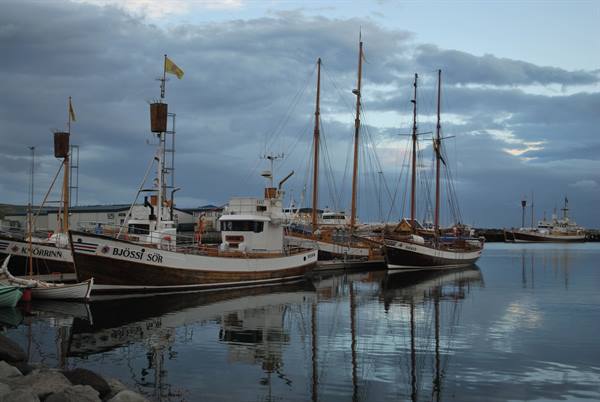
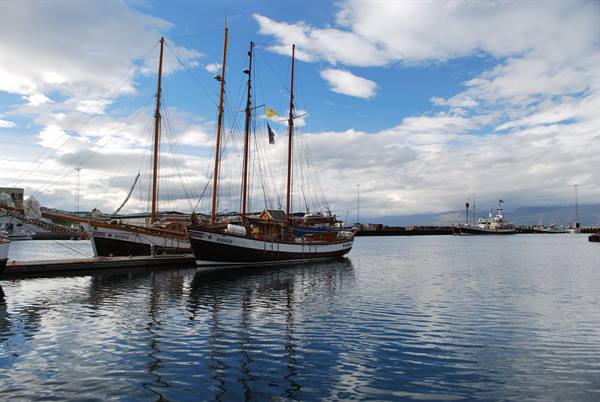
Húsavík
Day 1010 Sep 2010
Reykholt – Keflavik – Km 298
Breakfast: the best since we've been in Iceland; a truly rich buffet, a great availability of everything. Really well done, worth the €75 spent on the hotel. The room is also very large, one of the largest, with a small sofa, double bed, ample spaces and a huge bathroom with a thermal bath available! Excellent hotel, if it weren't in a place forgotten by God it could even be a nice holiday resort. We take two photos of what could be the village of Reykholt and then we go again on route 519 inland to see the Barnafoss waterfalls, imposing and famous for a tragedy: two children died in this waterfall on Christmas Day many years ago, trying to walk on a rock arch. The mother of the young victims asked for and obtained the destruction of the rock arch and the waterfall was called Barnafoss, that is, the children's waterfall.
At this point we're at a crossroads facing an important decision: turn back on route 1 but redo 50 km on route 519 from scratch, or take route 550 which cuts south to the Pingvellir park from where we'd then head towards Reykjavík and from there to the Blue Lagoon. Route 550 turns out to be a dirt road and we're undecided but both on the map and on the local road signs it's not named as F. we decide to go, it's 30 km and it seems doable; the road is dirt and apart from a few little stones the first 7-8 km are passable at a speed of 60 an hour. The signs indicate a maximum speed of 80 an hour which reassures me. The road points straight towards the Porisjokull glacier which opens up before us with its power and magnificence. The road starts to become rather rough with more frequent stones and we realise that it's necessary to reduce our speed considerably, we shift down to 40 km/h.
then after a couple of km the situation worsens irreparably, becoming a real off-road track for 4x4s. We realise we've covered about 12 km of the 30 planned and we go on very slowly, first and second gear trying to avoid fords, potholes and big stones that could cause serious damage to our Golf. Of course we don't meet anyone! We go on, at several points I have to stop to understand whether the potholes full of water ahead of us were deep or not, full of stones or not.
We do 10 km in an hour and it becomes arduous to think of doing another 10 in another hour...to save time in the end we're taking twice as long...what wimps we are! We come across a car, a 4x4, whose driver looks at us baffled but we look at him too as if to say "why on earth don't you signpost these roads!" in the end in about 2.5 hours we do our 30 km and reach route 52 which is dirt but packed earth and obviously it can't scare us or bother us! We go like arrows, by now we're at home. Taking route 52 we also see the famous fault line that separates the North American continent from the European one, impressive...it widens by 2 mm every year...crazy.
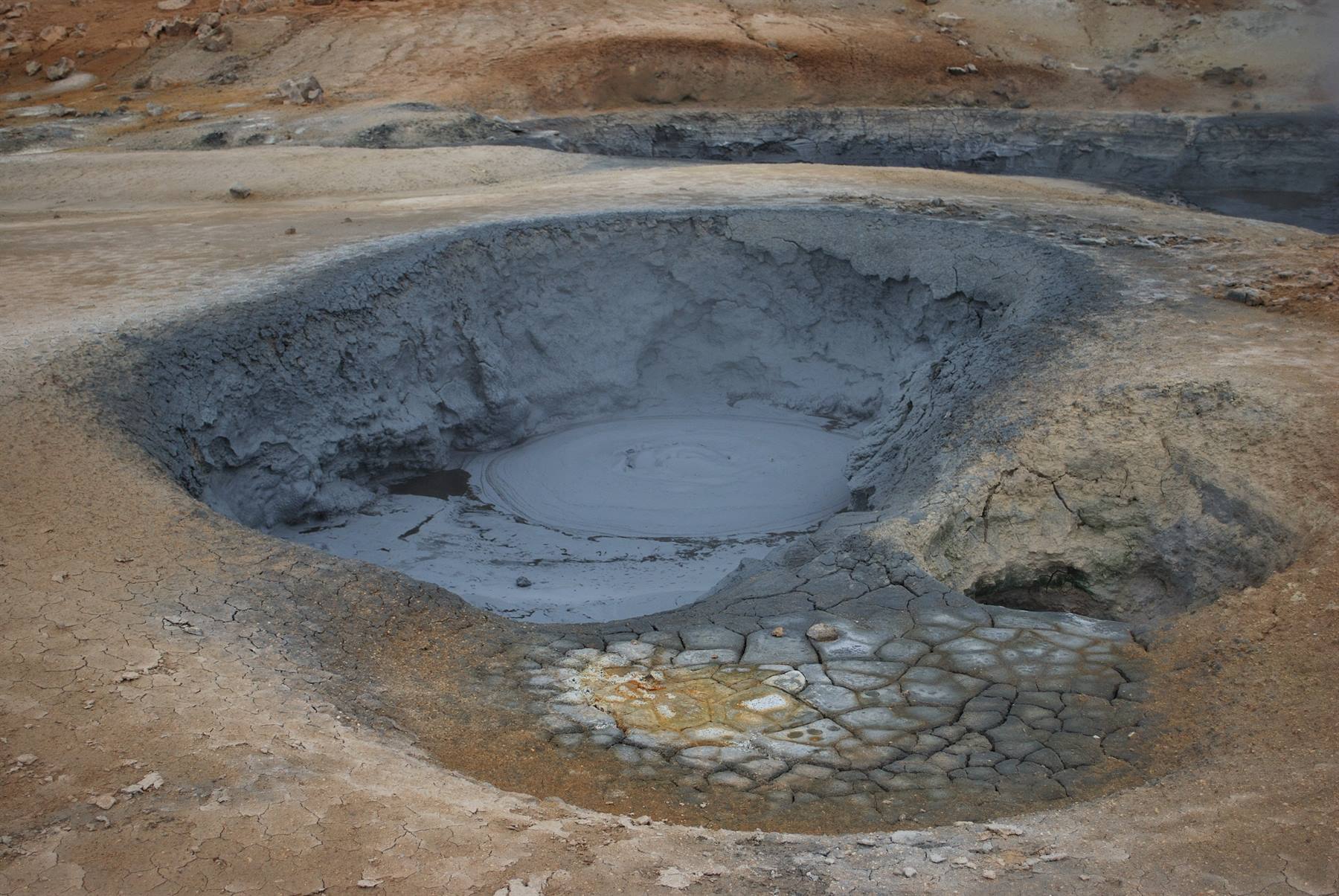
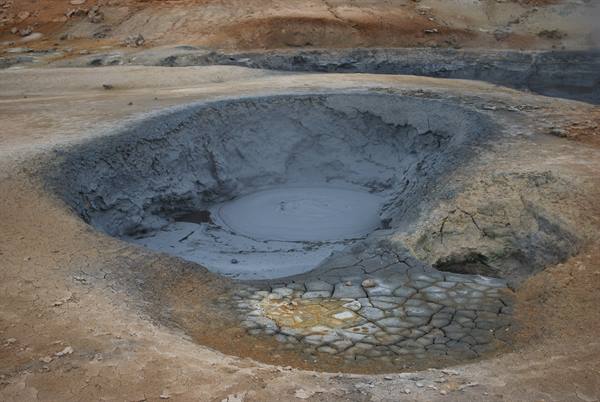
From route 52 to route 36 is a short step then route 1 via route 42 south, into the Reykjanes peninsula and then we turn west onto route 427 heading for Grindavik but first we stop at the Seltun geothermal area, it's an incredible multicoloured area where the steaming earth contrasts with the smell of sulphur and the bubbling mud pools. Route 427 that leads to Grindavik runs along the cliff and is a rather bumpy dirt road, not exactly easy to drive (but nothing compared to route 550). The views of the sea are very interesting, especially beautiful is the view of the endless lava fields that lie between the mountains and the sea. In Grindavik we take a short break to eat a sandwich at a service station and a stone's throw away we're at the Blue Lagoon, that is, the Blue Lagoon (Bláa lónið in Icelandic).
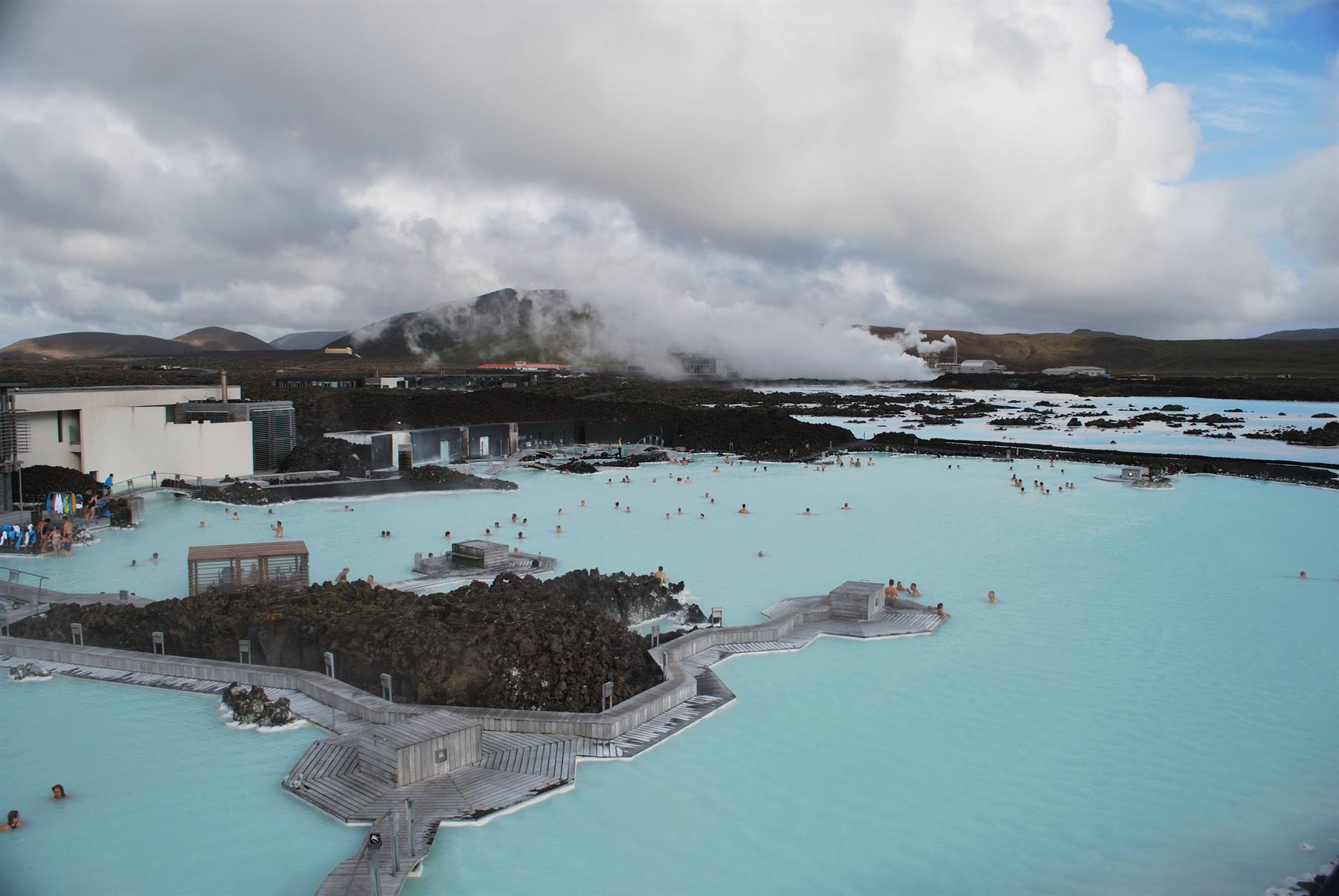
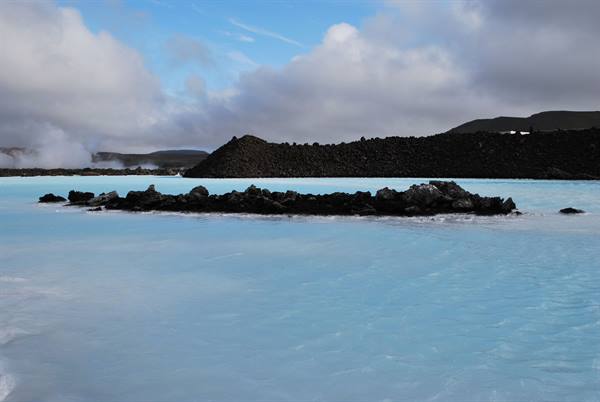
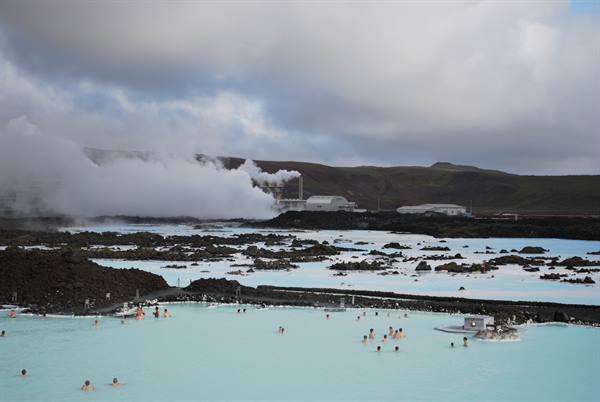
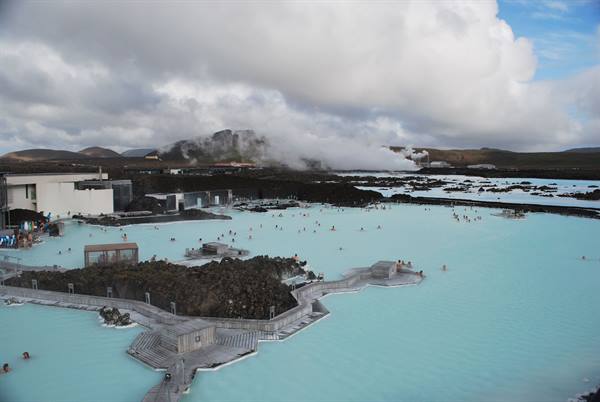
It's certainly the most important attraction in Iceland and is probably the most visited place on the island. It's not a natural lagoon but a designed one and it has thermal pools, wooden walkways, a hot waterfall and two steam rooms and a stone sauna (the steam rooms are closed for renovation). The water is seawater and is heated by the geothermal springs of the area; the water takes on a blue-green colour due to the algae present in the water itself and is rich in mineral salts and a thin layer of silica that tones and exfoliates the skin. The average water temperature is 38°C and since the outside temperature is much colder, big clouds of steam rise from the pools making the atmosphere truly surreal, almost infernal.
In the lagoon there's a restaurant (not even too expensive), a bar and a souvenir shop and one for beauty products made with the muds and the water of the Lagoon (these very expensive!). entry costs €27 each and you can rent a towel for €5 or a bathrobe for €7 and for another €5 a swimsuit if you don't have one. At the entrance you're given a bracelet that you'll use to open and close your locker to store personal items and clothes. Once undressed and in your swimsuit, before entering the pools you have to shower but without your swimsuit and washing with soap, head included. This of course is done by each person in their own changing room (I mean indoors and men and women separate): be careful because they're not permissive about this and there's a person who checks and reprimands people who don't take off their swimsuit.
The water of the Lagoon in fact isn't treated and has a rather slow turnover and that's why they care (rightly) about hygiene conditions. then comes the bad part: that is, in swimsuits and wet you have to go outside to reach the Blue Lagoon, the stretch is short but you feel all 11 °C! The water instead is wonderful and we of course did the silica masks and spent a quarter of an hour under the hot waterfall for the neck and cervical spine and then a few minutes in the cave to do the sauna. In short, in the end we spent a couple of fun and fully relaxing hours trying to flush out the toxins of the kilometres accumulated in the past days. Inside the lagoon there's also a bar to get something to drink (rather expensive but I had no doubt) and you can pay with the bracelet which allows you a credit of 5,000 ISK that you'll pay on the way out.
Around 7 we're out and we head for our hotel which is near Keflavik airport, a forced choice given our departure for the 7.55 flight direct to Amsterdam. To get to Keflavik we take route 425 where we cross the bridge that unites the two continents near Gunnhuver, a place where there's a deep fault that separates the American plate from the European one and symbolically a bridge has been built over this rift. Afterwards we continue towards Keflavik but we take a short drive around the former American base which is north of Keflavik and then head for our hotel, Hotel Keflavik of course, which is about 5 km from the airport. The hotel is rather good both in terms of rooms and general impression although the price for a double with breakfast is €95, truly unreasonable both in terms of location and services.
The only real positive note is that it's equipped to offer breakfast very early at 5 in the morning and has a handy screen in the lobby connected to the airport where you can see the status of your flight (whether it's delayed or otherwise). For dinner we went to a place I recommend, Kaffi Duus, in a seafaring style which is of course near the port of Keflavik. A very particular atmosphere but fish grills, lobster and many other sea delicacies at pr
Reykholt
Day 1111 Sep 2010
departure
Just to tell you that Keflavik airport isn't very big but is certainly rather disorganised. All the check-in desks are dedicated to all flights and the queue is a single one (!). Be careful because in the main hall there are numerous self check-in machines and the Icelandair hostesses will help you check in by yourself. Don't do like almost all the other passengers who after checking in at the machines and with their baggage tags in hand, instead of going to the drop-off desks, go and queue again for normal check-in!!! Also because the queue will be completely useless since the baggage must necessarily be left at the drop-off desks which are on the left side of the check-in desks. I insist, I saw hundreds of them pointlessly queueing twice. For this reason, show up with a good two hours before your flight or you risk missing it due to the long wait.









1 reader comments
Complimenti, che bel viaggio! Il tuo reportage, tra foto e diario di bordo, mi ha fatto venire voglia di partire! :-)