The choice to go to Budapest was, in some ways, a coincidence. I saw a few photos in a magazine and immediately suggested to Roberta that we go. Choosing when to make the trip was a touch harder, because we had to make work commitments and everything else coincide. In the end we decided to treat ourselves to Budapest as a birthday gift. A gift a few days early for me and a few days late for Roberta. Budapest is the capital of Hungary. The hills of Buda and the Obuda area stretch along the left bank of the Danube, while the Pest plain occupies the right side of the river. Budapest was founded in 1873 and, as the name makes easy to deduce, was born from the merging of three distinct cities: Buda, Obuda and Pest.
From a historical point of view, without going too far back, one has to admit that Budapest and Hungary itself paid a very high price for allying first with Austria and then with Nazi Germany. After the defeats in both wars, in fact, the country lost much of its territory and, following the Yalta agreements, found itself part of the Soviet sphere of influence in Europe. Only in 1989, with the fall of communism, was the country able to regain its sovereignty. Since 2004 Hungary has been a member of the European Union. Budapest is also one of the largest spa cities in Europe. There are indeed numerous natural hot springs with various therapeutic properties. It was the Turks who first made the most of these springs, although they were already known in Roman times. Today you can choose from a wide range of pools and facilities. We'll choose too…..
Sometimes Budapest is described as the Paris of Central Europe. Well… we only stayed 4 days but it was enough to make us fall in love with this splendid city. A little less with the Hungarians: we didn't find them very likeable.
Finally, Roberta is the ideal travel companion, we have the same ideas, we're fairly in tune on what to see and then she likes walking… as far as we can we love exploring cities on foot, limiting the use of public transport to only where strictly necessary.
Day 116 Feb 2007
We leave on a Friday morning from Turin with a bus that takes us directly to Malpensa (23 € round trip). And so almost immediately I remember why I don't like leaving from Malpensa but prefer Caselle… You never get there! The bus speeds along the highway but meanwhile, between leaving Turin and reaching Malpensa by taking the scenic tour of the Novara area, more than two hours have passed. At the airport we calmly check in and on time, Alitalia boards our flight. By the time we arrive in Budapest the sun has already set. It's just past 5 but it's already night. We pick up our luggage, get some cash from the ATM and go buy tickets for the bus and metro that will take us downtown. We start off on the right foot, we ask for four bus tickets, the woman with a bored manner hands us what we asked for and tells us the price to pay. We hand her the money and she gives us the change.. wrong.
We point out the mistake and with an innocent manner she admits she forgot to give us all the change. Ha ha ha… we had read on an internet forum to always check the change because often and gladly they make mistakes… apparently they don't teach arithmetic very well in elementary school!! Ha ha ha So we take our bus (bus 200 – 230HUF) and having arrived at the terminus, a suburban station that has seen better days, we take the metro (M3 – blue line – 230HUF). We chose to stay fairly centrally in Budapest so we picked the Marco Polo hostel. The place is clean, well maintained and seems fairly quiet to us too. We booked a double room with a private bathroom. To greet us at reception was a girl who does this job for the paycheck and not out of passion, judging by the enthusiasm and kindness she shows in everything she does and says.
We pay the room bill, strictly in cash, they don't accept credit cards (6,500 Hungarian forints per night per person including breakfast – Marco Polo Hostel – 1072 Budapest, Nyàr utca 6 – She hands us the room keys, explains the breakfast times and asks for a 5 euro deposit for the key. We ask her if we need anything else or if that's all and she says yes, handing us the invoice for the nights and telling us to keep it. Quality and courtesy is certainly not the motto of this place… as we will discover in the days to come, you can say anything except that the people at reception shine when it comes to kindness and friendliness.
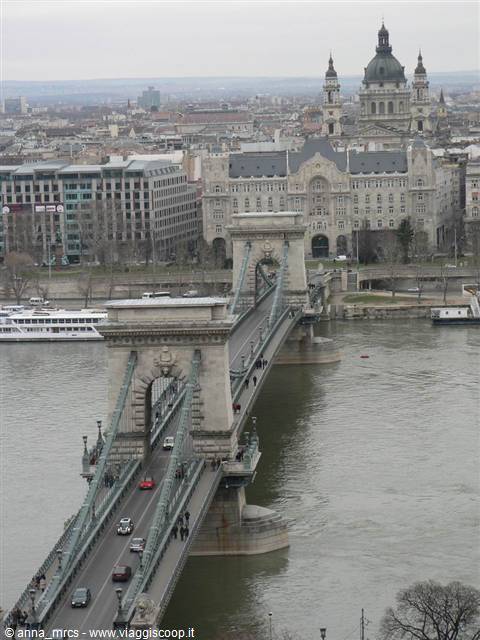
After putting our things away we go out for dinner. We pass by the Great Synagogue which we'll visit in the coming days and go to eat at a place not far away. After dinner we take a stroll around the city, we reach the Chain Bridge. The citadel and the castle lit up dominate the scene. There aren't many people around and now and then a few raindrops make an appearance. So we head back to our room, our first evening in the city comes to an end.
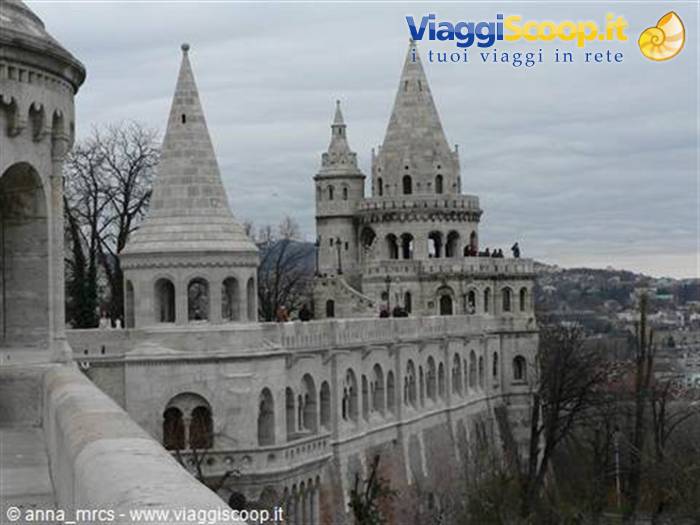
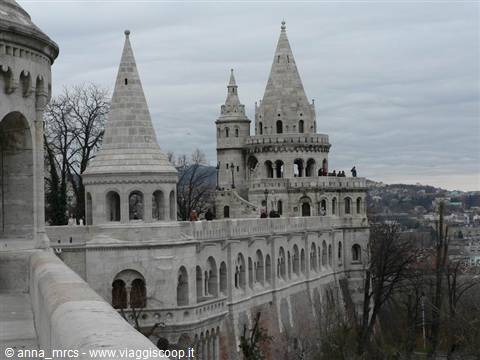
Fishermen's Bastion
Day 217 Feb 2007
The breakfast room is a bit of a disappointment. It's none other than the pub below the hostel. The table with the breakfast buffet is already set but, all around, in the venue, cleaning is being done. We look for a corner where, besides not getting in the way, we can also sit since many chairs are stacked up waiting for the floor to be washed. We start our visit from Obuda, so we take Muzeum krt. passing by the Magyar Nemzeti Galeria and the Calvinist temple and then arrive at the Great Market Hall: it's the largest covered market in the city. In front of us the Liberty Bridge. The bridge was built between 1894 and 1899. On the other side of the bridge we find the Gellèrt hotel with the thermal complex of the same name.
This complex, built at the foot of Gellèrt hill, from which it also takes its name, dates back to the beginning of the last century (1912-1918) and is one of the oldest thermal complexes in the city. After leaving the Gellèrt hotel we head toward the Cave Church. It's on the south side of Gellèrt Hill. It was built in 1926 on the model of the Lourdes sanctuary by order of the Pauline monks. After some tribulations in August 1989 the church and the monastery were reopened. At the entrance of the church there's a statue of St. Stephen. It's a small, intimate, particular environment. Very beautiful. After leaving the small Cave Church we follow the various paths on this side of Gellèrt hill, and arrive at its summit (140 m above sea level). At the top of Gellèrt hill is the Liberation monument. From a panoramic point of view: it commands the whole city.
The view is very beautiful, too bad about the somewhat sickly sun and the gray sky. This monument was erected to commemorate the liberation of Budapest in 1945 by the Russian army. From a historical point of view, the arrival of the Russians in Budapest certainly meant liberation but also the beginning of Soviet domination. We resume our way toward the citadel, we descend from Gellèrt hill passing near the Statue of St. Gellèrt. This monument is illuminated at night and is particularly evocative but now, partly because of the bare branches of the trees, partly because of the slight decay of this area of the hill, it doesn't make much of an impression on us. It's said that in this exact spot, where the monument was erected, Bishop Gellèrt was murdered in the 11th century.
It's said that he was thrown, sealed in a barrel, into the Danube, by a group of citizens who didn't appreciate the adoption of Christianity as the state religion. The Elizabeth Bridge, which we don't cross because we continue toward the Royal Palace, was originally built in 1897-1903. In 1945 it was destroyed, like much of the city, to then be rebuilt in the form in which we can admire it now. The Royal Palace is rich in history; in more recent times, so to speak, the Habsburgs built their residence here. Passing through the Lion Gate, guarded by 4 lion statues dating back to 1901, we arrive in the rear courtyard of the Royal Palace where the Màtyàs fountain stands, designed in 1904 and representing King Matthias Corvinus. King Màtyàs was an important Renaissance king, whose figure is rich in anecdotes and legends.
The monument, the fountain, represent a hunting scene in which it's said the king met a beautiful, and imagine if she was ugly, young peasant girl who fell in love with him. How the love story ends is unknown. What is known though is that if you toss a coin into the fountain you ensure you'll return to Budapest another time. We then move to the main courtyard, from which you get an excellent view of the city, to go visit the Hungarian National Gallery, admission is free, it was inaugurated in 1957 and houses a rich collection of Hungarian art from the Middle Ages to the 20th century. Around the gate built in 1903 to enter the Royal Palace through the Habsburg Stairs there are so many people that it feels like being in an anthill. For the lazy ones there's a cable car that brings you, from the foot of the Chain Bridge up here.
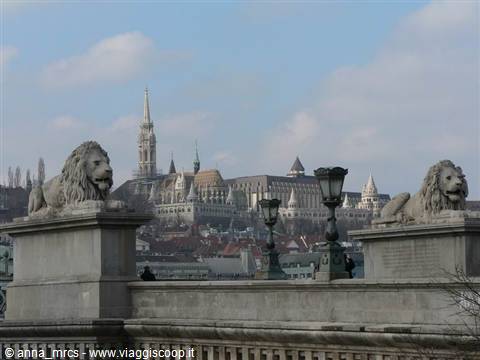
And finally here's the old town of Buda or also the Castle area: it's very pleasant to stroll through these little streets. In front of us the Màtyàs Church and a few steps away the Fisherman's Bastion. The Màtyàs church (admission 650 HUF) was built between the 18th and 15th century. Some parts even date back to the reign of Sigismund of Luxembourg (what a name!). The church anyway takes its name from King Màtyàs who was the one who enlarged and enriched it. During the Turkish domination it was turned into a mosque. It was destroyed and rebuilt several times. Its stained glass windows and its pulpit are very beautiful. After finishing the visit to the church we move to the Fisherman's Bastion. From this monument you get a beautiful view of the city and the Danube. This particular construction dates back to 1895 and arose in the square where, in medieval times, fish was sold.
In fact I was a bit unclear on the meaning of the name! We walk along Fortune street, pass in front of the tower of the Church of Mary Magdalene, or what remains of the church that was razed to the ground during the Second World War. Leaving the remains of the church behind us we head down Lords' street. There are some very beautiful houses; aristocrats and merchants lived on this street. Roberta and I are, however, interested in the ancient Castle Labyrinth. If in prehistoric times the caves meant a place of refuge and hunting territory, in more recent times they were first the castle's cellars, then connected with a system of underground corridors they served as a refuge for ten thousand soldiers. Admission costs 1500 HUF, they provide a small map and an explanatory booklet. They're poorly lit and the background music creates a considerable atmosphere.
Evocative, very evocative as a visit. Lastly the labyrinth of courage.. what is it.. well.. a heavy iron door allows you to enter this labyrinth.. completely immersed in darkness. Before entering, an explanatory panel tells the legend and the magic of this part of the labyrinth and what, if you have the courage to face it, you'll be able to see. Who knows what there will be beyond that door beyond that darkness…. Who knows… We go down toward the Danube, pass in front of the Calvinist church. the guide calls it unusual.. We agree. Strolling along the Danube we reach St. Anne's Church. It's a Baroque style church. Initially it was a Jesuit church. It was begun in 1740 and finished by Màtyàs, but the earthquake of 1763 and the subsequent dissolution of the Jesuit order prevented its completion and the church remained deconsecrated until 1805.
We continue strolling along the Danube, in front of us the parliament, further away Margaret Island, which we won't visit unless we have time left. Margaret Island is in the middle of the Danube: it was a place of religious retreat and contemplation, it was opened to the public in 1869 and is one of the most beautiful parks in the city where people stroll immersed in nature far from traffic. On the island, there's a thermal bath complex whose springs come directly from the island. Strolling along the Danube we reach the Rudas baths. It's a very ancient complex, the central pool of these baths is topped by an Ottoman dome. We conclude the day strolling along Vaci street.
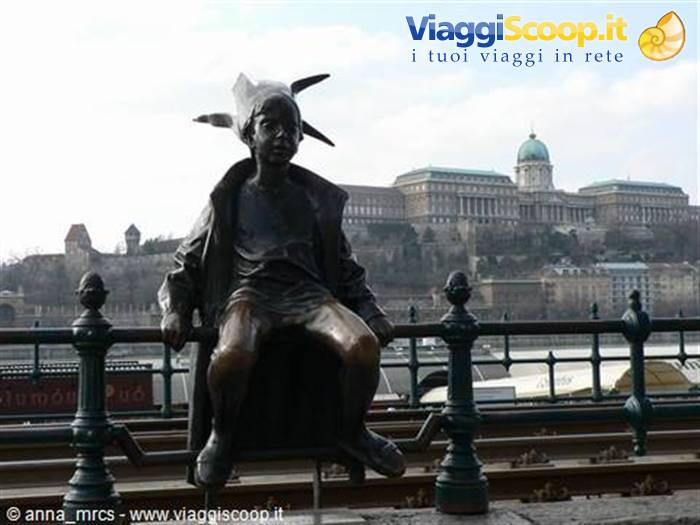
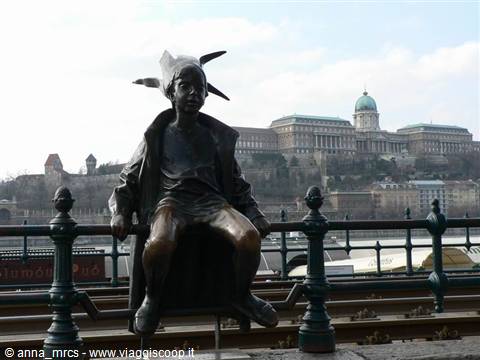
The Little Princess
Day 318 Feb 2007
Breakfast, same story as the day before, except that there are still some customers from the evening and in these pubs you can smoke… unpleasant inconvenience. Our plan is to start the day with a visit to the Vàrosliget area. This is the city park, once a marshy area used for royal hunting. We walk along a series of beautiful streets full of shops and venues (Krt. Erzsèbert) to reach the famous Andràssy avenue. It's a very beautiful and very long street. As we go toward Heroes' Square the street loses its commercial appearance to become a residential street, some embassies are located along this avenue, which is a whole succession of splendid buildings. Heroes' Square, where tourists have arrived by bus, is teeming with people. It was in this square that in 1896 the celebrations for the millennium were opened. In fact in the square there's the Millennium Monument.
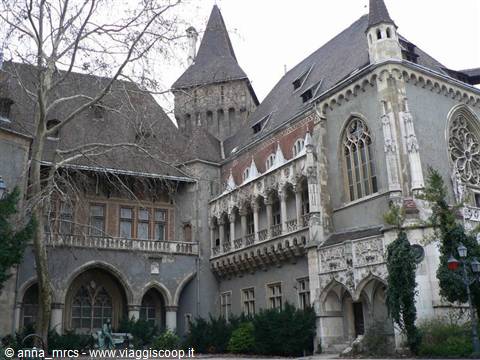
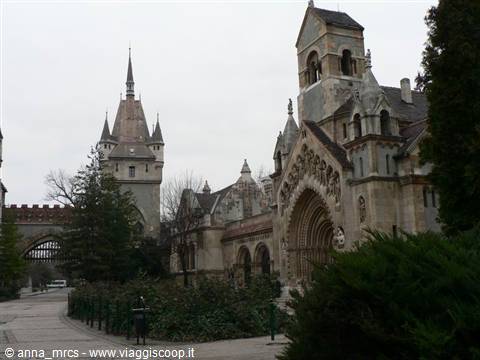
Its colonnade depicts statues of illustrious Hungarians. The Museum of Fine Arts and the Art Gallery overlook the enormous square. Part of the lake is dry and in its place a nice ice skating rink while in the remaining part several ducklings swim calmly in the warm thermal waters. We go into the park and go see Vajdahunyad Castle. There's no one, except a black cat walking around. Despite the name it's not a castle but a collection of buildings of different styles designed for the celebration of the Millennium of 1896. Among other things, part of the complex is the chapel of Jàk which faithfully reproduces the portal of a Benedictine chapel from 1914 located near the border with Austria in the area of the same name, Jàk. The door is closed so we can't enter, nor can we access the nearby monastic cloister.
After that we go peek at the Szèchenyi baths, according to the guide they are the deepest and hottest in Budapest, and their waters are distinguished by their therapeutic properties. At the main entrance there's the statue of the one to whom the baths are owed, a certain Vilmos Zsigmond who in fact found the hot water while digging a well in 1879. If he was hoping for some cool water he really had bad luck! Meanwhile we head back toward the center… we need to get to the Parliament area. We walk along Podmaniczky street, which you certainly can't call a tourist street. It runs alongside the railway and there's also a hospital.. our judgment, of the facility, obviously seen from the outside, is anything but positive. We pass in front of the Nyugati railway station. It has a very interesting facade, not by chance it was designed by Eiffel, yes him, the one of the Eiffel Tower in Paris.
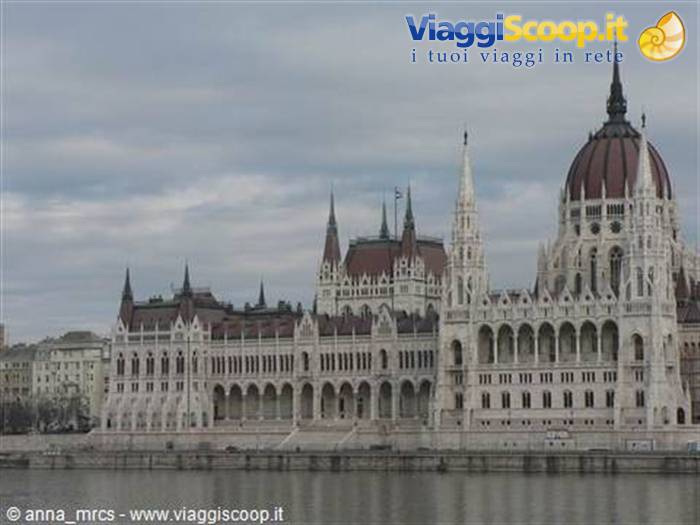
Little by little we head toward the Parliament. It's Sunday but this area is practically deserted. The Parliament is all cordoned off. We figure out where the entrance is because it's the only point where a small group of people is standing still, but there's nothing to suggest it's an entrance. Before our arrival we had contacted the local information office to find out the terms of the visit. They had given us the times, including visit times in Italian and the cost, free for EU residents. Too bad this information isn't correct. To visit the Parliament, one of the guards at the entrance explains to us, you need to call a certain number and book the visit at least two days in advance. Nice and how are we supposed to do that since we're leaving tomorrow? The Parliament is the symbol of democracy in Hungary, even though, during the communist era the red star was placed on top of its dome.
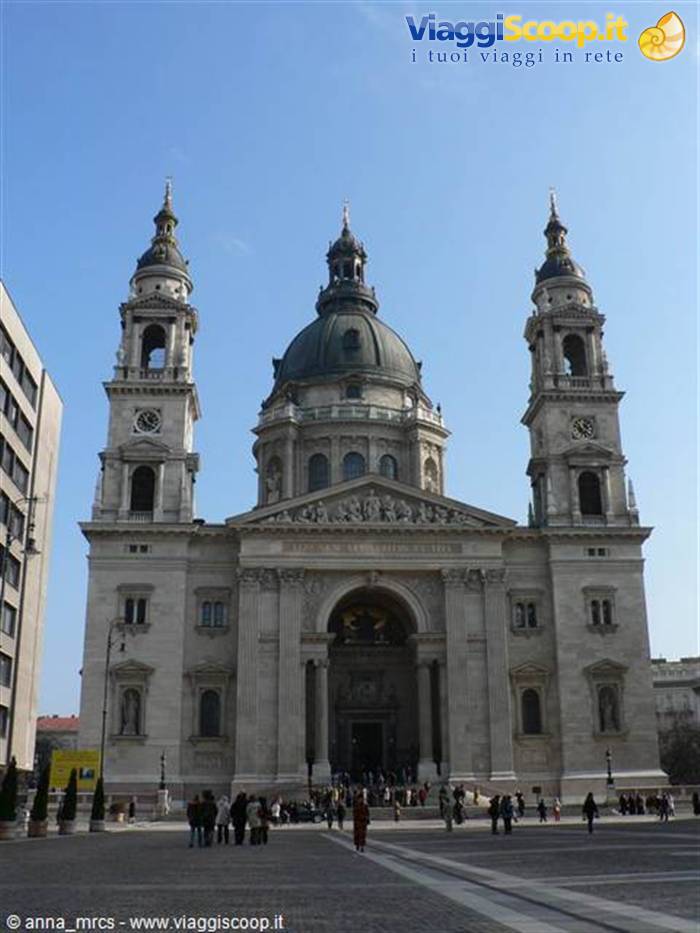
The Parliament Building is the largest building in the whole country. It was built between 1884 and 1902. It's made up of 691 rooms and inside it are kept the royal crown, the orb and the scepter! It's certainly a real shame not to be able to visit it, the photos in the guide are spectacular and it was one of our goals. Well.. it's not over yet.. as we leave Kossuth square we plan to make a quick stop at the local information office to see if we can book the visit for the next day. Besides the Parliament, on this grand square, overlook the Ministry of Agriculture and the Ethnographic Museum. There aren't many people around and we quickly head toward St. Stephen's Basilica. As the name says, it's dedicated to St. Stephen who was the first Christian Hungarian king. Its construction began in 1851. For 300 HUF we visit what we can call the treasures of the church.
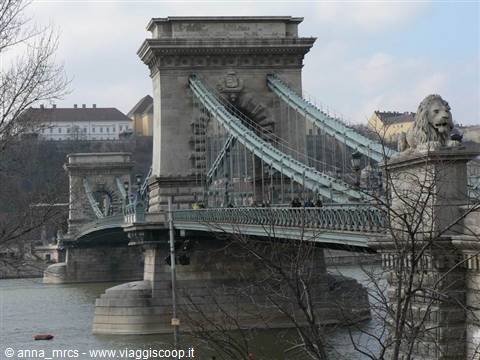
The Basilica is imposing and its interior is a testament to that. Leaving the Basilica behind us we head toward Roosevelt Square. Besides the beautiful Chain Bridge, the Hungarian Academy of Sciences and the Gresham Palace overlook this square. The Chain Bridge was built in 1839-1849 and was the first permanent bridge in Budapest. It was also destroyed during the Second World War and reopened in 1949. The bridge extends for a good 380 meters and is supported by two towers. Along the Danube we come across the statue of the Little Princess (1989). So cute! While we look for the information office we wander around downtown Pest. We walk along the crowded Vaci street. It's pleasant to stroll there now but it's more evocative in the evening even if it's not richly illuminated. We find the information office, the woman who receives us is again much more annoyed than willing to help us.
She dismisses the Parliament matter with a few words handing us a phone number to book the visit, reiterating the two days' notice. And after a stop in our room to get properly equipped.. off to the baths!!! Since the complex we chose isn't exactly a stone's throw away, this time we go by metro. The Szèchenyi baths have three entrances, and it costs 2200 HUF for two hours (each subsequent hour is 300 HUF), you can access the pools, the sauna and whatever else the complex offers. The changing rooms are in the basement and as we go down we meet several people in swimsuits and… we discover that the pools are outdoors. OUTDOORS.. in this cold! We've been wandering around all day looking like the Michelin man! Anyway we go down to the changing rooms and look for two free lockers. We take our towels and go upstairs to the pools. Wow… what fun..
the water temperature is around 32 degrees… a dream… There are also jets that act as hydro-massage. So much fun… If we look at the gray sky and think about all the cold we've endured all day it seems unbelievable to be in an outdoor pool. Roberta suggests going to try the sauna… it doesn't excite me but why not. So we gather all our courage and get out of the pool, cover the few meters that separate us from the sauna. There are showers and a tub with water at 16 degrees, definitely chilly. We go into the sauna. We last a little more than 5 minutes because the heat is truly suffocating. Before leaving the sauna area though Roberta convinces me to do a quick dip in the cold water tub. If nothing else when we go back outside we feel less cold. Since we still have time we make a quick dash into the third pool where the water temperature is 36 degrees.
The water is very hot and also has a particular smell. There are people playing chess. It's pleasant to soak.. there are lots of people, both Hungarians and tourists. We recognize some faces of tourists we've seen around the city.
St Stephen's Basilica
Day 419 Feb 2007
We leave the hostel but not before, first, arguing with the receptionist. It happens that when we hand her the room keys she doesn't want to give us back the 5 euro deposit we gave her a few days earlier, saying that we had lost the receipt her colleague had given us. No receipt no money… she says. Like hell, I say, if I hadn't given you the 5 euros your colleague wouldn't have given me the keys so.. I gave you the money so give it back! No luck! With a manner that's too calm and too perfect, so much so that her attitude seems to us a bit rehearsed, as does the whole heap of excuses she provides. Since we haven't lost any receipt, because it was never given to us, we try, first politely and then a bit less since I lose my patience because it's obvious she's ripping us off, to clarify this situation and get our money back. Let's say her snotty manner certainly didn't help..
So we gave her to understand that we weren't leaving without our 5 euros. Well.. we didn't think we'd manage to argue in English too. It's not so much about the 5 euros but more about the matter of principle behind it, the fact that it's quite evident she wants to rip us off, that bothers us more than losing the 5 euros. The fact is we were arguing when the elevator opens, out comes a couple of tourists of a certain age with their suitcases, clearly also leaving. The woman takes the 5 euro bill from the box and gives it to me with an annoyed manner telling us to leave. No sooner said than done.. lucky these tourists arrived and the situation was resolved… We're left wondering if she wanted to send us away to rip off the newcomers! Anyway this unpleasant incident, and the way this staff handled it, is certainly not good publicity for this place.
And damn!!! Even a fool could see that she wanted to skim off the top! Anyway.. this mishap cost us a good half hour, let's now try not to let this unpleasant incident, which also got me quite worked up, ruin the day!!! First thing we go for a stroll at the Great Market Hall. It's very beautiful, the most beautiful in the city, so they say. Its construction dates back to 1890 but in 1994 it was completely rebuilt. There are stalls with paprika, those with salami, fruit… It's a tangle of colors and smells. After leaving the market we go visit the Great Synagogue in the Jewish quarter. The first Jews arrived in Hungary in the 13th century settling in Buda and Obuda. Only in the 19th century did they also settle in Pest. In 1251 they were granted some privileges, including freedom of worship.
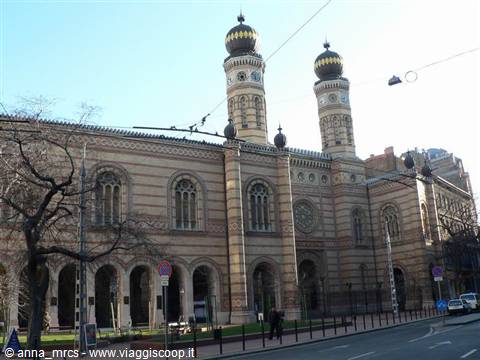
Everything went well until 1941 when, as a result of Hungary's alliance with Nazi Germany, some antisemitic Nazi laws were issued, including the obligation to wear the Star of David. A step toward one of the greatest crimes against Humanity! In 1945 the first ghetto was built in Pest and the deportation of thousands of people to concentration camps began. It wasn't until January 18, 1945 that the ghetto was liberated thanks to the Russian army. It's estimated that 600,000 Hungarian Jews were victims of the Holocaust. At the end of the 19th century, in this neighborhood, three synagogues were built and many shops were opened. The Great Synagogue (1400 HUF) is the largest in Europe and was built in Byzantine-Moorish style in 1854-1859. The checks at the entrance are meticulous, worthy of an international airport.
The interior of the Synagogue is spectacular, it has three naves and as Orthodox tradition requires, separate galleries for men and women. The interior and exterior of the building are very beautiful, it's worth the visit. Besides the Synagogue you can visit a museum where Jewish artifacts are gathered and a very evocative photo exhibit that through photos and text retraces the painful period of history linked to the Holocaust. Images of the people, of the destroyed city. They are images by a photographer whose name I don't remember, but they are very powerful images that speak for themselves that everyone should see and everyone should take in as something that must never happen again and yet.. the century has changed but history never changes… We continue our visit in front of the Holocaust Memorial. It's a sculpture representing a huge weeping willow.
It was inaugurated in 1991 and is the work of Imre Varga. We leave the Jewish quarter to head toward the center. We still have a few things to see: Liberty Square and the Opera House, they're not close but we still have some time on our hands. Liberty Square was built in 1886, destroying the barracks that had been built to house Austrian troops. On the north side of the square stands an obelisk commemorating the Red Army soldiers who lost their lives in the siege of Budapest in 1944 and 1945. Several buildings of particular interest overlook the square anyway, the Hungarian National Bank, the Old Stock Exchange both dating back to 1905, and the American Embassy, inside which Cardinal Mindszenty found refuge, an important figure of the Hungarian liberation movement that formed after the Second World War.
He lived, confined in this building for 15 years until in 1971 the Vatican convinced him to return to Hungary or rather to set foot outside this building. After leaving this square we head toward the Opera House, inaugurated in 1884 and built to compete with those of Paris, Vienna and Dresden. The time available to us is running short so we have to give up visiting the interior. So, even if reluctantly, we head home. We take the metro again and then the bus and here we are at the boarding gate waiting for our flight. Of course it couldn't be a simple return. The flight leaves late due to technical problems, would you believe it. We arrive in Milan with just over half an hour before the last bus to Turin departs. Obviously baggage claim is always something very eternal. That's also why I don't like Malpensa… The fact is we manage to catch the bus just in time.
For dinner we're left with two crackers taken on the plane.. and to think that if the plane had been on time we would have had time to eat at the airport calmly. We've almost reached the highway when a phone call from two passengers who had missed the bus, they had lingered at the airport, causes us a further delay. The driver agrees to wait for the passengers who would reach the bus by taxi. Roberta and I aren't very happy about this choice because we have a connection to catch in Turin, in fact, the rest of the trip was a fight with the clock. The driver did his best to arrive as soon as possible anyway, especially because to wait for those two, Roberta and I risked missing the last bus to get home. What an odyssey!! In the end we manage to catch the bus that takes us home. The trip is enlivened by a guy, a few rows behind us, who pesters a colleague by phone. In short..
the phone call enlivens the whole bus, and amid various chuckles we arrive at our destination. And so, between one delay and another we passed midnight on this day… when we finally get in the car, my husband greets me with a nice 'Happy Birthday'! And thanks to magnificent Budapest for giving us these fantastic days, hostel staff aside!





0 reader comments