Rome, Bari, boarding for Patras. From Patras, along the motorway, towards Corinth, a turn-off at Diakoto to Kalavryta, overnight in Klitoria; from there a pass through Tripoli towards Argos and Nafplio, overnight in that city; from there along the coast to Leonidio, then up through the mountains to Kosmas, and down through Geraki, Sikia to Monemvasia, where we stop for two days, continuing to Neapoli, Elafonisos where we stop for two days, then on to Gythio, overnight; then the Mani tour through Areopoli, Golimenas, Vathia, Marmari where we stop for two days, visiting Cape Tainaron and Porto Kagio. We set off again for Kotronas. Having closed the Mani loop, we follow the Messinian gulf to Kardamili, where we stay overnight. Through Kalamata, towards Koroni, where we stay overnight. Next stage through Methoni and Pylos, to Kyparissia. Overnight. Visit to Olympia, overnight in Katakolo.
Final stage with a stop at Kilini and boarding at Patras
Day 117 Aug 2007
August 2007 Around the Peloponnese with the Monster
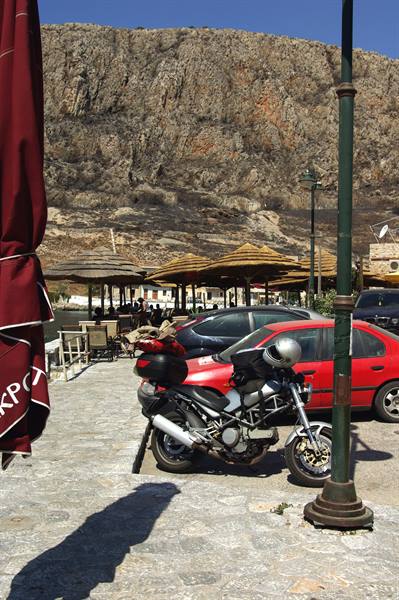
Once again, also for 2007, despite the years, Resi and I decide to tackle, for our holidays, with our motorcycle Monster the roads of Greece. We already know Greece, from previous holidays, by car, by motorcycle or by boat, but we had mainly covered the islands and the coasts facing them, now we want to travel the large island, which since the digging of the Corinth Canal has become the Peloponnese. The longest stages, 450 km, are the first and the last, racing on the highways that from Rome will take us to Bari and vice versa. We had been thinking about this holiday for some time, but due to a series of problems and commitments, we are grandparents of a large group of grandchildren, we were unable to plan dates and ways; the decision to leave by motorcycle we made almost suddenly.
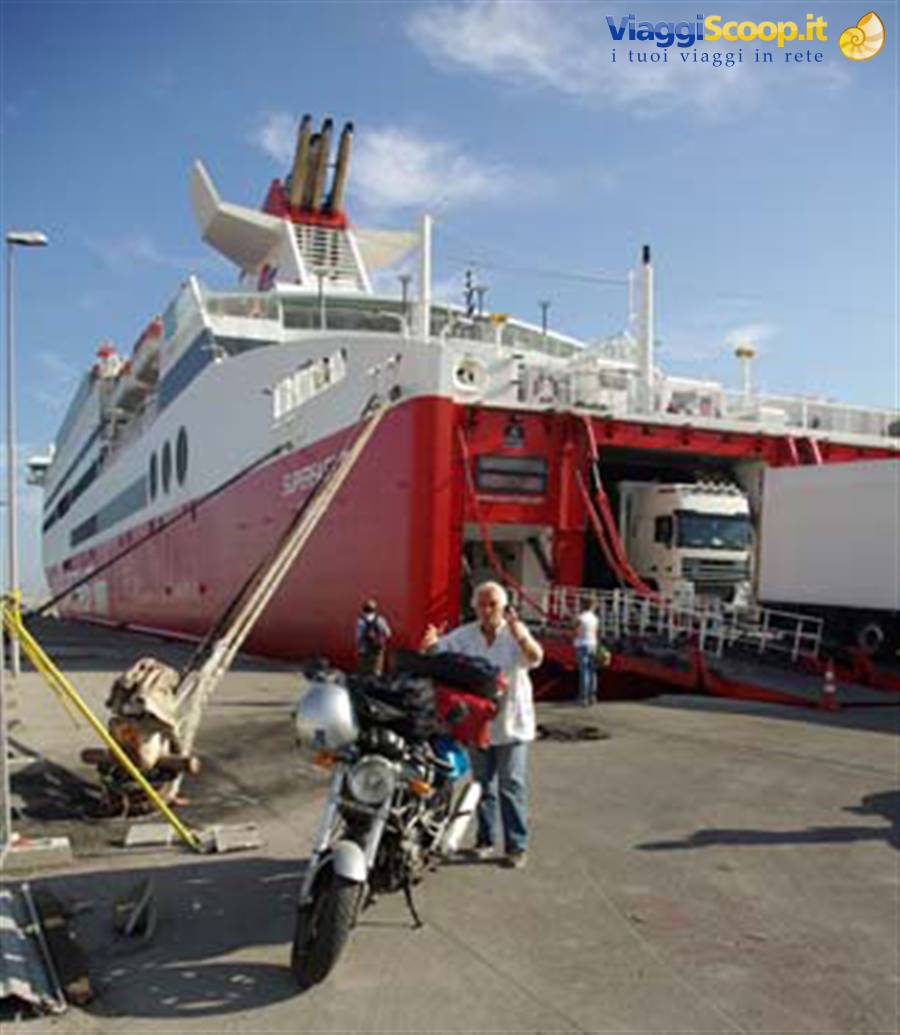
Friday 17 August We arrive at the port of Bari, without having booked the ferry, but for a motorcycle there is always a place in the hold, despite it being August, perhaps because of the date, for the superstitious, considered unlucky (17 and Friday), there are even two places in a cabin, we can sleep on comfortable bunks, which allows us to arrive rested to tackle the first stage on Hellenic soil. Saturday 18 August. We decide to start from the interior, visiting the much-praised Kalavrita. I have on the transparent of the tank bag an old rather inaccurate map that, erroneously, indicates the road to the planned destination starting from the northern outskirts of Patras, I head, therefore, reluctantly, toward the highway to Corinth. Reluctantly because that road, which I already know, is very busy.
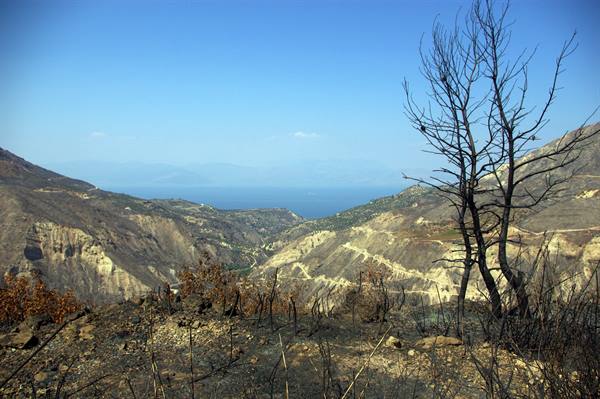
I notice the error too late, but I don't feel like going back, two other road routes starting from the coast of the Gulf of Corinth lead to Kalavrita, I miss the first, I intercept the second which starts from Diakofto, known among other things for the railway that through a suggestive route connects it to Kalavrita. Having left behind the nightmare of the highway, we climb up a pleasant excellent road with numerous curves, unfortunately we will begin to taste the bitterness of the slopes burned by the fires that this summer have devastated the Peloponnese and not only. It will not be the only sad spectacle of this tour, but this first impact has notable effects and in our memory is imprinted, canceling the images we actually saw, the memory of entire slopes, over an incredible expanse, reduced to ashes.
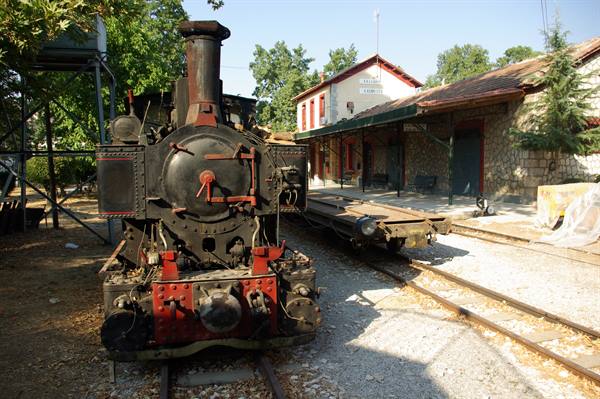
At the upper limit of the burned area in a tavern, grazed, but spared by the fire, we consume the first Greek salad, and sip the first retzina, the resinated wine, more used in Attica, less widespread in the Peloponnese. Kalavrita disappoints us a bit, perhaps because of the expectation generated by reading enthusiastic accounts that induced us to climb up, a bit because of the comparison with the beautiful memory of Metsovo that we visited in the distant seventies, today perhaps also contaminated by aggressive tourism. We treat ourselves to a short stop, a café-frappé, a visit to the little station where we are amused by the sight of an old, small locomotive with the tender full of wood to burn in the furnace of the steam engine.
The presence of numerous tourists, mostly Greek, the fame of the place, induce us, in order not to spend too much, to continue south to look elsewhere for a "room to let", here the term "domatia" that we learned on holidays in the islands is rare. We travel through beautiful valleys, on a road more modest than the climb to Kalavrita, but of sufficient quality. Having reached Klitoria we stop at a pleasant hotel, which seems suitable for our modest demands, they reply that it is full. Probably they suspect that being on a motorcycle, we will only stop for one night and they suggest we go to the service station at the entrance of the village where the managers rent rooms. The room offered to us is clean and tidy, but here we will pay the maximum price, €60 for one night, of the whole holiday.
In Kalavrita we would have spent less! Having arranged our useful things for the night, which are contained in the tank bag, we go out to visit Klitoria. It's a large village, decent and lively, having reached the big square, where under the plane trees numerous taverns are arranged in good order, with outdoor tables, we sit at one of them. Little by little all the chairs around the tables fill up, it seems that the entire population, priest and children included, participates in a great banquet, cheerful and lively, even if the dishes served are simple and not very varied.
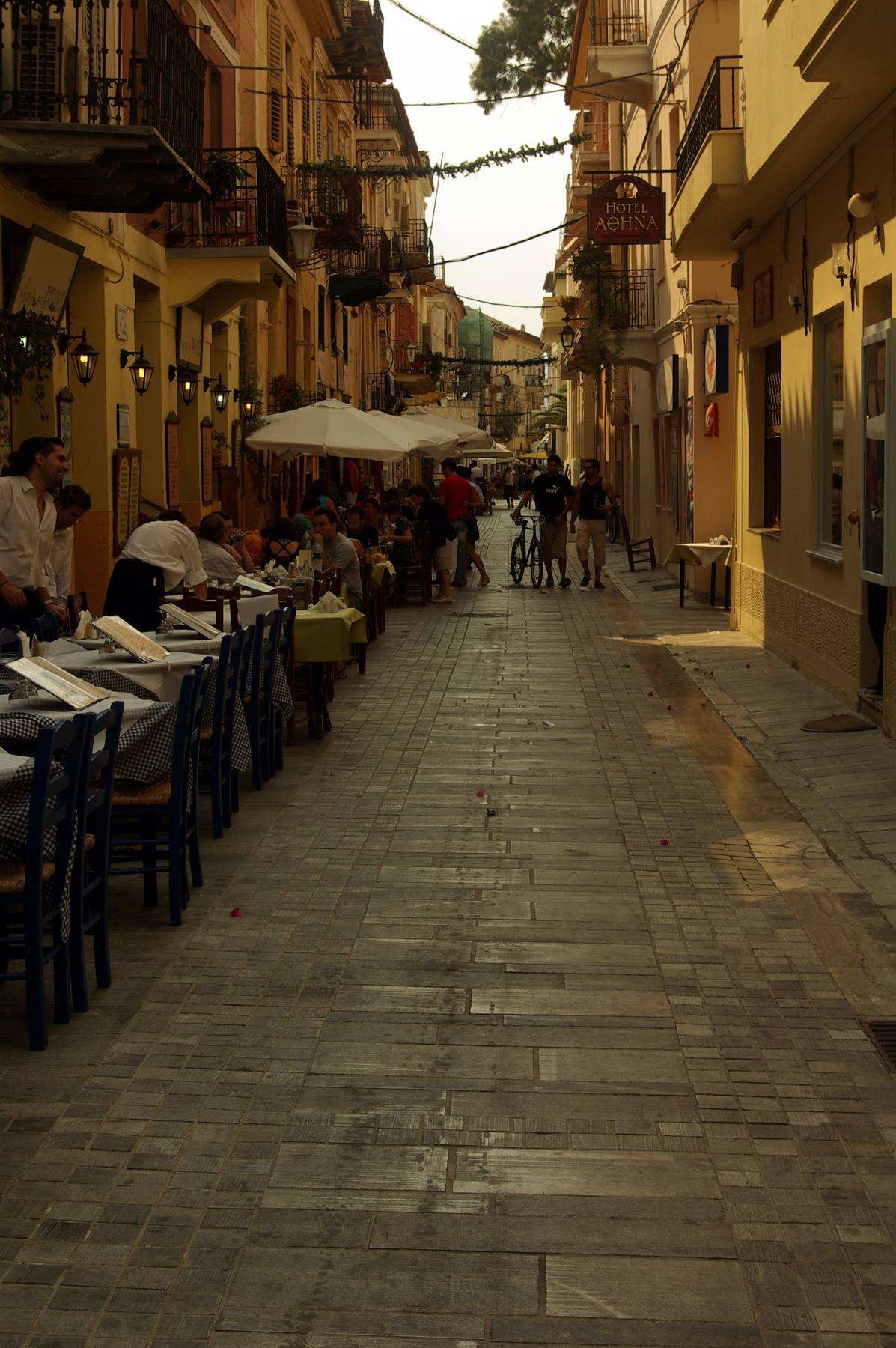
Nafplio Little streets
Day 219 Aug 2007
Sunday 19 August Early in the morning, we leave, we cross a pleasant mountainous territory, the road is generally good. Before reaching Tripoli, we have breakfast at a service station, with attached café and mini-market, served by children. In Tripoli we do not stop, eager for the sea. The road that descends to the Argolic Gulf, from the 655 m of Tripoli, is one of the most beautiful and spectacular, which makes motorcycling pleasant. The spectacle becomes thrilling when the Gulf appears in the distance, toward which one descends with wide hairpin turns. More banal the route, once you arrive in the coastal plain. We choose to visit Argos first. The current city, like many in these parts, is not very interesting, not so the ruins of Roman and earlier times, such as the theater, the baths and other ruins, as well as the castle, which dominates the city from a high hill..
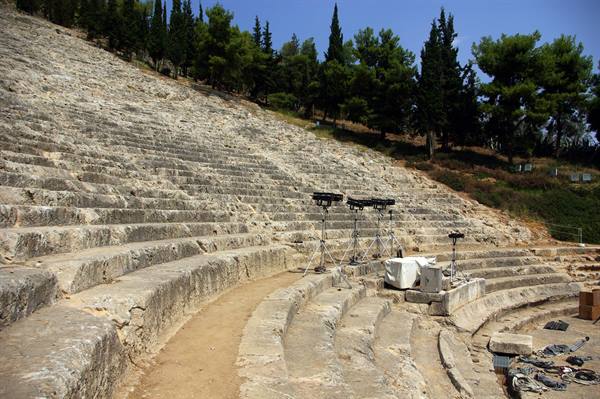
On our arrival the area is still immune from fires, but it is very hot. We visit the ruins adjacent to the current city, we eat a sandwich, sitting on the steps of the ancient theater, while some technicians are setting up equipment, we suppose, for performances scheduled for the coming days. We are sorely tested by the scorching sun, we therefore give up climbing to the fort. In this case and subsequently, in more than one occasion, we had to give up visiting sites that would have deserved our attention, to respect our program of traveling the entire perimeter of the Peloponnese in the too short period of the holidays available to us and not to transform our holiday into a tour de force. Having got back on the motorcycle we head to Nafplio, which is a few kilometers away, we travel the seafront to stop at corresponding to the port.
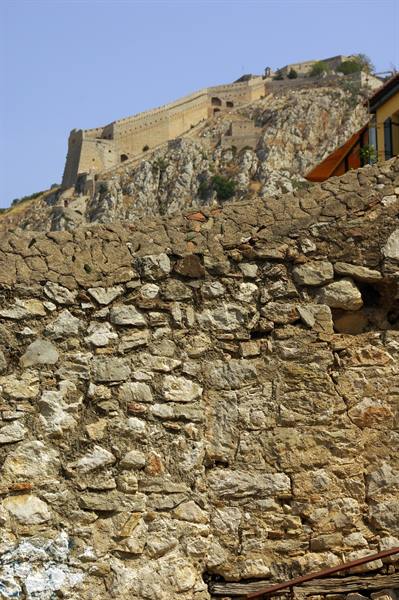
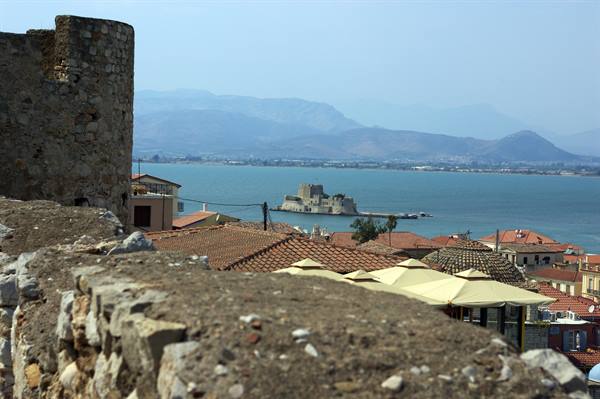
We sit at an outdoor table to sip a Greek coffee, we admire the Venetian fort, called Bourtzi, all surrounded by the sea and we witness, amused, the quarrel between little boat owners who transport tourists to visit it; a quarrel, indeed very calm, unusual for the Greeks who, by accents and tone of voice, always seem on the point of arguing, even if then it is a normal conversation. Nafplio, is partly spread out on the coastal plain, partly, it climbs up a steep hilly ridge, which innervates a peninsula crowned at the top by a fortified system that overlooks two seas. A second fortress climbs up the root of the peninsula still higher and steeper. At Argos we gave up climbing toward the castle, here we can not exempt ourselves from climbing toward the first fortress.
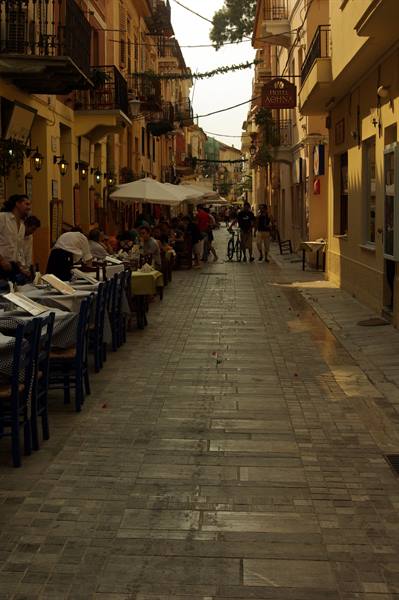
A road accessible to vehicles would allow us to go up with the motorcycle, but we prefer to climb on foot on stairways and stepped ramps that rise among the houses. Considerable care is needed, because the risers of the steps are in a white limestone made smooth and slippery by the wear of a thousand and thousand steps. Having reached the top we realize that it was worth tackling the climb, which opens up extensive panoramas. The second fortress we content ourselves with contemplating by looking upward. We descend following ramps and little streets full of cafés and souvenir shops, which recall other well-known tourist sites, perhaps improperly, they remind me of the alleys of Ponza port. We probe the possibility of finding accommodation at convenient prices, but we are soon dissuaded by the excessive demands, we get back on the motorcycle and we set off on the road that skirts the gulf.
Having stopped a first time at a "room to let" sign, we are already resigned to shelling out once again €60, for a not great room, but at the request to have a towel, for each of us for the shower, the big man with whom we are dealing opposes a flat refusal, he is not willing to provide more than one, tiny, per person, if it doesn't suit us we can also leave, a suggestion we welcome without hesitation. Different the welcome of a kind lady, on the outskirts of the first subsequent village, who for €35, offers us a nice domatia, towels in abundance, and a breakfast served in the room. We wander around the village, the sea does not invite us to bathe the beach is muddy, to have a bit of depth you have to go far out, moreover a strong breeze has risen. We end the evening in the usual tavern. before going to bed.
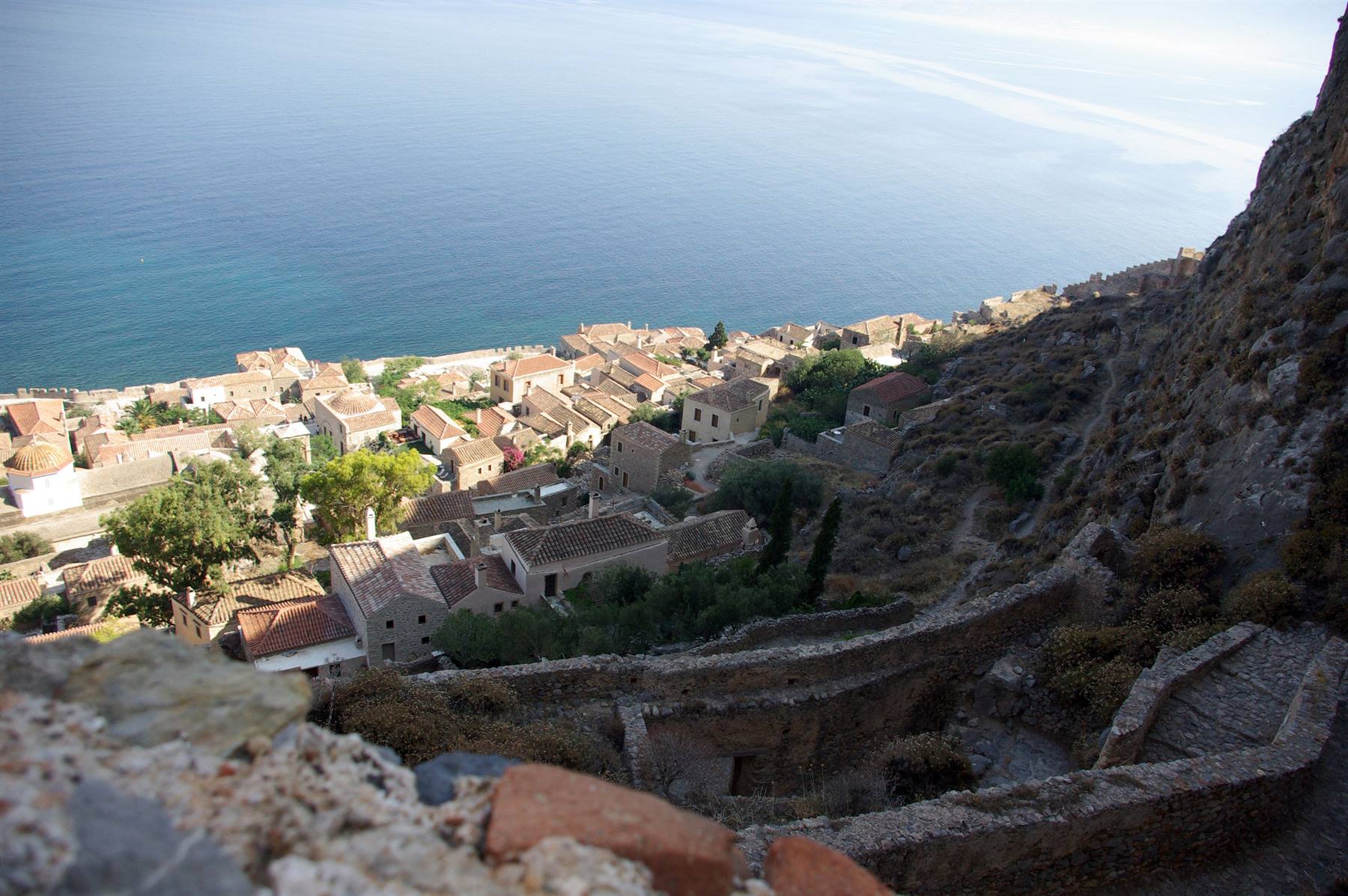
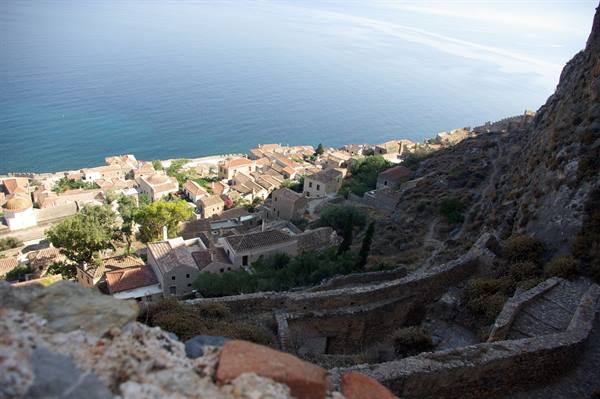
Monemvasia from above
Day 320 Aug 2007
Monday 20 August The next day a nice stage awaits us, very varied, for about 170 km, we will follow stretches of high coast, then we will climb up to over 1700 m to return through villages, hills and plains, to descend to sea level. The first stretch offers us panoramas worthy of being compared to the Amalfi coast, (the panoramas of Greece are mostly less cheerful, sometimes gloomy,) the route is also fun from a motorcycling point of view, on generally good road up to Leonidio; from this town the road pushes inland through looming mountains and valleys. Before abandoning the coast, we stop in one of those squares characterized by small shrines topped by a cross and dedicated to some Agios, that is Saint, particularly venerated by local religiosity.
We are sitting on comfortable benches, under a reed canopy, when a couple of camper vans stop next to us, out come some nice fellow countrymen, formerly motorcyclists, who express their envy for our means of transport, less comfortable, but more exciting. They offer us a good coffee, this time Italian-style, and a bottle of water just out of the fridge, more appetizing than the more than lukewarm one contained in a bottle tied to our luggage rack, exposed to the scorching sun. They proceed in the opposite direction to ours and they forewarn us of the harshness of the mountain stretch we are about to tackle.
Before starting to climb, we go to the coast in what appears to us as the marina of Leonidio, to refresh ourselves in a tavern overlooking a small port, the proprietress welcomes us with a: "hello brothers" which at the settling of the bill she justifies: "I have a Sicilian great-grandfather, that's why brothers!" Having resumed the road, I am a bit worried, thinking back to what the Italian friends told us. A state of tension will accompany me for the whole mountain stretch. At the beginning the difficulties are indeed not particular, the valleys are open. Having reached the first village on the route, the road narrows in some points, to a single lane, and rears up in very steep ramps, with poor visibility of who might come toward you.
Going forward it instills a certain fear the fact that toward the valley, there is no protection and often in the stretches halfway up the slope you graze veritable abysses. It is known that guardrails and low walls are not friends of motorcyclists, but seeing with the corner of your eye all that void flowing by your side, has a certain effect. The road surface is not the best, some landslides, unmarked, narrow the road section and the hairpin turns become more frequent. In compensation the landscape offers grandiose views, although rather harsh, until you reach the highest elevations, where the vegetation takes on a markedly alpine appearance. Having passed the ridge we begin to descend first gently, then having reached the village of Kosmas the descent becomes at times steeper, with unmarked narrowings, where it would be a problem to meet a vehicle coming up.
We end in an open square onto a large church, shaded by majestic plane trees, with people sitting at the cafés. Despite the very hot season, making its effects felt also here, we appreciate the relative coolness, we are in fact at 1680 m above sea level. We stop only a little, there are still more than seventy kilometers to travel to the intended destination. The downhill road after a first stretch, has completely different characteristics, no more hairpin turns and ramps, but a route with wide curves and a succession of straight stretches that follow the slow degrading of the mountain. Once the descent is finished, our stage is not finished, most is done, but the last stretch, partly because of lesser interest, partly because we are tired, seems never to end; we pass through some villages, followed by the gaze, just interested, of the men sitting at the cafés.
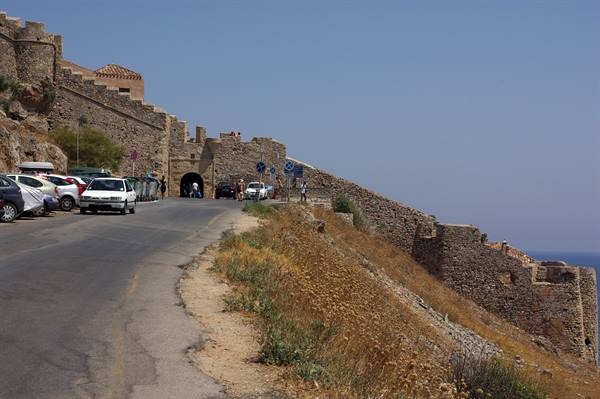
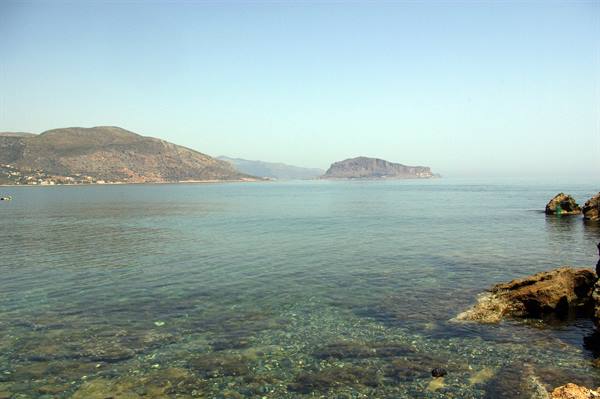
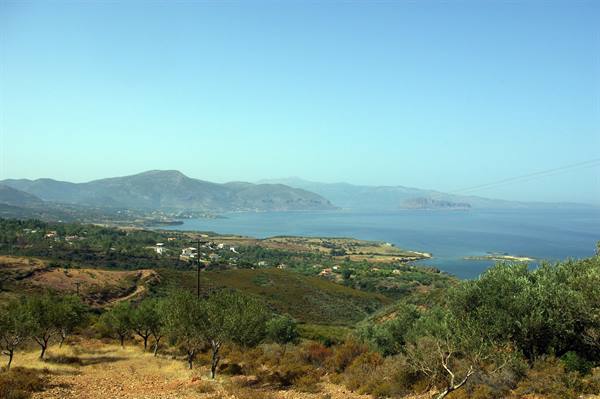
In one of these villages, we find ourselves in a very steep, angled narrowness, with a slippery surface, as can sometimes happen in these parts. Another handful of kilometers, keep going, in the end there appears to us the wonder of the rocky spur that, toward land, delimits the peninsula where stands, hidden from view: Monemvassia, ancient fortified settlement. It is almost dark, but we postpone the search for a room until later, satisfied with having reached the longed-for destination. We sit at the tables of a café, by the sea, contemplating the panorama, sipping a café-frappé. We are in Gefira, an eminently touristy village, having arisen, it seems, precisely because of the ancient fortified town.
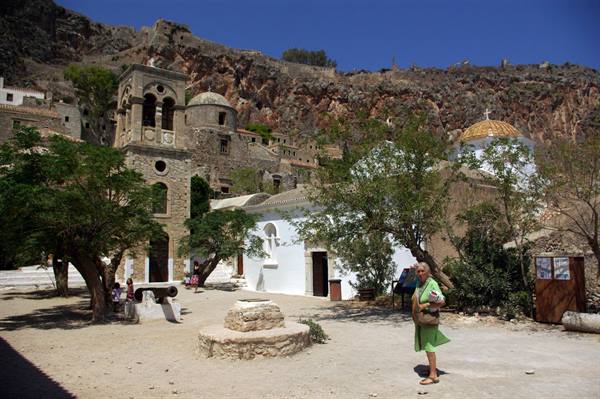
We are rewarded for the effort, since we find, at €45, good accommodation, in a beautiful residential complex composed of rooms with facilities, managed by a nice man with a grizzled goatee, so much so that we decide to stay at least two days. In three days of travel, from the landing at Patras, we have covered quite a few kilometers and we are already close to the southern extremity of the Peloponnese, we therefore deserve a bit of a break. Of Monemvassia we have read wonders, and we think it deserves a careful visit. This sea is equally appreciable and we wish to dive into its waters. Tuesday 21 August The following morning, we leave the motorcycle in the parking lot and walk toward the only gate that opens from the mainland side in the walls of Monemvassia, whose name apparently means, indeed, single gate.
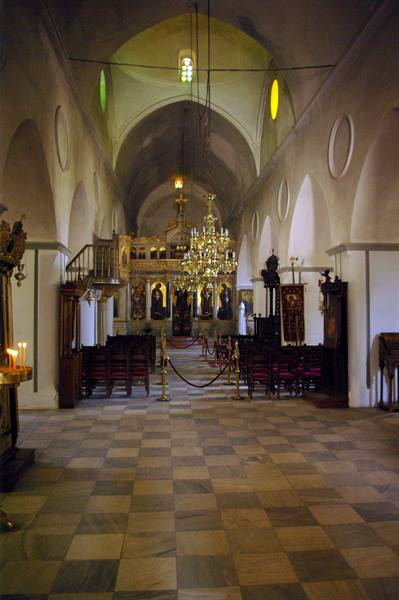
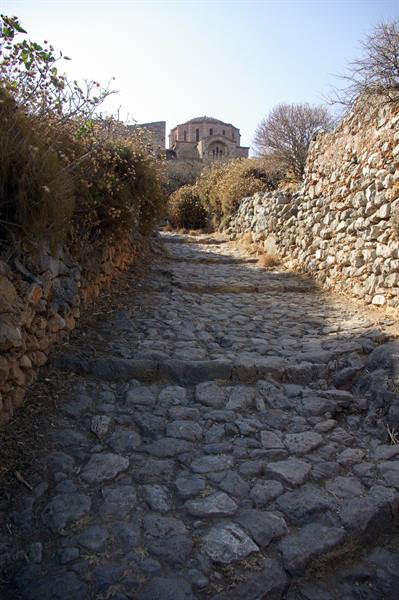
To reach it one must walk along a narrow isthmus, and about a kilometer of road halfway up the slope along the seashore. The visit to this ancient settlement requires at least a day, describing it even briefly would require more pages, descriptions are not lacking, even online, some are indicated in the attached Links. We had read, in a dated publication, published by National Geographic Magazine, regarding Monemvasia of the author's astonishment, at the scant attention of tourism for this place, today it is truly no longer so, the astonishment is rather aroused by the casualness with which they intervene, reconstructing ancient buildings in ways not exactly respectful of the correct rules of restoration; it is true that to prevent everything from falling into ruin, some concession to the rules of profit and some arbitrariness must perforce be tolerated, but....
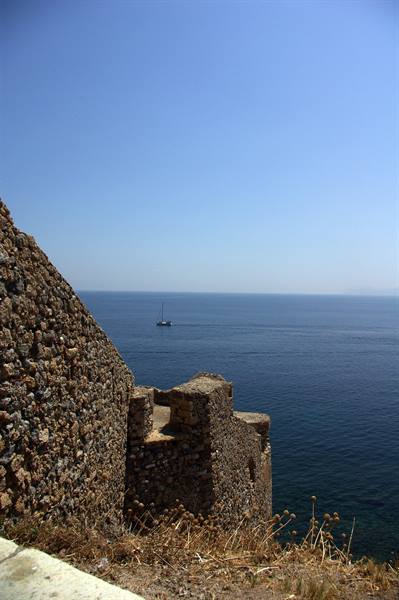
Despite the invasion of the souvenir market, and some other discord, the impression aroused seizes you deeply, both for the beauty of the place: nature and work of man, and for the history that the latter evokes. Having toured the ancient village far and wide, it is the turn of the sea; having descended to the ancient landing stage, which is accessed from an opening in the walls toward the open sea, we dive into the clear water, with great satisfaction.
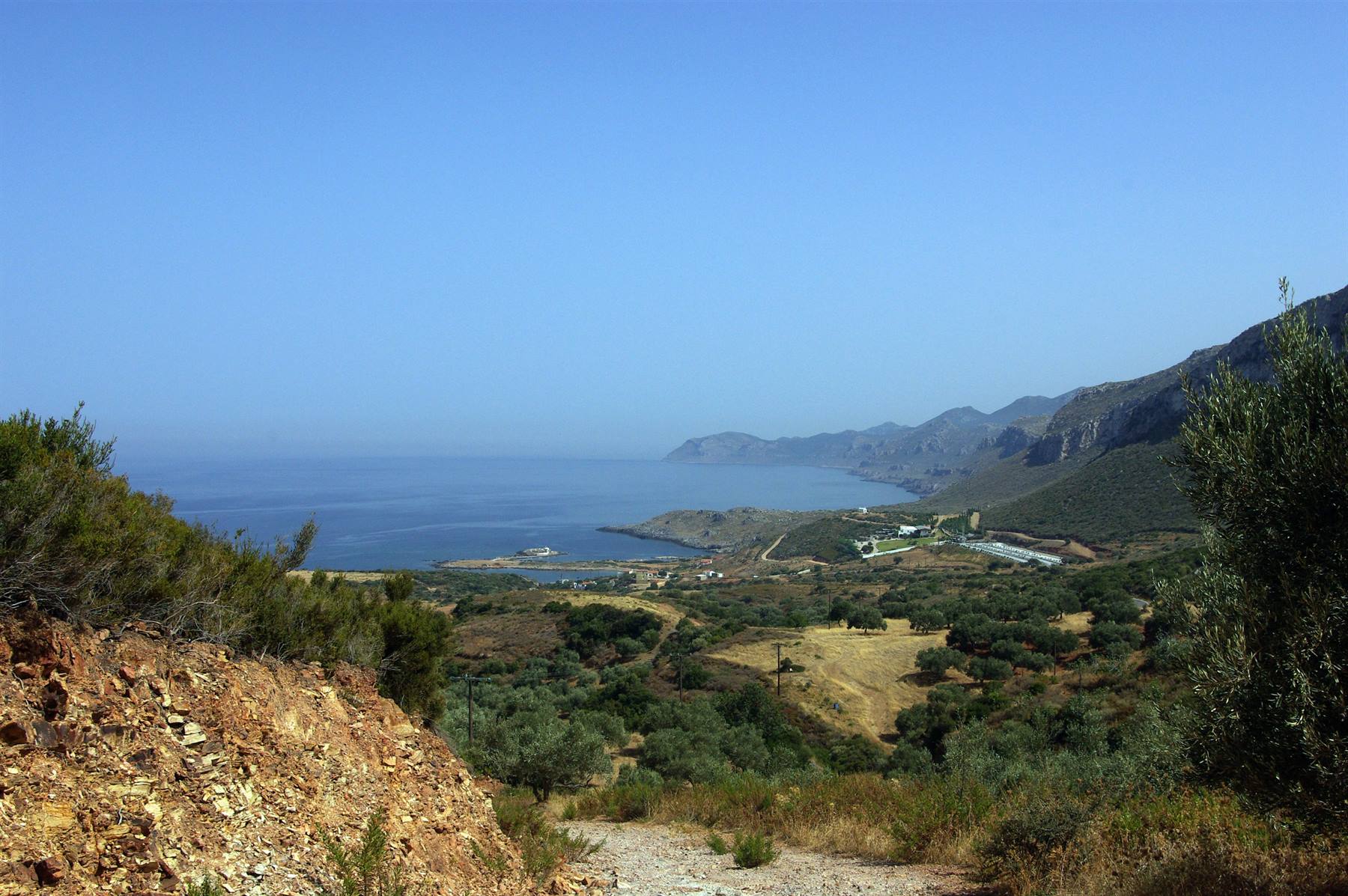
Wednesday 22 August The day after the visit to Monemvassia, we push further south to bathe peacefully at the marina of Xiphias; having finished the swim we proceed further, to admire the coast, we finally stop on the hill that overlooks the beautiful sea of Agios Fokas, where a vast development project is being implemented. Places dedicated to Agios Fokas abound in Greece, some of which already struck, like others, by the scourge of initiatives of incorrect tourist development, which can have devastating effects, it is what we fear is happening also here while we observe, saddened, the advertising signs and the earthworks in progress.
Ag. Fiokas excavations
Day 423 Aug 2007
Thursday 23 August
Of the eastern peninsula of Lakonia, we still have to visit the southernmost part. Crossing the ridge, to head to Neapolis, we can admire very beautiful panoramic views, toward one and the other open sea. A strong wind disturbs the motorcycle ride not a little, having reached Neapolis, we sit in a café, near the port and witness the towing, by the coast guard, of a sloop flying the Italian flag, clearly with engine failure. Among the sailors of the port we catch a few mocking chuckles, also to us, who in our time challenged the meltemi, with a 22-footer, proceeding under sail, this surrender seems little honorable, even if the skipper probably had his good reasons. The crew is formed by a couple, she remains on board and seems to want to make herself very small, he, with a sullen air, goes to the harbor master's office, for the bureaucracy of the case.
Neapolis does not offer much of interest, during the last kilometers on the road, we had noticed a camper van diverting toward Elafonissos, we return to the junction for boarding on one of the ferries, which continuously shuttle between the mainland and the island. Elafonissos is a sought-after tourist destination, it may seem difficult to find a "room to let". When we arrive in a new place, I am seized by agitation, fearing not to find accommodation, Resi instead impassive is always certain to succeed, so also here; at the beginning it seems that I am right: two or three approaches on the seafront receive a refusal, it almost seems they snub vagabond tourists such as we are and appear. We go into the internal little streets and in a short while we receive a positive answer.
Our hosts are a middle-aged couple, he suffering from diabetes, she seems resigned to a life without many satisfactions and many regrets. They make us feel tenderness, we sit, according to local custom, on the doorstep of the house chatting; beside, partly walled
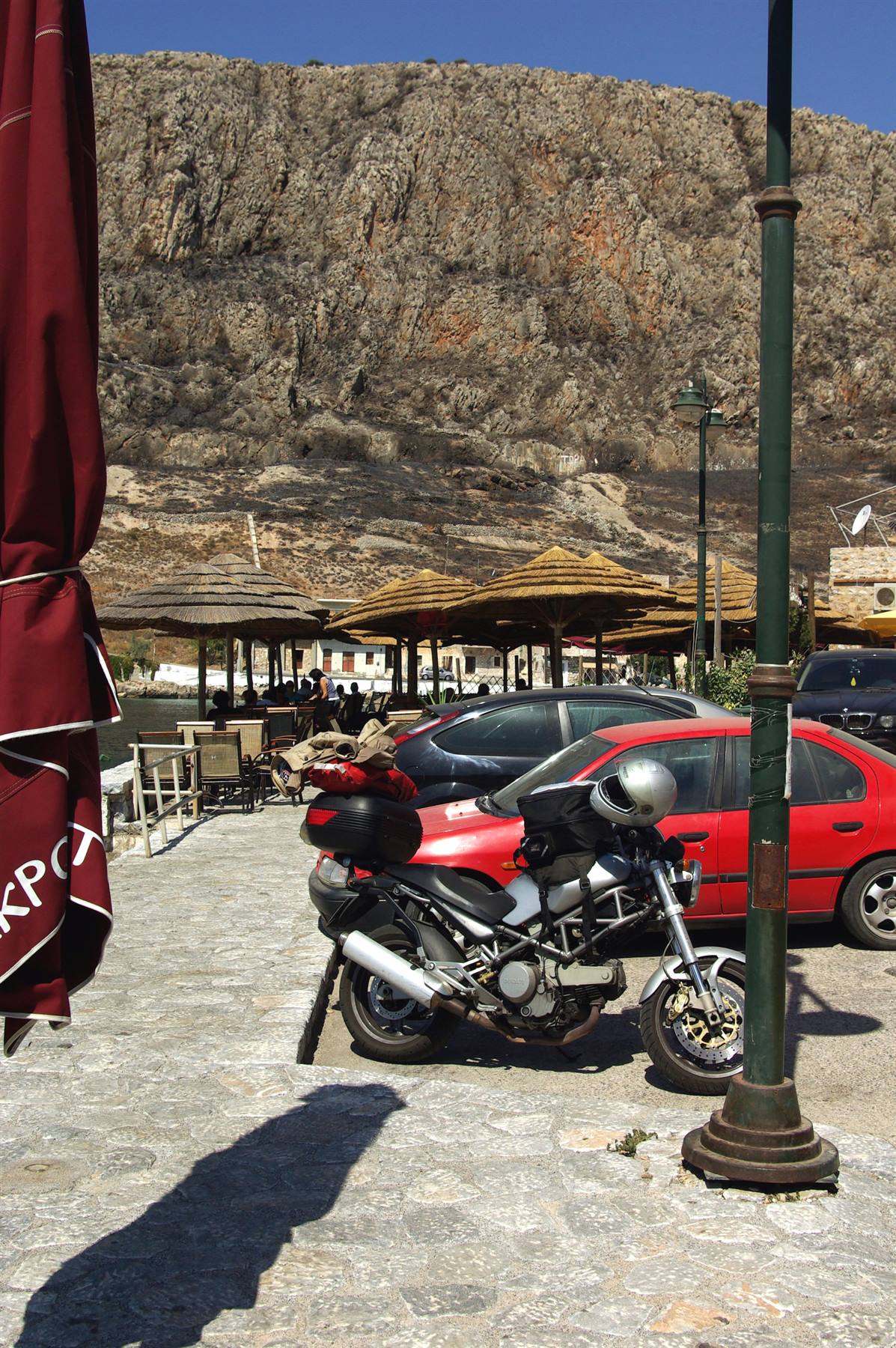
Gerolimenas
Day 526 Aug 2007
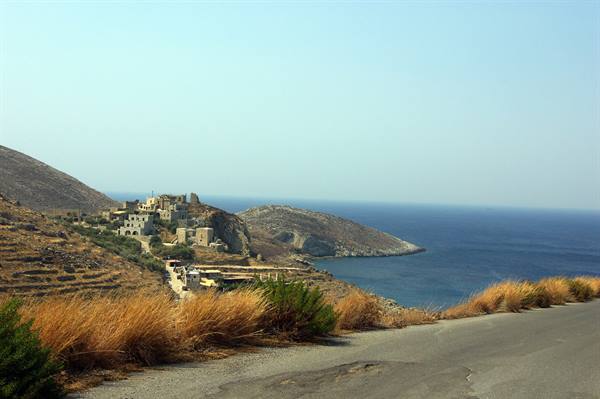
Sunday 26 August Next objective, the Mani peninsula. The road, as often in the Peloponnese, alternates coastal stretches with inland stretches of characteristic hills or mountains. We decide to visit the peninsula by going round it clockwise. First stop Areopoli, the city of Ares, or Mars for the Latins. The time we have left isn't much anymore; we can't visit everything we'd like to. About Areopoli we had read about the Pirgos Dirou caves; we go down to have a look; the bowels of the earth don't appeal to us and we don't enter the gates of Hades, but we content ourselves with admiring the little inlet, full of boats at anchor. On the move again, ignoring the thousand turn-offs to the villages scattered here and there, we follow the main road.
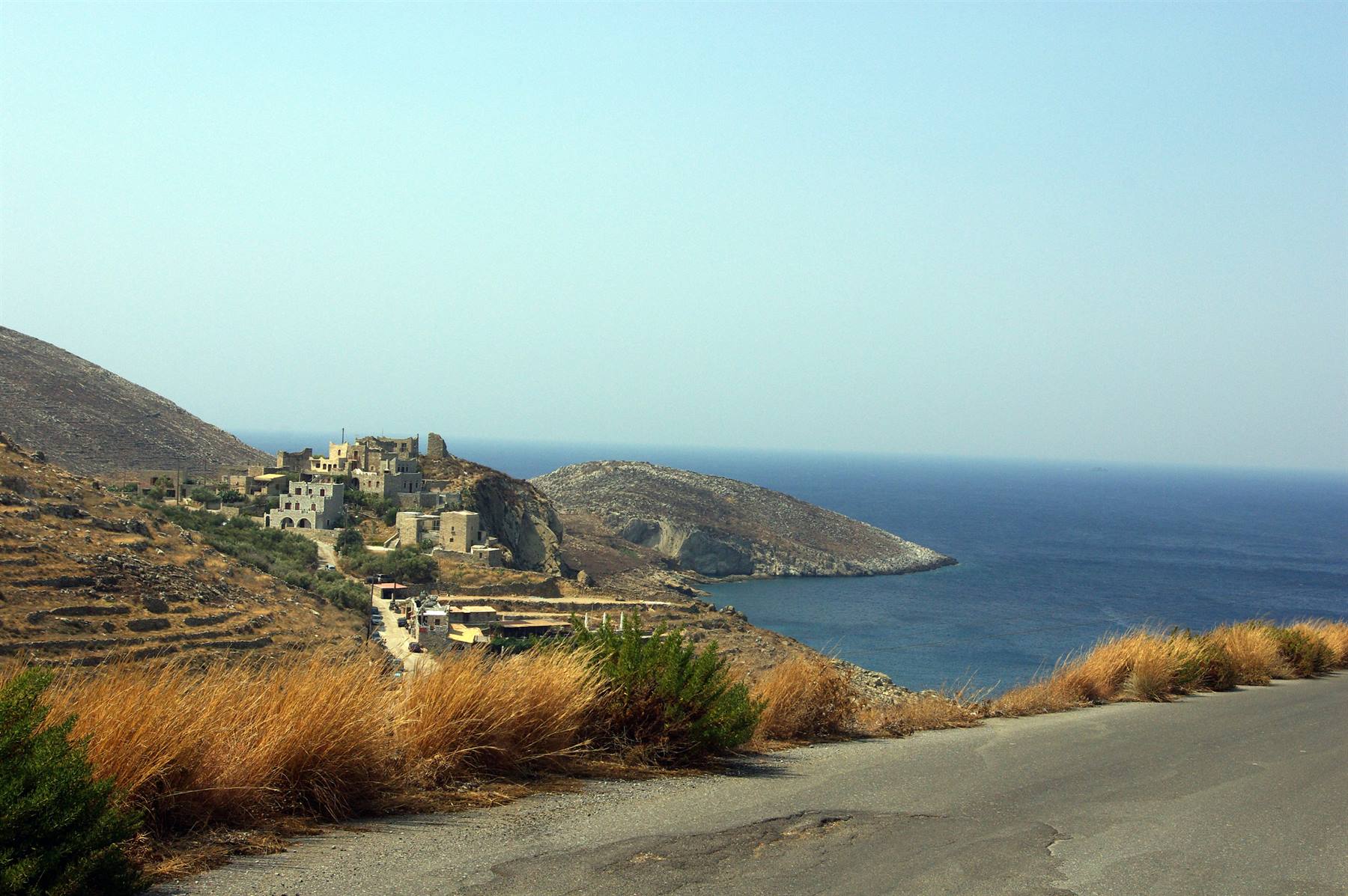
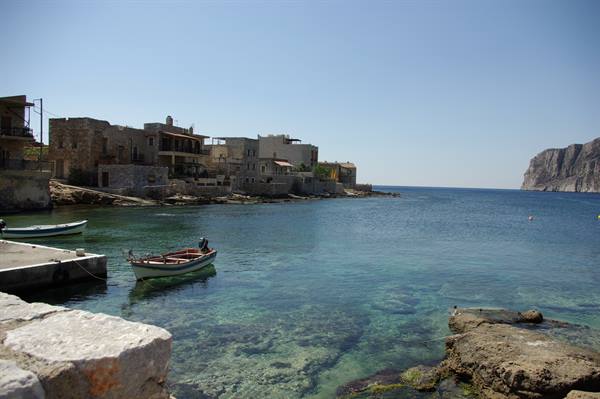
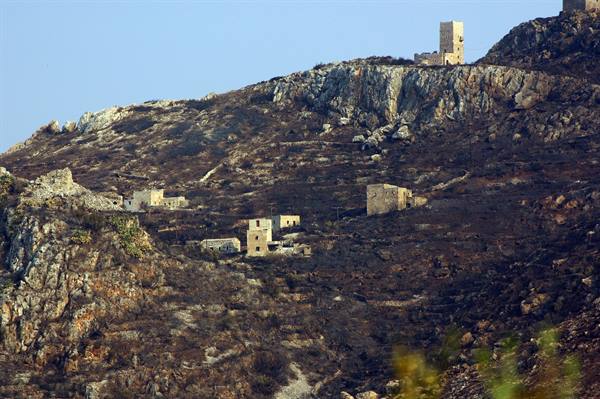
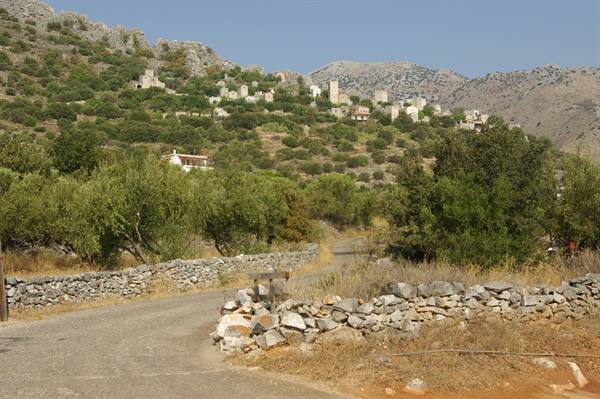
All around, not the usual Greek houses, white, often with blue window frames, as if to echo the colours of the flag, but houses in exposed-stone masonry, with the corners marked by quoins flush with squared blocks. Here the families were at war with each other and the houses were fortresses, the windows arrow slits. Unfortunately, on the Mani peninsula too there's a risk of denaturing what history has left behind; many towers restored with excessive fussiness become villas, in fact many newly built villas look like a parody of the severity of the old towers, mimicked with inconsistent taste, and there are also many offers to buy plots and buildings. We stop at Gerolimenas, a lovely village overlooking the sea, surrounded by severe rocky barriers. Here the fire has already burnt the maquis and the trees.
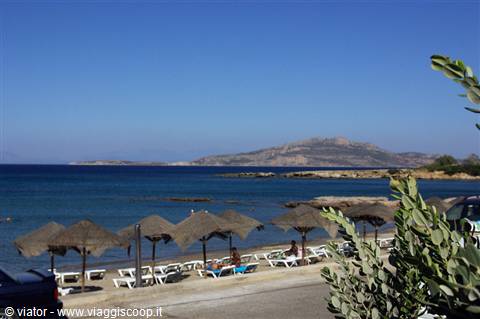
We stop to rest and swim in a clear sea, in the company of elderly Greeks, mainly women, who luxuriate in floating and chatting with their heads covered by wide-brimmed hats. We take advantage of the village, which is reasonably well equipped, to do a bit of shopping, and set off with the intention of reaching Alika. I don't know where, I think I read that it's a fishing village, but when I get to the junction it seems to me to be something quite different. It must be said that riding a motorbike on winding roads with surfaces of uncertain quality and reading road signs in Greek characters on the fly makes misunderstandings quite likely. In the fourth year of high school, in distant times, I studied a bit of ancient Greek, but to read it I have to spell it out like a primary school child.
I carry on, I spot a Mobil Oil petrol station, signposted as the last fuel stop (the notice, valid apparently a few years ago, is no longer true; a few dozen kilometres further on, on the eastern coast, we'll find another petrol station). I carry on, we reach Vathia, after a steep climb on the cement-paved road. Vathia is the place where the character of the buildings and the whole complex has been preserved most intact. Many stop, take photos and move on; the village seems almost dead, there isn't even a taverna or a café, which in Greece means desolation. We have enough for a packed lunch, but not water. Resi asks a kind young lady, one of the rare inhabitants, where one can buy some; the answer is "there are no shops", accompanied by the gift of a nicely chilled bottle, part of her household supply... Having eaten our meal, we move on.
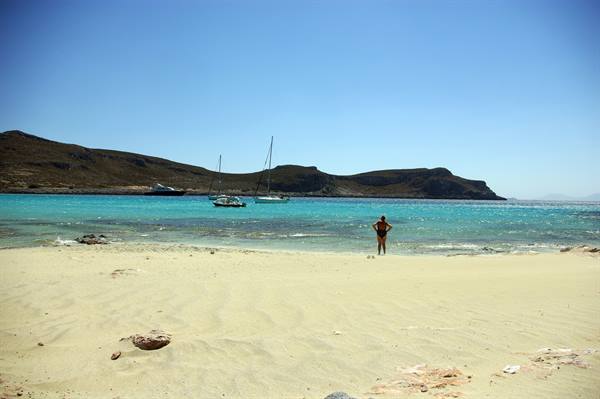
We won't go far: after a few kilometres we come across two junctions in succession; the first offers as an alternative the eastern coast of the peninsula, the second Porto Kagio. Catching sight on the right of a settlement that attracts us, Marmari, we decide to prefer it. It's a group of buildings in the Mani style, partly old, partly recent imitations, all overlooking an inlet bordered by a lovely stretch of sand, overlooked by slopes that are partly burnt. We find accommodation in a house that looks newly built (€35), higher up than the central cluster, which includes a café and a taverna. We decide to stay two days: the first more relaxed, swimming from the beach at Marmari, the second to explore the surroundings. Monday 27 August On the beach a group of Italians, who had noticed us at Elafonissos, on Simo beach, come up to us and one of those quick holiday friendships is born.
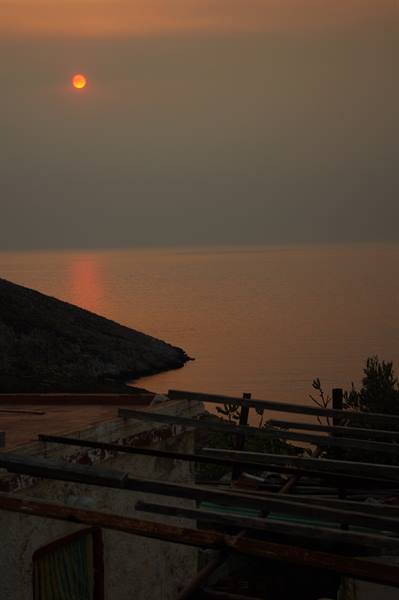
They tell us about the anxiety of the day before our arrival, when, while they were having dinner in the taverna, Greek television was broadcasting scenes of fire and meanwhile the slope opposite Marmari was burning. While we swim, ash snows down; in the late afternoon the phenomenon we observed before arriving in Gythio repeats itself: the sun, still high, already red; it won't be the last time we see it on this holiday. Tuesday 28 August We get the urge to set off for the eastern side of the peninsula. We ask whether the road at the second junction, which on our maps is marked as a dirt track, is complete and paved, as we thought we'd gathered from watching the traffic; the answer is yes. But it's not enough: in fact, fires towards Agios Kiprianos, they tell us, have led to the road being closed.
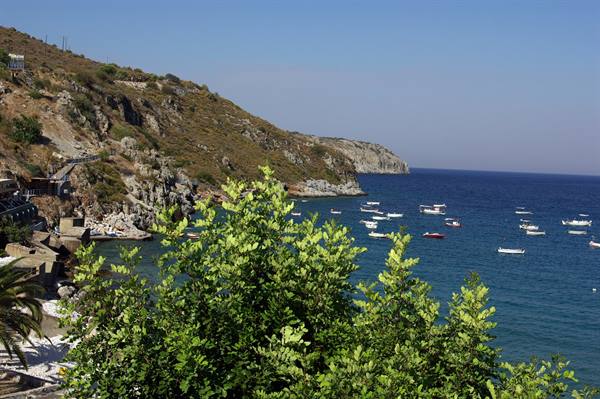
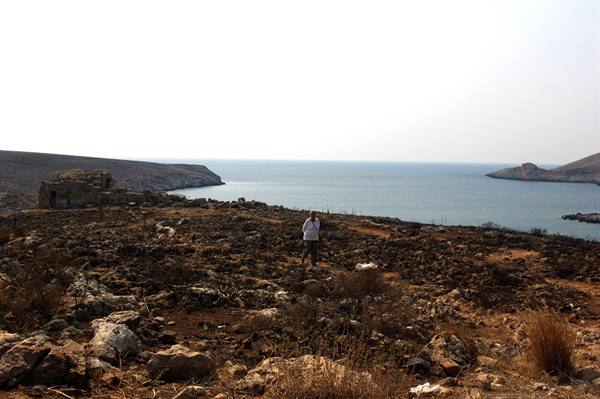
We'd better go back to our plan of exploring the tip of the promontory that ends at Cape Tainaron, also known as Matapan. We visit the temple of Poseidon first; the setting is evocative, the ruin a bit disappointing, a remnant of a wall of squared stones and a small vault, certainly not from the classical era—the ancient Greeks didn't build vaults—but the remains of a Christian chapel built on the ruins of the sea god's sanctuary. Paliros is a cluster of typically Mani houses; we don't meet anyone, but there are numerous cars parked. We go down the very steep road that leads to Porto Kagio, a small village overlooking a well-sheltered gulf, entirely surrounded by heights.
A few tourists, some camper vans, a sailing boat tacking to get out to sea, craft moored at anchor with a rope to shore, part of a system for bringing them back to the shore, a rather heavy girl stubbornly, with a somewhat clumsy diving technique, fishing for sea urchins, with a great production of splashes and a display of buttocks—you know how ducks look when they dabble at the bottom with their tails in the air? We make our way to the right-hand side, looking out to sea, of the coast, to a small market, where we intend to buy something for a packed lunch; the owner is closing up, but he turns back and serves us; we'll see him repeat the same manoeuvre several times. After our purchases we walk back up a stretch of path, then plunge into the water from a jetty. The visit ends at the taverna for a coffee. Then we return to Marmari.
Agios Nikolaos
Day 629 Aug 2007
Wednesday 29 August
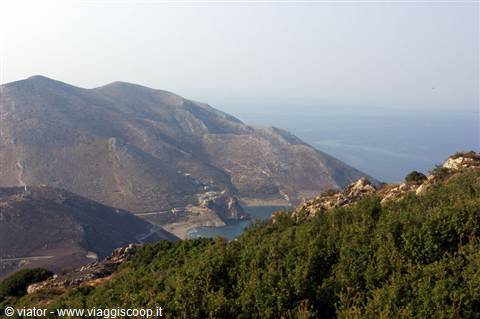
We leave Marmari, climbing back up towards the ridge that divides the two sides of the Mani peninsula, along steep ramps and narrow hairpin bends. Once at the top we can't help stopping to admire the succession of inlets, villages, slopes covered in maquis and the most distant horizons. The descent is steep and winding; the pleasure of driving doesn't fully make up for the attention necessarily fixed on the road, but drawn away from the panorama. Here the fire was brought under control early; we don't notice any obvious devastation. This side of the peninsula seems to us more cheerful, compared with the other, harsher one. Here too there are tower houses in exposed-stone masonry according to the custom of the Mani. Once we reach the base of the peninsula we head for Kotronas.
We're a bit uncertain about the road; we go back a short way to a hamlet where we had noticed a group of elderly people sitting outside a café chatting; at our questions they become animated and, in the usual approximate English, they give us the right information, not before having first introduced us to one of them, a centenarian, almost a point of pride, surrounded by the attentive care of the others—an attention to the elderly that we had already noticed elsewhere earlier in our trip. We make our way to the end of the quay of a small harbour where we dive into the clear, refreshing waters. Having completed the circuit of the coasts of the Mani peninsula, we head for Areopoli to close the loop and continue towards Kalamata.
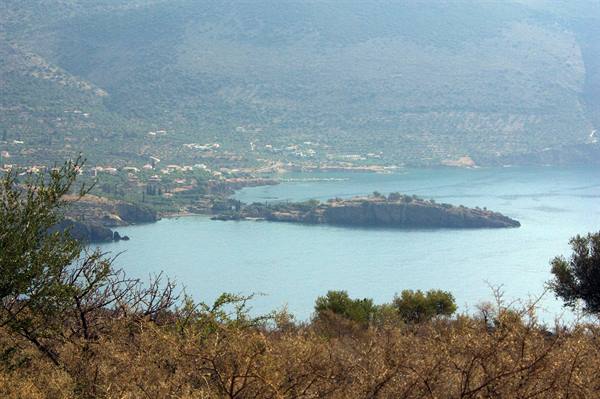
From a coastal landscape we move onto a road with mountain characteristics that goes into a rather enclosed valley; the variety of landscapes is one of the most appreciable features of the Peloponnese. In Areopolis we don't stop and head north. Soon we come out onto the edge overlooking the eastern coast of the great Gulf of Messenia; it's a magnificent spectacle, a splendid coast, here contrasted with the high Taigetos range. We had already appreciated this panorama when coming from Gythio to Areopolis. The road, a good surface, descends rapidly from over two hundred metres down towards the sea, but soon despondency takes hold: this slope that we had already admired a few days ago is badly scarred by the fires, which were started just a few hours after our previous passage; here the fire claimed the sad record for damage and victims in this disastrous summer.
Crops, olive groves, houses blackened by fire almost make us want to flee with our eyes, metaphorically, closed. Soon the somewhat selfish need to enjoy our holiday takes over; we turn off the main road towards the coast to have a swim. The side road that leads us to the sea acts as the axis of a development of tourist houses under construction, which reminds us of the similarly disfiguring developments that have blighted so much of our own coasts. We park the motorbike under a tree next to mostly Greek cars, and make our way onto a crowded beach for a rest and a refreshing swim. Today's stop, Kardamili, welcomes us, after about fifteen kilometres, with the cheerful face of a site immune from the disasters of the fire, which nonetheless announces its proximity with clouds of smoke that grey the sky in part. The town is set in one of the most cheerful landscapes.
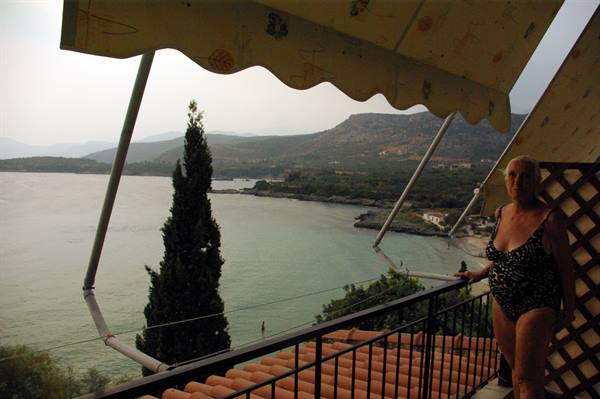
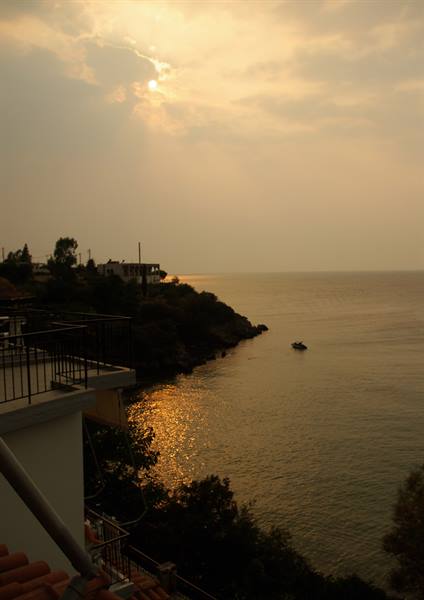
Resi goes off in search of a room while I stay by the motorbike; she comes back straight after her first look. This time she suggests, even at the cost of a bigger outlay (€40), treating ourselves to a small luxury, a room with a view. I approve, and when I look out from a first floor full of greenery, banana plants included, with a backdrop of a stunning coast and sea, I can only confirm my approval. The complex our room is part of belongs to a German woman who has chosen to live here and who lives with or is married to a Greek, a witty, likeable type who co-manages the business. There are numerous rooms; for swimming there's a path down to the sea that leads to a small cove on the left, with a short beach, or, if you prefer, on the right, to a lido with a row of sunbeds and umbrellas. To catch our breath a bit we stop for two days to enjoy the sea and the landscape.
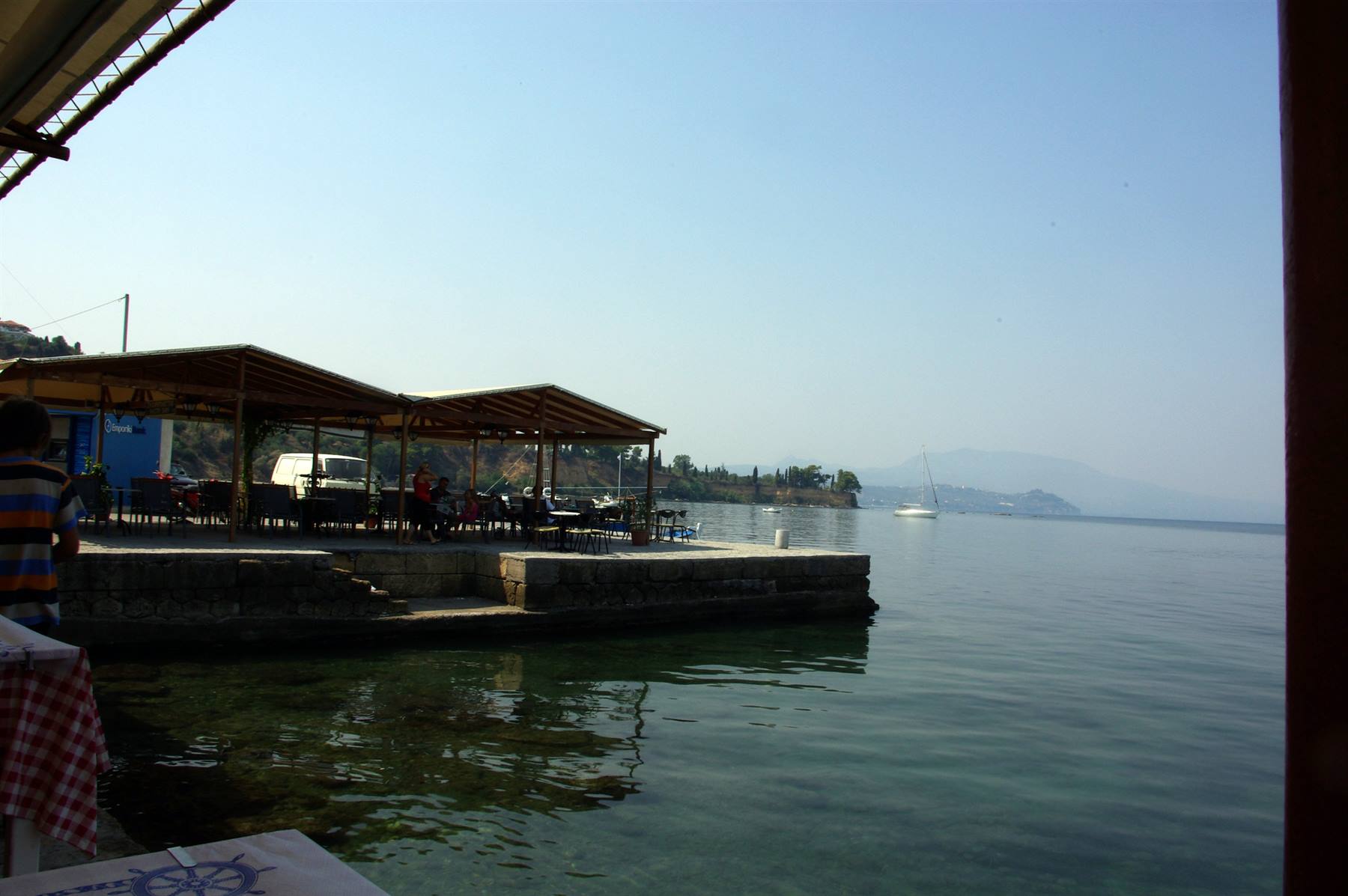
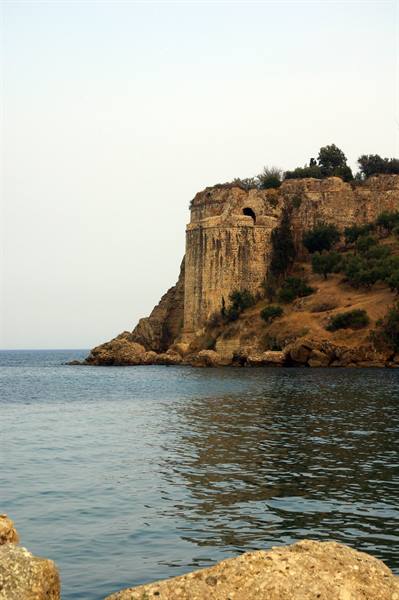
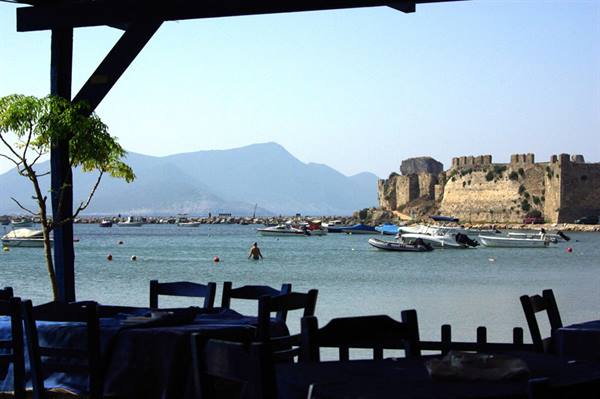
Friday 31 August Having crossed Kalamata, not without some difficulty interpreting the road signs, a city with an urban imprint and size, we turn south to begin the circuit of the south-western peninsula of the Peloponnese. Next stop Koroni, a charming village with a fishing harbour, a large Venetian fort, a seafront with many tavernas. We find accommodation at the far end, on the left looking out to sea, in a ground-floor room facing the sea. We head off to the left to swim in the sea; the depth of the water, even going quite far out, doesn't increase much. We stop for just one day; gripped by laziness, we don't visit the fort, preferring to stroll along the seafront and on the mole, at the end of which a large stainless steel grapnel anchor surprises us. A little over thirty kilometres and we're at Methoni.
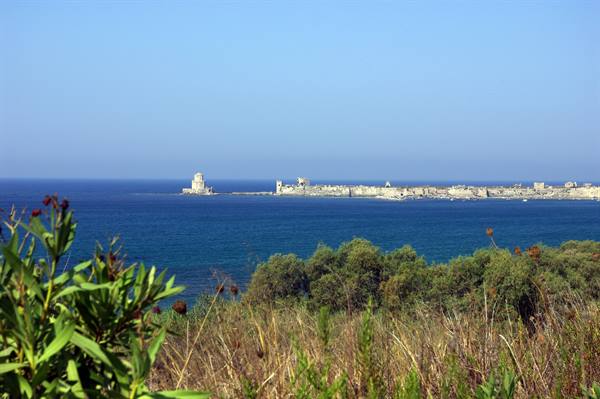
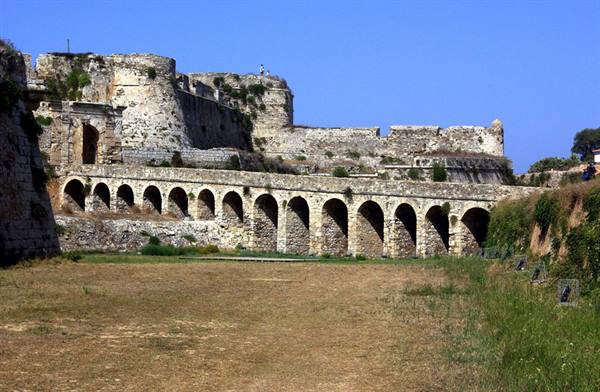
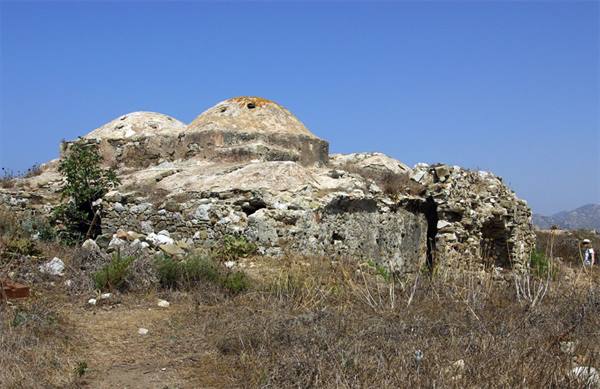
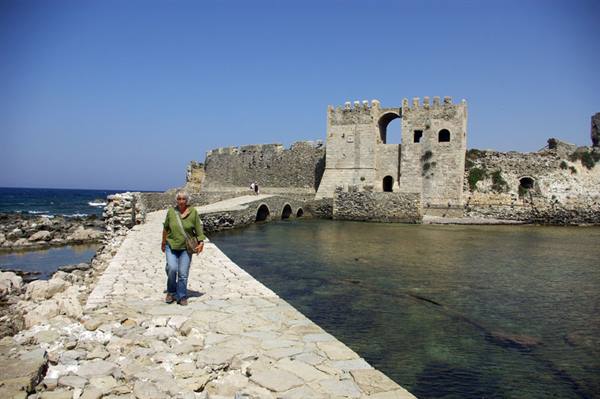
The road is lovely with striking panoramic views, but when Methoni appears the sight is superlative. The actual settlement is neither here nor there, at least from the little we visited, but the natural setting and the castle are very beautiful and interesting. After the ritual coffee, we begin the visit of the fortified town—better to call it that than a castle, given its variety and extent—a visit that takes a few hours, well spent. When we reach the outermost point, relentlessly battered by the sun, we see a visitor diving in to swim back, to our great envy, but we're without swimsuits and with bags and camera, so we have no choice but to continue the visit on foot, crossing the sun-drenched open areas. But in the end it's a good thing, because we can see other things, such as the Turkish baths covered by domes in which portholes open to let in light from above.
Coming out of the ancient fortified walls, we feel a strong desire for a refreshing swim; many have preceded us into the sea. The way many tourists swim, especially Greeks, is to stand upright immersed up to their necks with a hat on their head. The motorbike with the luggage is parked towards the edge of the village; to get our swimsuits we go all the way there, put them on and head for the nearest beach, but we realise it's not easy to work out the route to get out to deep water; reefs just below the surface make it problematic. We follow a lady who seems to know the sea bed already, but it won't be a great swim; we regret not having swum near the far end of the fort. After a packed lunch and a short siesta in the shade of tamarisks, we set off again towards Pylos.
The vast inlet facing it is Navarino Bay, completely sheltered from every wind, famous as the site of the famous naval battle of October 1827, a victorious battle for the Greek rebels with the decisive contribution of the Anglo-French-Russian fleet over the Ottoman and Egyptian fleet, a battle that marked the end of Turkish rule. We find accommodation in a hotel at a reasonable price, located by a pier in the port; from the little balcony the panorama is framed by a pole and electricity wires arranged in a jumbled way, as is the custom around these parts. A short distance away, a concrete quay with steps for climbing out of the sea hosts numerous bathers, whom we join by diving in. For today we've had enough of visiting fortifications, and we skip visiting those of Pylos.
Koroni, taverna on the sea
Day 71 Sep 2007
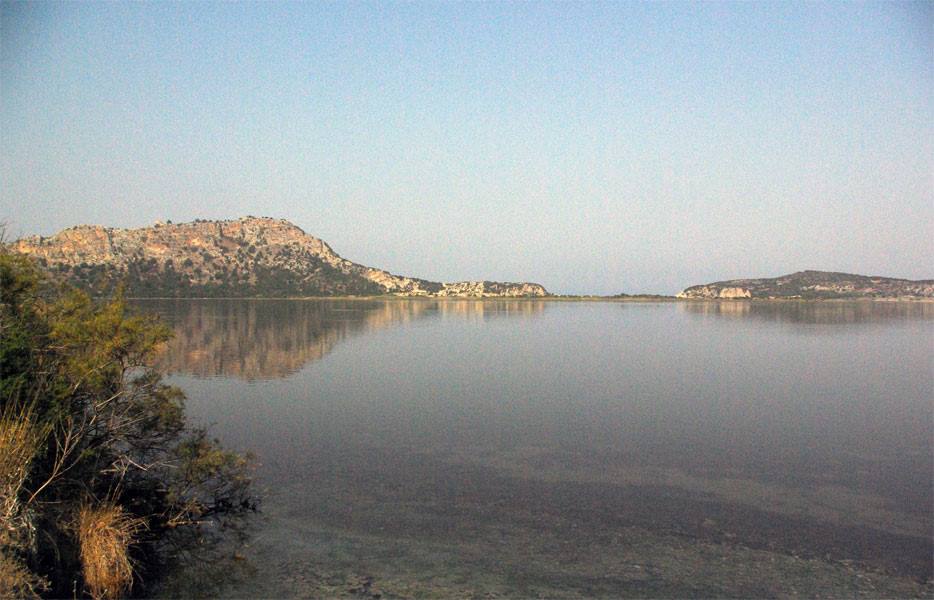
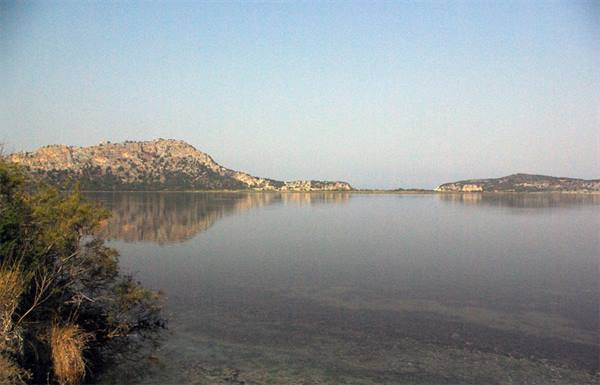
Saturday, September 1 On waking, the desire to visit the fortifications does not return; we are rather eager to go and visit the Gialova lagoon, a few kilometres further north. Separated from the bay of Navarino by a sand bar, the lagoon has been made into a nature reserve, a pleasant environment, but perhaps because we are in an unfavourable season, we see very little live fauna, except for clumps of snails clinging to dry twigs; we read on the signs about the presence of birds, a stopping place for migrations, but we see nothing either in flight or on the water; the comparison arises spontaneously with the salt ponds of Cagliari, with their multitude of flamingos, or with the Nazzano nature reserve; even seagulls are a rarity.
From the reserve we move on to the Bay of Navarino; now we are near the northernmost inlet; we follow the sand bar that separates the lagoon from the gulf, we dive in to cool off and return to the Monster, which we had parked on the road. Heading for Kiparissia, along the way we visit the Palace of Nestor, a complex reduced to ruins in which not much more than the floor plan of the mythological king's palace can be made out, and an ancient Mycenaean tholos tomb, set in an olive grove among beautiful trees. In Kiparissia, once again we have a disagreement with the owner of a room for rent, about the towels for the shower; the man preferred to give up renting rather than give us two towels.
It is strange that this kind of conflict has happened to us with men; women are much more mentally agile and have always rolled out the red carpet for us, and here too it is the same, just a couple of blocks further on. Kiparissia is a very spread-out settlement, which extends considerably inland from the sea. After the usual swim, taken on a long, rather crowded beach, we try to visit the usual fortress-castle, climbing a road that winds up towards the entrance, which however is barred; all around, the square seems to have been turned into a public toilet. We fall back, anything but satisfied, and observe, half worried and half astonished, two young people who, fully dressed and with shoes on their feet, go almost running down the steep slope that overlooks a high cliff facing the sea, into which they throw themselves in a dive, upright, from at least thirty metres.
Sunday, September 2 Today's destination is far from the sea: Olympia, but for a good stretch the road runs along the Ionian Sea. After about forty kilometres, we glimpse among the trees, on our right, a lagoon or a coastal lake, a pleasant diversion, but all around the spectacle is desolate because of the blackened trees and the ash left by the fires; we can also smell the burnt wood. When we reach the junction for Kaiafas, I suggest following the detour, to visit the lake. Resi is a little perplexed; in some places smoke is still rising, but by now I reassure her that everything has already burned, there should be no danger. For a short stretch we follow the road that, beyond the lake, leads us back southwards.
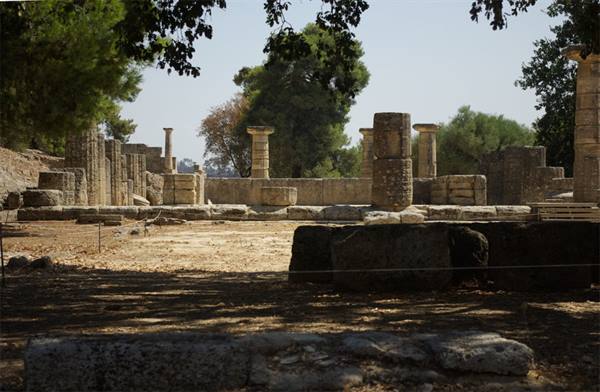
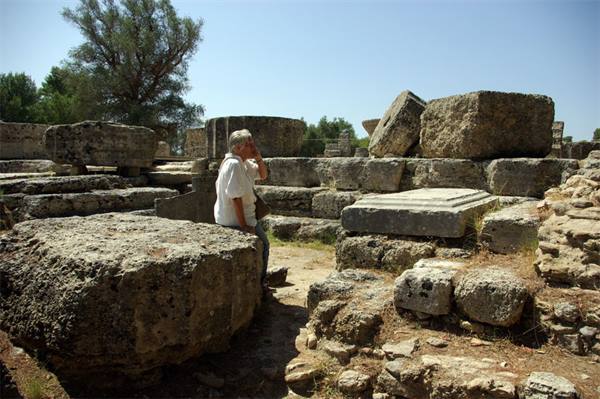
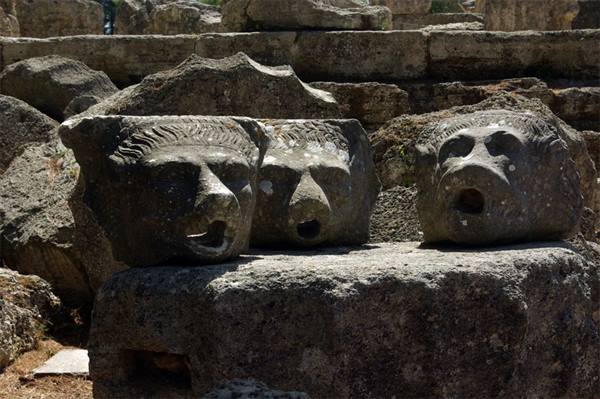
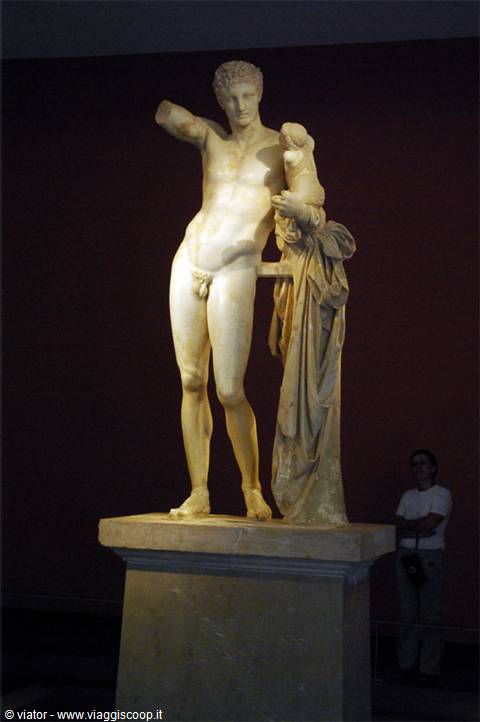
Our reconnaissance stops at the Kaiafa thermal baths, where we meet many people; in such desolation, it strikes us to see people who, at least in appearance, seem calm and serene. With some uncertainty due to doubts about the signage, we reach Olympia; the first impression is not favourable; the present-day town gives the impression of being entirely a monument to tourism and the souvenir trade, like when you arrive at our own sanctuaries, which at first impact seem to have little that is sacred about them; but when we enter the archaeological enclosure, although the ruins prevail, on which time has imprinted its heavy mark, the emotion goes through the roof and, despite the heat, we do not miss a single detail; among other things, we are fascinated by marble column drums on which erosion very clearly shows their underwater sedimentary origin, with fossil shells in plain evidence.
The sacred grove, on the hill overlooking the site, is badly damaged by fire; firefighters are spraying the ground to damp down any smouldering hotspots, but the impression is that here—though we also observed it along the road—they want to show an activism that was lacking at the moment when it would have been needed. Lastly we visit the museum, which contains marvellous finds, well displayed, even if the best pieces are said to be in Athens. The only flaw, ultimately negligible, is at the adjoining bar: a sign declares that you can pay by credit card, but when I show mine, they tell me there is no electricity, a manifestly ridiculous excuse, since everything all around is abundantly lit. Having finished the visit to Olympia, we head for Katakolo, which intrigues us because of its position on a promontory. We join the motorway for Patras.
At Pyrgos we exit; driving through the town we have the usual problems due to the signage, finally resolved by asking passers-by. Racing along a road of unusually high standard and characteristics, we reach the small port town. After a stop at one of the countless cafés facing the harbour basin, we set off in search of a room, without success, until a likeable young man on a bicycle approaches us and guides us up a flight of steps that climbs the hill parallel to the coast. The steps are of varying dimensions, both in rise and tread, painted white and edged in blue; we count quite a few before reaching our destination. A row of low buildings, among the olive trees, white and blue like the stairs, are rooms for rent and the accommodation of the young man and his family, which includes his mother and father, Mr Tsokalas, a former sailor.
We deduce that the three of them have invested money and effort to build this complex, hoping to improve their lives, compensating for the tiring access with competitive prices and the beautiful view enjoyed from up there. On the terrace that gives access to the rooms, we sit at a table savouring the view of the port, the sea and the surroundings, and a nice bunch of grapes offered to us. Monday, September 3 On waking we see a large cruise ship moored in the port, from which numerous passengers disembark to visit Katakolo and do the usual shopping. In taking our leave of our likeable hosts, we have the pleasure of the lowest price requested (€25) of the whole holiday. We look for a place to swim, but the port occupies much of the seafront, so we decide to continue to the next destination: Kilini or Killini, the port of embarkation for Zakynthos and Kefalonia.
We follow the labyrinth of minor roads, and when I am beginning to believe I will never manage to reach Kilini, there the port appears down below. There is also a nice beach with numerous bathers, and we take advantage of it for a good swim. The landscape is pleasant, but not as thrilling as what we have enjoyed for much of our trip; many clouds appear in the sky, suggesting a change in the weather; an overnight stay here was planned, but for the two reasons mentioned above we decide that it is better to head for Patras to return home.
We slip into the bottleneck of the motorway; soon we are nothing but a drop in the whirling flow of traffic; having reached the city of the port of embarkation, once again for the last time we lose track of the sequence of road signs, we go by instinct, and in the end, perhaps not by the shortest route, we plunge into the chaos of the port; there is little time left before the boarding hour, but we manage to secure two deck places.
The lagoon of Gialova
Day 84 Sep 2007
Tuesday, September 4 Having disembarked at Bari, we manage to escape the downpours and thunderstorms, which we see all around, only a few kilometres from Rome; to protect ourselves from a few showers, we put on the rain gear that we have carted around the Peloponnese, without ever having to take it out of its bags. The Peloponnese has fascinated us; if we could, we would set off again at once. The inhabitants are mostly affable and helpful, except when they are at the wheel, of a car or a truck; then they become domineering and reckless, they race like madmen, they overtake, grazing you, everywhere, on crests in curves, ignoring prohibitions; they manage to be worse drivers than us Italians.
The roads are by now mostly asphalted, but the road surface is often rutted both transversely and longitudinally, which on a motorbike is not the best, and there is no lack of slippery stretches, especially in built-up areas. The signage, not always present and complete, is mostly written in both Greek and Latin characters, but not always, which creates problems. A road sign that is completely missing is that of "shoulder not passable", but it is not only the sign that is missing, but almost everywhere any semblance of a shoulder, and the asphalt ends directly, even on the motorway, in gutters, sometimes deep ones, or with a fine step down onto the outside ground. Main roads or motorways often have level crossings; they are, for the most part, single-carriageway, without a median. Still, long live Greece!
Salve!
Innanzitutto complimenti per il viaggio!!!! Siete mitici!!!
Io e mia moglie andremo in Grecia (Atene+Peloponneso) dal 9 al 21 agosto.
Domandona: è un rischio non prenotare dove dormire se si fanno tappe come Olimpia, Monemvasia, Napulia, Corinto, Delfi, ecc ecc?
Di sicuro prenoteremo l'hotel ad Atene per le prime notti, ma le altre vorremmo farle in libertà: per la serie "dove capita capita".
Consigli? Indicazioni?
Grazie infinite!!!
David
(p.s. se mi volete rispondere direttamente per mail: comeilmare AT hotmail.com)























1 reader comments
Salve! Innanzitutto complimenti per il viaggio!!!! Siete mitici!!! Io e mia moglie andremo in Grecia (Atene+Peloponneso) dal 9 al 21 agosto. Domandona: è un rischio non prenotare dove dormire se si fanno tappe come Olimpia, Monemvasia, Napulia, Corinto, Delfi, ecc ecc? Di sicuro prenoteremo l'hotel ad Atene per le prime notti, ma le altre vorremmo farle in libertà: per la serie "dove capita capita". Consigli? Indicazioni? Grazie infinite!!! David (p.s. se mi volete rispondere direttamente per mail: comeilmare AT hotmail.com)