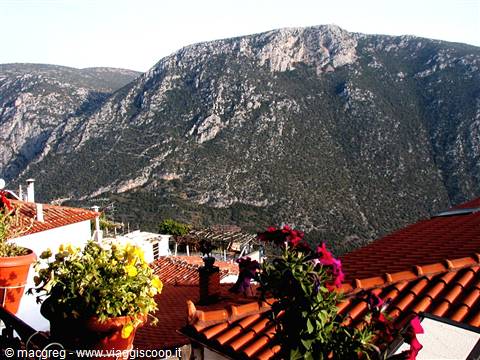
The road leading to Delphi passes through splendid scenery made up of harsh and wild mountains.
Even before arriving, you realize the effort made by ancient civilizations in building such an important site in this territory.
Nestled in a fascinating environment, with splendid panoramic views overlooking a valley, where the gaze reaches as far as the sea, here are the imposing ruins of what in antiquity was called "the center of the world."
..."It was Zeus who chose its location at Delphi: he sent two eagles flying around the earth in opposite directions; the point where they met was Delphi"...
Delphi was the seat of the oracle of Apollo. Here private citizens and high state officials came to consult the oracle before making any decision.
It was up to a priestess in a hypnotic state to communicate with the god Apollo: the questions were handed to a priest, and the answers, though often ambiguous, were heard "almost always" with great respect.
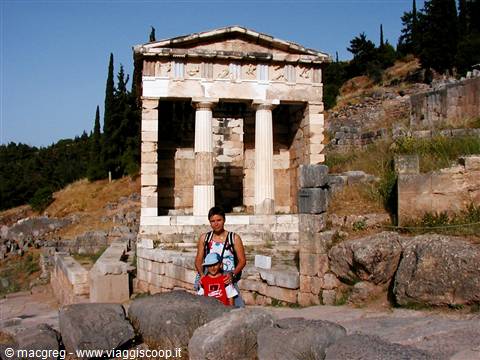
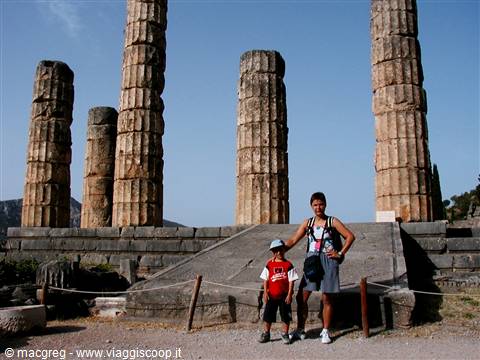
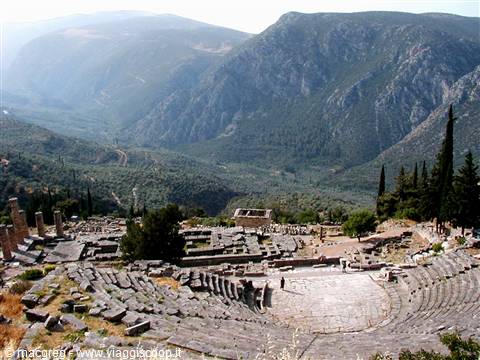
The archaeological site is located on the slopes of Mount Parnassus about 1 km from the center of the town: once past the ticket office, the long climb begins that ends at the stadium. You walk along the Sacred Way, where the offerings of those who came to consult the oracle were placed. Shortly after you encounter the majestic ruins of the Temple of the god Apollo. The exact location of the oracle isn't known, but it's assumed to have been in some chamber inside the Temple. Continuing ever uphill on the slopes of the mountain you reach the grand amphitheater (4th century B.C.).
The last building you encounter is the Stadium, considered one of the best preserved in Greece, just before which you get the best view of the whole valley and the entire site: in the foreground the Theater, then the columns of the Temple of Apollo, while in the distance you glimpse the famous Tholos, the most spectacular construction of Delphi. The ruins themselves, combined with the majestic setting, create great atmosphere.
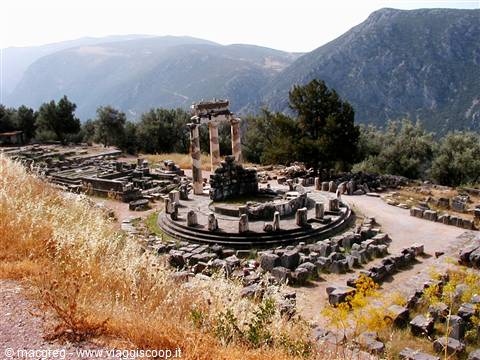
To reach the Tholos you need to go back down to the ticket office, cross the road and continue for 500 m. (better to move by car for those who can).
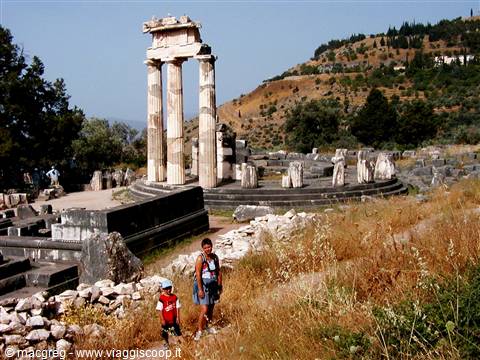
The Tholos is truly magnificent: it's a circular temple consisting of an outer ring of 20 Doric columns and 10 more internal Corinthian columns, by now become the most depicted symbol of Delphi.
Lastly you can visit the museum which collects a good part of the treasures of antiquity.
Admission to the archaeological site alone costs €6, with the museum €9.
In Delphi too there's the summer heat problem, and year-round the problem of large groups, so it's necessary to hurry and plan the visit early in the morning, before 9.
For accommodation there are endless possibilities, from camping to B&B, from 4-star to guesthouse.
Personally I opted for the Hotel Parnassos. A good 2-star, a structure that blends into the somewhat mountainous style of the town, central, decent rooms, terrible breakfast. Price paid for a triple room with breakfast €70, best rate found on Booking.
In the town center there are numerous typical restaurants, practically all lined up along the main street, with terraces overlooking the valley and magnificent panoramas. Decidedly competitive prices, generous portions, dinner for three people €35 based on Greek salad, moussaka and grilled meat with the inevitable Souvlaki (skewer) and lamb, accompanied by Rizi (rice).
Meteora
Day 220 Jun 2006
Meteora
The monasteries suspended in the sky
Meteora: a place long desired, and which did not betray my expectations.
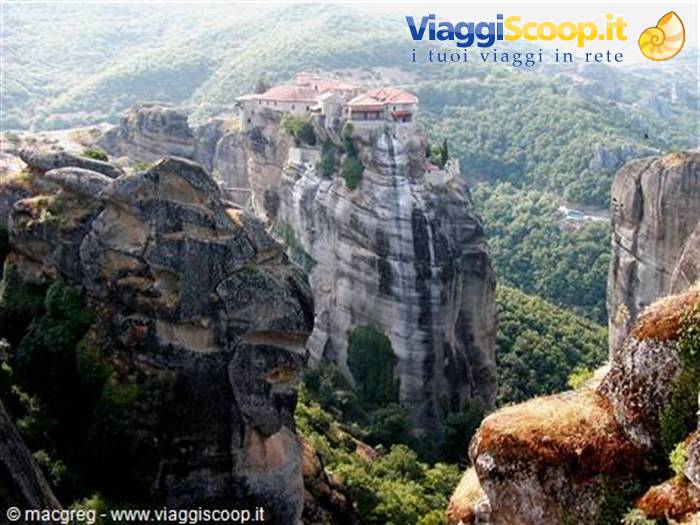
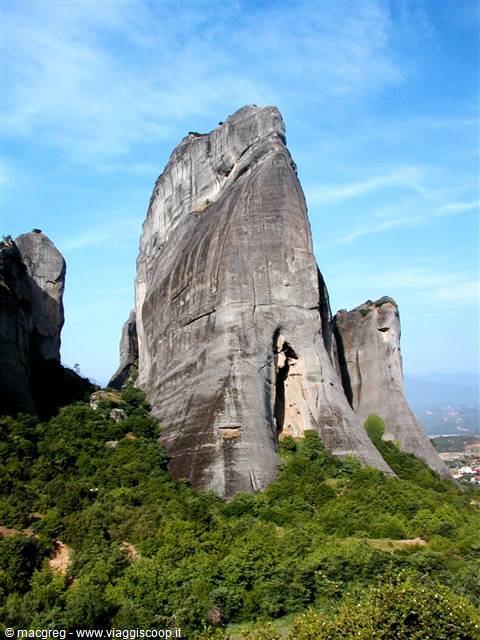
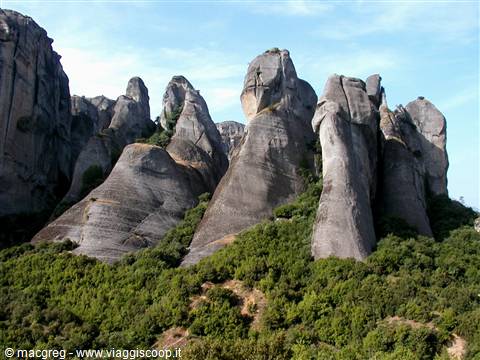
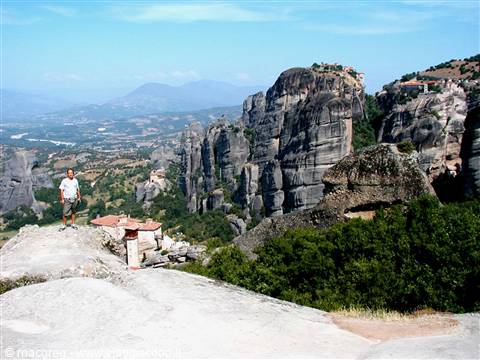
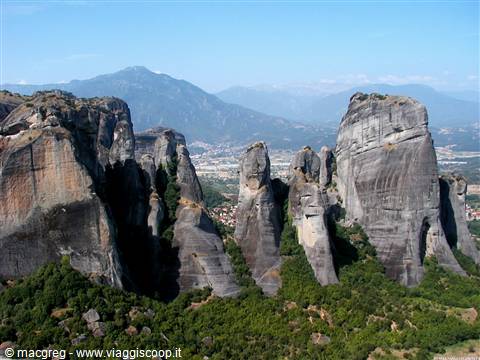
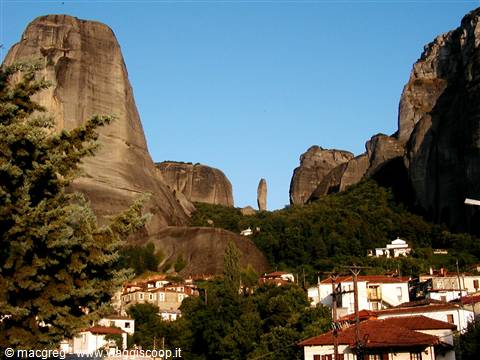
As soon as you take the road that penetrates among the majestic pinnacles, which rise impressively popping out of nowhere, you realize you've arrived in one of the most bizarre places that can exist. But nature wasn't enough: man wisely enhanced the environment by building, in a way that's to say the least daring, a series of monasteries right on top of the pinnacles. A majestic work, an emotion for the eyes. An emotion that grows as you proceed along the road, until you reach the foot of the first monastery, where the gaze wanders 360° in search of the most evocative corners. And here's another monastery, then another still...astounding!
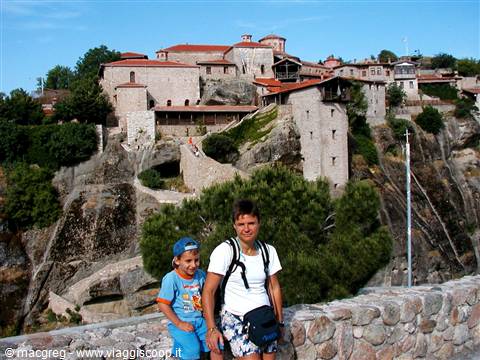
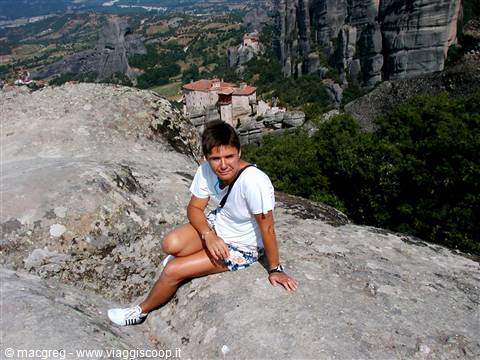
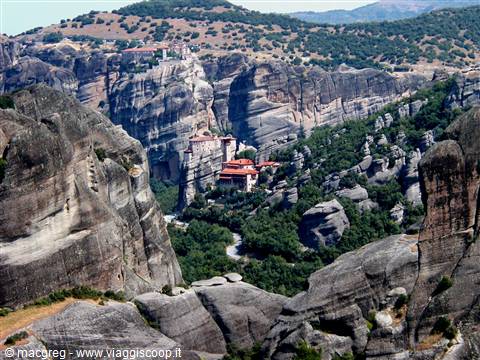
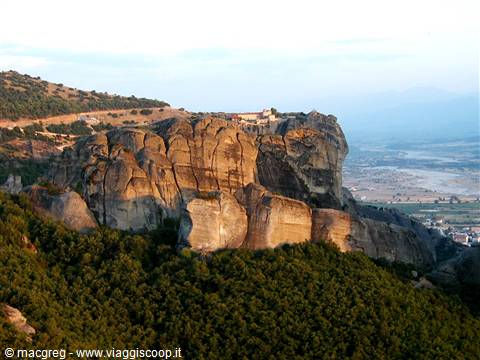
Impressive is the contrast with the green at the base of the pinnacles and the smooth rock that juts toward the sky, and the monasteries that seem suspended up there, almost unreachable. And yet unreachable they are not: you access them via staircases carved into the rock, a breathtaking climb both for the path itself and for the incredible view of the whole valley with a series of pinnacles of the most bizarre shapes, which seem endless.
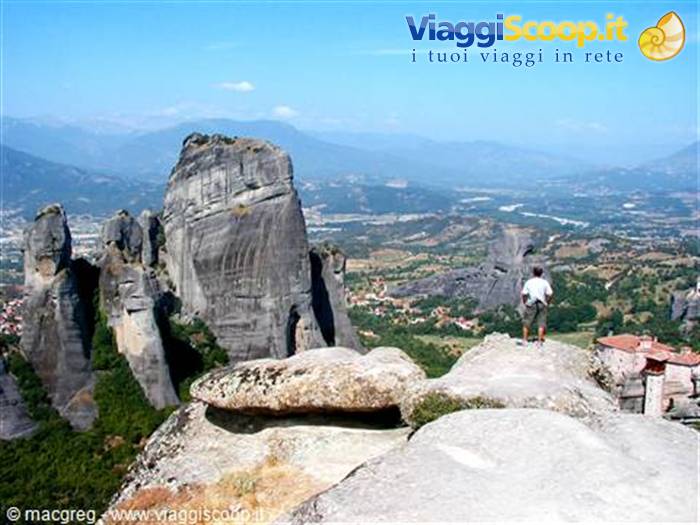
At every curve a different view opens up, a new enchanting corner, another frame for taking an unforgettable photo. But it's still nothing compared to what awaits me from the top of the last rock of Agia Triada, the most austere, the only one where the number of monks exceeds that of tourists: the wind blowing strong, the sense of vertigo looking into the void, the bell ringing and then....silence, peace; it feels like being in a lost time.
The monasteries date back to the 14th century. It seems that the hermit monks who lived in the valley were driven to build their monasteries in these unreachable places to defend themselves from the raids of the Turkish populations. At that time, to reach the top, hoists were used: some of these are still in operation to transport materials and provisions and the one at Agia Triada, though modified, still transports people.
The starting point for visiting the area are the towns of Kalambaka and Kastraki, built close to Meteora. From here starts the winding road of about 10 km that crosses the entire area and allows you to reach all six visitable monasteries, while others are closed to the public. The entrance cost for each individual monastery is €2, and skirts are available to cover bare legs. The climb to the monasteries isn't very tiring and takes about 10 minutes for each one. Each monastery consists of the katholikon (church), the courtyard, the cloister and the monks' cells (not visitable because currently inhabited).
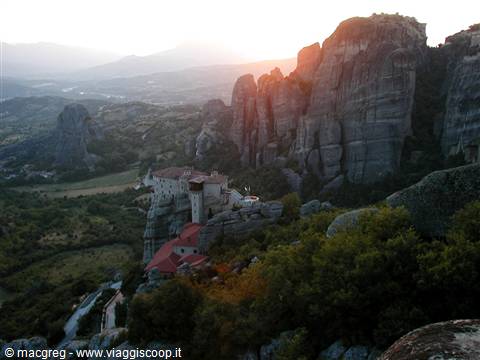
The first monastery you encounter is Moni Rousanou, perhaps the most incredible construction because it occupies the entire base of a pinnacle. The road continues to a fork: turning left you reach Moni Megalou Meteorou, the most visited monastery and without doubt the richest in the area. Built on the highest pinnacle at a height of over 600 m, it has a church richly decorated, as well as the cellars that preserve the ancient work tools used by the monks. From the courtyard you can enjoy an unforgettable view, with Moni Varlaam, built on a pinnacle right at our feet, which you access via a wide and spectacular staircase literally carved into the side of the pinnacle. Returning to the fork and taking the right, you reach Agias Triados, in my opinion unmissable because, being the least visited, it preserves the quiet and austere appearance of times gone by.
It also offers the most spectacular view of the valley, overlooking Kalambaka below. Shortly before the monastery, on the right, a short path leads to an incredible panoramic point: here we're right on top of a pinnacle, and the last rock is placed without any protection, sheer over the valley; it's dizzying. The 360° view is to say the least exciting: you can see 5 monasteries in a row and the most incredible rocks of the whole area. The last monastery you encounter is Agiou Stefanou, one of the largest and most visited and which houses an order of nuns. Although all the monasteries can be visited in a day, it's less tiring to split the visit over two days. Moreover, some observe a closing day per week on a rotating basis, so you'll find at least one monastery closed on the same day.
For accommodation you can choose between Kalambaka and Kastraki, practically joined together. The first offers more choice of hotels, the second is in an even more spectacular position and has many B&Bs, rooms for rent and elegant restaurants. I opted for the Hotel Orfeas, an excellent 3-star, elegant lobby, huge pool to cool off in the scorching afternoons, very large rooms, good breakfast. Price for a triple room €80, best rate found by contacting the hotel directly. For dinner there are many convenient taverns with typical Greek cuisine and grilled meats.
After dinner there are some places in the center, but my advice is to leave behind sounds and noise and go back up there, to admire one of the most unforgettable sunsets: the tourists have finished their visit, silence reigns, the sun slowly sets behind the highest pinnacle illuminating the last monastery: perhaps, the one before me, is exactly the same image as 700 years ago; perhaps, tonight, I've understood the secret of the time machine...







0 reader comments