We set off on 17 August 2005 from our beautiful Sicily to board at Brindisi for what we had been told was a really lovely island. I chose "A Corfu Dimension" as the title of this little travel tale precisely because in some parts of this fantastic island you certainly find yourself in another dimension, where time and places dress in unique colours and scents that together bring to life atmospheres capable of wrapping even the most stressed tourist in a relaxing, deep and warm embrace. But feelings are hard to describe, so I'll start by describing our adventure!
Day 118 Aug 2005
The arrival
On August 18 we land in Corfu. It's 6 in the morning and all is silent in a Kerkyra that is beginning to wake among faint glimmers of light. Having left the port we head toward the CorfùMare agency, where incredibly but truly, Claudio was there waiting for those who for Corfu are ordinary tourists, but for him are "pargoli" to be assisted (great Claudio!). We arrive at the agency and after enjoying a really good espresso "Dal Salernitano (I don't remember the name!)", we decide to take a first stroll around the center of Kerkyra and head toward the center, that is, toward the Spianada.
We walk along the road that skirts the port, strolling first under the New Fortress and then venturing into a first reconnaissance of the city's alleys where the atmosphere is that of "ladies and knights", that is, you find yourself taking a plunge into the past among welcoming alleys where you can't help but stroll even without a specific destination. We spend the afternoon at the enchanting Dassìa beach, where it almost feels like being in a splendid "natural" pool: in short, a true enchantment. The evening passes while we sit at the Spianada, which with the lights of the night becomes a truly romantic little spot; here I decide to try a typical Corfu liqueur without, alas, asking about the main ingredients of this "drink"...
in short, I order an Oùzo and I'm served a glass with a white liquid and a glass with some water; believing the water was just to quench my thirst, I drink the white liquid which perhaps would even have been good if I had diluted it with the water they had served me - something that should have been done but that I only discovered afterwards, and if it hadn't been a strong concentrate of an herb I hate, anise
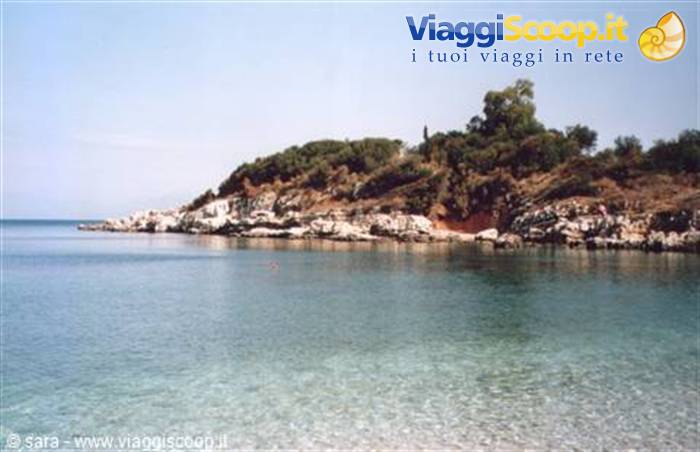
clear turquoise water in front of white rocks and green hillside
Day 219 Aug 2005
First day
After recovering our strength (exhausted during the journey), on the 19th we begin our exploratory tour heading south toward the Achillion, located near Gastouri (where you can enjoy an excellent bread baked in a wood-fired oven). At Achillion there is the famous building that was once the residence of Queen Elisabeth of Austria (also Princess Sissi): the palace, in neoclassical style, is surrounded by a wonderful garden where there are numerous statues (of Shakespeare, of Achilles Victorious and Triumphant, of Lord Byron and of the nine muses). Having left the princess's residence we continue our tour, passing through Benitses where, just as we leave the town, we glimpse the remains of the Kaiser's bridge (Wilhelm II), a bridge that once joined the Achillion to the beach to facilitate the Kaiser's access during the period when the Achillion became his property.
We continue heading south, and venture into the village of Moraitika, where strolling through the alleys we meet a kind and friendly old man who speaks a little Italian; after a pleasant chat we buy from him (after having been in his cellar) some really good olive oil, obviously Greek and homemade: a real feast for our taste buds! On the walk that takes us back to the car, we stop to help two Greek ladies who at that moment are unloading wood from their overflowing off-road vehicle: happy with the noble gesture, they kept repeating: "Italiano bravo, bravo italiano...". Really nice. For lunch we stop at Spyros on the beach in Messonghi where, besides a nice beach, there's the mouth of the river of the same name.
It's our first Greek culinary experience and we decide to try Gyros and Souvlaki, and it's also the time we fall in love with the divine Tsatsìki (a treat!) which will become the very welcome torment of my travel companion. The afternoon continues at Korission Lake, an elongated lagoon that extends for about 600 hectares. The surrounding fauna and flora are interesting, in fact more than a hundred different species of birds have been observed here, numerous wild ducks, cormorants and grey herons, all in the vicinity of a particular grove on the sand made up of cedars, white lilies and various types of orchid.
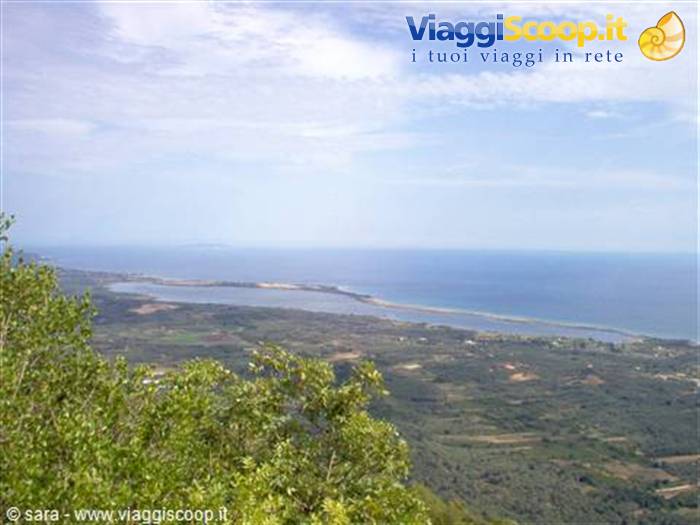
But the real spectacle awaits us; in fact, after a quick visit to the remains of a 13th-century Byzantine castle located near Gardiki, we begin the climb (by car along paths immersed in an endless and suggestive olive grove enriched by wonderful oaks) toward Aghios Matheos where, even higher up, we reach the monastery of Pantokratora (south). Once up there we walk into the woods and find the post of a very friendly man (I believe belonging to the forestry corps) who in crystal-clear English tells us many things about the place, the island and the monks who live on the mountain. From here the view is stupendous: an immense panorama in which the sand dunes of Lake Korission seem to be painted on a canvas...
it almost feels like being inside a postcard! Having finished our daily tour, tired and satisfied, we head home to end the day beautifully at Dassìa in the Edem venue, a very nice place on the beach where we conclude the day with drinks and Koùm-Kouàt (a typical Corfu liqueur made from Chinese mandarins: a delight!).
Paleokastritsa
Day 320 Aug 2005
Second day
On the 20th we spend the morning in what I think is one of the most beautiful places on the island. Obviously it's a matter of taste and perhaps Nissaki is my favorite beach (though choosing among the wonderful places of Corfu is truly hard). Nissaki beach is a tiny cove of white pebbles where the sea is particularly crystal clear and the water quite "cool". Perhaps this corner impressed me particularly, besides for the panoramic setting, for its size; in fact, due to the limited space, it seems to be a little spot for just a few intimates: truly a love.
For lunch we move to a taverna by the sea at Kalami bay, yet another very beautiful cove where the White House (not the American one!) overlooks, where the Lawrence brothers (writers) lived, while for the after-lunch coffee we linger at the delightful Venetian little harbor of Kouloura (stop a little further up on the main road to take some photos of the little harbor seen from above!). For a quick dip after lunch we opt for the less crowded Imerolia (a small beach a little above Kassiopi), after which we spend a few hours in the touristy Kassiopi and it's the turn of the "Greek coffee" experience: there are things you have to try in life. And objectively it wasn't even that bad, although I strongly advise you not to swallow what's left at the bottom of the cup especially if you're...
"weak-stomached"! Having concluded our carefree shopping among the delightful little shops (which, by the way, are present in almost all the localities), we continue toward a destination that certainly attracts the attention of a tourist from Catania: the destination is Zigòs. It's a village with few inhabitants where there's a church perhaps unique in all of Greece, unique both for its year of construction (1536) and for the Saint to whom this ancient building is dedicated: Agia Agathì (our patron Saint Agatha!). Having concluded our tour we head home among the various iassù (hello), kalispera (good evening) and the various smiles of the welcoming and hospitable Greek population (especially the elderly). We spend the evening in the venues of nocturnal Gouvia, and wandering among the souvenir shops that stay open until late at night.
Paleokastritsa
Day 421 Aug 2005
Third day
Day 21: it's the turn of Sidàri. We head toward the well-known locality where the so-called Canal of Love is found. The beach, at times clayey, is interrupted by large rocks of friable stone shaped by water and wind (in these rocks you'll find several carvings by lovey-dovey couples of lovers): all of this, combined with a sea that seems to be a sheet of glass, makes the landscape truly unique. We move for lunch, heading toward Afionas. From up here the view is spectacular, and I recommend taking advantage of it to take some photos with the island of Karavi as a backdrop; it's said that this island is the petrified ship of the Phaeacians (Pliny's version), while in the area they tell of Queen Pamflagona, who reigned over the city of the same name.
Once the queen's husband set off to fight a foreign queen, with whom he eventually fell in love, and after bringing her onto the ship he tried to escape together with her. Pamflagona, betrayed, invoked St. Nicholas, who punished the unfaithful husband by turning his ship to stone. To stay on the theme of "fairy tales", at Afionas we enjoy a fabulous Moussakà which apparently has a lot in common with the "divinities" of the place. We spend the afternoon at the beach of Aghios Georgios (a beach made of pebbles in the southern part, and sand in the northern part). We end the evening with a walk along the seafront of Ipsos, and then finish by "cutting a rug" at the Blue Bay in Dassìa.
Paleokastritsa
Day 522 Aug 2005
Fourth day
We spend the morning of the 22nd at the beach of Kassiopi. The sea here has been nicknamed by many "The Pool" (not wrongly!); this small expanse of white pebbles is also very welcoming and the seabed offers a truly beautiful spectacle. As usual, for lunch we decide to move and this time chance takes us to Agni, a less frequented cove but no less enchanting than the others! Here we have lunch at Nikolas who delights us with Ghemistà, a dish based on lamb (whose name I don't remember) and with Imam Baildì aubergines (all truly exquisite!); because of a tasty nectar of the Gods (local wine) we spend our afternoon in the arms of Morpheus. In the evening we get moving again for a fun tour among the souvenir shops (the Olive Wood shops are beautiful, full of artisan objects made by shaping the local olive wood: the scent of these shops is unforgettable and indescribable...).
Paleokastritsa
Day 623 Aug 2005
Fifth day
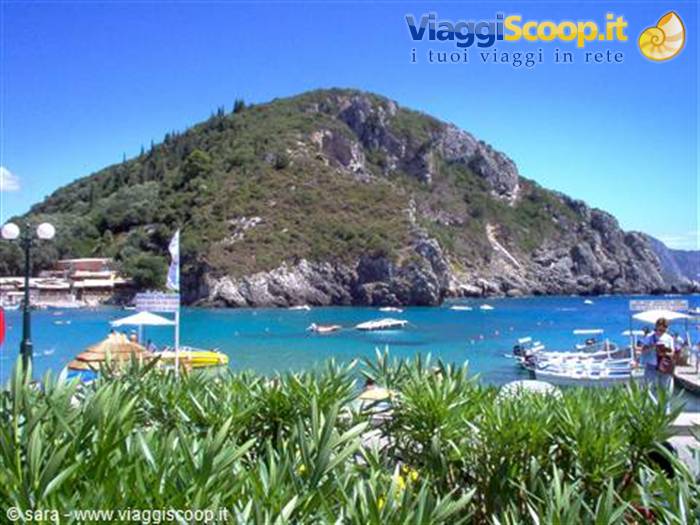
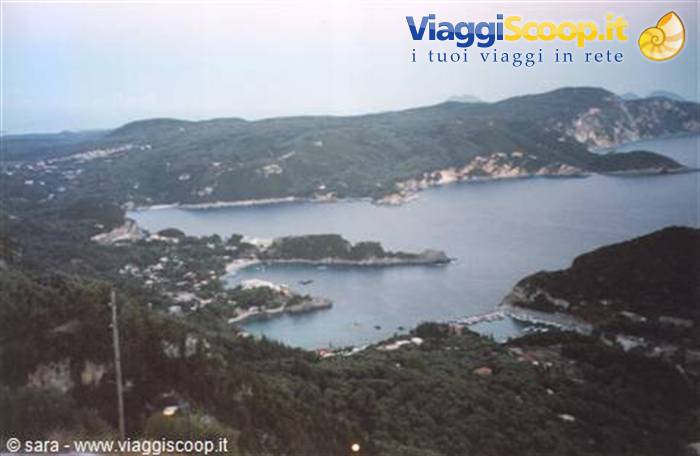
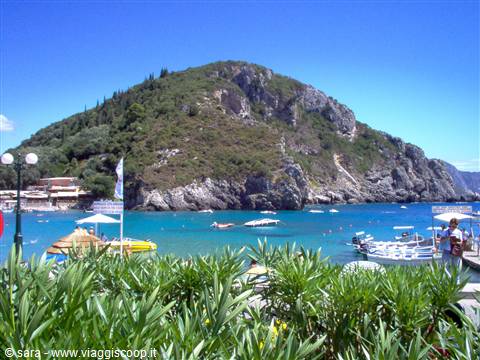
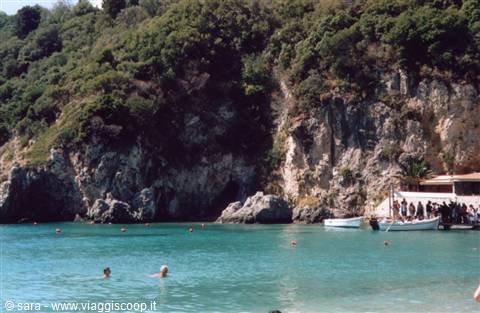
The weather conditions on the morning of the 23rd are not on our side... in other words, the storm we're immersed in doesn't leave us indifferent. However we decide to set off for yet another day of wonders. The destination is Paleokastritsa. One of the positive surprises of the day is that as we move we leave the storm behind us, and once we arrive in Paleokastritsa the sky is splendidly blue. We climb up to visit the monastery of the Panaghia, a place where you breathe a surreal tranquility. Needless to say, the monastery is truly a love: it has completely white walls and the little paths inside it are adorned with brightly colored and splendid flowers. Inside we visit the museum and here we admire beautiful Byzantine icons. After leaving the monastery we head toward the beach. Paleokastritsa is made up of two peninsulas and six enchanting bays.
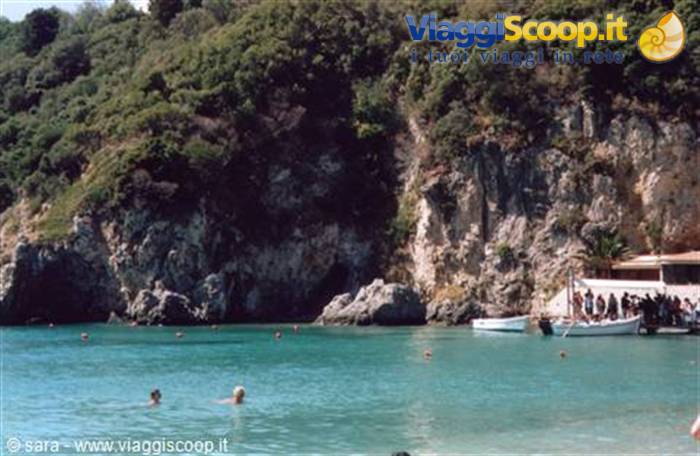
The combination of lush vegetation, wonderful seabed, rocks plunging into the sea, sandy beaches and a sea of indescribable colors makes this place truly enchanting (but for my taste it's a bit too "touristy"). After our very relaxing dip and sunbath, we have lunch with an exquisite Pita Gyros accompanied by a thirst-quenching Nescafé Frappè (a drink much consumed all over the island). Around 19:00 we head to the agency of the very friendly Claudio and Chrystos (who as always reserve for their clients a welcome that has no equal). The evening is dedicated to the Moussakà kindly offered by Claudio at the restaurant "Castellino", at an altitude of 300 m above the village of Làkones.
Once at the restaurant we enjoy the so-called "Bella Vista" over the Mediterranean: practically a terrace over the sea and over the bays of Paleokastritsa that are so beautiful they seem fake!! We end the evening with... local wine and, alas, with another substance to fight my unexpected sun rash (miraculous the advice given to me by the great Claudio, who in turn received it from a wise old Greek woman).
Pantokrator south
Day 724 Aug 2005
Sixth day
Day 24 we decide to change the "Dips & Sunbathing Day" program (also because of my sun rash) for a trip to Mount Pantokrator. The Pantokrator is the highest mountain on the island (917 m) and needless to say, from the summit of the mountain you can admire a beautiful panorama. At the top we visit the suggestive monastery (it was built in 1347 and later destroyed and then rebuilt later toward the end of the 17th century): the air here is very "crisp" and the place is surrounded by a tranquility that apparently is very familiar to Corfu. After taking a few photos we start descending, opting for a dirt road, or rather I'd say "bumpy" road, that from the top of the Pantokrator takes us to Perithia (the bumpy road earned us about a kilo of blackberries collected along the way). In Perithia it really feels like being in a film...
in fact this village was abandoned in the 20th century and currently has only a few inhabitants (probably fewer than 10!), inhabitants who I believe are the same people who run the three Trattorias in the town. Having lunch here and wandering among the houses half-destroyed by time was perhaps the most beautiful moment of the entire vacation; in short, magic for those who want to relax in every sense and for those who want to delude themselves, even just for a little while, that time can somehow be stopped.
Vlacherna
Day 825 Aug 2005
Last day:"The tour de force!" :-)
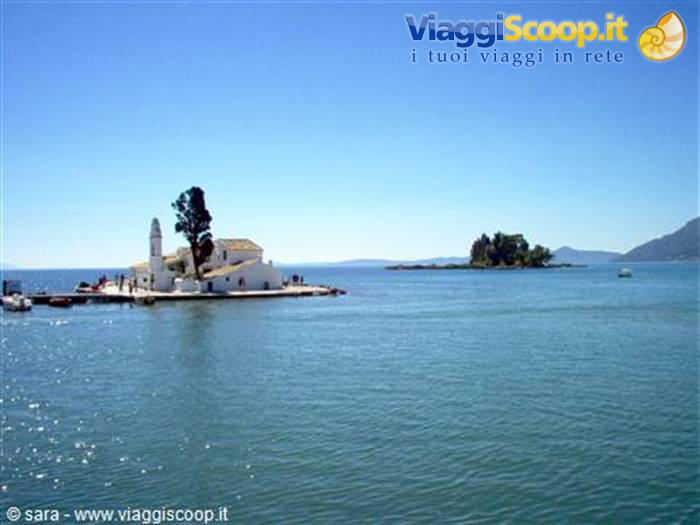
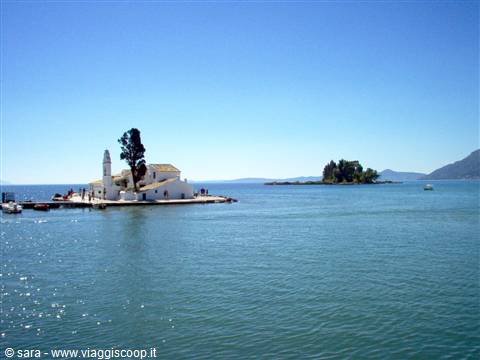
Day 25, alas, is the day of departure. The program for this sad day included a "tour de force" that we managed to follow only in part. The first stop is Kanoni, a locality just below Kerkyra with a view over the Chalikiopulos lagoon, the Vlacherna monastery and Pontikonissi (called the mouse island because of its shape resembling that of this animal). The monastery, which is joined to the mainland by a narrow passage, is truly enchanting... it's said that this, with the island of Pontikonissi as a backdrop, is the most photographed landscape of the whole island. Here too it feels like being inside a postcard! We continue our tour, stopping at Paleopoli.
Near the entrance, which initially was the residence of the English governors and later became the summer residence of the Greek kings, we see the remains of a temple dedicated to Juno and the remains of the Basilica of Paleopoli dedicated to Aghia Kerkyra (Saint Kerkyra). We head toward the former royal residence, and spend quite a while on the little paths immersed in the large garden where the royals spent part of their time. Inside the residence we visit the Mon Repos museum, while wandering through the garden we continue toward the remains of a Doric temple (which compared to the other temples has been preserved fairly well). Having left the gardens, the program includes a visit to the monastery of Platytera.
Here the little church is truly a love, full of very beautiful frescoes including the one portraying the Madonna of Platytera (larger than the heavens); moreover in this monastery are buried Count Giovanni Capodistria (first president of Greece) and Photis Tavella, revolutionary hero. For lunch we return to Kerkyra and, after having lunch in one of the characteristic alleys, we decide to aid our digestion with a nice climb up the New Fortress. The construction (excluding the internal buildings which are the work of the English) was built by an Italian architect and is considered a true miracle of defensive architecture! Inside you'll find a bar, a gallery and a hall where art exhibitions are organized.
We hop among the imposing walls and reach "on the top": is it necessary to say that even from up here the panorama is wonderful? In fact from the highest point you can admire the entire city, the nearby Greek coasts and the islet of Vido which is only 1,200 meters from the Corfiot coast (in the past, to communicate between the different points of the city, underground tunnels called "Mines" were used and it's said that Vido is connected to Corfu by one of these tunnels). Having concluded the tour of the New Fortress, we decide to make a stop at the Spianada, the large square once used as a training ground by the Venetian army and which owes its existence to strategic reasons; today it's also known as the largest square in the Balkans.
Sitting comfortably at the Liston (the street with arcades, the work of the French, in the western part of the Spianada) we finally taste the Tsitsibeera (a drink produced only in Corfu, made with lemon juice, lemon oil, chopped ginger -ginger- water and sugar: really good!), which because of me was one of the running gags of the trip (another running gag was the phrase:"Ops... well look at that: an olive tree!". This is because Corfu is truly an immense olive grove, just think that in the 18th century there were about two million olive trees!). Together with the Tsitsibeera we delight our taste buds with a really good dessert: the Galaktoboùreko (really good and less sweet than the Baklavàs which is anyway, if consumed in small doses, quite good).
After recovering some strength, we go to admire up close the Royal Palace (a beautiful Georgian-style building where you'll find the Museum of Asian Art), after which our tour continues with pleasant strolls among the little streets of Kerkyra, interrupted by the continuous browsing among the many souvenir shops that you'll find even in the smallest alley; during the walk we see the Church of Saint Spyridon (Saint of the Corfiots) where the Saint's relics are kept; thanks to Claudio's guidance I learned that some Corfiots believe that Aghios Spyridon goes wandering around the city by himself, and every year the people of Corfu donate a new pair of slippers to the Saint, because it's maintained that the old slippers are found worn out from use! The walk continues with a visit to a Catholic Church (I believe there are few since most Corfiots are Orthodox) and the Town Hall where nearby you
can see the monument to Admiral Morosini mutilated (again from Claudio's guidance, I learn that the monument was mutilated just as the Parthenon of Athens was after the infamous bombing ordered by Morosini himself in 1687). Our tour ends for lack of time and above all of energy! We conclude the day first at the agency in the company of Claudio and Christos and then in a delicious restaurant (recommended to us by Claudio who as always dispenses very useful advice!), where we will conclude our trip with an exquisite dinner (whoever says Greek cuisine is awful has in truth never tasted any Greek dish!). Our trip ends with the hope of being able to return soon to Corfu to continue exploring what is perhaps the slightly less touristy part of the island... One more special thank you goes to Claudio and Christos for the enthusiasm and professionalism with which they do their work.



0 reader comments