Gortys, Chania, Rethymno, Matala, Heraklion · ISOLA DI CRETA
When
2 Oct 2005 – 9 Oct 2005 8 days · trip of 2005
Who
Paolo Silli · @americaneagle · Gorizia
How
Travel diary
The story · 8 days
During my stay on this island I visited archaeological sites (of world renown) and some towns. This time, unlike the last (and first) time, I'm not dividing my travel diary into days but into episodes.
Day 12 Oct 2005
PREPARATIONS AND FIRST HICCUPS
Before facing the winter I decide to grant myself a proper vacation: all inclusive served and waited on. After deciding the destination of my trip, narrowed down to three or four Greek islands, I start looking at numerous catalogs. After a few days, either because of the end of the (Italian) season or because of exorbitant prices or, on the contrary, too low (are they hiding something?), picky as I am in these cases I decide to leave with a tour operator that is part of a very large group in the tourism sector so as not to have surprises. After contacting the travel agency where I am by now a regular customer (given their availability and seriousness), I decide on the island that will have me as a guest: Crete and more precisely the locality of Alonissos near the capital Heraklion, located on the northern coast and in the center of the island.
A few days later I receive the summons at the departure airport for 07.00 on October 2nd and where I read (and still read) that, after the distribution of the plane tickets to all the participants, around 09.00 the aircraft was supposed to leave. Reading those sheets of paper I thought that, getting up very early to drive the car for about 270 km, I would anyway enjoy the vacation more under the Mediterranean sun, at the expense of a few mugs of beer and Central European foods offered to me by the Goritian festival "Gusti di Frontiera" that right in those days was livening up the city of Gorizia. All thoughts that, having become dreams, would become reality... but I was wrong...
and badly too!!! Two days before departure I receive the second summons (which obviously cancelled the first) in which I was informed that the departure airport had changed (making me gain 67 km) and that the appointment was for 19.20 with departure at 21.20... AAAAHHH!!!!!!!!! This meant losing an entire day just for the trip, contrary to the first instructions!!! The agency immediately contacted the tour operator (famous for its seriousness) but, upon the request for a refund for over 12 hours between the first and second summons with the related loss of the "on-site" dinner with all the trimmings given by the all inclusive, I was told that they could not refund what was requested. Being already with my mind in those shores, I decided to make the trip anyway, reserving the right to present a formal request upon my return.
The date of departure has now arrived (October 2nd of this year) and, after facing in the rain the 200 km that separate Gorizia from Verona, I reached the departure airport. Finally at 22.00 the plane lifts off without any other problem (apart from the fact that at the air security check I was the only one who had to take off my shoes). Let the parents of small children not hold it against me (I have a 2-and-a-half-year-old niece;) but flying with little ones around is quite "stressful" (always ask for seats in the middle or at the back of the aircraft, never at the front since these are reserved for families with children); if you then add the fact that the person in front of you "plays the boss" with their seatback almost reaching your face, given the scant space between one seat and another, I've said it all...
Around 23.00, while we had almost passed halfway through the trip, the sad and shocking news: due to a malfunction of the plane we had to reach Malpensa airport. We later learned that there had been an anomalous lighting up of a warning light related to the braking system and that on the Lombard runway, being 3.5 km long, we would have run no risk at the moment of landing. We were also promised that upon our arrival we would find another aircraft ready to take us to our destination. Dismayed by the news, but reassured by the crew about the inconvenience, we landed without any problem: therefore, and fortunately for us, the fault was in the lit-up warning light and not in the brakes. Inside the Lombard terminal another bitter news: the aircraft, given the lack of crew, would not leave until 08.00!!! AAAHHH!!!!!!! (the second and last - fortunately).
So, in addition to the damage, of course, the mockery!!! The funny thing was learning all of it by word of mouth, since the ground hostess, bearer of the bad news, did not have the possibility of having a PA system: something that suddenly appeared when something close to a riot formed! The main problem was not so much the anomaly detected in flight (the decision of the pilot-commander was certainly right), but the mockery about the promise to leave immediately. I decided, like part of the unlucky ones, to spend the night in the airport terminal, since spending two hours in a hotel room (as proposed to us) was absurd. At least, chatting with my fellow unlucky travelers or reading the book that I had promised myself to leaf through under the Greek sun, those few hours passed quickly.
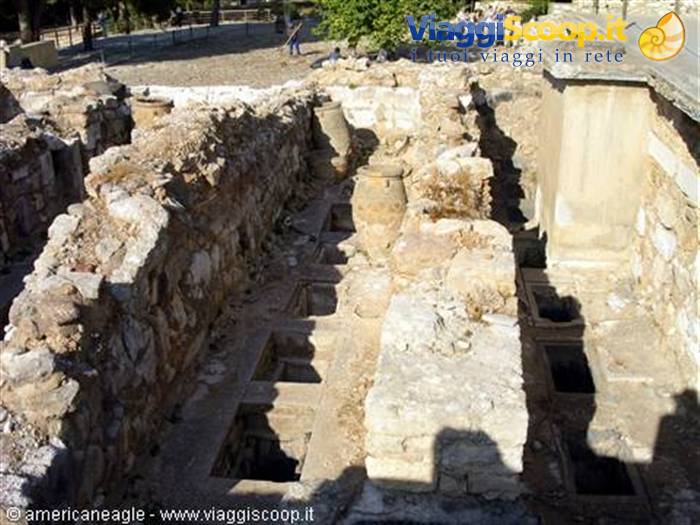
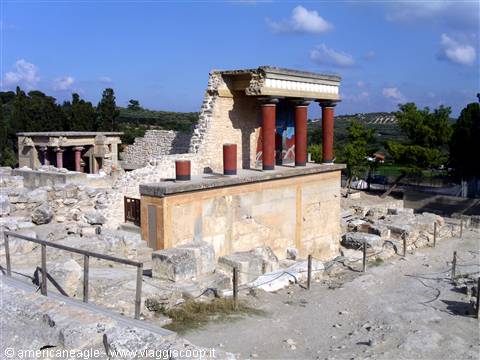
Palace of Knossos
Day 23 Oct 2005
WE MADE IT... (luckily)
Finally, around 08.00, we managed to leave without further hitches to reach the Hellenic island around midday. At the arrival airport, and more precisely in the baggage claim area, there was a tremendous chaos caused by hundreds and hundreds of people waiting frantically for their suitcases (which arrived with tremendous slowness on only 4 conveyor belts) and an enormous coming and going of carts. Then, the continuous arrival of aircraft fueled it all. Strange for an island that swallows up thousands of tourists every day. Finally, after a few minutes by shuttle bus, I reached the hotel where, together with other travel companions, after check-in I headed to the dining room, literally throwing myself on the buffet: the hunger (and not only mine) was great.
Having arrived in the room and already savoring the first contact of the sun on my skin I took a healthy shower to wake myself up well, after the nap on the plane, and (sigh) I settled "temporarily" on the bed. Every now and then, when you sleep, it happens that you suddenly open your eyes because your unconscious warns you of "something" that upon your full awakening is all too clear&... It was by now 19.00 and after unpacking the duffel bag (by now a companion of many trips) I headed to the dining room. During dinner I noticed a slight detail: while the other diners already had a nice red color I still had a mozzarella color, a color that I fully intended to transform into "Ferrari red" (me bronzed, no!... I don't like it!).
At the end of dinner and while waiting for the evening entertainment of the staff I sat at the bar counter for the classic espresso and for the classic "coffee-killer". I must say that the classic espresso, which we Italians love so much, was quite good: in the end, after seeing the bill, I decided that abroad espresso is a coffee that we desire so much while its price is not! Here I want to open a parenthesis and talk about a person whom I had the pleasure of meeting and getting to know: the barman. Remember (write it down somewhere) that making friends with the barman has its rewards: first, he tells you so much about the customs and traditions of his country, he always knows some tips about the places around the hotel and, lastly, he waters his stories.
In this case with local grappa offered by him (in Greece refusing a shot is an offense and I, in these cases, never want to offend!!!). Numerous were also the anecdotes with which he entertained yours truly together with the travel companions I met and with whom I still keep in touch. Just to mention one, he told us that in August, when the facility is fully at the mercy of the kids, one of them, just for the fact that the drinks were free, had drunk in one afternoon a good 25 glasses of Coca Cola!!!!
The capital Heraklion
Day 34 Oct 2005
PALACE OF KNOSSOS AND THE ARCHAEOLOGICAL MUSEUM
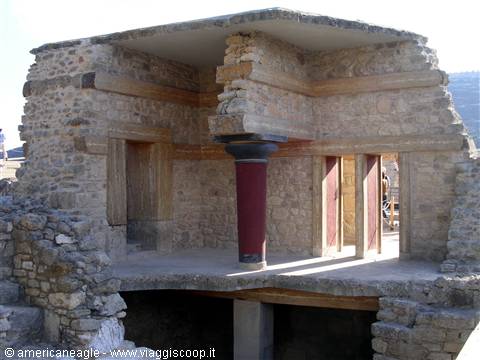
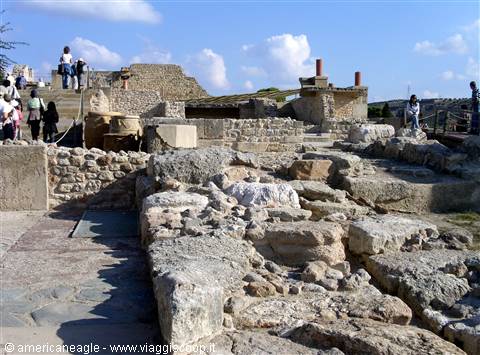
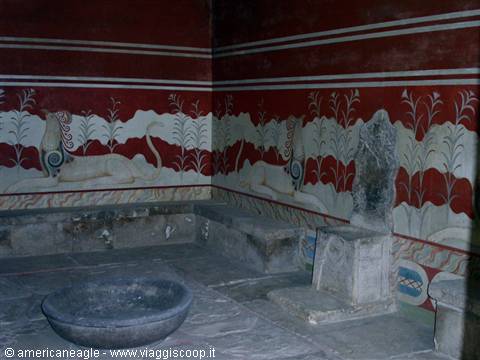
All of Greece, by now it is known, is rich in archaeological sites and obviously the island of Crete is no less. They are the Palace of Knossos, the Palace of Phaestos, and the old city of Gortys (Roman capital of the island). But let's go in order. The Palace of Knossos, located in a small valley a few kilometers from Heraklion, was the seat of the famous King Minos and his Minoan Civilization. Moreover, according to Greek mythology, this was the place where the "Minotaur" was imprisoned, a man with the head of a bull, son of Europa. Its complex structure with many floors (up to five), corridors and colonnades gave rise to the legend of the "Labyrinth". It appears to have been first erected around 2000 BC and in the following decades repeatedly destroyed (due to earthquakes and fires). The archaeological site was discovered around 1900 by the Englishman Sir A.
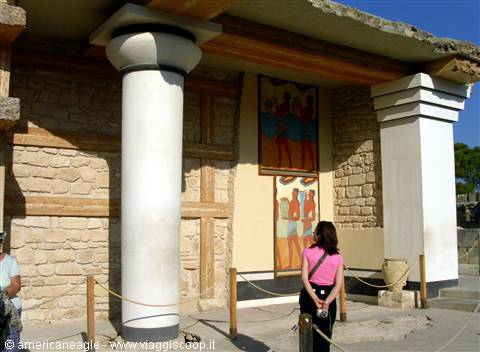
Evans who, aware of its importance, restored the palace in his own way even though at the time other colleagues of his were (rightly) opposed. In fact, studying its remains, he erected parts of the construction visited daily by thousands of tourists. However his studies and restorations helped to understand, in the following years, much about the life of the Minoans. A population that expressed the maximum in physics, engineering, architecture, politics, economy and religion. Suffice it to think that in the palace they used an excellent water system (both for clean water and for waste water) and a ventilation system to bring fresh air into all the rooms.
Moreover, since manual "linear A and B" writing had not yet been invented, they used stamps that imprinted symbols related to the pronunciation of syllables: in order to chisel these small primordial printing characters they used magnifying lenses extracted from rock crystal. Their laws, handed down orally until about 500 BC, turn out to be much more fair and just than many current ones: they regulated the social life of everyone, from man to woman (with equal rights and duties), from nobles to slaves (who had numerous rights), from divorced couples (who saw their assets equitably redistributed) to their children, from widows to orphans, etc. and the death penalty was repudiated even though the crimes prosecuted were very numerous.
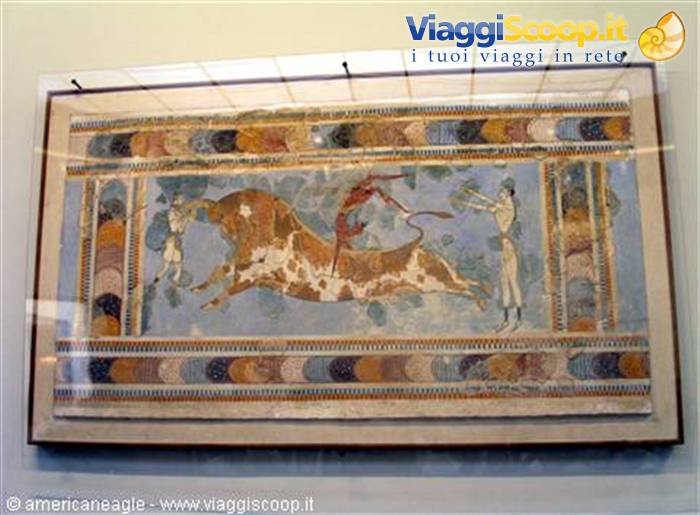
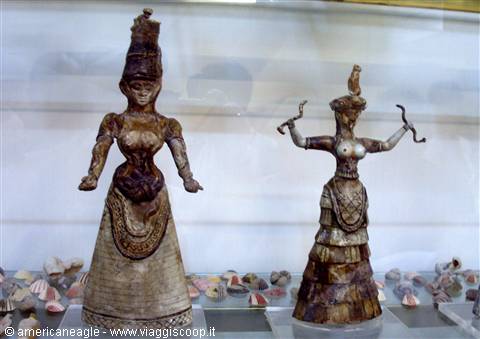
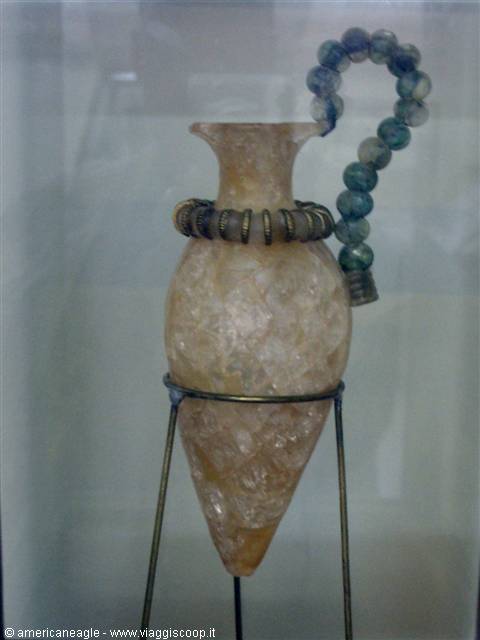
Due to the numerous earthquakes they had reached a notable maturity in the field of engineering: to make the wall more elastic they erected wooden frames where the empty spaces were filled with raw bricks or stones joined by mortar and concrete; in the end everything was embellished with frescoes of excellent workmanship. The Archaeological Museum is also beautiful, in the center of Heraklion, where an enormous collection of Minoan art is displayed, starting from pottery, passing through splendid gold jewels, finely worked sarcophagi and ending with the frescoes (brought here from Knossos). In the museum there is also a beautiful collection of double axes, of any size, that adorned the Palace and that were called in Minoan "labrys" and from which was born the term "labyrinth" (place full of double axes) that we know.
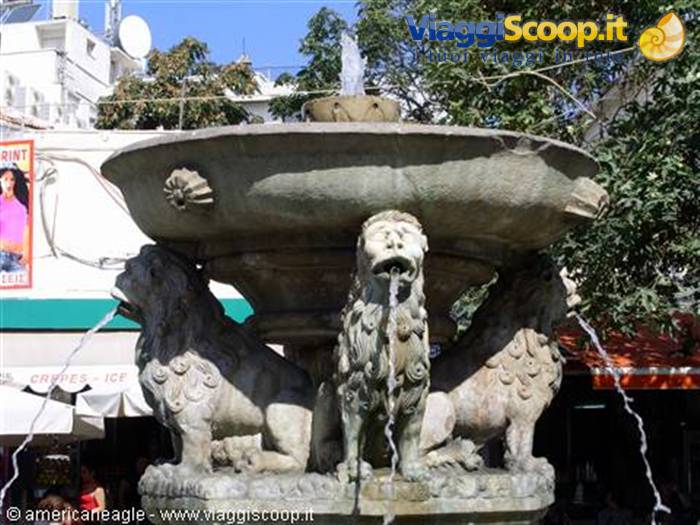
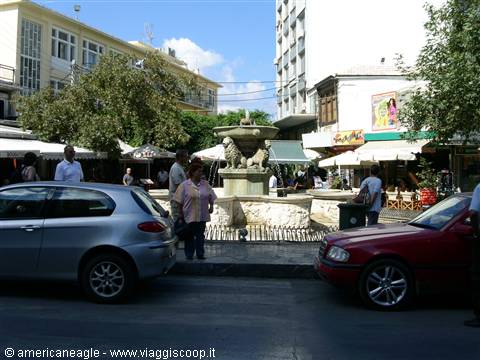
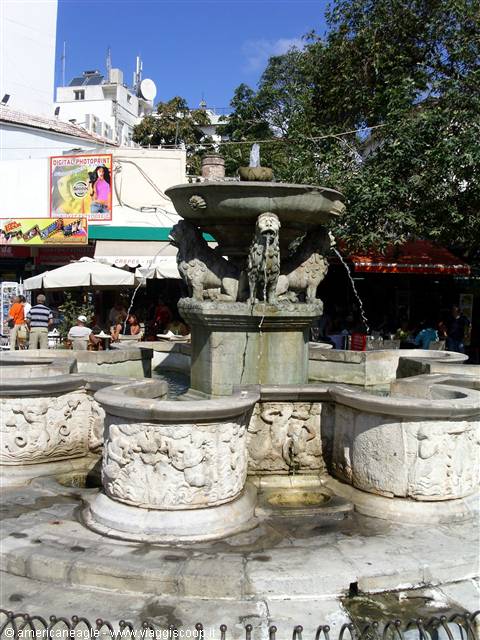
The capital Heraklion - Fountain of the Four Lions (or Morosini)
Day 45 Oct 2005
MONASTERY OF MONI ARKADIOU - CHANIA - RETHYMNO
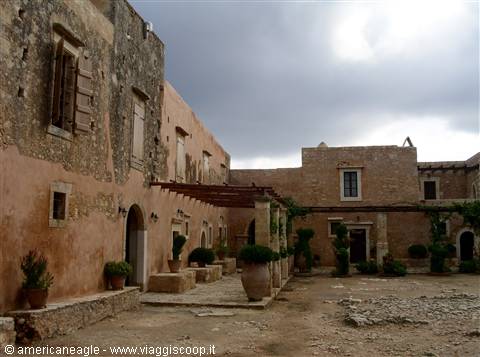
Crete is about 140 km long and about 50 km wide and is crossed at its longest stretch by a national road (sometimes four lanes) that one travels, unfortunately, in about seven hours. The other roads are like our "provincial" roads that sometimes prevent even two cars from passing at the same time. Therefore my visit focused rather on its central-western part, neglecting (unfortunately) the whole eastern part. Today I had the pleasure of visiting the Greek Orthodox monastery of Monì Arkadìou a few kilometers from Rethymno. Seeing it in the first moments, it reminded me of the old Mexican missions that so many American films have made us know. Obviously I was wrong...
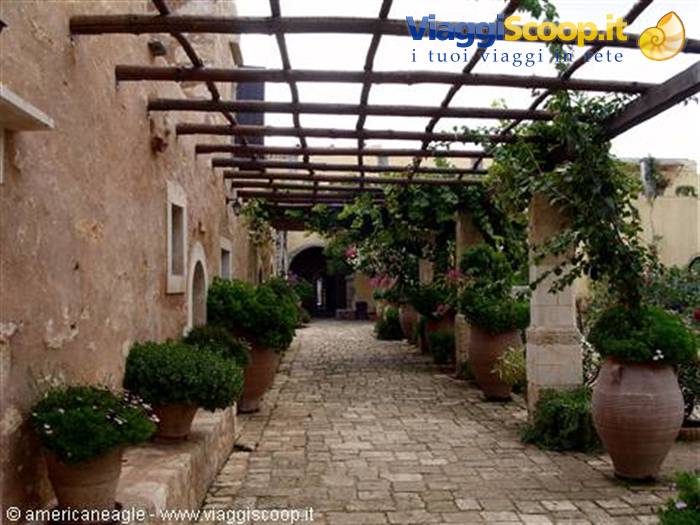
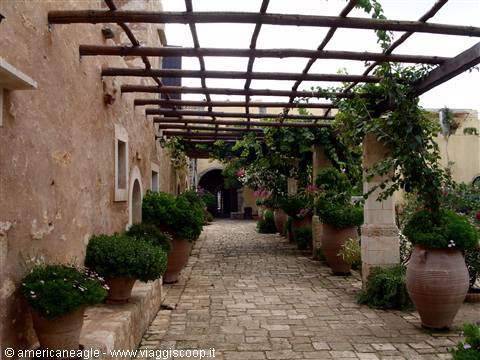
The structure, erected in the 16th century, forms a quadrilateral with an enormous central courtyard where the church stands, which externally appears quite baroque but which internally shows the sumptuousness of Orthodox places of prayer. The site is of national interest since it was used as a refuge by the very numerous Cretan citizens who decided to fight the Turkish occupier who had been stationed on the island for a couple of centuries. In fact in 1866 the Ottoman army moved towards the monastery (transformed into a fortress) to eliminate, with a demonstrative act of force, the various insurrections that by now were growing in intensity throughout the island. About 2,000 were the Turks who assaulted the religious building that housed hundreds of Cretans who had fled from their burning villages.
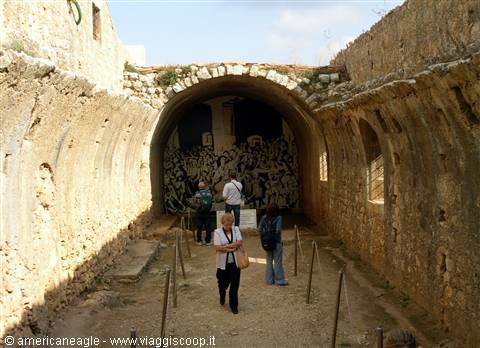
The Ottomans, after entering the courtyard committing atrocities of every kind, headed towards a storeroom (used as a powder magazine) where most of the fugitives had taken refuge as a last defense. Seeing that by now the Ottoman horde was at the gates of "Santa Barbara", the Cretans, rather than surrender or die by Turkish hand, preferred to sacrifice themselves as martyrs by setting fire to the gunpowder. The explosion spared no one, including the 2,000 soldiers. By a miracle only a little girl was saved, the only witness of the episode, who lived to a ripe old age. The Turks (given the numerous losses among their ranks), out of spite, forbade anyone to approach the monastery (thus prohibiting a worthy burial for the poor remains left there) for some years.
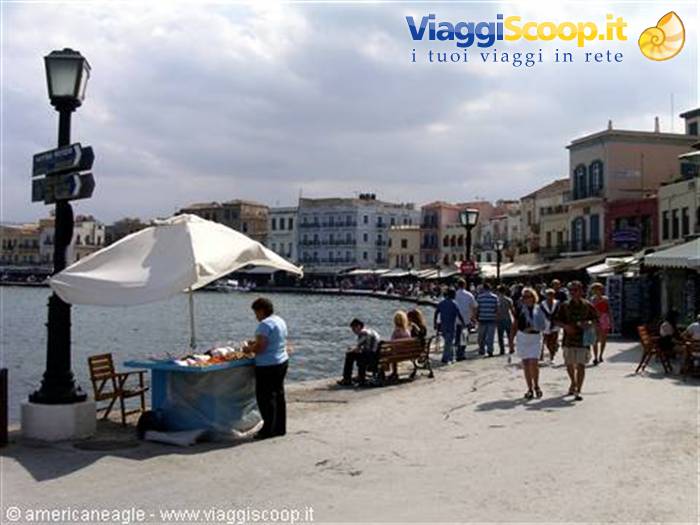
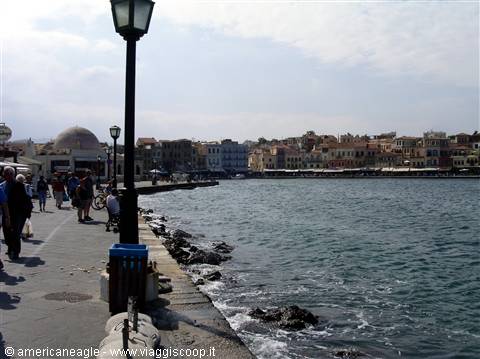
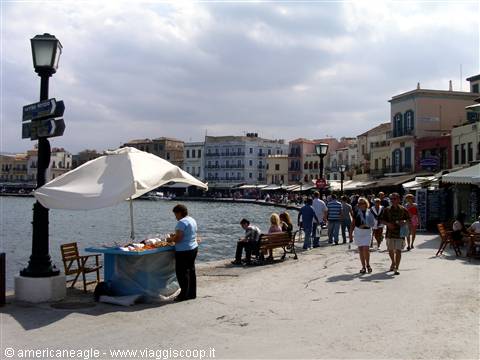
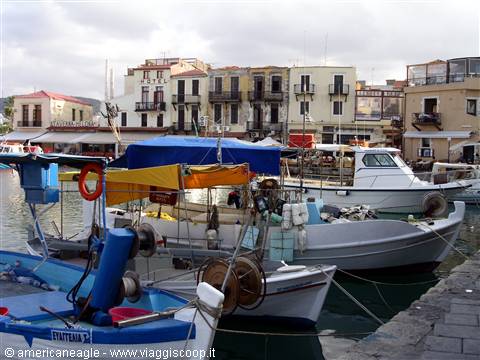
The episode, which had worldwide resonance, gave a jolt to public opinion and to the powerful of the time who, with considerable pressure, convinced the Ottoman empire to abandon the island of Crete which, having become independent, decided, some years later, to unite with the rest of Greece. A few centuries before this episode, and in any case before the conquest of the Moors, these lands were a Venetian possession. The Maritime Republic of Venice, in its Mediterranean conquest, left tangible traces here too. Visiting the city of Hanià (Chanià or Xanià), which now hosts a NATO base (confirming its strategic area), it is enough to linger in the "old city" overlooking the sea thanks to its Venetian port, to be almost at home.
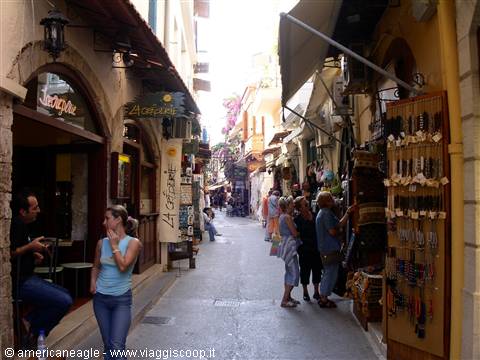
Strolling through the ancient alleys or "calli" (which we remember in Venice, Grado or even in Istria and Dalmatia), even if crammed with restaurants or tourist-trap shops, enchants any person. Here the covered market is famous, similar to an enormous herbalist's shop, where you can find any type of Cretan herb or spice, any type of sea sponge and any type of skin soap (always based on olive oil). All dominated by the Venetian fortress, subsequently modified by the Ottoman occupiers. Then it is the turn of Rethymno which is a town on the sea similar to Hanià even if much smaller. Here, besides the port (unfortunately the spread of numerous restaurants, which with their tables reach almost to the water, have taken away much of its charm) there is the loggia (used as a goods exchange) and the "Fontana Rimondi" (more than anything a spring), besides the fortress that watches over the town.
Note that here there is the only mosque with a minaret on the island).
The capital Heraklion - Archaeological Museum
Day 56 Oct 2005
PALACE OF PHAESTOS - CITY OF GORTYS - MATALA
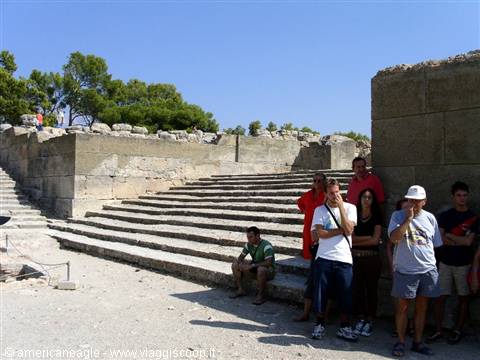
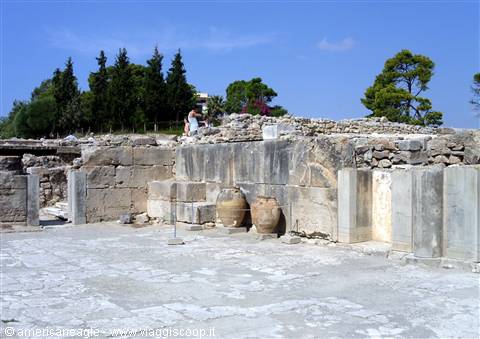
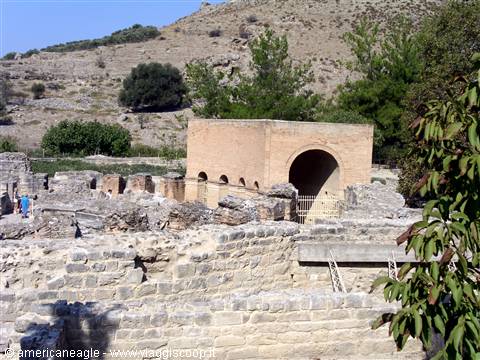
Another archaeological site that I visited was that of Phaestos. Here is another of the Minoan palaces that in importance is second to that of Knossos. It is located in the southern part of the island in the Messara plain which is also the only one on the island. The palace, placed on a small hill (but with an exceptional panorama), is almost a copy of the one mentioned in another chapter of my trip. The layout is almost the same, with the rooms arranged around a central courtyard, but it does not have the restorations and reconstructions of its more famous brother. However, unlike the latter, here the excavations have also brought to light parts of the previous palace (even if superimposed on the last construction).
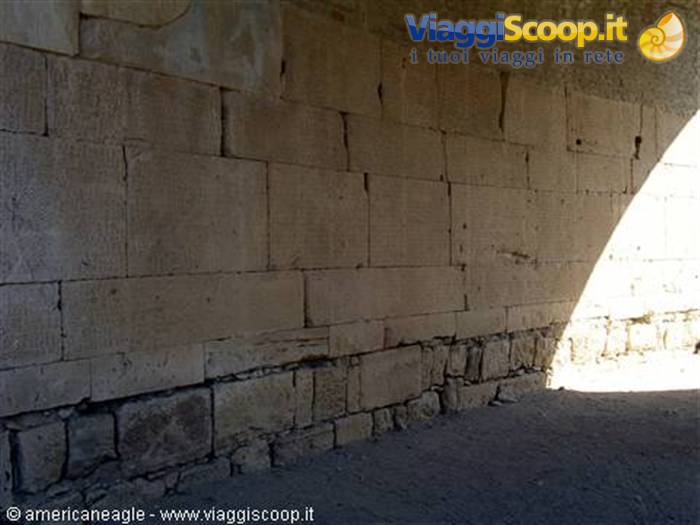
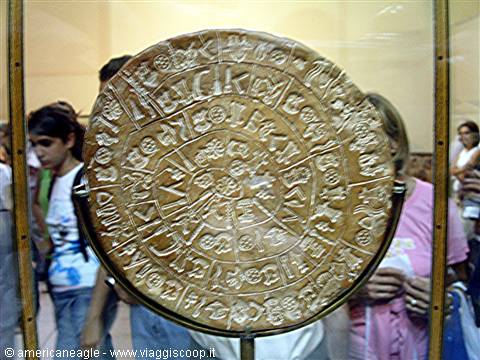
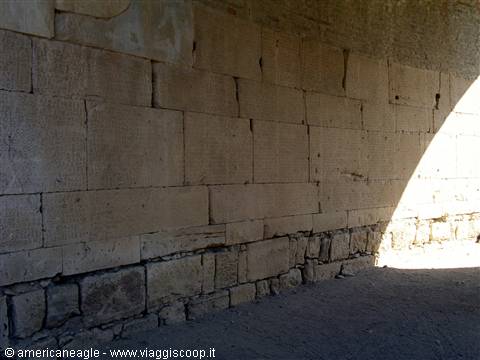
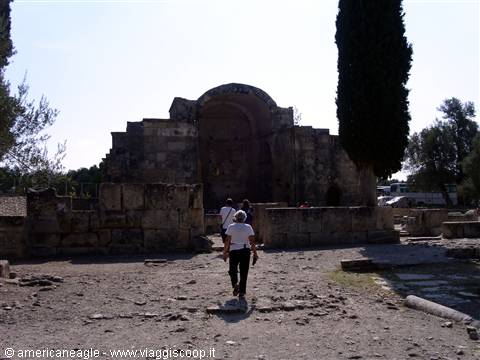
Here a clay disc was found on which was impressed, with the help of stamps similar to those kept in the Archaeological Museum of Heraklion, a text that, covering both sides of the artifact, has still not been deciphered. A few kilometers from Phaestos is the archaeological site of Gortys. Here stood the ancient Roman capital of the island. Even if only a very small part of what was an enormous urban agglomeration is visitable (a large part of the city is extended and hidden among the numerous olive groves), its remains (from the late Minoan to the early Christian) identify its splendor. Here you can observe a Roman theater (even if similar to a Greek one) and the "Laws of Gortys", whose legislative code I have described previously. Next to the Roman ruins stand the remains of a 6th-century basilica dedicated to Saint Titus (first bishop of Crete).
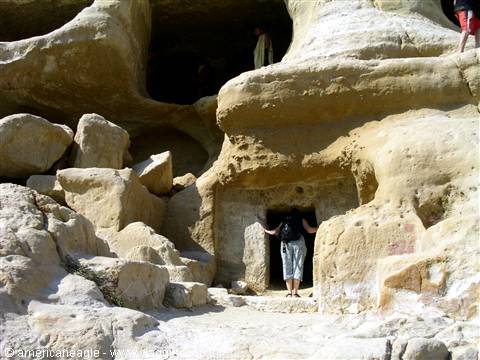
Another place I visited was the beach of Matala, in the southern area of the island near the Minoan Palace of Phaestos. This place was famous in the '60s for being one of the localities that gathered numerous "flower children" from all over the world. The dwellings used by these "hippies" were ancient caves exposed on the sea and used by the ancient Romans as tombs: lodgings that were ideal for defense against the sporadic attempts of the local police to drive them away. Today, even if some "hippy veteran" still lives in these places, the beach has transformed into a noisy and overcrowded tourist destination in summer and deserted in winter. The seafront however remains one of the most beautiful on the island.
City of Gortys
Day 67 Oct 2005
HERAKLION
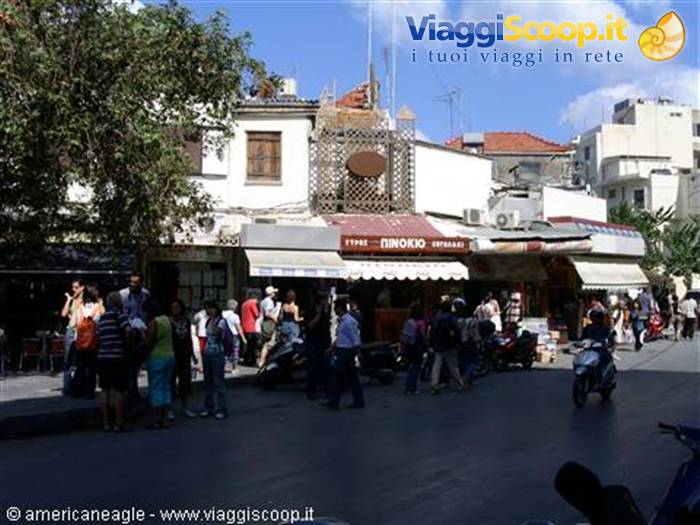
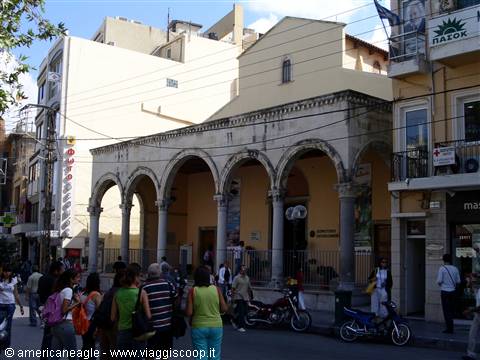
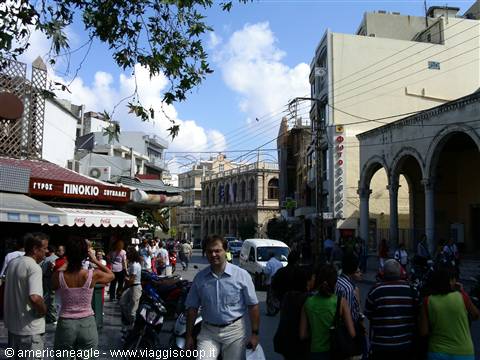
An extremely chaotic city, dynamic and with a lively, bustling center. The outskirts look like an eternal open-air construction site (no offense to the Cretans). I had the chance to visit the Archaeological Museum and the "Fountain of the Four Lions" (also called "of Morosini" - governor of Crete), which is just a few hundred meters away. Moreover, here too stands the Venetian Loggia (at the time a club for aristocratic men only) and the basilica of San Marco, which, rebuilt several times, now houses an art museum. The imposing city wall with seven bastions and four entrance gates was built by the Venetians between the 15th and 16th centuries. There are also numerous restaurants, bars and shops full of young people and students. The little market is lively and, just a few steps from the Morosini Fountain, manages to satisfy any need of both tourists and housewives.
The port, on the other hand, is a constant coming and going of ships (especially cruise ships) that ceaselessly churn out tourists for visits of just a few hours. There's one small detail I want to mention... While the classic cloud covered the sun above the hotel (forbidding the sunbathing that we Italians cannot do without), during these days on my excursions I found a clean, clean blue sky... So I spent the afternoon at the hotel just to "top up on iodine - which is good for the lungs" and to read.
The old Port of Chania
Day 78 Oct 2005
WATCHING THE CLOUDS
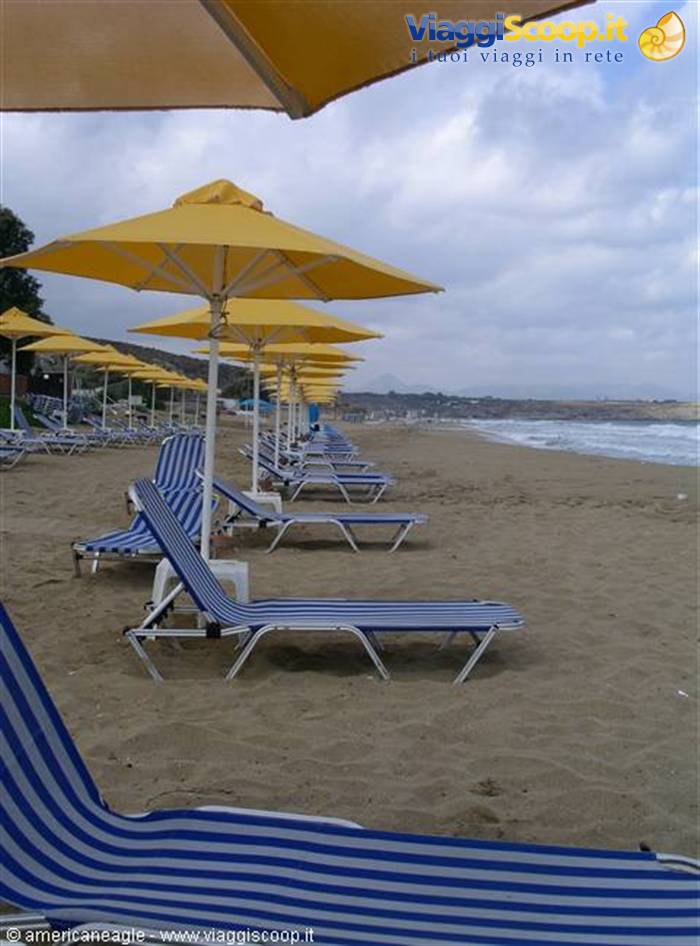
Of course, even this last day didn't want to betray tradition.... Clouds...clouds...clouds... The newsagent at the facility by now knew my editorial wishes well... Stretched out on the lounger, as I had been doing daily upon returning from excursions, I absorbed page after page almost obsessively (a method to relax against the "no sun"). This evening I decided, together with Livia and Francesco (my companions met on this adventure), to go and have dinner at a typical trattoria in Alonissos, just a few meters from the hotel. The "tip" we got from Costantinos was a godsend.... In fact, the place we chose (or rather, that was recommended), even though it was empty when we arrived, by the end of dinner was packed with locals...
The other trattorias (one right next to the other) were empty!!! The dinner, fish-based, went pretty well, even though for choosing the dishes, since the menu was in Greek, we were helped by the waiter, who understood a bit of Italian and English. The fish dishes, almost entirely fried, dominated. At the end of the evening everyone at the bar counter for "one for the road" and to say goodbye to Costantinos.
Greek Orthodox monastery of Moni Arkadiou
Day 89 Oct 2005
HEADING HOME
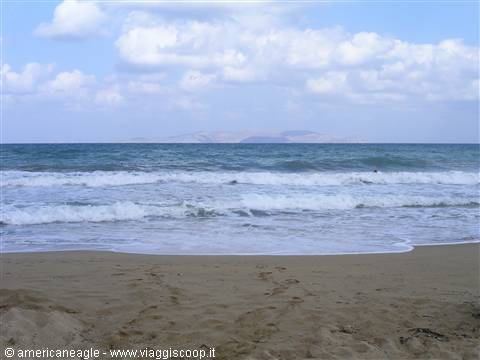
After packing my things back into the duffel bag, here I am again on the beach for the last "cloud bath"... The sea, moreover, as throughout the week, was rough, preventing anyone from setting foot in the water. Last meal at the now abundant and familiar buffet, a goodbye to Livia (who will leave on the next plane) and then everyone in line with their luggage to board the coaches that will take us to the airport. We arrived in Italy in the late afternoon. Once we set foot in Verona, we all missed the Cretan climate (even though it was cloudy). Just enough time to say goodbye to my travel companions and I'm already in my car speeding along the highway toward home. Crete?... just a beautiful memory...


















0 reader comments