It was Roberta's idea to come and visit this splendid city, which turned out to be a real surprise. I was a bit doubtful, it gave me the impression of being an austere, serious, perhaps even slightly boring place, and instead Berlin is a lively, brilliant city, and our stay was truly pleasant in every respect.
Berlin is perhaps the youngest of the European capitals. Since 1991 it has been the capital of the new Federal Republic of Germany, which came into being after the fall of the wall in 1989, which until then had divided East Germany from West Germany.
If as a capital it is still young, as a city it boasts a rich history starting from around 1237, when it was born as a simple fishing settlement. In time it became an important trading hub, capital of Prussia and finally capital of the German empire (1871). The events and the history that, in the last century, shaped the destiny and the life of this city belong to those pages of history we all know very well. The ideas of Nazism, the protagonists and the events that led to years of brutality and violence throughout Europe are not just a chapter in the history books to study, a lot of literature to read, or the history of this city and its nation itself, but are part of the whole history of Europe, and not only. But although the brutalities of this period are known, it seems that humanity has learned nothing.
Since then there have been, and there still are, corners of the world where different ideologies and different beliefs generate violence and destruction, where history seems to have taught nothing, where violence seems the only possible weapon.
The Second World War began with the invasion of Poland on 1 September 1939, but already many Jews, in the preceding years, had had to migrate to escape the Nazi regime, and already a year before the start of the great war, on the night between 9 and 10 November 1938, hundreds of synagogues, cemeteries, Jewish houses and shops throughout the nation were looted and burned. This night, known as the Night of Broken Glass (Kristallnacht), was only the tip of a far bigger iceberg. Berlin, like many other cities, was the scene of this brutal war; at the end of the war it was a destroyed city, its buildings collapsed, its streets a heap of rubble, and its people poor, hungry, shattered by years of war, violence and fear. The Potsdam Conference of 1945 divided Berlin into 4 sectors, occupied respectively by Russian, American, British and French troops.
Once again marking the destiny of this city, which found itself at the centre, the pivot, of another war whose protagonists were the intelligence services of these nations: the Cold War. In 1949 the Federal Republic of Germany was born with its capital in Bonn, and the German Democratic Republic (GDR) with its capital in East Berlin. To stem the continuous flight of refugees from East to West, in 1961 the GDR built what was the symbol of an era, of this city: the Berlin Wall. Only in 1989 were the borders reopened with the fall of the wall. Although I was little more than a teenager, I remember the images broadcast by all the TV newscasts, the moments that marked the end of an era and the beginning of a new one. On 3 October 1990 Germany was unified and Berlin chosen as the country's capital, where, in 1991, the government was also moved.
Day 15 Feb 2009
After spending the morning and part of the afternoon at the office, we find ourselves at the bus stop for Turin Caselle airport. We bought the tickets directly on the Lufthansa website and for just under €150, with a stopover in Frankfurt, we'll arrive in Berlin around 9.30 pm. The journey was smooth and between one stopover and another we even had time for a snack. Once in Berlin, having collected our luggage, we immediately go to catch the TXL bus which for €2.10 takes us directly into the city and for me and Roberta it's particularly convenient because our hostel is less than 5 minutes on foot from this bus stop. We chose to stay at the Amstel House (Waldenserstraße 31 - 10551 – info@amstelhouse.de), a very beautiful structure, also recently renovated, whose choice, made on the basis of the images on the website and various reviews, turned out to be spot on.
The room we chose, a double with en-suite bathroom, cost us €42 per night. Breakfast, on the other hand, costs €5 per person and is a rich buffet, both sweet and savoury. You need to bring your own towels, while bed linen is provided. It is nevertheless possible, for those who forget them at home, to rent bath linen.
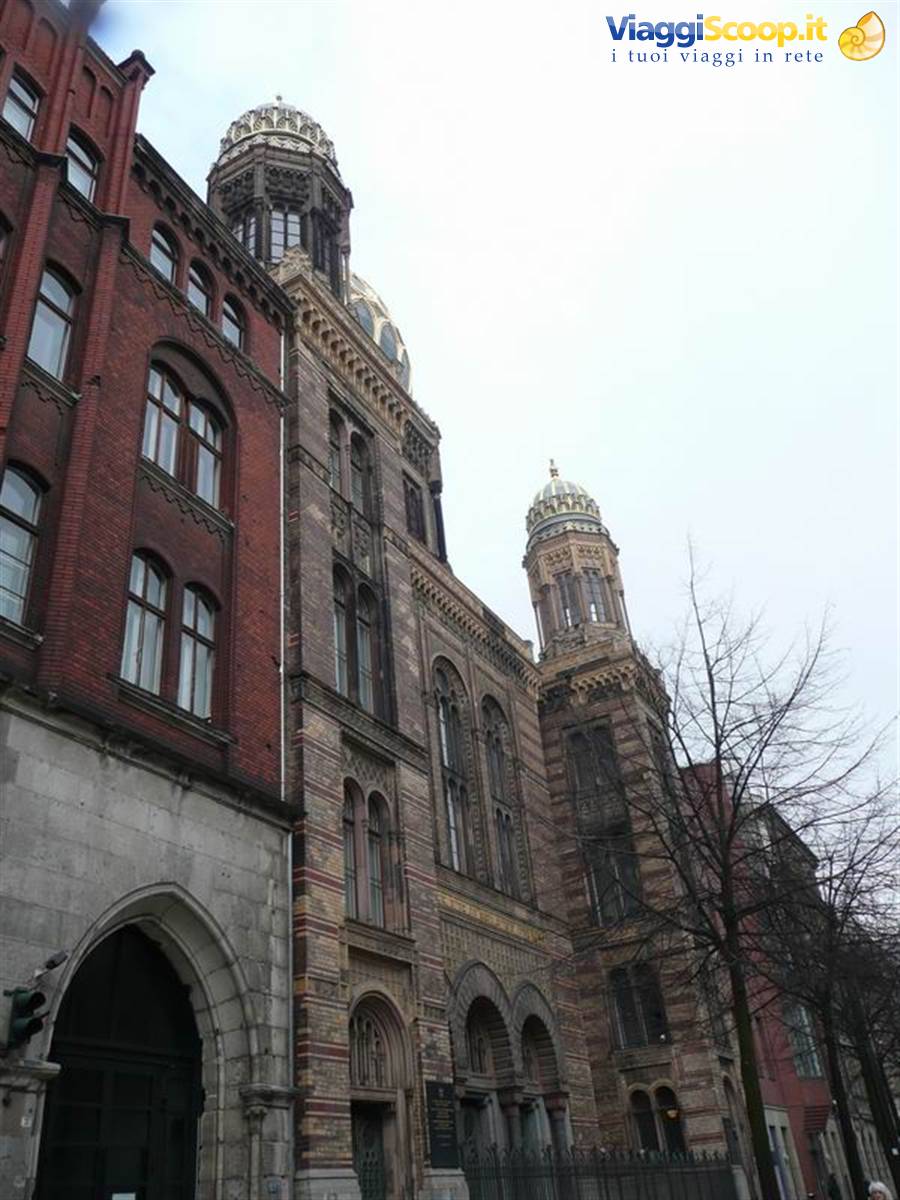
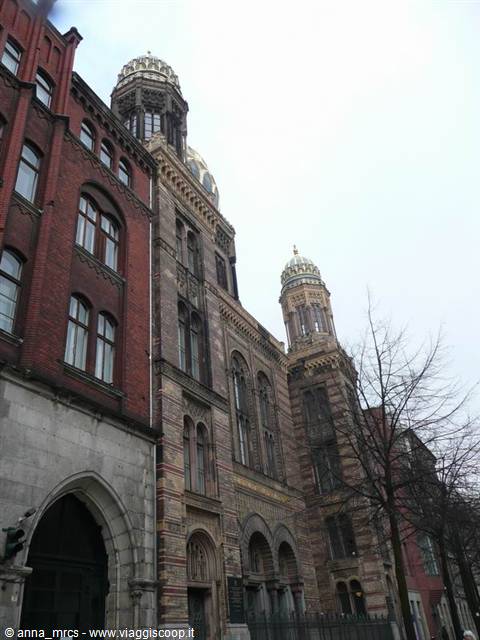
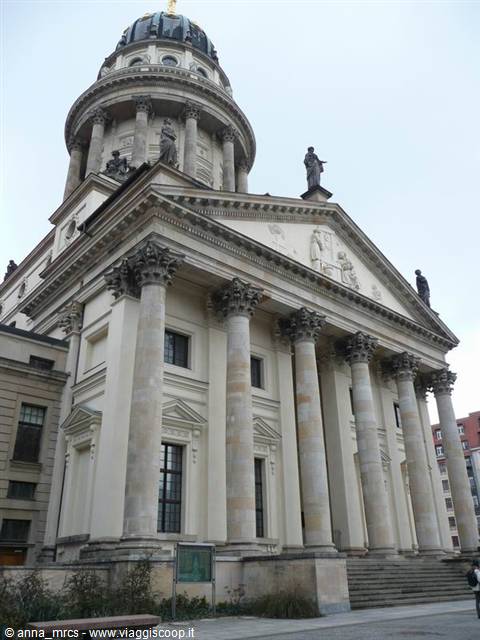
Neue Synagoge
Day 26 Feb 2009
After a nice breakfast at the hostel we go out for our first Berlin day. We head towards the Tiergarten, the largest park in the city. This park was an ancient hunting ground of the princes and was turned into a park in the first half of the thirties. A myriad of little streets and paths cross it and make it one of Berliners' favourite places. Our stroll in the Tiergarten park is not random but has a very precise direction. We first stop near Grosser Stern, a huge intersection with a corresponding roundabout and in the centre the imposing Siegessaule or triumphal column. To reach this column, which was erected to celebrate the Prussian victory over Denmark in 1864, there's no need to risk your life crossing the road, as there's a convenient underpass.
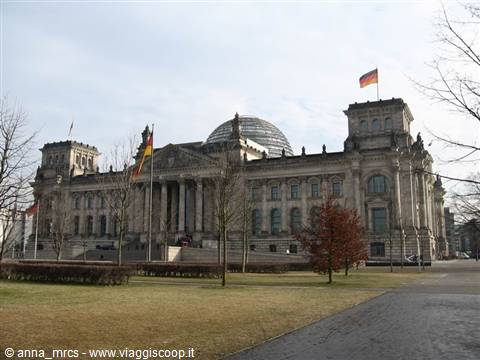
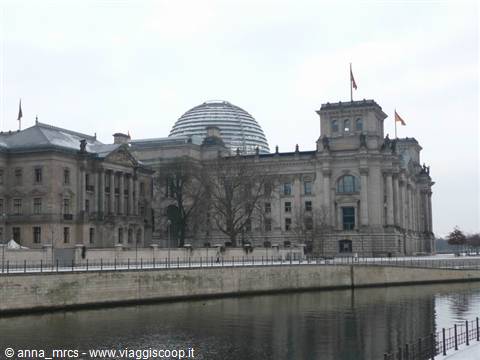
The best view remains from one of the corners of the street, from where you can also see the golden statue, which represents the Goddess of Victory, placed on its top after other Prussian victories. Continuing on our tour we pass in front of Schloss Bellevue (Belvedere Palace), an austere white palace that is the official residence of the German president. We walk along the Spree for a while to arrive in front of the Haus der Kulturen der Welt (House of the Cultures of the World). An architectural horror that someone, for its shape, has wittily called a 'pregnant oyster'. To enter the Reichstag, the building that houses the German parliament (Deutscher Bundestag), we have to queue for quite a while, starting from the steps. Access to the building's dome is free and allows you to enjoy a beautiful view of the city.
In this building, from 1894 to 1933, the Reichstag met, that is, the parliament of the imperial period and of the Weimar Republic. The building kept its name, even after the war and the end of the Reich. And finally here is the symbol of Berlin, the Brandenburg Gate (Brandenburger Tor), a neoclassical work built between 1788 and 1795. It's curious to read that in 1806, during the French occupation, the French on Napoleon's orders thought it a good idea to dismantle the imposing work and take it to Paris, as if there weren't architectural works in Paris too! In 1814, however, they had to give it back and the Brandenburg Gate returned to its place and became the symbol of victory. Over the course of history it was the scene of many important events that happened in this city. Until 1989, with the fall of the wall, the gate in fact marked the border between the two Berlins.
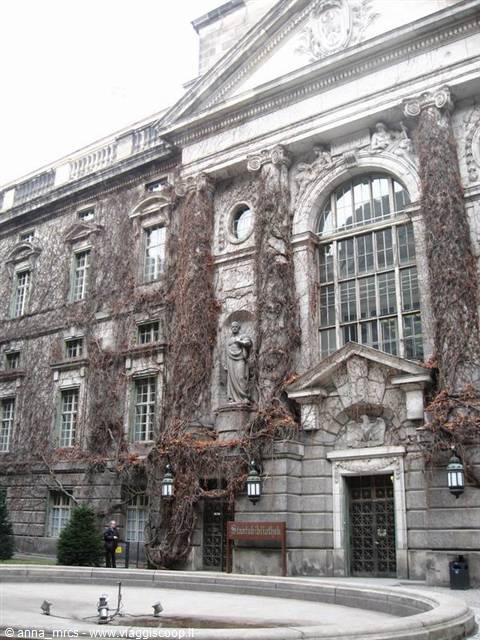
At the nearby information office we buy our Berlin WelcomeCard valid for 3 days (€25, ABC zone). As well as being able to use all public transport in Berlin and Potsdam for three days, it will allow us to enjoy discounts on admission tickets for various monuments and also in some shops. We continue along Unter den Linden. It's considered one of the most famous streets in the city. We enter the courtyard of the Staatsbibliothek. Inside the national library is conserved nothing less than the original score of Beethoven's Ninth Symphony along with other priceless treasures as well as more than 10 million books. Opposite the Staatsbibliothek we find the Altes Palais (Old Palace). We visit the war memorial, the Neue Wache, built between 1816 and 1818.
Originally the building housed the royal prisons but then in 1930 and 1931 it was transformed into a monument commemorating the soldiers killed in the First World War. It was subsequently restored in 1960 and then became the memorial to the victims of fascism and tyrannies. In 1993 the memorial changed once again and was dedicated to all the victims of war and dictatorship. With a small detour we go to visit the Catholic Basilica of St. Hedwig (St. Hedwigs Kathedrale), in whose crypt are conserved the remains of many bishops of the city, which is located right next to the oldest opera house in the city (Staatsoper Unter den Linden) and perhaps in all of Germany. We reach the Jewish quarter. At first a refuge for Jews fleeing Russia and the east, it later became the hub of the Jewish community; it was a lively and vibrant neighbourhood. With the Second World War it all ended.
It was subsequently restored and recovered and is now a lively centre crowded with tourists and Berliners where you can choose among the many venues. We see the Neue Synagoge (New Synagogue) with the splendid golden details of the dome gleaming under the rays of the winter sun. Its construction was completed in 1866, partially destroyed during what was called the Night of Broken Glass (1938) and then severely damaged by Allied bombing (1943). Given the extensive damage, in 1958 it was demolished and then rebuilt and completed in 1995. The Postfuhramt is very beautiful; we're amazed to read that it wasn't a residence but simply the old stables for the postal service's horses. The Gedenkstatte Grosse Hamburger Strasse (Grosse Hamburger Strasse Memorial) is on one of the streets that, before the world conflict, was one of the main streets of the Jewish quarter.
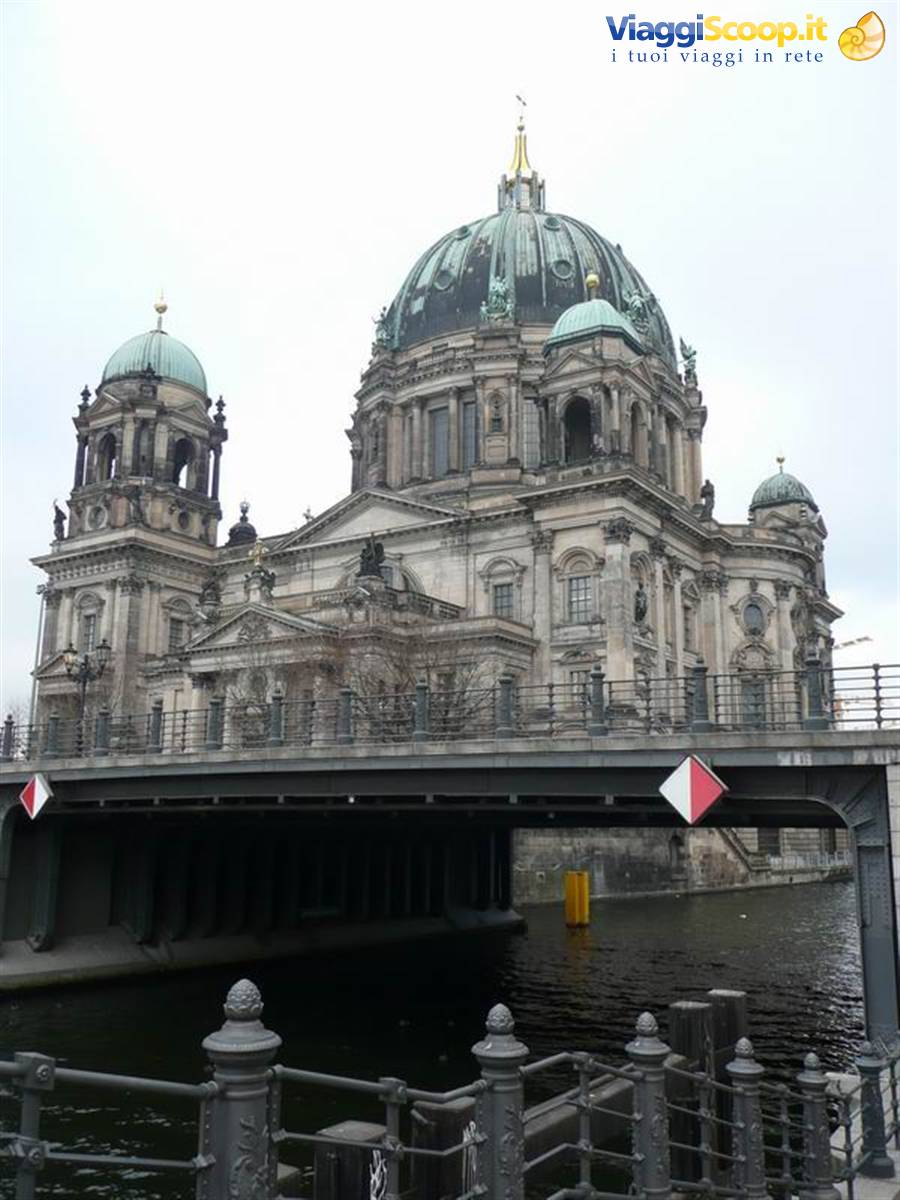
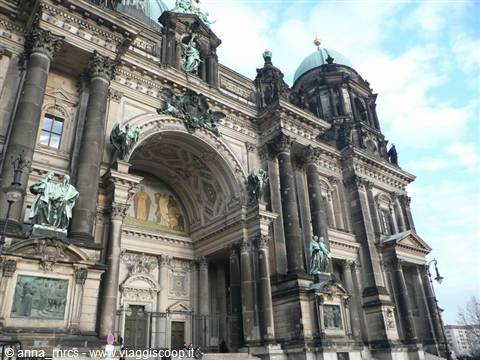
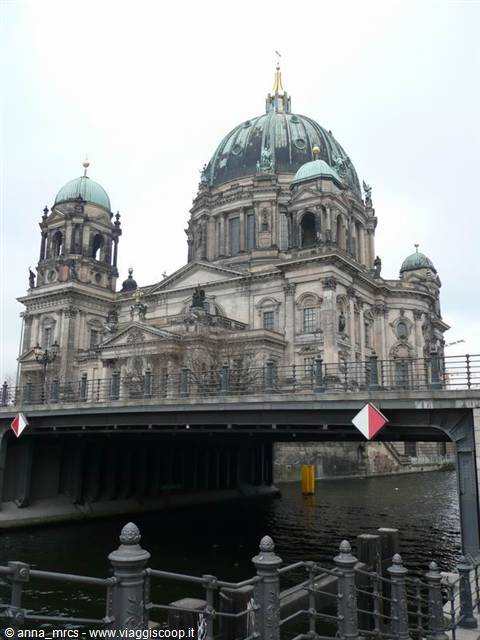
In this neighbourhood there were schools, houses, shops, a cemetery and also a home for the elderly that the Nazis turned into a prison where they held the Jews who were to be deported to the Auschwitz and Theresienstadt concentration camps. Today in place of this building there is a memorial, a particularly touching and evocative monument depicting a group of Jews going towards death, alongside a commemorative plaque. We then visit the Sophienkirche, reached through a narrow passage. It is a Baroque church that was built at the behest of Queen Sophie Luise in 1712. Having left the Jewish quarter, we go to visit the Berlin Dom and climb onto the dome to enjoy the sunset from above. The Berlin Dom (with the Berlin WelcomeCard the ticket costs €3) is something special.
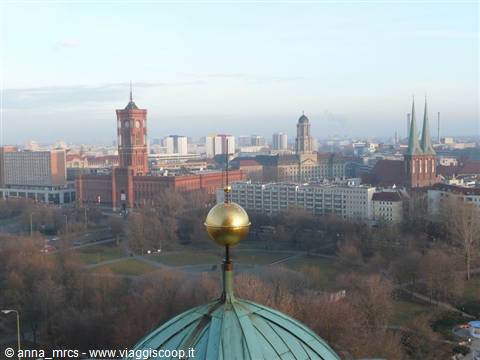
We have the chance to pass through this area other times and admire this imposing cathedral which, together with the nearby Schlossbrucke bridge, offers picture-postcard images. The Schlossbrucke is, not wrongly, one of the most beautiful bridges in the city and connects Unter den Linden to Schlossplatz. It was built in 1824 and the statues that populate it are inspired by scenes from ancient Greek mythology. The interior of the cathedral is very beautiful and certainly merits a visit. The sarcophagi of Frederick I and his wife Sophie Charlotte are also conserved there. We climb the 270 steps (we didn't count them) that take us to the panoramic gallery from which you can admire the interior of the church and we reach the dome where we can enjoy a beautiful view of the city.
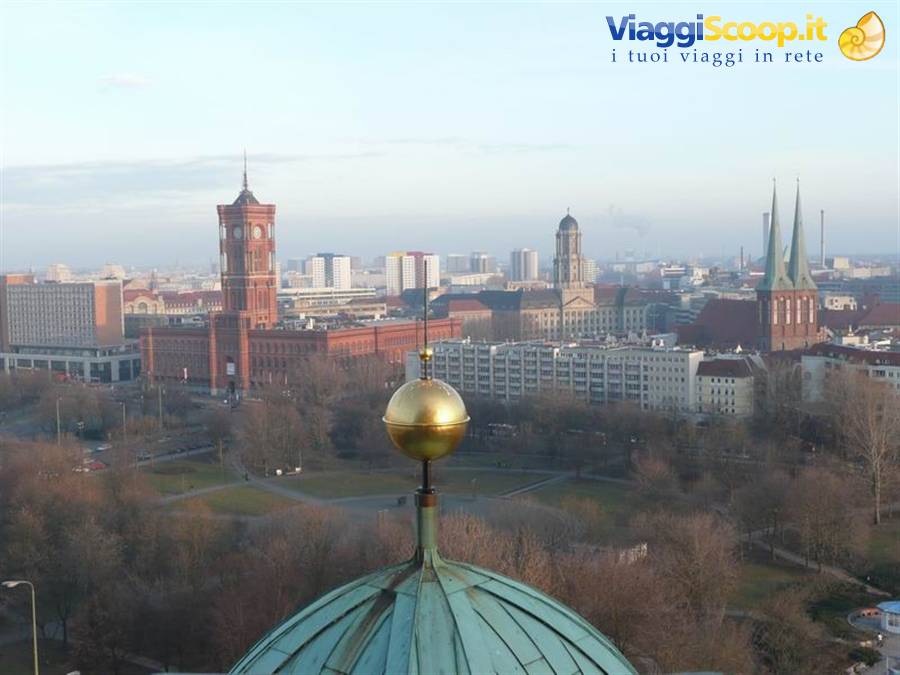
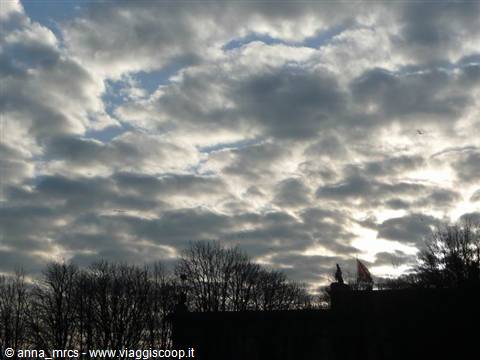
The sun is setting and strange plays of light form with the clouds veiling the sky, giving us splendid images of this city. The Museum Island. There is in fact the Alte Nationalgalerie located on a platform reached by a double staircase, the Neues Museum (Egyptian antiquities), the Altes Museum (Greek and Roman antiquities), the Bodemuseum near the railway bridge, an example of modernity well integrated into the context, and finally the Pergamonmuseum, where we are headed. The Pergamonmuseum was built between 1912 and 1930 and owes its name to the famous Pergamon Altar that it houses inside. It is one of the most astounding pieces of this museum. Also impressive are the Aleppo Zimmer, a room that belonged to the house of a merchant from the Syrian city of Aleppo, and the Ishtar Gate of Babylon, perhaps one of the pieces I appreciated the most.
View from the Berlin Cathedral
Day 37 Feb 2009
Having had breakfast, we leave our hotel and by bus head to the Hauptbahnhof station, which was inaugurated in 2006 and is a fine example of modern architecture. Here we take a train to nearby (so to speak) Potsdam. Potsdam, capital of Brandenburg, is located on the border with Berlin. Like Berlin and other European cities it was severely damaged by the bombing of the Second World War and has now been completely rebuilt to return to its original splendour; fortunately many of the palaces we will have the chance to admire escaped the bombing. In the 17th century Frederick William of Brandenburg established his second residence in Potsdam, and what a residence! With the birth then of the Kingdom of Prussia, Potsdam became the seat of the court.
It was then Frederick II, known as Frederick the Great, in the mid-18th century who had most of the palaces we have the chance to admire today built. We have come here to visit Park Sanssouci, an enormous park containing several very interesting buildings or royal palaces. The city would deserve a careful and attentive visit but we're only passing through and didn't want to give up visiting the palaces in this park. The bus we take to get to the park crosses some interesting points of the city, thus allowing us to see Potsdam even if from the bus window. We get off near Schloss Sanssouci. Schloss Sanssouci is a splendid Rococo-style palace built in 1745. Among other things, Sanssouci is of French origin and means precisely 'without worries'.
Beside it we find the Neue Kammern, built in 1747, which was once the orangery of the Sanssouci palace and was later converted and used as a guest house (of course...) by Frederick the Great. The gardens are not exactly at their best but we manage to get an idea of how they are and how they must have been. Further on we also find the Friedenskirche, or church of peace. Its construction began in 1845 through the work of Frederick William IV, who laid the first stone, and ended in 1848. The church is inspired by that of San Clemente in Rome. Beside the church there is a mausoleum with the tombs of some royals (William I and IV and Kaiser Frederick III). The visit to Sanssouci castle (Schloss Sanssouci) is guided, in the sense that they hand everyone the relevant audio guide and invite us to stay in a group and follow the attendant who does nothing but open and close doors.
Couldn't we wander at our own pace? If the guide is a recorded tape anyway!?!? The construction of the castle was completed in 1747 and it's said that no other castle reflects the personality of Frederick the Great as well as this one. The interiors of the palace are very beautiful. The Carrara marble entrance leaves us open-mouthed; imagining it with the coming and going of ladies in sumptuous gowns, of men perhaps in full dress uniform is perhaps curious but fun. This palace alone is worth the trip from Berlin to here. We read, and that's why we got moving early this morning, that UNESCO has set a maximum limit of 2000 visitors per day and that even in low season these tickets sell out in the morning.
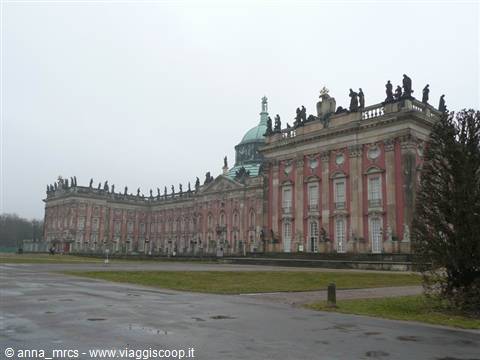
Opposite Schloss Sanssouci, or perhaps better to say, on the other side of the road, there is the historic mill (Historische Muhle) which served to give the place a, so to speak, rural charm. It was built between 1787 and 1791 in perfect Dutch style. It was destroyed by a fire in 1945 and rebuilt in 1993 with a new mechanism. The next visit is the Neues Palais von Sanssouci. This imposing Baroque palace was built by Frederick the Great and construction (1763-1769) began only after the Thirty Years' War although the design dated back many years earlier. Here too we have to submit to the rules of a guided visit but since we don't speak German we are given the usual audio guide. However, we must stay with the group and move along obediently behind the guide like everyone else.
I don't know if it's because of the weather outside or if it's the custom, but we are all given a nice pair of slippers to put on over our shoes. Curious! The halls of this palace live up to the occasion. Curious and, let's say it, ridiculous is the hall of shells (Grottensaal). Opposite this building there is another imposing building, the Communs, where the kitchens were; an underground system allowed the dishes to reach the castle hot. The park preserves other buildings, such as Schloss Charlottenhof, the Chinese tea house and the baths. We return to Berlin in the afternoon. We get off at Charlottenburg station and walk towards the Charlottenburg palace. This neighbourhood, before reunification, was the beating heart of West Berlin and is still today a very lively centre. We walk along a pedestrian street, swarming with people and shops.
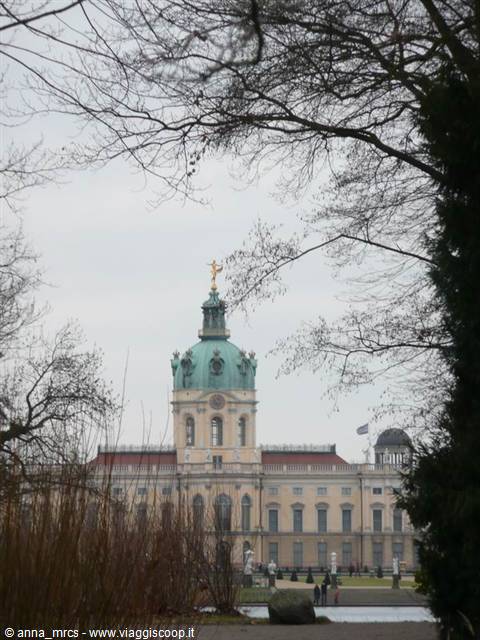
We arrive at Schloss Charlottenburg in time for the visit to this splendid Baroque palace. Fortunately we can wander around the palace, obviously without leaving the designated route, at our own pleasure. We are given audio guides (included in the price) and begin our visit. If on the one hand the audio guide is interesting to listen to, on the other it is frighteningly long-winded. The palace was the summer residence of Sophie Charlotte, the wife of Frederick III. The work for its construction began in 1697. Over the course of history it was expanded several times. Behind it there is a splendid park that we will visit tomorrow; by now darkness has fallen on the city. Later we also treat ourselves to a stroll in the KaDeWe shopping centre (Kaufhaus Des Westens) at Wittenbergplatz, where consumerism reigns supreme.
It is the largest department store in Europe and one of the most exclusive in Berlin, the symbol of West Berlin's success. In many ways it reminds me of Harrods in London. KaDeWe was built in 1907 but over time it has been modified several times.
Berliner Dom
Day 48 Feb 2009
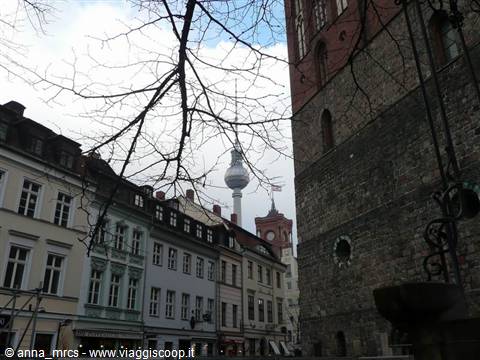
We begin today's visits at Alexanderplatz. We've been there several times during our evening bus rides but the time has come for a daytime visit. The square owes its name to Tsar Alexander I who visited Berlin back in 1805; originally it was called Ochsenmarkt, that is, cattle market. It's easy to deduce what its original purpose was. During the years of the GDR it was the beating heart of East Berlin. A new redevelopment project for the area that aims to transform it, according to some, into a little Manhattan is awaiting implementation but apparently the funds are lacking; no matter... it's distinctive even as it is. A little further on there's the Fernsehturm, the television tower, let's say an eyesore in the middle of the city. It is 365 metres high and, as well as being the tallest building in the city, it is also one of the tallest in Europe.
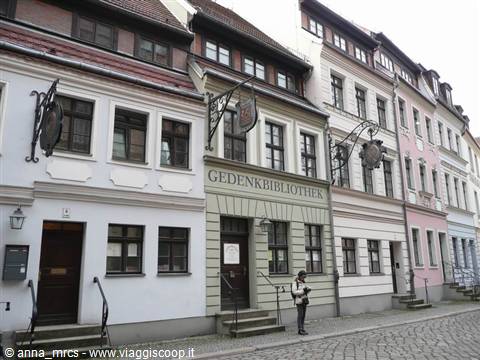
Certainly more evocative and in harmony with the rest of the square is the Marienkirche, the church of Santa Maria. Although its construction began in 1280, the church was only consecrated in the second half of the 13th century; together with the Nikolaikirche it is one of the oldest churches in the city. The interior is very evocative; the carved alabaster pulpit is of particular beauty. We then move to the area of the Nikolaiviertel (St Nicholas's quarter); it's a small area along the Spree where it almost feels like walking in another city, in another place. Narrow little alleys, evocative houses and few tourists. In this area there are some of the oldest houses in the city. The Nikolaikirche is the oldest church in the city, which also gives its name to this quarter. The church did not come through the wars unscathed and over time some parts were destroyed and then rebuilt.
Today the church houses an exhibition of objects saved from the destructive fury of the war. We walk until we reach the famous Checkpoint Charlie. Today what remains is a reconstruction of the booth that marked the border crossing with a actor in uniform. The area around it has been rebuilt, so the place has lost part of the sad charm it could have. This point, between 1961 and 1990, was the only point that allowed foreigners to pass between East and West Berlin. It was for many a symbol of freedom and for all those who tried to cross the border to escape communist tyranny it was the point where the dream began or where it was brutally and dramatically interrupted. There were thousands and thousands of people who in those years tried to cross the wall (Berliner Mauer), to cross the border in search of freedom, using the most curious and daring expedients.
The nearby museum is an exhibition of testimonies, events, stories and people that characterised the history of the wall, and of this border crossing point. Many died trying to conquer freedom. It seems so absurd, so distant, yet the wall was destroyed only in 1989, only twenty years ago; before that all this was real, concrete. Before that date this wall conditioned and determined the life and death of so many people and was the theatre of the Cold War, told and described by the press and literature in so many ways. After this visit into the horrors of an era we decide that we still haven't had enough and go to visit the open-air museum Topographie des Terrors.
Close to the museum there still stands a piece, about eighty metres long, of what was the wall, and right where the museum now is, during the Third Reich stood one of the most feared buildings in Berlin, where the Nazis' headquarters were located. One reads that it was in this building that the most inhuman decisions that characterised Nazism were taken, such as the genocide of the Jews. After the war the buildings were destroyed and in the cellars, which served as places of torture, this exhibition on Nazi crimes was set up, which Roberta and I had the chance to see. I don't know how to describe it; there are images, photos of people, images of death, faces of people in the prime of life, of women, men, lives... alongside a short text describing their story, their tragedy.
We spend a long time there, reading, looking, marvelling at how cruel and brutal man can be, asking ourselves how it could have happened, how a man can go so far against another man, how it could have happened and how it can still happen because the world is not yet free of these horrors of violence, of these examples of cruelty and brutality. We leave this place almost without speaking, we don't know what to say, what thoughts to express.
This morning it is really cold; we notice because despite moving around we can't shake off the cold. So we arrive in modern Berlin at Potsdamer Platz, the beating heart of the modern city and a havoc of modern buildings, as always of questionable taste. Although we know the Berlin Film Festival is taking place these days, we never really noticed the presence of this event, but at Potsdamer Platz we find ourselves catapulted into this world-famous event. This area was, in the twenties, a vital centre which obviously followed the fate of so many other places in this city: during the world war it was destroyed. Since this area was near the wall, for years it remained there, empty, without purpose. Tourists visited the area only to manage to see, climbing onto the high platforms that were still there, what was beyond the wall.
With reunification the neighbourhood was transformed into what we see today. Skyscrapers have been built, now the headquarters of big international companies. Among the architects who contributed to the redevelopment of the area is also the Italian architect Renzo Piano. The work began in 1992. The name of the neighbourhood derives from one of Berlin's gates, namely the Potsdamer Tor. We take a stroll around the Arkaden shopping centre, the Sony Center and finally decide to go up to the Aussichtsplattform or Panoramapunkt at number 1 Potsdamer Platz. With our Berlin Welcome Card we are entitled to a discount. The lift, according to the guy accompanying us, is the fastest in Europe. The view from above is interesting; we can see all this jumble of modernity.
We take a bus to move around, and thus cross the diplomatic quarter, a succession of houses and embassies. Yesterday we left behind the park of the Schloss and the new palace. We head straight into the park. We wander around until we reach the Belvedere, which houses a collection of German porcelain, and then, mindful of yesterday's visit, we head with plenty of time to spare, before closing time, to the entrance of the Neuer Flugerl (afterwards we can take advantage of a discount thanks to the Berlin Welcome Card). For the visit we are given the usual audio guide, which sorely tested my patience... at first the quantity of details and information it provided was interesting but towards the end you start to get a little tired and want to finish the visit. But apart from that the visit was interesting and the palace is worth a visit.
We come out and it's already dark; all that remains is to head back to the area around the Berlin zoo to stroll a bit along the streets looking at the shop windows while waiting for dinner time. And so our last day in the city comes to an end. Back at the hotel we begin that sad ritual common to all travellers... repacking the bags... preparing the travel documents
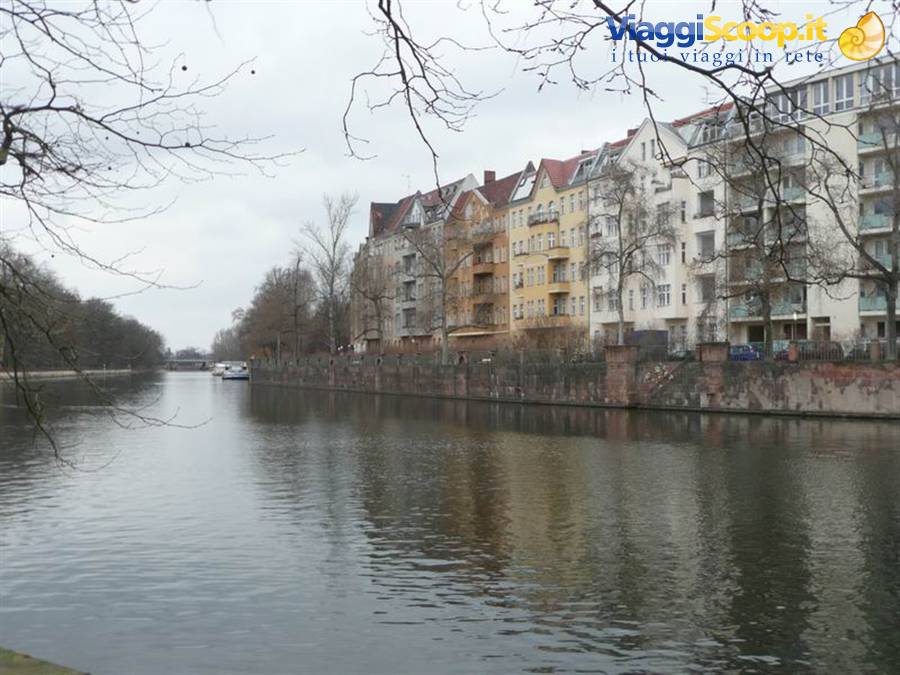
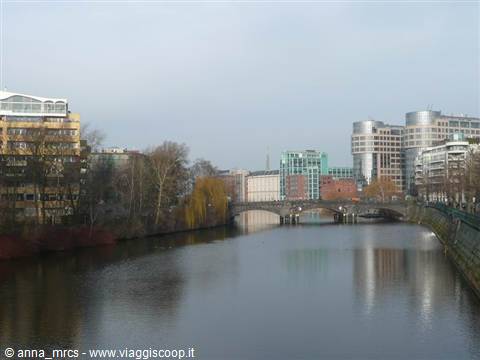
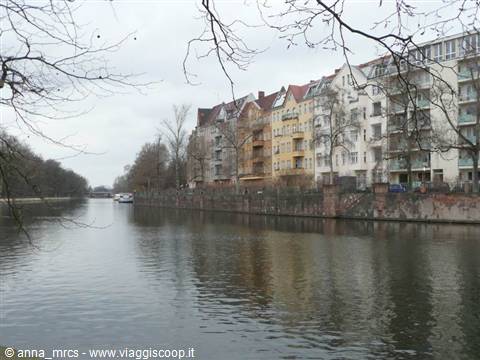
Houses along the Spree - area of Schloss Charlottenburg
Day 59 Feb 2009
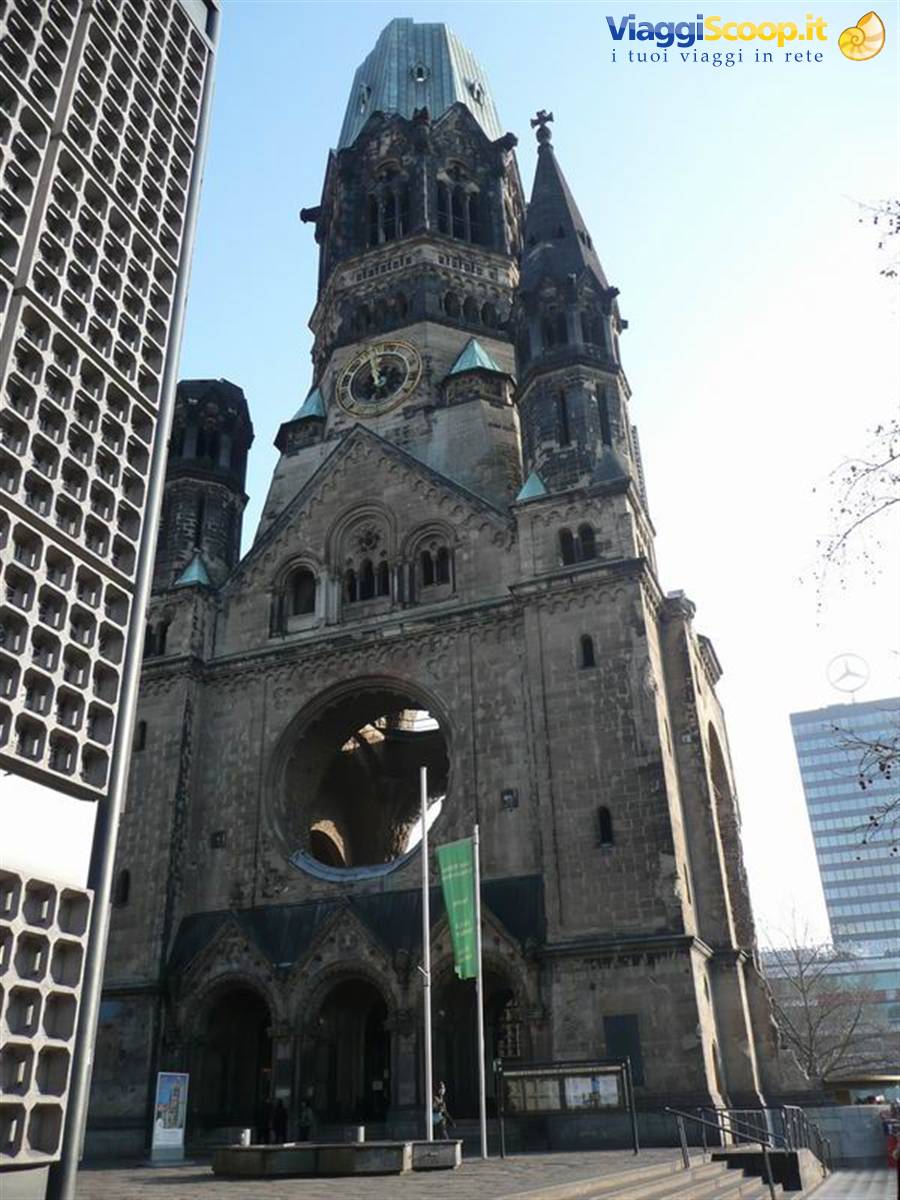
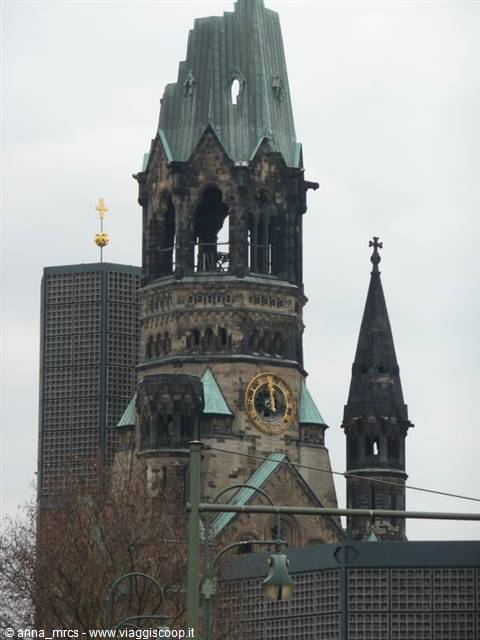
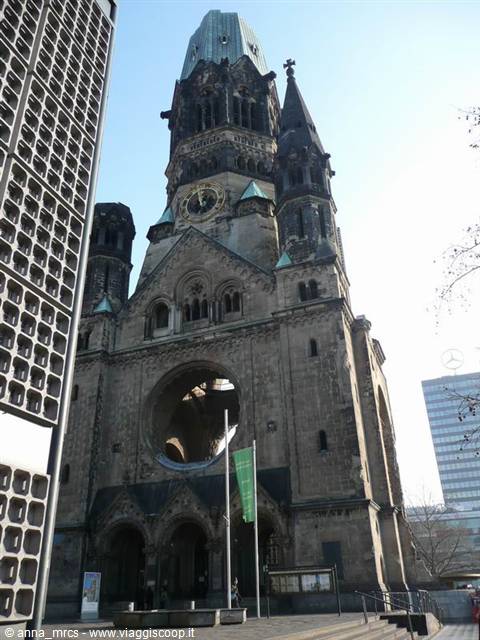
Our plane leaves at lunchtime, so we take the opportunity for one last visit to the Kaiser-Wilhelm-Gedachtnis-Kirche. It is one of the best-known symbols of the city, and a committee is hard at work defending its bell tower from destruction. The church appears rather damaged but perhaps it is also evocative for this reason. The church was built in memory of Emperor William. The bell tower is nevertheless what remains of the original church that was built between 1891 and 1943. Although the bell tower was the subject of restoration in the eighties, today it again needs consolidation and maintenance work. Work which unfortunately costs money, which is why a committee — I don't know how else to define it — collects funds to be able to keep this monument alive. So we too give our small contribution to the cause. And with this our visit to the city ends.
Quickly we catch the bus and return to the hotel to collect our luggage and take the road to the airport. Our holiday is just about to end. Berlin... what can I say... it's a city that deserves at least one visit! Not going there would be a shame!
Bibliography Berlino - EDT - 5th edition 2006 Berlino – City Book Corriere della sera – Arnoldo Mondatori Editore - 2005






0 reader comments