Before the trip I recount in this itinerary I had been to Paris on two other occasions, which I refer to in the related itineraries 'Paris the first time' and 'A stop in Paris'. For this itinerary I left Milan by train together with my wife, travelling at night and sleeping in couchettes. In the morning we woke up in Paris and began our visit.
Day 11 Mar 2008
In the morning we woke up on the train as it arrived in Paris and began our visit. After breakfast at a bar near the Petit Palais we crossed the bridge over the Seine and the gardens that precede the Hotel des Invalides. Here we went in to see the museum exhibitions it contains: the Museum of Arms, which traces French military history with various objects including edged weapons, armour and firearms; the Museum of Relief Plans, in which scale models of naval bases used for military purposes are reproduced; the Museum of the Order of the Liberation, dedicated to the period of the Resistance and part of which is dedicated to General De Gaulle with his decorations and his last uniform. The perspective of the Hotel des Invalides is closed by the cathedral of the same name, which holds the porphyry tomb of Napoleon Bonaparte.
Walking along the Seine we arrive near the Pont de l'Alma, the one famous for Lady Diana's accident, where we visit a stretch of the Paris sewer system, the one described in the novel "Les Misérables". The underground canals have the names of the streets above and even the street number of the corresponding drain is shown. Back in the open air we cross the Seine and walk along Avenue Wilson, near which we stop to eat a savoury crepe at a little market, and we reach Place Trocadero. From here one of the best views of the Eiffel Tower opens up, which stands on the other side of the Seine, framed by two long twin Chaillot Palaces with a semicircular shape. The Tower is much more beautiful to look at from here, where you can savour all its grandeur, than up close, where it's impossible to frame it completely.
Inside one of the Chaillot Palaces we visit the Naval Museum, one of the oldest of its kind, showing numerous exhibits related to geographical discoveries, nautical charts, navigation techniques and naval battles. In the twin palace opposite we enter the Museum of Man, one of the most important ethnographic and anthropological museums in the world. The Museum is very educational and perhaps aimed at an audience more prepared on the subject, which is why it doesn't fascinate us that much. In the same Palace we would also like to visit the Cinema Museum but we're told it has been moved, so by public transport we head to its new location on Rue de Bercy, 6 kilometres east of Trocadero.
The Cinema Museum is probably the best museum of its kind in the world, it preserves costumes from famous films, the reconstruction of Melies' film sets, the first cameras of the Lumiere brothers and the strange mechanical contraptions based on optical illusion that preceded the dawn of cinematography. Perhaps for many this won't be an essential museum, but I believe that seeing the history of cinema in the country where it was born is nonetheless very interesting. We're outside the city centre but getting back is easy and quick thanks to the numerous metro lines. So we arrive at the foot of the symbol of Paris, the Eiffel Tower. From below it appears immense, but the real spectacle is going up to the top, to the last floor. You get there by fast lifts, the first is actually a kind of rack-and-pinion cabin that rises above one of the tower's legs.
When you're at the top you can enjoy an excellent 360-degree panoramic view of the city. Once back down we take the Metro from Champ de Mars and get off near Place Vendome, an elegant square framed by noble palaces, we then walk along a stretch of rue de la Paix up to Place de l'Opera, where the important theatre of the same name faces. We continue along the elegant and lively Boulevard des Italiens, full of bistros and theatres. From here we take a metro and arrive at the Pompidou Cultural Centre, by now it's dark. We enter this large and futuristic building where, among other things, we're given the chance to browse among the books and use a computer. The escalators suspended on the outside of the modern construction inside transparent tubes are very curious.
Back on the Metro we go to the Pigalle district where we booked a hotel from Italy for two nights, and here we sleep after a very intense day of visits.
Paris,Notre Dame
Day 22 Mar 2008
On the second day we head straight by subway to the Luxembourg Palace Gardens, seat of the French Senate. After a quick peek at this green park made up of very neat geometric flowerbeds, we take a short stroll to the Pantheon. The mighty neoclassical building has a Hellenistic façade and a tall dome. The interior is very spacious and at the end of the dome Foucault hung the pendulum for his famous experiments on the Earth's rotation. Even today, on the site of those first experiments, a pendulum continues to swing. The Pantheon, however, is above all the burial place of illustrious French figures such as Hugo and the Curies, whose remains are interred in the crypt below. We are in the Latin Quarter, the area of the Sorbonne University, whose numerous faculties can be seen on the way to the Cluny Baths, a corner of the Middle Ages in the city.
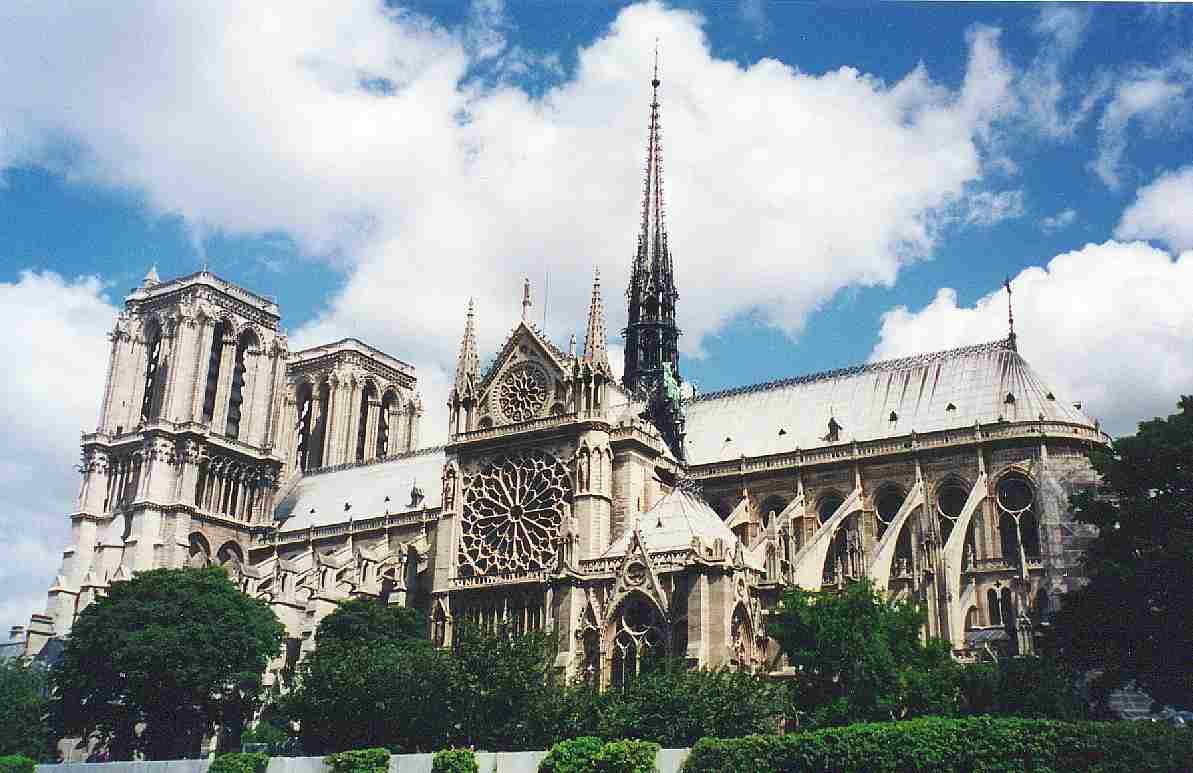
Here the beautiful Museum of the Middle Ages and the Renaissance is housed, one of the most important in the world of its kind, which we visit with great interest. The peculiarity of the Museum is that not only the numerous objects on display but also the setting in which they are housed are medieval. In no time we reach the Seine and cross one of the bridges connecting to the Île de la Cité, where we go to Notre Dame Square. The famous Gothic cathedral has a splendid sculpted façade; it is a complex work of art rich in sacred and profane sculptures, apostles and saints are often flanked by monstrous figures protruding from the sides. Beautiful are the lunettes above the doors, the great rose window and the two towers.
After visiting the immense interior we climb one of the towers, which offers the chance to enjoy a beautiful view over Paris but also to see up close the numerous sculptures of the façade and find yourself face to face with one of the protruding monstrous figures. Having come down from the Tower, on the same Île de la Cité our visit continues to the Sainte Chapelle, a small but splendid church, superimposed on another one, considered one of the greatest masterpieces of Gothic art and whose walls are mostly filled with stained-glass windows that, according to experts, are the most beautiful in the world. Unfortunately it's not possible to visit the nearby Conciergerie because it's closed on a rotating schedule, so we leave the Île de la Cité and, crossing a bridge, go to the other bank of the Seine.
Right after, we come across the Tour Saint Jacques, unfortunately muffled by ongoing restoration, then the Place de l'Hôtel de Ville, the fairy-tale Paris City Hall that looks a lot like a Loire castle, then in the square of the Georges Pompidou Cultural Center where we stop to admire some street artists. We were right to rest because for the next destination a long walk awaits us to the Renaissance palace of Carnavalet, which houses the Museum of the City of Paris, an entire floor of which is dedicated to the French Revolution. At the end of the visit we pass through the aristocratic Place des Vosges surrounded by a quadrilateral of similar palaces in soft colors. The square offers a beautiful sight, it's tree-lined on the sides and has a garden in the center, a plaque commemorates the house where the novelist Victor Hugo lived.
In just a few steps we reach the modern Place de la Bastille, where on July 14, 1789 the fire of the Revolution was lit with the storming of the prison of the same name. Now in the center of the square stands the July Column topped by a gilded statue, but there is no connection between this tall monument and the eighteenth-century revolutionary uprisings. From here by subway we reach the Museum of Arts and Crafts, where numerous scientific discoveries and inventions are exhibited. There are so many exhibits; some very bulky ones have been placed inside a deconsecrated church incorporated into the Museum. Here it's also possible to see a Foucault Pendulum in operation as it measures the Earth's rotation with its oscillations.
At the end of the visit we take the subway to Les Halles, walk alongside the gardens of the same name, pass by the Church of Saint-Eustache and go down into the large Shopping Center, a true city within the city and underground to boot. When we return to the surface it's almost evening, we go to the Louvre, which we don't visit (I had seen it on two other trips), we cross the Tuileries Gardens as far as the beautiful Place de la Concorde with the Egyptian Luxor Obelisk in the center and two monumental fountains on the sides. Each of the four sides opens onto a scenographic vista: the Louvre Palace, the neoclassical façade of the National Assembly on the other bank of the Seine, the long Champs-Élysées Avenue, the pseudo-Hellenic temple of La Madeleine.
The Champs-Élysées are too long to walk, so we take the subway to the Arc de Triomphe, beneath which the flame for the Unknown Soldier burns. We go up to the terrace of the Arc, from which you get a beautiful panoramic view of the city where night is meanwhile falling. The Eiffel Tower can also be seen from here from a particular perspective, while on the other side the skyscrapers of La Défense tower up, one of them shaped like an enormous Arch. Below us the many streets that converge right on the Arc de Triomphe to form a great star. Having come down from the Arc we ate a sandwich at the nearby McDonald's and took the Metro to Pigalle. Before heading back we strolled through the red-light district as far as the famous Moulin Rouge, among nightclubs and numerous neon signs. Back at the hotel for the night, we thus close this intense Parisian day.
Paris,Notre Dame
Day 33 Mar 2008
Eurodisney
We take the Metro to Marne la Vallée, where EuroDisney Park is located. It's the third time I've visited it; compared to previous times, the Disney Studios have been added, a veritable Park within the Park. The Studios attempt to explain the various secrets of cinematography, animation techniques and those for special effects. I prefer the traditional Park, the one with the big rides, the fantastic sets and a touch of magic. Surprisingly, compared to other times, there are no long lines to get on the attractions; I manage to visit them all except the ones I give up on because they seem too dangerous. In the evening we return to Paris by Metro, reach our hotel in Pigalle and before going to bed we take a stroll through the "red light" district as far as the celebrated Moulin Rouge.
Paris,Notre Dame
Day 44 Mar 2008
It's our last Parisian day and upon waking in Pigalle we take a few steps and here we are in front of the staircase climbing the hill of the Sacré-Cœur. After visiting this imposing church we wander through the surrounding Montmartre, the artists' quarter. In the nearby Place du Tertre dozens of artists create impromptu works in the hope of palming them off on the many tourists. The tree-lined square isn't large but it's very characteristic and it's nice to wander among the stands of these street artists and observe their works displayed on easels. Here it feels like being in a village rather than a big city; the urban design is characterized by low buildings with flowered balconies and cascades of ivy on the walls, and yet you only need to peek between the plants to glimpse the urban sprawl of Paris with the Eiffel Tower.
We go down into the valley as far as the delightful tree-lined Place des Abbesses, where there is an Art Nouveau Metro station. We take the Metro and get off at Les Halles, returning to the large underground shopping center to do some shopping. Once out, we go in front of the nearby Pompidou Cultural Center to watch a couple of performances by street artists such as mimes and jugglers, then we cross Place du Châtelet, the bridge over the Seine, and reach the Île de la Cité. Yesterday we had found the Conciergerie closed on a rotating schedule, and I'm interested in going in, so I do. Located in a part of the Palace of Justice, once a Royal Palace, the Conciergerie was the prison where aristocrats condemned to the guillotine were locked up during the Revolution. Here, among others, Robespierre and Queen Marie Antoinette spent their last days.
Among the most interesting rooms to see are the Salle des Gendarmes, which served as a refectory, and the Chapel of Marie Antoinette on the site of her Cell. Our visit to Paris is over; all that's left is to take the Metro to reach the train station from which we'll depart for Italy.

0 reader comments