The story
Menthon Castle: The medieval castle stands on a height at Menthon-Saint-Bernard, with a view over the shores of Lake Annecy, reachable by car or by shuttle bus. Restored, in excellent condition, with furnishings and furniture, it's a castle much frequented by tourists. Inhabited since the 11th century by the same family, the castle, with its slender, tall architecture, dominates Lake Annecy. The castle houses a very rich and important library; guided tours are held only in the afternoon and are guided visits with entertainment by masked performers in period costume. You arrive at the top of the hill where there's a small car park and a small house for tickets; you enter the castle on your own and can take a walk in the small park; once inside, the visit begins and lasts about an hour.
The castle keeps a large restored lounge, complete with all the era's furnishings, very well preserved; the rooms visited number about 8. On the way out you can stop at the belvedere overlooking the lake. Inside the courtyard there are toilets for tourists and visitors; there's also, before the exit, a small souvenir shop. Address: Ruisseau Nant des Charnieres 74290 Menthon-St-Bernard
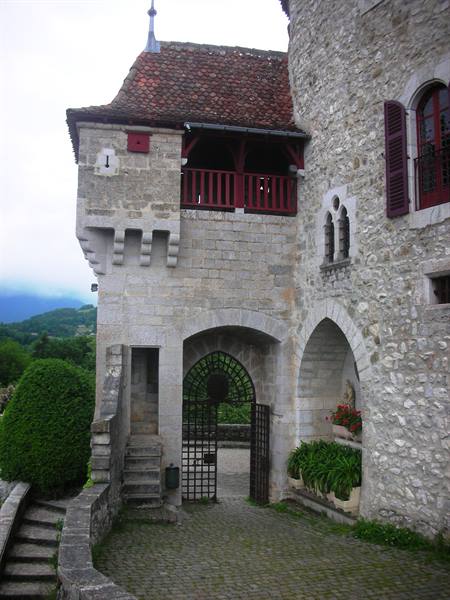
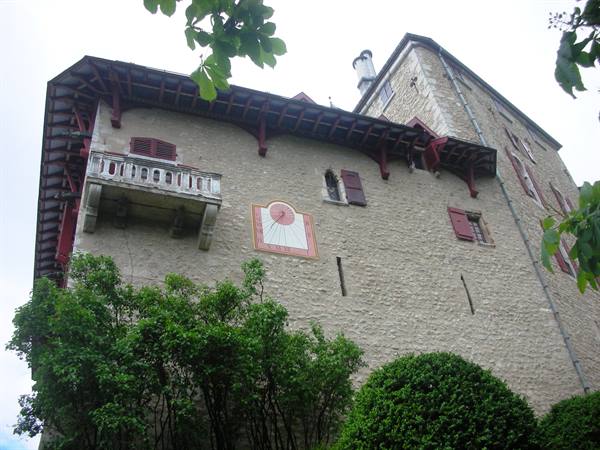
The castle is magnificent, both inside and out — restored, excellently preserved, beautiful and imposing, a fortress on the fortress, from which you have a magnificent view over Lac d'Annecy. When we arrive there's half an hour to opening (afternoon only); we park and get distracted by a pony in an enclosure. Meanwhile the tourists arrive. At two o'clock we buy tickets; we're a fairly large group — French, Germans and Italians (us). They tell us the visit will be special, with entertainment by actors in period masks... well, that's nice, isn't it? NO. We enter the courtyard that goes around the castle and take a few photographs; from below the castle is really grand — tall, narrow, with clear architectural echoes and colours of the medieval period. The roof is steep, very steep, tall and narrow roofs, classic of northern buildings.
From outside we notice some very beautiful picturesque features that catch our attention; from the belvedere (where we wait to go in) we enjoy the lovely view over the lake, the whole valley and the green mountains around us. Everything recalls Ireland. When we go in and have access to the small inner courtyard we find ourselves with a boy dressed as a castle guard; he wants to be funny and fires off jokes in French, laughs (only he does), asks questions around... I don't understand French spoken quickly very well, so I had to rely on the mercy of my partner, who acted as simultaneous translator. I can tell from Luca's face that the young lad — who also gives a brief introduction before entering the castle — isn't likeable, isn't professional and above all doesn't put you at ease. I keep looking around and snapping a few photos that will later be forbidden inside.
We move on to the castle chapel, small and cramped, very beautiful — stuccoes, statues, altar, frescoes, truly noteworthy. Then another little boy appears, 20 years old or so and in a costume like a Franciscan friar or an executioner, something like the robes of satanic sects... Again we're at the mercy of someone who isn't able to give serious information, doesn't much hold the group's attention and certainly not mine, where I understand half of what he says. We then enter the kitchen where the master's servants lived; here two girls act out some little scenes of daily life — nice but nothing special.
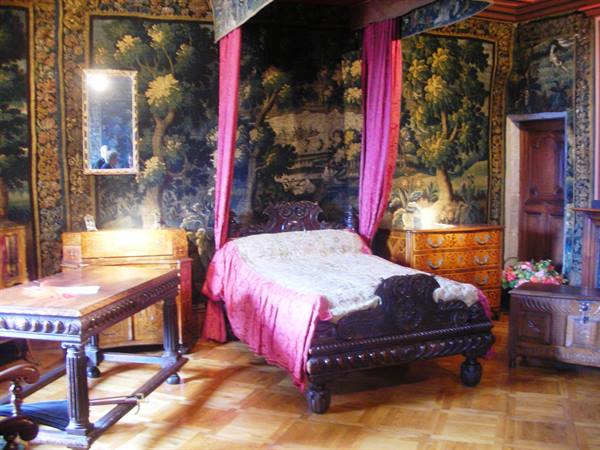
We move on to a library that leaves me open-mouthed, a place of pure culture, a large room with a great many books, very brightly lit, books on all the walls, ancient and original texts, some kept in an open glass case, belonging to and written by illustrious figures of history and the past; in this room a lady welcomes us and tells us the story, which fortunately is interesting. The rooms where the lords dined are almost without importance, anonymous — a few pieces of furniture, a few furnishings but nothing special; after the library nothing has much prominence any more. We arrive in a hall that is almost as important as the library, a large place with a big fireplace, tapestries, period furniture, a grand piano and a violin played by two graceful French girls who tell us a great deal about that hall and its inhabitants. The furniture is truly beautiful and I watch curiously.
Vases, armchairs, paintings... chairs, antique objects; here I discover that despite the ban on photographing, some are snapping away at everything and no one says anything, so I let Luca loose around the place to take photographs... after all, why should only I stick to the rules? After the stop in the great hall we land in a strange place, the last bare room before the exit, where a girl dressed as a boatman, servant or gardener, I don't know, makes us very involved in her monologue, pointing here and there and doing her artistic turn, very exaggerated and very unserious... We come out a little dissatisfied, not with the castle but with the guided tour in costume... it didn't let us fully enjoy the beauties of the place at all. So, since we still have a little time... we set off for the Seythenex caves.
The journey's photographs
5 photographs · click to open them full screen


0 reader comments