Florence, Aosta, Rochamp, Colmar, Strasbourg, Reims, St. Quentin, Rouen, Le Havre, Ètrata, Fécamp, St. Martin Buneaux, Veullettes sur Mer, Caen, Bayer, Montgardon, and many others · Normandia e Bretagna
When
1 Jan 2007 – 1 Jan 2007 1 days · trip of 2007
Who
Nathan & La Francese Un Mondo di Bene · @LaFrancese&Nathan · Firenze
How
Travel diary
The story · 5 days
We set off separately, La Francese from Florence and Nath from Aosta, heading up to Alsace, then Champagne and finally Normandy, to explore it meticulously and then go down into Brittany and back to Italy from below Paris, barely touching the Loire and Burgundy!
Day 116 Jul 2007
the departure
Departure from Aosta at 9:00 AM, not too early – are we on vacation or not? – heading for France. No route planned before getting in the car, the only thing we got was a few guidebooks, the green Touring one for the whole country bought at half price, a couple of Routard guides borrowed from the library, one on chambres d'hotes and another on Normandy. We decide the route to take while Nathan is already behind the wheel of "L'Ammiraglia", my 206 which, so excited to return to its country of production, yesterday decided to freeze the speedometer at 10 km/h and stop blowing fresh air conditioning. This is our starting condition for the 2 itinerant weeks discovering northern France. Nath takes the Gran San Bernardo tunnel, we snub the pass that would have cost us two hours, to pay a tribute of €22.40 to the company that manages the tunnel with Switzerland.
After the 5 km through the guts of the earth we find ourselves in No Man's Land and immediately take advantage of the fact that gas costs less, even though we pay the Vignette (the Swiss highway toll) for a whole year. But the most shocking thing about this start of the vacation is the first flush-water coffee. The first of a small series, before I decided to stop ordering it, never again until we get back home, of course! The road started to spin under our wheels, the city outskirts following one another identically, Lausanne, Bern and finally Biel-tratto-Bienne. From there, we made a somewhat rough choice on our Michelin map, also borrowed. We followed a dashed highway, which we realized as we drove was under construction, and which we therefore alternated with stretches of "normal" road.
The border was in the Delémont/Porrentruy direction, to reach (in theory) as quickly as possible our first stop: Ronchamp, a place near Belfort. To do what? a normal person would ask. To see a masterpiece of modern architecture! I answer! The Chapelle de Ronchamp by Le Corbusier! Aaaah! And who doesn't know it!?? Nathan lovingly agreed to my request, even though, during the long journey to get there we both got a bit impatient. We arrived as the sun was already setting. The church sits on a hill, hidden among the brush. You reach it from behind and walk all the way around it, able to admire it also from a small pyramid a few meters high. It looks like a toy, a little child's construction, so much can it be glimpsed from every side.
Seeing it from outside leaves you with a vague sense of dissatisfaction, but as soon as you set foot inside, you're caught in a whirlwind of feeling, of participation, of emotion. Small splayed windows in the thick masonry borrow warm and colored light. The roof slab is made inconsistent by a thread of light that detaches it from its supports. The telescopic lights create side chapels evocative of divine energy. I came out fulfilled from this first stop of my French journey, my first long trip with Nathan and my first full month with him! YesYes! A whole month of sharing awaits us! Back in Belfort, having glimpsed the walls of its famous fortress from a traffic light that led us back to the highway, our new direction is Colmar.
It was recommended to me by a friend as a very very lovely little town, and since it's on the way, how could we deprive ourselves of such beauty! The Touring guide confirms it and once we arrived our own eyes could verify it too. Here we took advantage for dinner of my friend Paul, the franchised boulangerie I prefer, and of a tasting of splendid local wines, Alsatian! Colmar is a little gem, a beribboned little town, where the public greenery even tends to the geraniums hanging on the balustrades of the water canals that run through the city, the balconies compete to spill out flowering plants of every kind and color, softening that tangle of lines generated on the facades by the lines of the wooden frameworks that characterize the Nordic style of the half-timbered houses.
One last stop for this first day of our vacation, Strasbourg, where we booked our only night, at the Hotel Confort for €35 a room. Our record, until now, in our very frequent travels we had never spent so little.
the countryside of Belfor
Day 217 Jul 2007
From Gothic to Gothic...
A sweaty night at the Hotel Confort in Strasbourg, no one at the time of booking had mentioned the absence of air conditioning, which apparently seems to be a constant of our French journey. Overall the verdict is positive, hospitable, nice and dignified, close to the center and the highway. Without breakfast, obviously not included in the price, we headed toward the center. Having parked L'Ammiraglia safely in a central underground lot near the gigantic modern art museum we headed toward the center under a gray gray sky that was anything but promising. I had already been there, to the border city that hosts the European Parliament, about 16 years ago. A prize trip for a competition held by the Movimento per la Vita that I had taken part in with my class, without knowing who organized it or what you won.
I swear!! I didn't enjoy the city on that occasion, so busy dodging religious functions and proselytizers. From this second visit I wasn't expecting much more, even though I had some revelations. First: the covered passage over the canal that we crossed to reach the center area. Gloomy, with the faces of statues abandoned there, in a sort of exposed basement. Nath liked it a lot, it seemed evocative and romantic to him… to me just evocative, so much so that I couldn't appreciate it with detachment, this genius loci of its! Then, the Cathédrale de Notre Dame, with its warm facade, in a pinkish stone, different from the examples of Gothic seen in Paris, and all the typical neighborhood around it.
Here I started to get the sense that I wasn't exactly on a beaten path during this period, in the sense that many shops were closed for vacation and, if two plus two always makes four, maybe this late-July time isn't exactly the peak tourist season for northern France, all the better, even though a bit of shopping always does you good! …but I don't think opportunities will be lacking. An interesting anecdote, or rather the first blow to my Nathan's super-refined French: sitting at a café, he asks the waitress, along with the bill, for a pen for me, calling it "plume". The young woman doesn't understand and looks at him with cow eyes, at which point I, an Italian klutz with languages, make him the simple gesture of writing and the girl exclaims: "Ahhh!!! Un stylo!!".
Poor MyLove how taken aback he was, he still attached to the language of Chateaubriand and Maupassant! He spent a lot of time thinking about it: "…and yet the French don't have a dialect, they all speak the same, at school they taught me you say plume". MyLove is precise, not like me, he believes in the power of language, in correct accents and all that stuff. Who knows how he'll manage to put up with my dyslexic distraction, alibi of my spelling horrors! Back to Strasbourg, I think I'll need another visit because this morning's light, so dim and harsh, didn't manage to make it fully appreciated, didn't enhance its neighborhoods of low houses with half-timbered facades, its wide squares and its navigable canals. After a quick lunch we set off north again, next stop Reims. The countryside we crossed before getting there is immense and immeasurable.
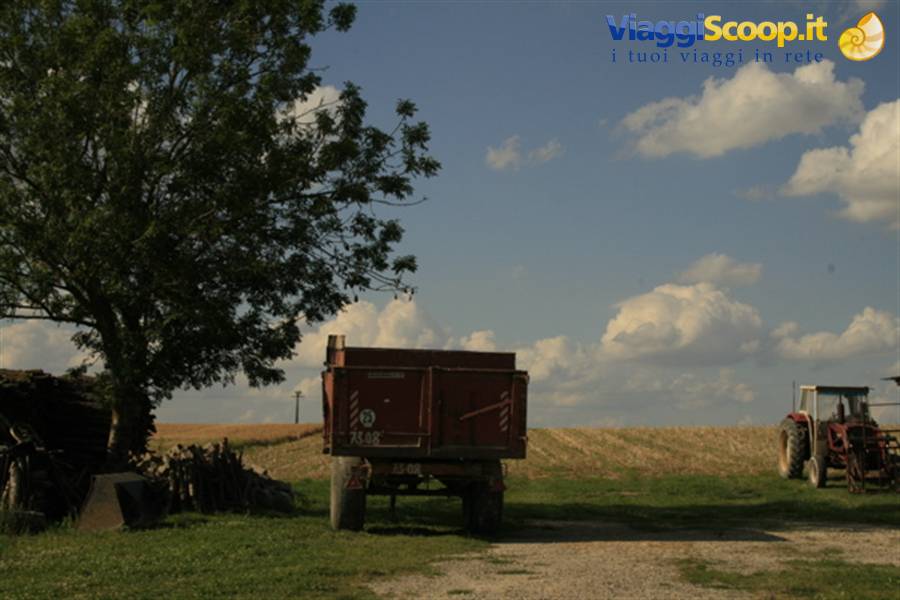
Reims is in the Champagne region, but you see many more abandoned hay bales on golden fields than green vineyards along the highway that leads there. From the Routard guide we drew an address for a chambre d'hote 20 km from the town center, on a farm. Getting there wasn't easy, we circled around the town center looking for the right direction, found by elimination. It might be worth getting more detailed maps. Having reached the cozy and singular lodging for the night, we race again down those deserted roads deep in the fields that reach the city. I can't get over the light, it's daytime until 10:30 PM. Nathan can explain all he wants that we're further north and further east, for me it's not natural. With a huge stroke of luck, we find the cathedral open, a fabulous example of gothique flamboyant. We furtively make use of the deserted interior leaving the facade for later.
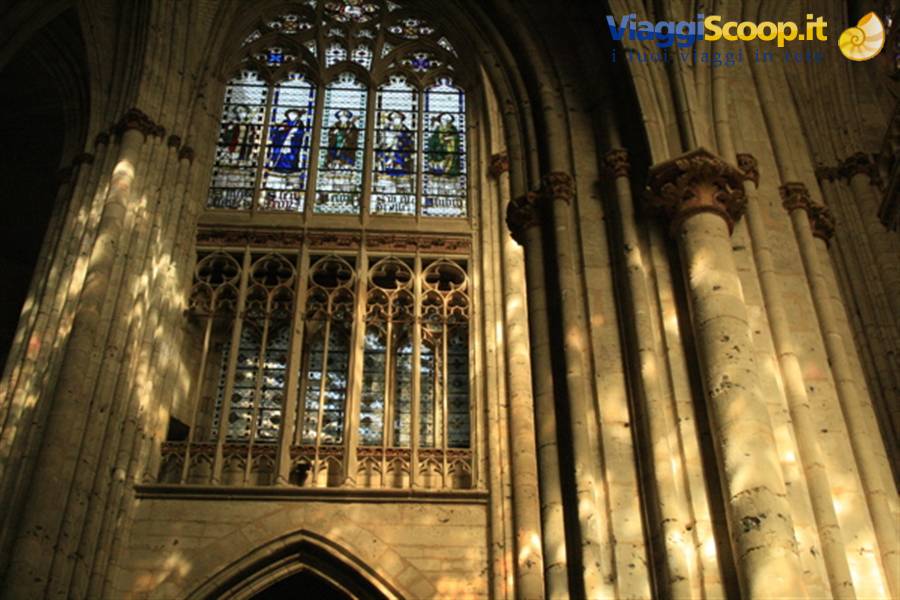
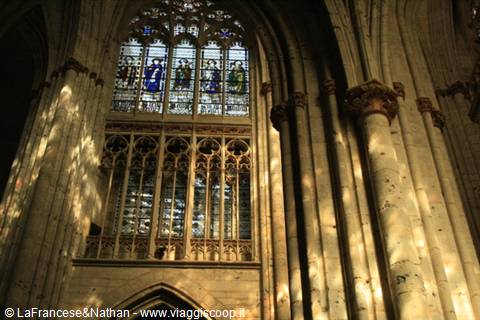
Inside, the blue stained-glass window made for the apse by Chagal and that immense height, that distance between man and the divine, typical of Gothic north of the Alps. Outside the facade, teeming with monstrous animals and divine figures, which majestically, dignifiedly communicate all their overall magnificence, even in a square gutted by maintenance works. A couple of steps in the center, an eye to the shops, to the bottles and a quick dinner based on pork knuckle, a light little thing…
the Champagne countryside
Day 318 Jul 2007
the thatched roof: what a surprise!
Waking up in the countryside really makes us feel on holiday, a new dimension that will last a whole month, our month together. We go down to Mrs. Jacquelin Leriche for breakfast. We leave the wing of the farm reserved for the chambre d'hote, which also contains a museum of peasant civilization, and head toward the dining room. Here a relic of the civilization that was, a large dining table for large families, the arms of agriculture. It is set for two, with croissants, café-au-lait, baguette, yellow butter and jam. What a good awakening! After the hearty meal, a few words with the lady, who originally considers French, Italians and Spaniards all of the same race, Latin (at least as far as language is concerned. Incidentally, I really wouldn't know how much the kindness, cordiality and civic sense of these Normans have in common with many Italian inclinations – the comment is Nathan's)
Back on the road, we say goodbye to Brienne-sur-Aisne and the Champagne countryside without having given in to the temptation to postpone our arrival in Normandy for the underground cellars of the nectar with bubbles. Our destination is Rouen, capital of Normandy as well as adopted city of my Simone, the already too-often-mentioned author of The Prime of Life. I feel drawn to this city that hosted her for years, that saw her as a commuter of love toward Berlin, Paris or Le Havre, toward Sartre. To reach Rouen we take the A26 again at Neufchatel-sur-aisne. We decide on an intermediate stop and choose the nearest one, St. Quentin, snubbing the next and more famous Amiens. St. Quentin, a "minor" town according to the green guide, turned out to be a real surprise.
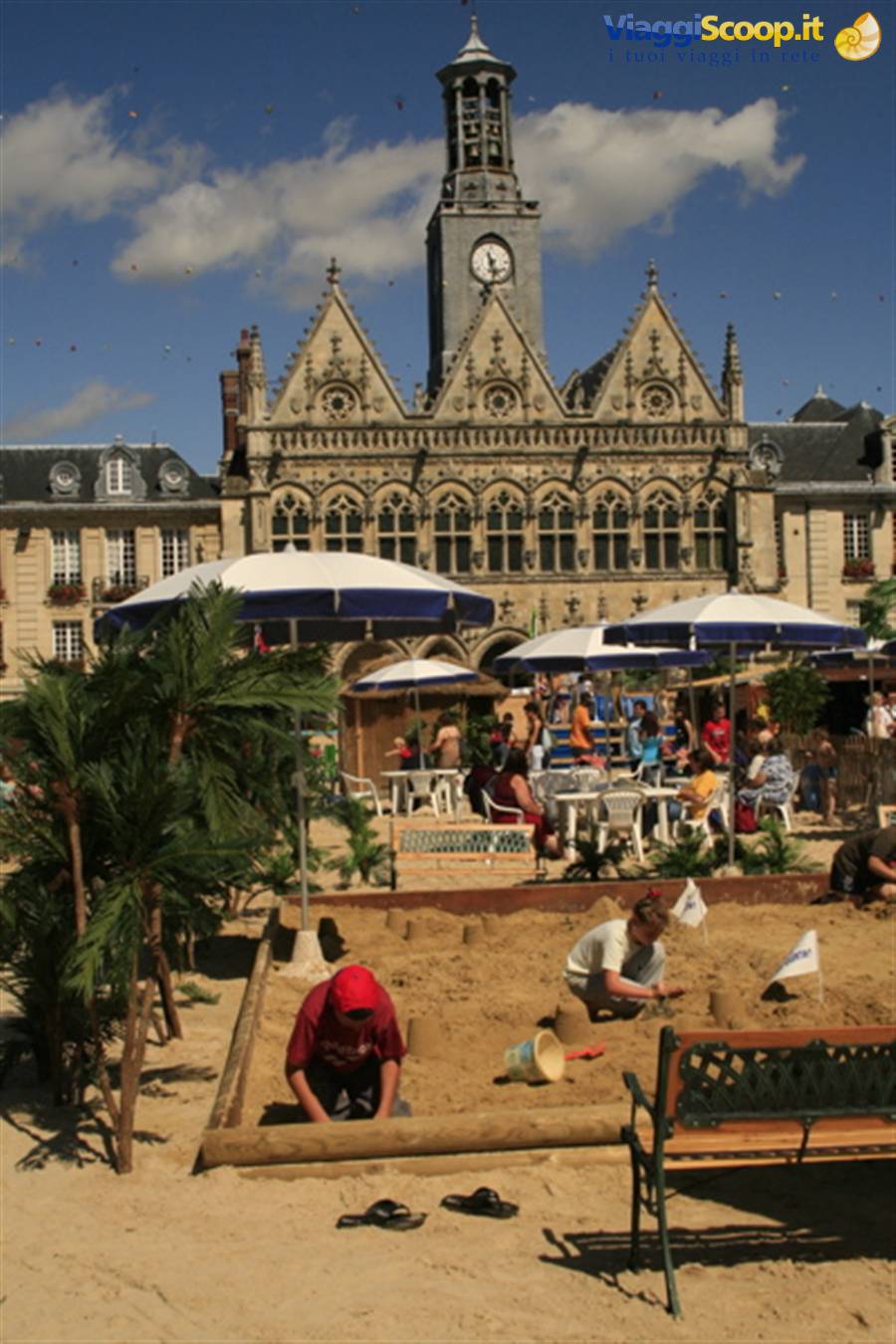
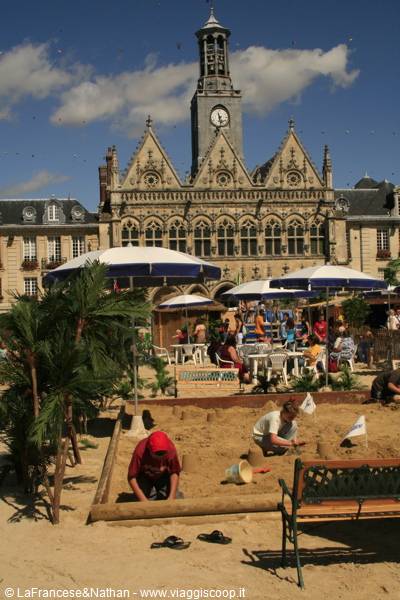
Interesting right from the highway exit, which reveals it perched on a small hill, but the real surprise came when, emerging from the underground parking lot, we found ourselves on an equipped beach. The central square of the Hôtel de Ville in flamboyant Gothic style was set up with sand, pools, slides, children's games and deck chairs with umbrellas for the adults. A satisfaction to see them! All around, the weekly market with fruit and food stalls. We treated ourselves to a nice walk, with a visit to the Basilica of St. Quentin from the 13th-15th century and also to the market. Here we bought the "basket" for our highway picnic: two little rounds of goat cheese directly from the producer, a baguette non complète, and deux tomates because they went well, plus a coca cola as a substitute for coffee, which they insist on calling espresso but it isn't.
(Note: usually I adapt to local habits, I've drunk long-long-long Austrian coffee, the Swedish kind, the Turkish kind which is very good, but this one I find absolutely unsatisfactory for my palate). Along the car journey, Nathan looked for lodging for the evening by phone, and anticipating being able to visit the capital in the afternoon, we booked a Chambre d'hote about fifteen kilometers west, near the Abbey of Jumièges, a San Galgano of the Seine. Rouen turned out to be splendid, lively with beautiful people, not at all provincial, and rich in monumental buildings: the Notre-Dame cathedral, heart of the city, the Renaissance Gros-Horloge, the flamboyant Palais de Justice, the abbey church of St. Ouen, the Place du Vieux Marché, where the Maid of Orléans was burned alive, the church and the Aître of St.
Maclou, the first a Gothic masterpiece but closed due to insufficient staff, the second the seat of the Academy of Fine Arts, so beautiful that it made me want to go back to school! Beautiful Rouen, truly! In the evening we resume our car journey toward the country rooms. It is never easy, the small villages where we find the Chambre d'Hote are always poorly signposted and our maps not very detailed. This time we take the long way around, passing through Maromme (Nathan: anonymous and unsettling satellite town of Rouen…), twinned with my Florentine municipality of residence (Nathan: I understand why they twinned…). We also have a mishap, we buy gas with the debit card and instead of the 20€ spent the text message reports 100€. We hope to sort it out on our return. We arrive at the Relais de L'Abbaye after a long wandering that, fortunately, is still in daylight.
Of course, in my opinion, the sun never goes down here! Jumièges is the first stop on the route we will take tomorrow along the Abbey Road. The lady of the Relais recommends a restaurant, there don't seem to be many here, along the Seine. The river here is close to its estuary and is enormous, you cross it with boats (Nathan: the bac, equipped to carry cars) and large barges overloaded with containers navigate it. To reach "Le Pommeraie" (tel. 02 35379487) there are moments of friction between me and Nath, generated by hunger and poor road signs, but they are dissolved at the table (Nathan: not true, we just reasoned calmly about the road to the restaurant. I argued, wrongly, that we should take another road to the restaurant, but I followed your intuition anyway and we arrived at our destination). We sit on the veranda, along the road that runs alongside the Seine.
Romantic at first sight, if it weren't for the fact that the road is traveled at very high speed and it worries us a bit. But the sunset arrives and the poetry of a warm, enveloping light. The very kind maître recommends an alternative route to the one we had studied for the following day, the route des chaumières – what will these chaumières be? – as well as advising us to return for a big event involving this bend of the Seine, the Armada of 2008
continues on
the gothic beach of St. Quentin
Day 419 Jul 2007
old and new infrastructure...
Again this morning, a more than satisfactory breakfast. The chambre d'hote is truly an excellent arrangement, welcoming and economical, the nightly rates for a double range between 35 and 45. It seems that the big euro markup hasn't happened here. We get back on the road, but only briefly, the Abbaye de Jumiège is truly just around the corner. There's a ticket to pay, we would have preferred not to. Ours is meant to be a brief stop. We want to get back on the road to Le Havre, whether by the Route des Abbayes or des chaumières. We pay and the spectacle inside is very evocative. The Basilica dates back to 654 with reconstruction in the 11th century. Now it is a roofless ruin, but well kept. The park would have deserved a more careful visit. We set off again dividing ourselves between the two routes, first toward the Abbaye de St-Wandrille, then the route des chaumieres.
Once there we understand that it is a route on the left bank of the Seine to showcase the traditional thatched-roof houses, chaumières indeed (Nathan: I had already figured that out before. You hadn't?). We cross, even too quickly, picture-postcard villages, where everything is precious and well kept. The bridges over the Seine are remarkable and imposing works of engineering, they span hundreds of meters because here the river is gigantic, being very close to its mouth at the sea. Le Havre sits right on the estuary, at the far tip toward the sea, it is the second port of France after Marseille, and I adore ports, so different from my motionless Florence. This city matters particularly to me. It was completely razed to the ground during WWII and completely rebuilt by Auguste Perret, an architect of classical stamp who codified the use of reinforced concrete.
The same Perret of Rue Franklin in Paris (see here). I already know what awaits me, nothing of what we have seen up to now, no typical half-timbered little house, no bright colors or flowered balconies, but prefabricated reinforced concrete, quick and homogeneous buildings, in response to the need to give a home to the displaced, to restore dignity to a city battered by war. A dignified community, in the name of what was then a "new" material. I remember the presence of a church but not much more. Once in the city, we opt for the underground parking. Once in the light, we find ourselves in the heart of Perret's project, the Place de l'Hotel de Ville. The town hall has a large tower with a clock, an echo of the historic public buildings. Around it, a beautiful square, lush with greenery and ordered in the modularity of the facing facades.
We see emerging from the urban fabric a bell tower of what I read on the map to be the vague memory of the church, Saint Joseph, also in concrete, also by Perret. The sky is always changeable, and just as we approach it turns gray, like the exposed reinforced concrete, a gray light permeates everything. We walk around the square building, up to the entrance, anonymous. Here my expectations are already at zero and I begin to form an idea about the teasing that Nathan will perpetrate for days on master Perret and his material. But it is precisely when we are discouraged that we have the greatest surprises, no?! (Nathan: yes yes, absolutely!). Inside opens a welcoming and luminous belly.
From the base of the building a luminous cone lights up - the central lantern, what I earlier called a bell tower but which is of exaggerated dimensions - all studded with colored glass, current descendants of Gothic stained glass. Each side of the building filters light with different dominant colors. We read that St-Joseph has been recognized as a monument of humanity, and in our opinion rightly so (Nathan: a now overused title, here in France…). Satisfied at having to change my mind and happy to be able to continue seeing Perret as a master of contemporary architecture, we head toward the beach. There is a nice port and a nice tourist beach; a promenade runs along it flanked by food-stall restaurants. The beach is dotted with single-family wooden huts to shelter from the cold sea wind. We, more than by the beach, are attracted by the little restaurants.
The first one convinced us, we find what we were looking for: the regional dish moules-et-frites. We sit down and they bring us too those delicious single-portion little pots with mussels au naturel with a bit of onion and the french fries to dip in the sauce! Goodness of elaborate digestion! Here I tried coffee again, but I swear I give up! Well refreshed, we set off again, saying goodbye satisfied to Le Havre and Perret, heading for the Côte d'Albâtre. We have booked for the night in a chambre d'hote at Mme Vaird's, near St-Martiin-aux-Buneaux, loc. Tournetot. The Routard guide labels her style as truly particular, we will see with our own eyes by evening. In the afternoon we go down along the alabaster coast to see the cliffs plunging into the sea and the characteristic Norman villages.
One after another: Ètratat, where I buy my French striped shirt in a building like a covered market with characteristic wooden carpentry, and Fecamp, where we try to visit the Bénédictine Distillery but find it closed. We both recognize in this place a very Anglo-Saxon charm, the kind, to be clear, of Loach's films. Even this time finding the room for the night was not easy, also because of the rain. Once arrived the surprise is enormous, Mme Viard is a sort of Lucia Bosè, the house the lair of a junk dealer (the photo is blurry but it conveys it). She assigns us a duplex room for 6 people and advises us to go eat in Veulettes-sur-mer. Thanks to the bad weather, everything here seems scarcely inhabited. The charm of a land at the end of the world is amplified by the wind, the twilight light and faces weathered by salt.
We choose the last dive of the seafront and we are lucky, they bring us enormous and tasty dishes.
continues on: unmondodibene.blogspot.com
the cathedral of Rouen
Day 520 Jul 2007
True land of Normandy!
The lady with the shimmering hair has definitively won us over with breakfast, literally taken by the throat! A mix of sweet and savory welcomed us in the junk-dealer's room. A comment on the stay overall positive. The style, as Routard said, is decidedly particular and characteristic, a not entirely positive judgment on cleanliness – I'd challenge anyone to manage to clean well an old house with all those knick-knacks – excellent on breakfast. You decide whether to go to Mme Viard's if you happen to be in those parts (tel. 02-35975477). We set off again with the usual gray sky and sparse rain. By now we are resigned, this variability of weather must be characteristic. Heading South, toward lower Normandy.
Lucia Bosè advised us to go to Honfleur, in fact she ordered us to go there! After about ten km of normal road we have a bit of bickering (Nathan: it must be the weekend pressing on…), fortunately we soon reach the highway and strike up a conversation on the great systems, inflation and wage indexation, the cost of living in Italy for twenty years, the economist in Nathan resurfaces every now and then. We cross the Normandy bridge, the last, chronologically, of the infrastructures connecting the two banks of the Seine at the estuary. As soon as we come down we are already in Honfleur, a typical northern town, with a tourist port, half-timbered wooden houses and those of black slate (the most typical of this city). Walking among shops and restaurants was truly pleasant. When it started raining again we got back in the car toward Caen, after Rouen the other big city of Normandy.
The guide says "university city completely destroyed during WWII", of course because the landing beaches here are right around the corner. Also in Caen we look for the town hall parking, where we find ourselves on a height in front of a monumental Abbey. With uncertain skies we walk by feel toward the center. At the first decided downpour, although equipped with matching kways, we take shelter inside a tea room to warm up a bit. We take the opportunity to book for the night. We begin to have some trouble finding lodging, it must be the weekend, combined with the most touristy area.
In the end, risking Nathan's nervous breakdown as he hates making reservations by phone (Nathan: let's clarify, please: I hate making phone calls and hearing "c'est complet, désolé" repeated every time), but he is forced to, being the only one of us who speaks the native language – yes, I know it's shameful, the Frenchwoman doesn't know French – we book chambre and table d'hote at the Seguineaus' in Montgardon. Despite the at times pounding rain, we still have to get an idea of this city. So, we set off again. We take a couple of quick photos: the fortress, the ancient streets surviving the destruction. We intersperse the cultural with pain-au-chocolat, just to not lose the habit of eating with our eyes! (Nathan: but above all with the mouth, I'd say!) Before getting close to the place of our evening rest, we have one more stop: Bayeux, the city of the tapestry.
We discover that Friday, or maybe this Friday, is a market day and I would lose myself among the stalls, but Nath huffs, rightly I must admit, because it's a market like any other. We slip into the city church, which I must say is rather ugly, at least to our eyes accustomed to the highest masterpieces of French Gothic. We approach the site of this tapestry, which the guide describes as a long canvas with narrative embroideries on medieval life. This time the cost of the ticket, and the scant interest of finding ourselves in front of meters of embroidery (Nathan: and let's add a certain tiredness, perhaps more mine than yours, I admit…), make us skip the appointment with the Middle Ages and we set off again toward the Parc naturel régional des Marais du Cotentin et du Bessin, at the center of the Norman peninsula in the Manche department.
The chambre d'hote is near Le-Haye-du-Puit, the landlady awaits us for dinner at 8 pm. Nath offered to be my voice at the table, with a certain excitement he literally said these words "Amore, I will be your voice, you speak and I will translate for you". I would never have asked so much, I am all meek and shy when he speaks, it bothers me to ask him to report for me… at most sometimes I prompt him! Be that as it may, after a few empty turns (French road signs have a reading all their own) we reached our destination. The place is very charming, the Seguineaus very welcoming. They seated us at the table with 10 other people after the usual introductions, Nath immediately specified that I don't utter a word and that he will take it upon himself to translate for me. Fine, I had taken him at his word in his statement a little earlier.
Within 10 minutes, at the second request to report my thought, between dishes to pass and to portion out, he gave me wide eyes and made it explicit that he was fed up, literally "next time you want to come to France with me you learn French!" Charming, no? my love! Ah! Men! they don't even know what multitasking is! (Nathan: this is an infamous lie! It wasn't the second request, we were already halfway through dinner, in fact perhaps Mrs.
Nicole's dessert had already appeared, and all those transalpines were interested in the Italian couple, I had to answer and ask for myself, do it for you, pass the dishes to the Alsatians, have the old people from the Paris region pass me the roast potatoes and explain the shape and consistency of a grain you had seen but whose name you didn't know, all in two languages, with some colorful notes on the Alsatian Germanic dialect, and the Burgundian who wanted to know from me what I thought of the pension reform in Italy, given that in France people retire at sixty already for a very, very long time…. Ugh, what a stressful dinner!). In short, I sat there the whole dinner smiling and saying "merci".
An experience to have, the table d'hote, if you can converse with your table companions! Gastronomically everything excellent, the cider made by the host, the terrine campagnard as entrée, the roast beef with gratiné-de-pommes-des-terres-au-daufinois, which is nothing other than oven-baked potatoes with cheese, then to close a tray of regional cheeses, needless to say, very good, and also the dessert, whose name and recipe I couldn't say (Nathan: I seem to remember a plum jam and a shortcrust pastry, very, very buttery). Given the weekend and the difficulty of finding lodging, we thought of scheduling a subsequent night in Montgardon, with a following day of relaxation, excluding the table d'hote which was not so relaxing!


0 reader comments