Genoa, Gordes, Roussillon, Avignon, Les Saintes Maries de la Mer, Arles · Provenza, Camargue
When
26 Apr 2007 – 1 May 2007 6 days · trip of 2007
Who
Silvia Campagnolo · @sika79 ·
How
Travel diary
The story · 6 days
Six days discovering two beautiful regions of the south of France: Provence and the Camargue. A road trip by car with my boyfriend, from Padova, stopping at Genoa and then wandering between Provence and the Camargue, as far as the mouth of the Rhône.
Day 126 Apr 2007
Padova - Genova
The alarm goes off at 6.30: Enrico and I gather the last few things, load the luggage into the car, I check for the third time that all the plugs are unplugged (yes, I have this mania before leaving for a holiday) and off we go towards our first stop: Genoa. The journey is smooth and the decision to set off the day after the 25 April public holiday turns out to be a good one: there is no traffic on the road and we head straight for our destination. We arrive in Genoa at around 11.30: in the distance the city appears to me in all its "crumbling" beauty, an aging lady reclining on the hills. I check the sat nav, enter the address of the bed and breakfast where we will spend the night, and we carry on along the road indicated.
The thing that strikes me most is the elevated dual carriageway that separates the city from the sea: an injection of noisy modernity into a setting that seems to have remained unchanged since the Sixties. The juxtaposition jars, in fact, but I will soon realise that the charm of the city lies precisely in the coexistence of such different aspects. After some hesitation on the part of Petruska (as we jokingly christened our sat nav because of its marked Eastern European accent), we reach the Blu bed & breakfast, on the second floor of an old building near Palazzo del Principe. We are welcomed by Fulvia, a very friendly woman with a lively gaze, who shows us to our room. The bed & breakfast has been carved out of a large flat, in a bright and clean space. And the price is really good value: € 50.00 for the room, breakfast included.
After settling the luggage, Fulvia shows us the things to see in the city, pointing them out on the map. She tells us there will be quite a lot of walking but that doesn't frighten us, in fact: after 5 hours in the car we can't wait to stretch our legs a bit. And indeed our wish is amply granted: on foot we go all round the historic centre, pass in front of the monumental church of S. Lorenzo, emerge into piazza De Ferraris, explore the little alleys where we get lost several times, visit a fine photographic exhibition on the Seventies, and keep wandering until evening without stopping. Our feet hurt but the pull of the city is strong: and we keep walking.
After stuffing ourselves with focaccia and farinata, we plunge again into the characteristic little alleys of the centre, packed with small shops of the most varied kinds: it is not unusual to find franchised outlets of big brands, with excessively "glamorous" fittings, next to small workshops of craftsmen or traders that smell of old wood and damp walls. As soon as we leave the most beaten track, which winds along the main tourist-friendly streets, and venture into the little alleys of the centre, the city reveals its true face. An old print shop catches our attention: we try to peep inside but the windows are darkened, shielded from curious eyes. The sun, which that day was often hidden by the clouds, barely filters between the old, tall buildings, casting a particular light on the ground.
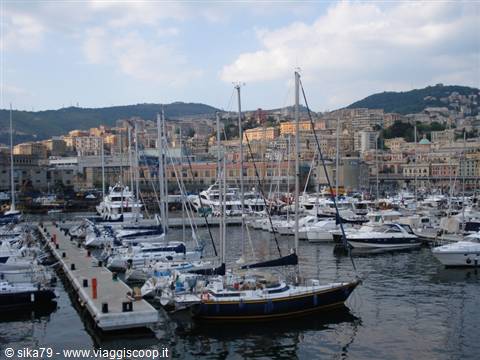
It is here, among the alleys of the Maddalena, just a few metres from the glittering "commercial" streets, that it is common to come across women and girls in skimpy clothing, mostly foreigners, stationed beside the entrances of homes where they offer their services for payment. Genoa amazes me once again by showing itself brutally in all its multifaceted reality. At this point we decide to take a break, and where if not on the romantic pier of the old port? We therefore reach the big floating pontoon, after minutely examining all the boats moored there, most of them foreign, fantasising about which of the many would have suited us. We pass by the big tropical bubble designed by Renzo Piano, a kind of transparent spherical greenhouse where a tropical forest has been recreated, plants and animals included.
The thing might even tickle our interest but 5 euros' entrance seems decidedly excessive to us for what the attraction offers, and we decide to carry on. We reach the end of the pontoon where we finally rest our "weary limbs". The sun finally peeps out between the clouds. From here the view of the city is exceptional: the buildings clinging on seem to clutch the hills, almost as if equipped with claws, and distribute themselves over them in a disorderly way. Some operators with a camera and microphone reach us, a girl and a grey-haired man of about 45: they set up the equipment, quickly study the place and choose the right framing. We watch them curiously: they do indeed seem to be professionals. The girl starts interviewing the man, who answers facing the camera.
The noise of the sea prevents me from understanding the meaning of his words but I manage to catch something: they talk about a film shot last winter, set in Genoa with protagonists of the calibre of Margherita Buy and Antonio Albanese. I sense that he is a figure of some standing but I don't dare ask. Only later, on returning from the holiday, will I make the bitter discovery: it is Silvio Soldini, a well-known Italian director, who among other things directed "Bread and Tulips", by far my favourite film. Unfortunately, mea culpa, I easily recognise the overexposed faces of vapid television personalities, perhaps also because they are shoved down our throats in every possible way, but the director's face was not at all familiar to me. A shame, I would gladly have seized that opportunity for a cordial handshake.
We leave the sea and plunge again into the characteristic little alleys of the centre. After dining at the trattoria "Alle due torri", near the Towers of Porta Soprana, we head, exhausted, to our accommodation for the night.
Gordes - Provence
Day 227 Apr 2007
Genova - Aix-en-Provence
After yesterday's trek, today we decide to opt for a more relaxed agenda and treat ourselves to a visit to the Aquarium. We set off on foot and along the way we notice the presence of a great many Chinese shops selling products at very low prices: a real invasion. Of "native" traders, in the westernmost part of the city centre, there is not a trace. We head for our destination, but on the home stretch we allow ourselves a small detour towards the alleys of the centre. I have to admit it: these little alleys draw me in like Ulysses' Sirens. I don't know, I find a particular flavour in them, a "gypsy" one, and the smell of the sea mingles with that of the multi-ethnic human reality that populates them. After a brief plunge into the alleys of the centre, we head, with no further distractions, for the Aquarium.
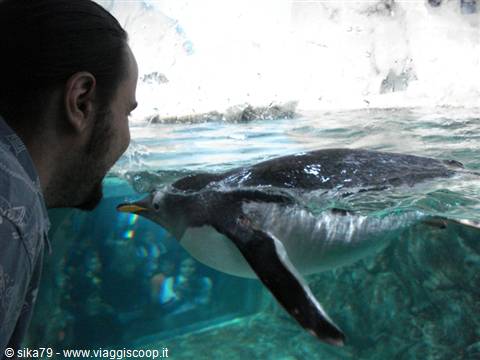
A tourist destination par excellence, the Aquarium attracts enormous groups of tourists and lively school parties every day. Indeed, if you are in Genoa, it is really worth visiting (entrance €15): the spectacle is guaranteed and don't be surprised if you seem to become a child again when you get excited at the sight of the beautiful dolphins or marvel at their aquatic agility or, again, recognise in the clownfish the features of Nemo, the lively little fish from the cartoon of the same name. You are allowed to take photographs but remember to turn off the flash. The tanks are bright and the photos come out very well anyway. And the fish thank you. The route is fairly long and it takes no less than three to four hours to complete it.
Inside the complex there is also a spacious cinema where, roughly every 20 minutes, a 3D film is shown that projects the viewer into the deepest sea abysses, in contact with truly terrifying creatures. If you love tropical birds, with a small supplement (€ 2) it is possible to visit the hummingbird room, where these little creatures, with their very rapid wingbeats, fly freely above your head.
In the early afternoon we resume our journey towards Aix-en-Provence where we will spend the night. We reach our bed & breakfast "Mas des Oliviers" in the evening. The accommodation is outside the town centre but really lovely: the central part, used as reception and restaurant, is surrounded by numerous "bungalow"-style rooms arranged in a horseshoe. The setting is spartan but clean and comfortable. The price is really good value: € 40 for the room.
Gordes - Provence
Day 328 Apr 2007
Gordes - Roussillon - Avignon
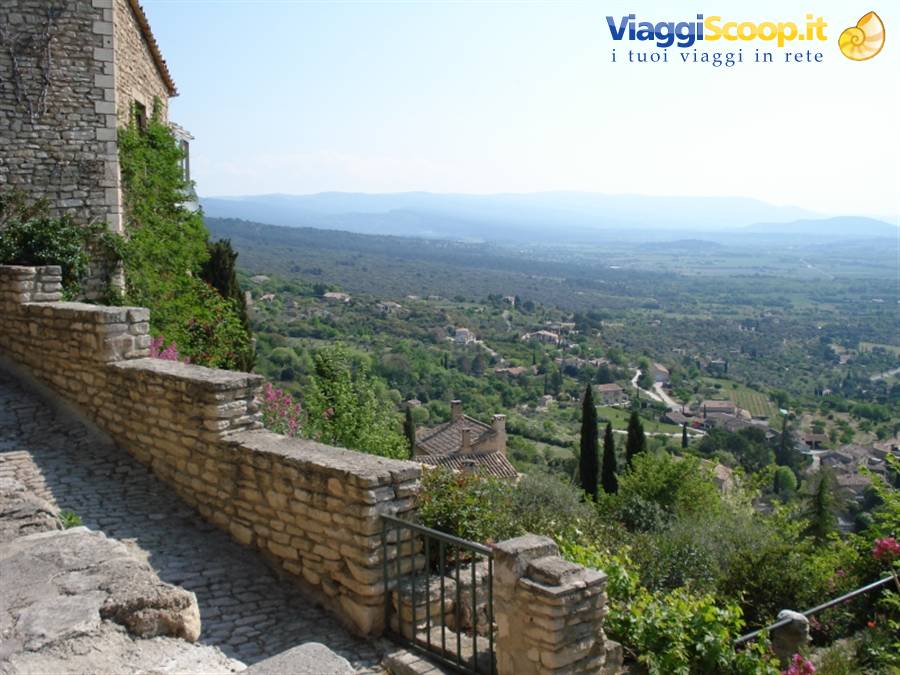
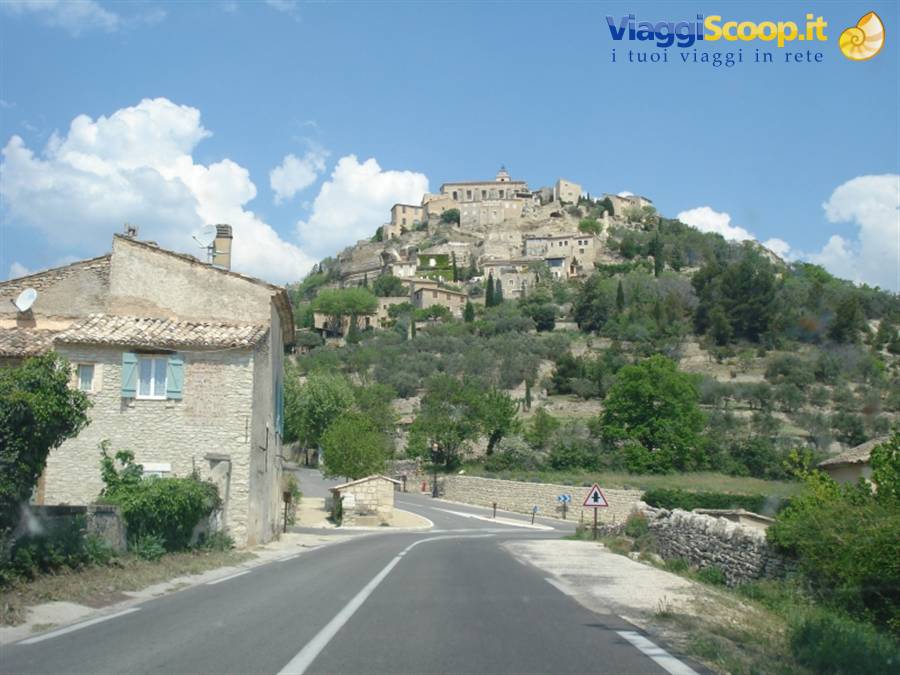
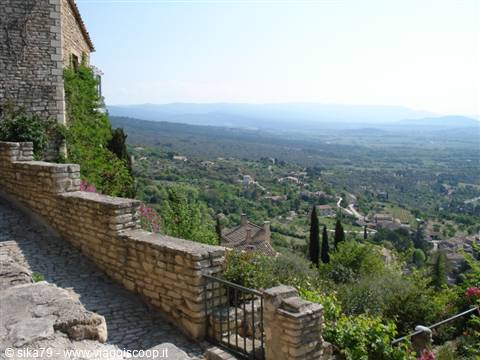
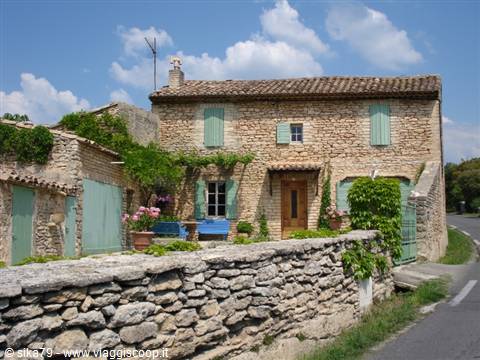
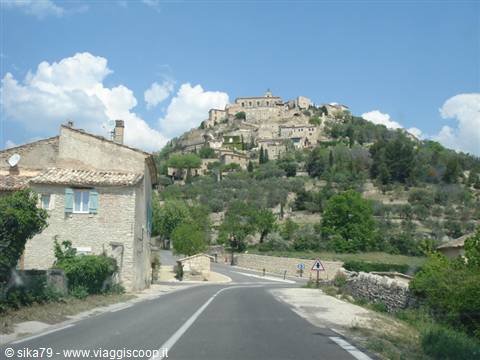
The drive resumes in the direction of Gordes, in the heart of Provence. The village is truly enchanting: a charming hamlet of dry-stone houses and buildings constructed on a rocky outcrop from which the view over the valley and the mountains of the Luberon truly takes your breath away. All the little alleys lead to the pretty Place du Château, the central square where the tourist office is located, at the entrance to the castle. I can't resist the temptation to buy two little bunches of dried lavender in the small fruit and vegetable shop in the center (I'd advise against buying it in souvenir shops, where you pay at least double). The atmosphere here in Gordes is calm and reassuring, and I'd love to stay here for the entire holiday. A stay in this place is definitely ideal for anyone who wants to detox from the stressful, frenetic pace of modern life.
What catches my attention are the cicadas of every size and material that invade all the souvenir shops. Terracotta, ceramic, plaster, wood… cicadas as sachets or as flower holders, as cake molds or as simple ornaments. There are even special ones, equipped with a "photocell," that chirp when someone walks by. Along with the more traditional soap, the cicada is, I suppose, the item most sought after by tourists. While strolling through the streets of Gordes, we're flagged down by a lady who invites us inside her little shop to taste some typical local wines. We try several, but in the end our choice falls on a "vin de figue" and a "vin de coings." Given my now-rusty French, I can't immediately understand what "coings" means. The lady isn't much help, she speaks only French and a little English.
As for Enrico, I don't even consider him — he can barely say "oui" and "no." The flavor is familiar to me, I'm sure I've tried it before, but I can't connect it to anything specific. The scene becomes grotesque, with the lady trying to "mime" the shape and consistency of the fruit and me not knowing which way to turn. Finally it comes to me: it's quince! But the lady doesn't seem convinced; she makes me understand that I'm not on the right track. "Ce n'est pas melocotòn!" — she tells me — "Melocotòn est pêche!" In the end I realize the lady has confused the Italian "mela cotogna" with the Spanish "melocotòn," which is indeed the peach. After this amusing little scene of linguistic misunderstandings, I confirm my theory: it is indeed a typical quince wine, very sweet, still, fortified.
We head toward the car to move on to Roussillon, but first we decide to make a brief stop near the Cistercian abbey of Senanque. The road from Gordes leading to the abbey is rather narrow and winding, and traffic jams frequently form, especially because of tour buses that, given their size, take up the entire roadway. We go down until we reach the valley where enormous lavender fields stretch out (unfortunately not yet in bloom), in the middle of which the abbey stands majestically. We weren't particularly interested in visiting it inside, so we hadn't looked into how visits work. However, if you want to admire the interior rooms, it's advisable to book the visit, which, among other things, can only be done on certain days and at certain times. We resume our drive toward Roussillon, about ten km from Gordes.
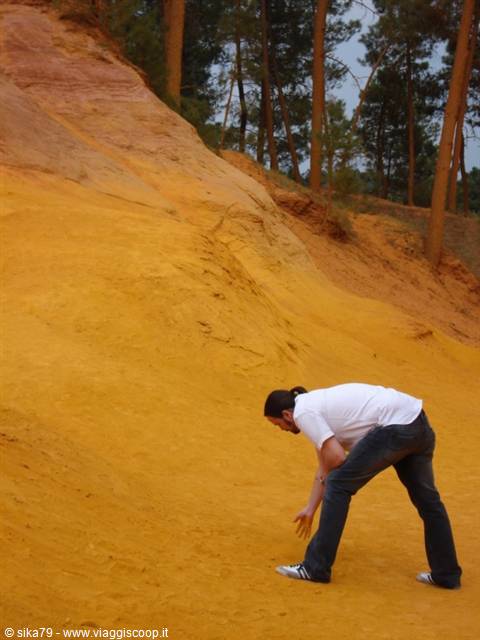
We park the car just outside the center and right away the impact is astonishing: before us opens an immense valley on which a promontory of ocher earth rises. An enormous red splash on a green palette. The village stands on a hill that was once the largest red-ocher quarry in Europe, used mainly as a dye for fabrics. The delightful center is a web of little streets lined with houses whose walls are the color of sunset: yellow blends with shades of red, orange, even touching hints of purple. In the center of the little village there are several small shops: in one of them, whose name I don't remember, I bought pieces of artisanal soap with a wonderfully good and long-lasting scent. In Provence, little soap shops abound, and you can find different types and fragrances (some are rather cheap, packaged specifically for tourists).
Only here in Roussillon did I find a type of soap that is truly high quality, produced according to ancient methods (by Mas du Roseau). As we walk through the center we meet several tourists with their shoes caked in ocher dust. The most extreme ones have even covered their skin with the red earth, as if it were a beneficial mud. I'm really curious to know where they could have gotten themselves into such a state! We follow the signs and on foot reach the entrance of the ocher trail (€ 2.00). The spectacle is breathtaking: a few steps and you find yourself contemplating from above an immense hollow with a thousand amber shades. You go down along a wooden staircase: at every step I stop to admire this most strange scenery from a new angle. It really feels like having landed on Mars.
The path leads you deep into the green of the Mediterranean vegetation, made even more intense by the contrast with the reddish background. Walking on fine dust that looks like saffron, we observe the vivid green of the pines and cedars breaking the monotony of the yellow and red, and we're surprised by some rocky pinnacles towering majestically upward, shaped by water and wind. In the late afternoon we resume our journey toward Avignon, crossing endless stretches of vineyards with low, twisted rows (from which the "Vins des sables" — wines of the sands — are produced). So we arrive in Avignon, but reaching our hotel in the center is quite an undertaking. We drive through one of the gates in the city walls through which you enter the historic center, but because of a detour and the countless one-way streets that allow no going back, we get lost among the little streets.
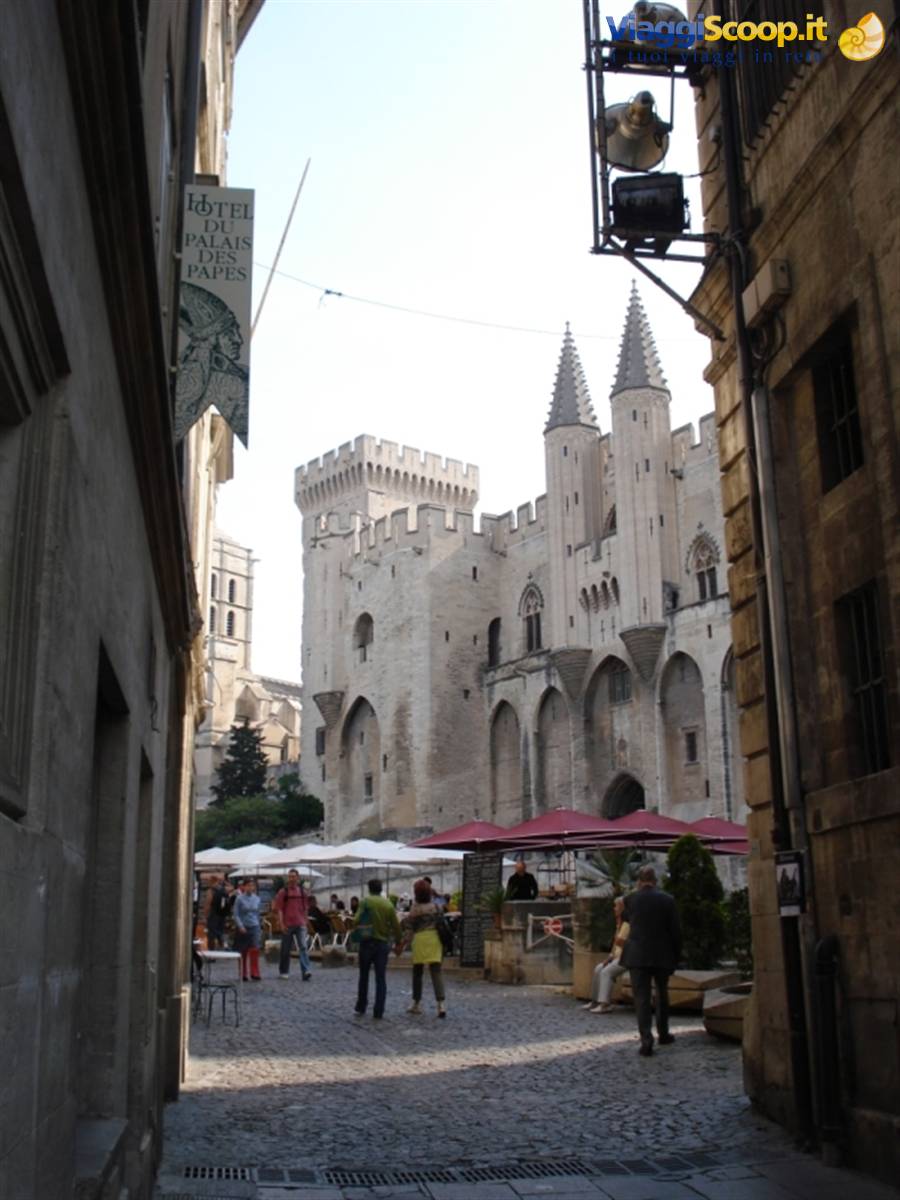
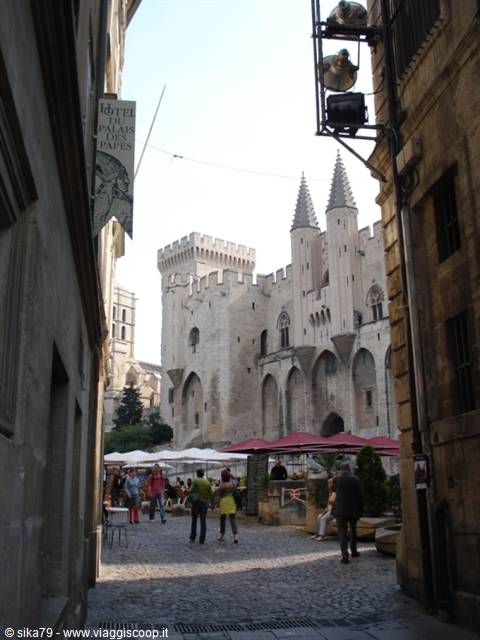
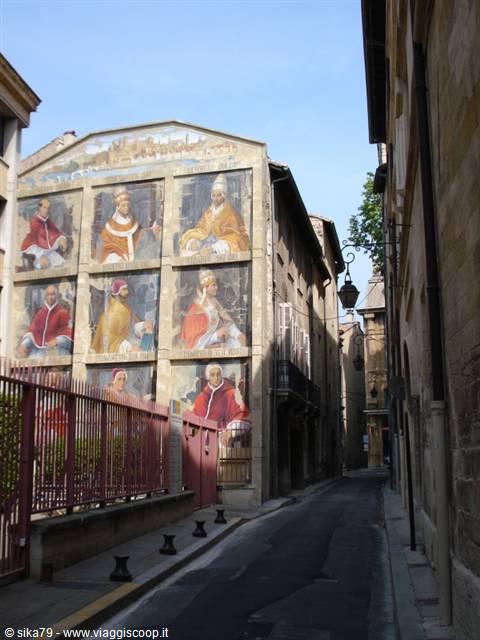
Our hotel (Hotel Danieli, € 77.00 per night per room) is right along the main Corso, which on Sundays is closed to traffic. We wander around for an hour trying to reach the hotel, and when we finally make it, they tell us the hotel has no parking, that we have to leave the historic center and park the car in a paid parking lot near the train station (€10.00 per day). An Odyssey! In the end (finally) we arrive at the hotel and treat ourselves to a well-deserved break. In the evening, after a good refreshing shower, we go out to visit the center. We reach the Clock Square, quite lively, and head toward the imposing "Palace of the Popes," one of the largest and most important medieval Gothic buildings in Europe. At the foot of the palace opens an enormous square, made even more evocative by the traditional songs in the old Provençal language of a street performer.
We linger a while in that magical setting to admire the strength and pride the Palace gives off. We then resume our walk and follow the signs to reach the Pont St Bènèzet, the symbol of the city of Avignon. Who doesn't remember the famous "pont d'Avignon" mentioned in the famous children's rhyme? Dating back to 1,100 A.D., the bridge was rebuilt several times until its partial collapse in the 17th century caused by a flood of the Rhône. The collapsed arches were never rebuilt, and today the bridge is interrupted, made up of only 4 arches. We return to the center and decide to treat ourselves to a very indulgent crêpe sitting in one of the many outdoor bars overlooking the Clock Square. It's worth it: chocolate crêpe with coconut flakes and ge
Avignon - Popes' Palace
Day 429 Apr 2007
Avignone - Les Saintes Maries de la Mer
After a hearty "petit dejeuner" eaten outdoors, comfortably seated in one of the cafés/restaurants in the centre, we return to the vicinity of the Palais des Papes, even more majestic in the sunlight. Next to the Palace are the papal gardens, a fairly extensive area of which only part is open to the public. From a panoramic terrace in the gardens you enjoy a splendid view over the countryside around the city. Towards lunchtime we pick up our suitcases, take the long Rue de la Republique and head for the car park to retrieve our car. With a certain emotion I think of our next stop: Les Saintes Maries de la Mer, perhaps the place that, more than any other, I want to know. And not only because there is the sea (which I adore).
What fascinates me is the story of Sarah, a gypsy princess, who during the Christian persecutions rescued some pilgrims abandoned off Palestine on a boat without sails, without oars and without food. Having thrown her cloak into the water, it miraculously turned into a boat and the exiles were saved. Among them were Maria Jacoba, cousin of the Madonna, and Maria Salomè, who later gave their name to the seaside place where they settled to carry out their work of evangelisation. Perhaps because of her dark skin and her humble origins, Sarah was never recognised as a Saint by the Catholic Church. Nevertheless she became the protector of the gypsies, who every year, on 24 May, gather at Les Saintes Maries de la Mer to celebrate her and accompany her statue in procession down to the sea.
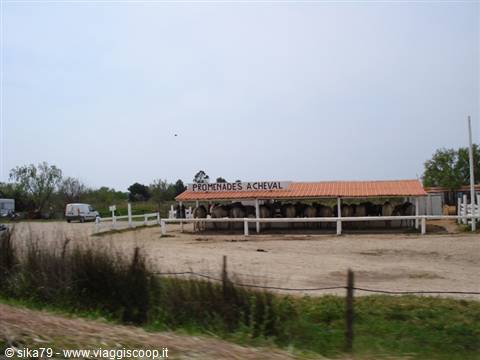
As we penetrate deeper into the heart of the Camargue, the landscape changes and becomes wild, "rough-and-ready". Around us open up vast expanses, marshy plains where no end can be seen. On one side of the road I glimpse a riding school: a notice in white chalk on a worn wooden sign informs tourists of the possibility of "promenades à cheval" (horse rides). I will soon realise that riding schools of this kind are very numerous. This part of the Camargue seems to have been completely untouched by mass tourism; you can still breathe its authenticity. We arrive at our accommodation (Les Rizieres, € 76 a night for a double room), a fine complex just outside the centre, surrounded by greenery. As soon as we have settled the luggage in our room I head for the pool for a bit of relaxation and a refreshing dip while Enrico takes a nap.
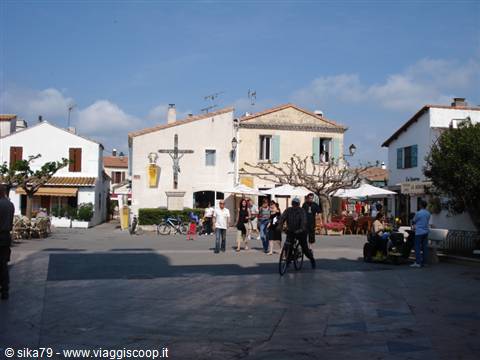
Towards evening we go out and reach the centre of the village: a group of small white buildings, arranged along an intricate tangle of little streets, dominated by the very tall façade of the central Church. The centre becomes distinctly more touristy and restaurants and souvenir shops run riot. The "gypsy" inspiration is strong: from the shop signs to the restaurant names, from the flamenco music heard coming from the venues to the ever-present bull symbol. For dinner we opt for a small restaurant adjoining the church, "Le Felibre". What captivates us is the music of Golfo & Miguel, a duo of guitarists/singers who envelop us with the warm notes of flamenco, sometimes melancholy, sometimes sparkling and rhythmic. The day turns to dusk and the atmosphere is perfect, made even more relaxing and light by an excellent bottle of wine with which we accompany the meal.
What catches my attention for a moment is an elderly gypsy woman, seated at a table, wearing a wide colourful skirt down to her ankles, a "buttero" hat and showy golden earrings. I don't know why but the gypsy people have always fascinated me, for their being wandering, nomadic, for the strong bond with their own tradition. For the first time I taste bull steak: quite a step for someone who until not many years ago was a strict vegetarian! The evening slips by among the notes of flamenco until dessert and the final cigarette that we cadge off the waiter. A short walk to digest and off to the hotel where we will spend the night.
Les Saintes Maries de la Mer
Day 530 Apr 2007
Les Saintes Maries de la Mer - Arles
The day gives us lovely sunshine right from the morning. We leave the hotel and return towards the centre of Les Saintes Maries de la Mer. We are lucky: it is market day. The central square is taken up by numerous stalls selling everything: wines, local gastronomic products, straw bags, utensils, clothes, etc. One of these stalls displays dozens of very colourful wristwatches, made with coconut wood beads. The faces are all the same but set into pieces of wood of the most disparate shapes and colours, as are the straps, made from combinations of all different beads. I can't resist and, given the low cost (€ 5.00), I take two. Other purchases I recommend making in the Camargue are the traditional straw bags: the market is full of them, in all sizes and colours, and the price, compared with Italy, is decidedly lower.
After an exhausting "shopping" session (I thank Enrico for his patience since when I go shopping I am a real whirlwind), we load our (mostly my) purchases into the car and resume our visit of the small town. We return to the centre and visit the church. More than a church, it looks like a genuine fortress, with walls interspersed with arrow slits. The inner nave is very tall and the light filtering in from outside is not enough to illuminate the space, which thus appears even more austere. The church would be rather bare were it not for the hundreds of ex-votos crammed along the sides of the nave. It is impressive to see how many people have appealed to the saint in difficult moments of their lives. There are even paintings that graphically depict the misfortune for which Sara's help was sought.
In a display case there are instead numerous human limbs in silver or metal, probably donated by suffering people who asked the saint for the grace of healing their sick arm or leg. It is as if something indecipherable were vibrating in the air; the thoughts, prayers and pleas of generations of faithful who have passed through here are almost perceptible, each with their own troubles, each with a desire in their heart. Inside the crypt, to the right of the altar, the statue of Sara the Black is kept. Adorned with a sparkling diadem, Sara waits for 24 May each year to leave the church and be venerated in procession by the thousands of gypsies who pour onto the streets of the village. I imagine her, Sara with dark skin, lifted by the arms of her faithful, admired like a queen, pampered on the day of her feast, led down to the sea and there immersed.
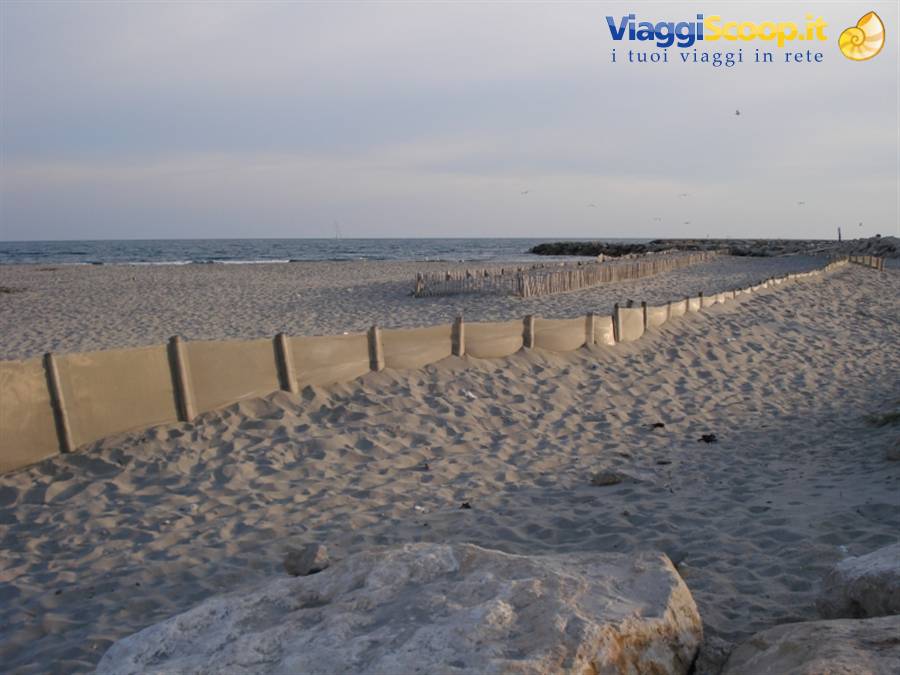
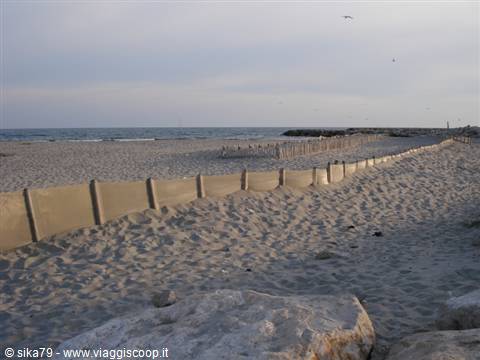
I imagine the night-time celebration, the whirling dances, the women's swirling skirts, the frenzied violins. I emerge from my fantasies and we leave the Church. Just a few steps and I stop to look at the jewels displayed in a shop with a name unmistakably linked to the tradition of the place: Les Bijoux de Sarah. We linger to look at a copper pendant on which a strange gypsy symbol is stamped. The symbol depicts a stylised man supporting a rainbow: a lucky symbol, which makes you strong and protects you from misfortune. What better gift could we give ourselves to remember our journey? After a pleasant walk along the seafront, we set off again towards Arles but not without having treated ourselves to a typical horse ride.
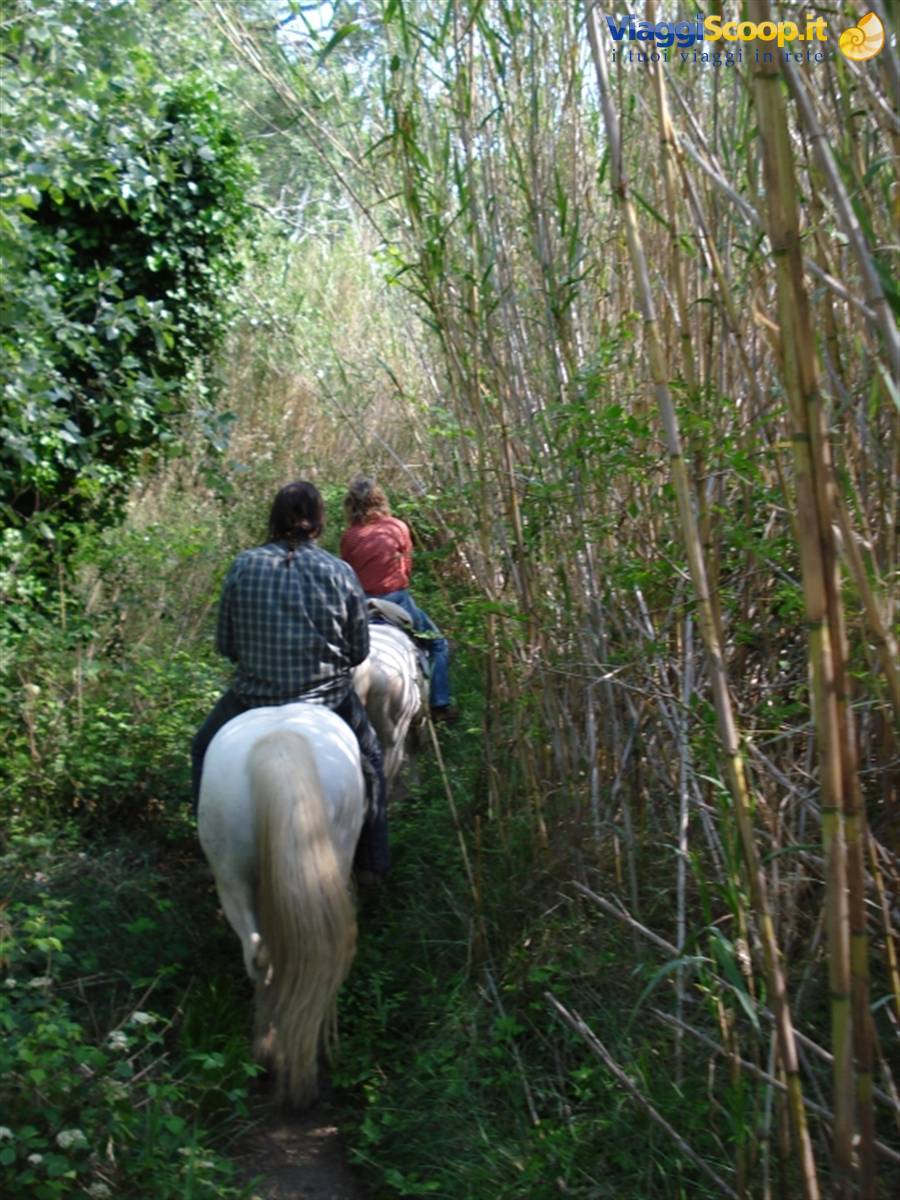
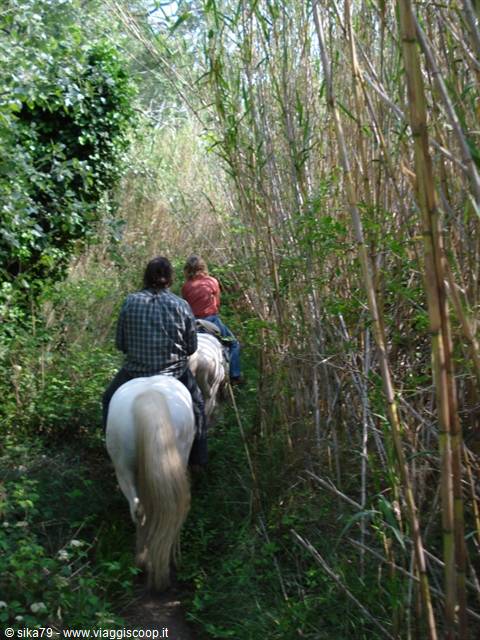
Instead of going to one of the many riding schools at Les Saintes Maries de la Mer, crowded with tourists, we prefer to stop at a riding school a little off the beaten track along the road to Arles. Given that neither Enrico nor I have ever sat on a horse, we nonetheless decide to try the thrill of being cowboys for a day. We park the car and talk to the owners, a western-style couple who reassure us about the gentleness of their ranch's horses. We choose the one-hour route (€15.00 each), thinking that first they will let us get acquainted with the animals, perhaps holding the reins themselves and letting us try on a circular course, like the classic Italian riding schools. Instead they saddle up the "little beasts", give us a few quick instructions on how to "steer" the horse with the reins, and invite us to mount the animals.
From up there the view is completely different and the feeling of precariousness is strong. I think that Moustique, my horse, sensed my tension at the start and did not recognise me as a rider, so much so that he began to do as he pleased. While Enrico and the woman have a great time at the head of the group, Moustique and I fall behind and my urgings are to no avail. A few steps and the horse stops to eat: at a certain point, after yet another "refreshment" break, Moustique raises his head and I see him with a whole bush in his mouth. I think I got the laziest and greediest horse in the whole Camargue! As we go on with our ride the tension eases, I begin to relax and I manage to admire the beautiful places we are passing through. We are right in the heart of the Camargue Regional Nature Park.
Moustique wants nothing to do with catching up with my fellow adventurers and that upsets me a little. Although Enrico doesn't know the language, I can see he is doing great and holds a long conversation with the lady acting as his guide. I strain my ears but manage to understand very little. In the end I give up: it will just mean I will enjoy this experience "solo". The ride winds through stretches of flat ground, small climbs, narrow paths and reed beds where, to get through, you have to duck your head and become one with the horse. Despite a certain pain "in the lower regions", typical of beginners, the horse ride delighted us and immersed us totally in the nature of the place. We set off again therefore towards Arles, our last stop. The journey, unfortunately, is about to come to an end.
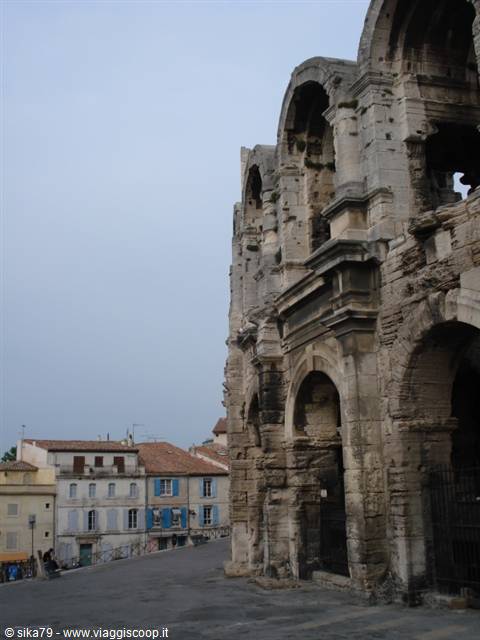
In Arles we stay at the Hotel Le Régence on Rue Marius Jouveau, a modest but spotlessly clean and well-run guesthouse in the historic centre, along the bank of the Rhône. For the overnight stay in a triple room (the only one available) with en-suite bathroom and TV we pay €55.00 (excellent value for money). Compared with the severity of bourgeois Avignon, Arles appears more "genuine" and "extravagant". We wander around the centre, losing ourselves among the thousand little streets that intertwine until they emerge in front of Les Arènes, one of the oldest surviving Roman arenas. Remodelled over the centuries, today the arena is the venue for numerous events such as the traditional festival of the Camargue guardians, organised precisely on the days of our visit.
We dine at the restaurant Media Luna (rue Amédée Pichot) where, alongside typical Provençal dishes, you can enjoy various types of tapas.
Camargue - horse ride
Day 61 May 2007
Arles
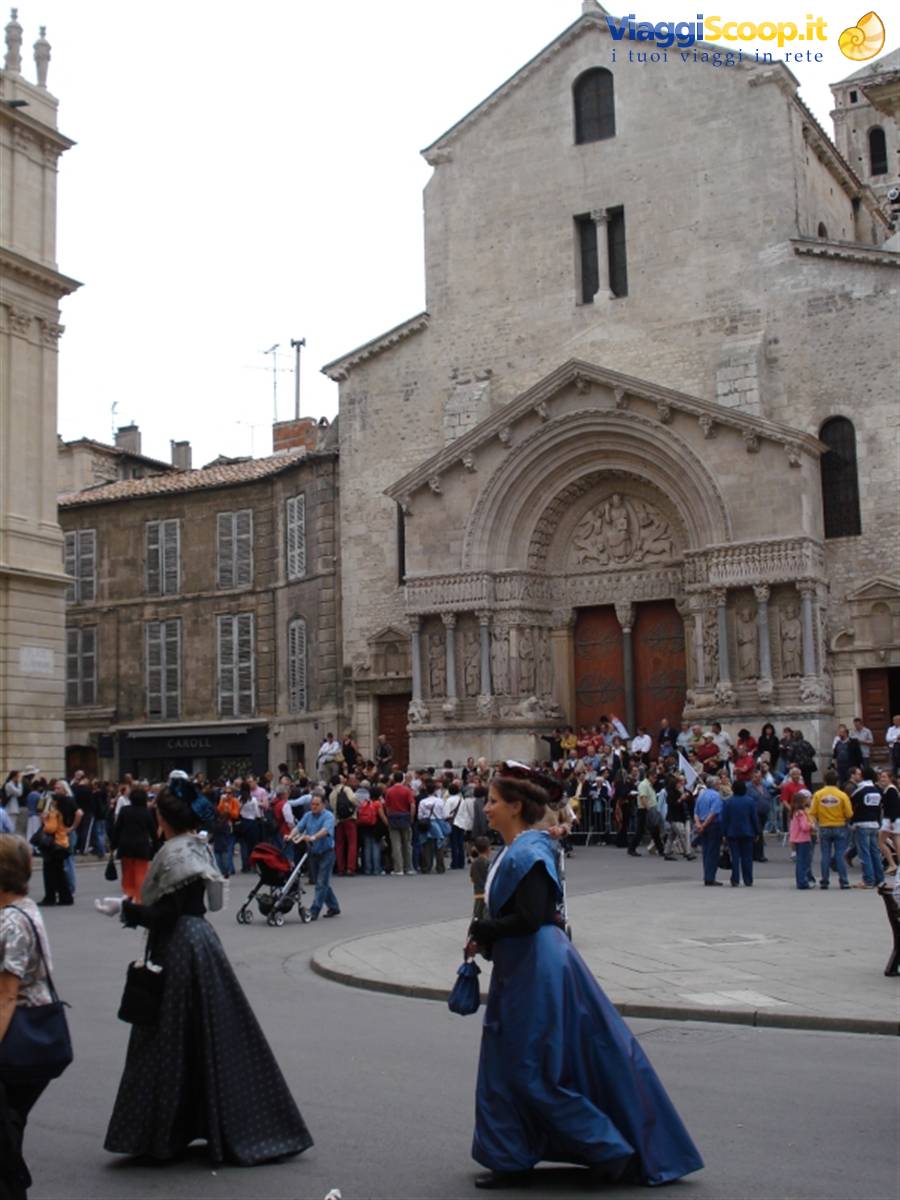
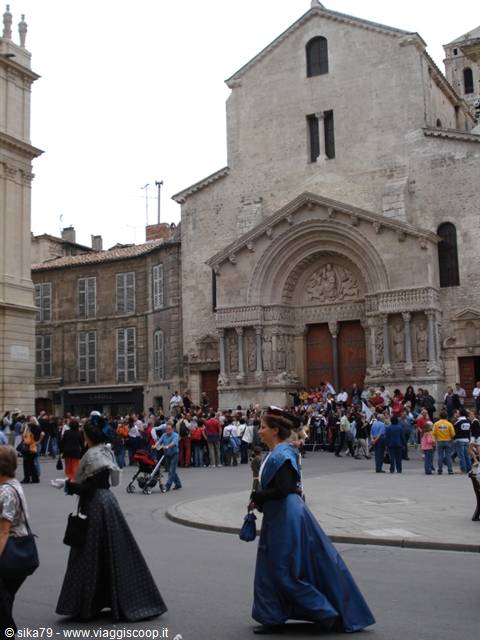
We spend our last morning of the journey wandering around the little town decked out for the festival. We pass by the remains of the Ancient Theatre, return to the vicinity of the arena and slip into the alleys of the centre until we reach Place de la République, on that occasion extremely crowded. We missed the parade of "guardians" on horseback but we enjoy the festival all the same. The women are dressed in elegant traditional clothes, cinched at the waist and long to the ankles, and their hair is done up with a ribbon arranged to look like a little hat. Many of them hold a small bunch of lily of the valley, considered a good omen. We then reach Place du Forum where we come across the famous café portrayed by Van Gogh in 1888.
We continue our walk in the footsteps of the Flemish artist until we reach L'Espace Van Gogh, once a hospital where Van Gogh was admitted for suspected schizophrenia. During his stay in this place, Van Gogh painted "The Garden of the Hospital in Arles", which indeed portrays the garden and the inner courtyard of the building. Studying the perspective of the painting, a copy of which was on display, Enrico and I have fun finding the precise spot where the artist must have placed his easel: along the arcade, on the first floor, exactly at that point that we have no trouble recognising, 119 years earlier the artist could have been seen at work. A thought that moves us at that moment. In the early afternoon we retrieve the car to return to Italy.
A stop in the evening at Piacenza for a very Italian pizza and then straight home, with the desire, at least on my part, to repeat such a lovely experience as soon as possible.


0 reader comments