Aix-en-Provence, Saintes-Maries-de-la-Mer, Marseille · provenza e camargue
When
28 Apr 2007 – 1 May 2007 4 days · trip of 2007
Who
elena longo · @ilonka · racconigi
How
Travel diary
The story · 4 days
From Racconigi to the Colle di Tenda... arriving at Aix en Provence via the Esterel, visiting the city and visiting the Camargue, a beautiful region of France. Last day in Marseille and the little islands off the city, then back among traffic, rain and tiredness...
Day 128 Apr 2007
We're off....
We set off on a sunny Saturday early afternoon by car toward Aix en Provence, up over the Col de Tende and down through the Esterel; the trip went well and the traffic wasn't excessive. We arrived in the city in the evening and spent the evening at home, staying with a friend who would arrive the following day. I immediately noticed some things about France that I don't like; first of all, France is dirty.....streets, houses, squares, everything steeped in the most insidious filth. They're probably not a people who care about cleanliness, neither of the cities nor of themselves, since the people there are also strange. Their bathroom is divided into a shower area and sink and toilet; for the record, the toilet is shut in a tiny little room where, I'd say, it's not the best, for obvious reasons that I think can be imagined.
People walk around barefoot at home and even at the bar some take off their shoes and put their feet on the floor......no comment!! Apart from that, our real vacation began on Sunday with the visit to Aix.
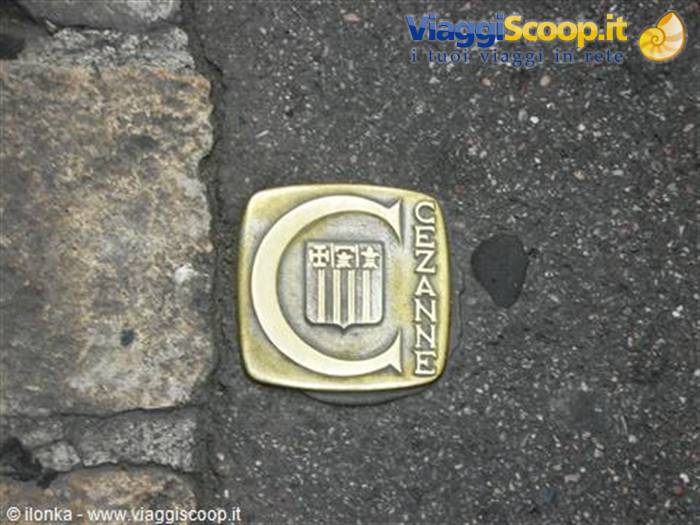
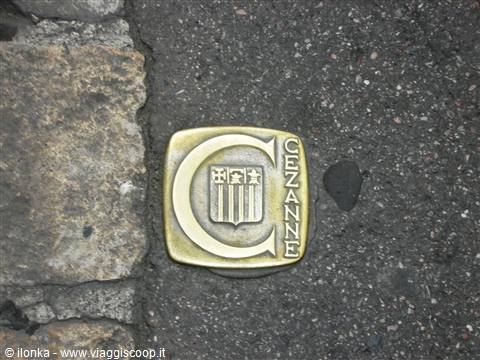
Golden plaque with Cézanne's letter C set into the asphalt of Aix
Day 229 Apr 2007
Aix, ancient but young city....
Up very early and after a healthy shower we set off on foot from the residential area toward the center of Aix. After twenty minutes we arrive in the center and immerse ourselves in everything there is to visit and photograph in Aix........ We reach the central square with the fountain that marks the start of Cours Mirabeau, a place of history and open-air strolls; it remains one of the city's most frequented and lively spots. The central cours is long and has shops and venues on one side and the other of the street; many tourists stroll along the cours as in the rest of the city. The city of 100 fountains.....it really does have fountains everywhere.....
LA ROTONDE: La Rotonde was erected in 1860; this large fountain is topped by 3 statues representing Justice (facing Cours Mirabeau), Agriculture (toward Marseille) and Fine Arts (toward Avignon) LE COURS MIRABEAU an old carriage cours, it forms the connecting axis between the Mazarin district to the south and the old commercial city to the north. This "artery" is adorned with plane trees, fountains, cafés and elegant old private residences. Three fountains embellish the cours: LA FONTAINE DES NEUF CANONS LA FONTAINE D'EAU CHAUDE known as mossy, fed by the thermal spring LA FONTAINE DU ROI RENÉ (19th century), a work by David d'Angers. The statue shows the King with a bunch of grapes in his hand; it was he who brought muscat to Provence.
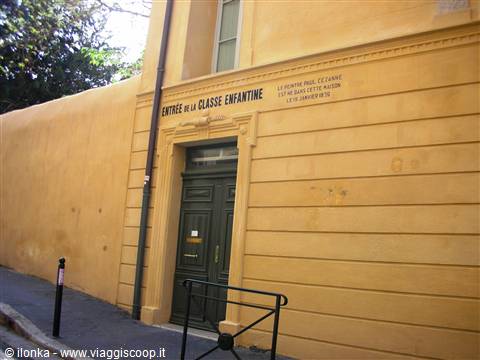
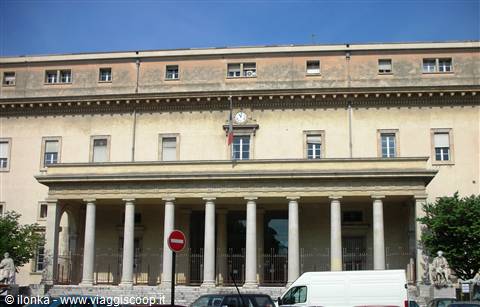
From here, strolling on, we found ourselves in front of the house where the famous and very popular Paul Cezanne died.....A quick stop at the courthouse and a square with a flower market, beautiful and very colorful. Here a stop for a coffee that cost us a fortune. The Old City: It is the oldest part of the city center, a maze of semi-pedestrian alleys, very lively and full of shops. LE PALAIS DE JUSTICE it is built on the old palace of the sovereign Counts. In the 16th century, the Palace housed the Parliament, the Court of Accounts, the Finance Office and the Government. Demolished at the end of the 18th century, the construction site of a new Palace was built according to Ledoux's designs. From here we go around to the back, where we find other modern judicial buildings. Walking and walking, we reach the historic center, beautiful, lively and famous.
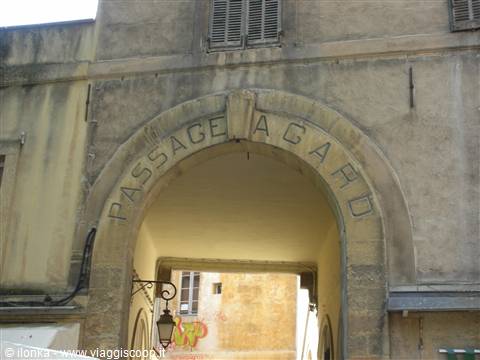
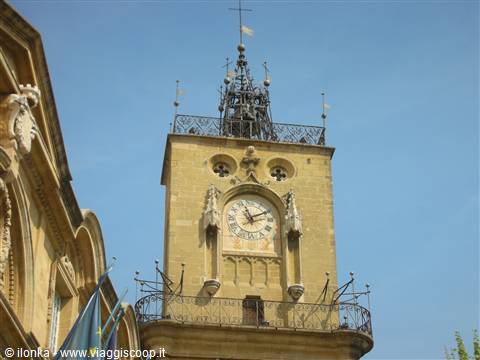
People are celebrating and happily wandering through the alleys and squares animated by sounds, people, and the outdoor seating of the venues...the sun is out and tourism is teeming. The town hall square is studded with beautiful things to see, the town hall inside....the bell tower, the vegetable market, shops and venues..... We turn back and find LE PASSAGE AGARD an old Carmelite convent, it connects Cours Mirabeau to the Courthouse. Also worth observing is the café "Les Deux Garçons," frequented by Cézanne and his friends, the chapel of the Offertory, the old chapel of the Carmelite convent.
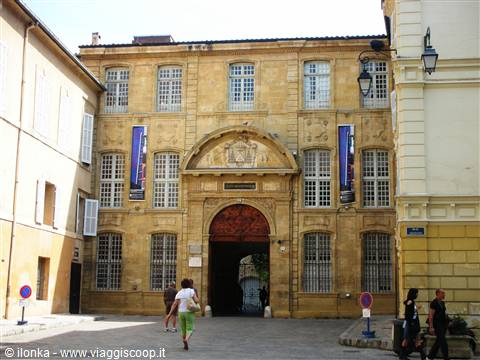
For lunch we go to a huge square near the town hall where there is nothing but little restaurants with adjoining outdoor seating, nice enough; people are starting to stop for the lunch break and after going around all the menus posted outside, we choose a small restaurant at the beginning of the square with the classic menu of the day: rare steak, fried egg, salad and fries....water, coffee: 40 Euros....Vive la France! On Cours Mirabeau we sit at the outdoor seating of a bar for a crêpe. The day is hot and we continue on to reach LA PLACE DE L'ARCHEVÊCHÉ at the far end of the square stands the Archbishop's Palace, the old residence of the archbishops of Aix, decorated with a beautiful Regency-style door. In this building, during the month of July each year, the International Festival of Lyric Art is held.
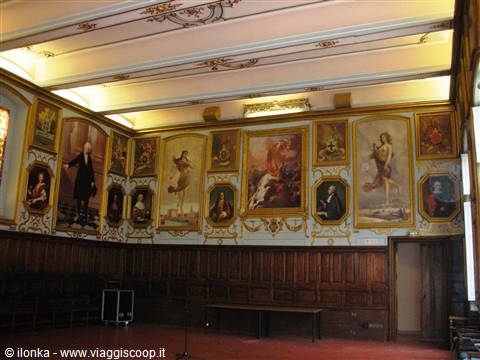
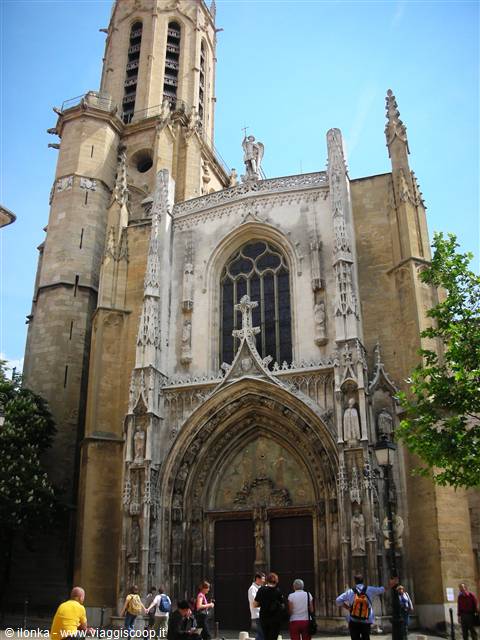
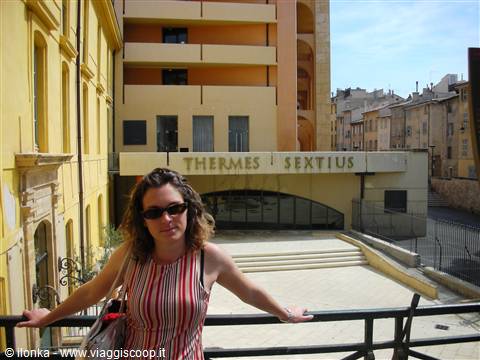
Nearby is LE MUSÉE DES TAPISSERIES located on the 1st floor of the Palace, in the state apartments, it brings together a rich collection of tapestries and decorative objects dating back to the 17th and 18th centuries. The beautiful and imposing CATHÉDRALE ST SAUVEUR, in which all architectural styles from the 5th to the 17th century are represented, from its Roman foundations to the Merovingian baptistery, from the 12th-century cloister to the famous Triptych of the Burning Bush by Nicolas Froment, and its 16th-century carved wooden doors. Opposite the Cathedral is the Place de l'Université, where the old Faculty of Law has given way to the Institute of Political Studies. The natural history museum is closed, and we make a quick stop at the Aix thermal baths: LES THERMES SEXTIUS they are flanked by the Tour Tourreluque (14th century).
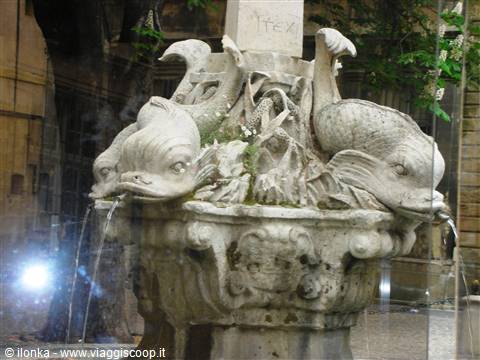
The current building rises on the foundations of the ancient Roman baths of Sextius. The excavations brought to light a Roman thermal pool that can be seen at the entrance of the new spa complex. The place is beautiful and ideal for photos; on the way back we head again toward the central cours to take a little ride on the tourist train. The train takes us roughly to the same places where we had already been on foot during the day, but we enjoy the view comfortably seated with an Italian-language audio guide. We pass by the PLACE DES QUATRE DAUPHINS, where the lovely Fountain of the Four Dolphins, built by Rambot, stands prominently, and the Hotel de Boisgelin, a work by Pavillon and Rambot, adorned with a facade featuring an imposing Doric frieze.
At the end of the ride we head home, passing through the new commercial district under construction, where there are shops and venues ready to open. Satisfied with that long tour in that beautiful old Provençal city, a university town full of young people, ancient in its palaces and with a thousand things to photograph.... I arrive home exhausted in the neighborhood just outside the center.
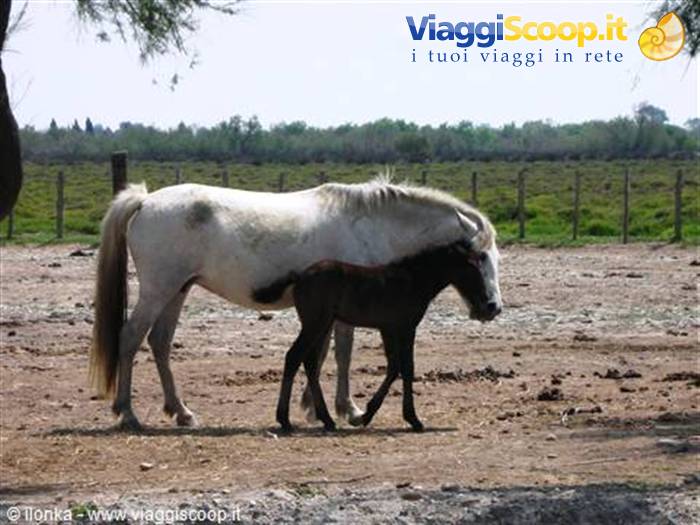
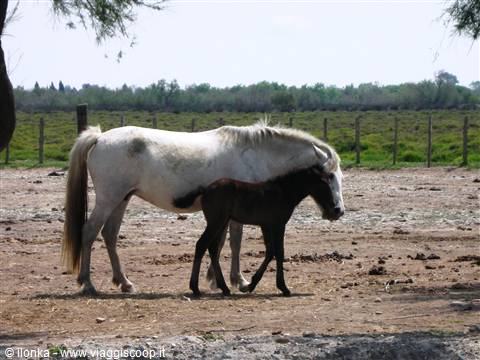
White mare walking beside dark foal on fenced dry ground
Day 330 Apr 2007
Camargue...beautiful Camargue!!!
In the morning, early wake-up call heading for the famous and enchanting French region of the Camargue.....Along the road you start to see only meadows, riding-horse farms, woods, rice paddies......enviable farm stays with riding stables and typical local restaurants....Destination Saintes Maries de la Mer, a typical town and characteristic hub of the Camargue, a tourist crossroads and attraction for those who want to immerse themselves in a small, sunny, seaside Spain, very very welcoming and cheerful. We arrive and the town is packed with people on a sunny morning where people are celebrating and the atmosphere is crisp.
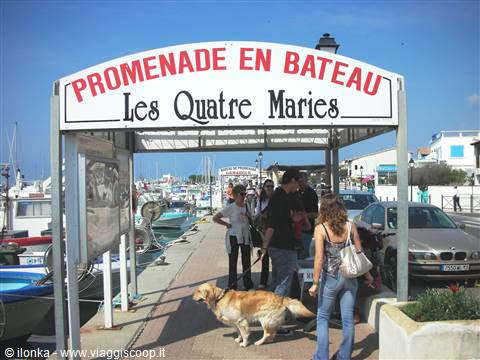
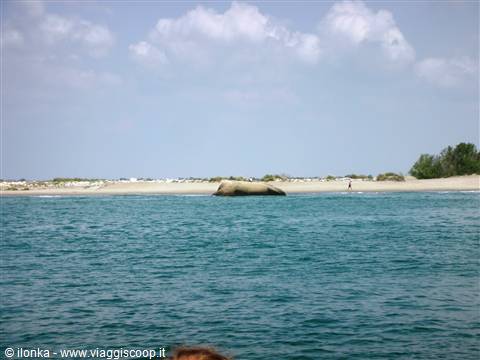
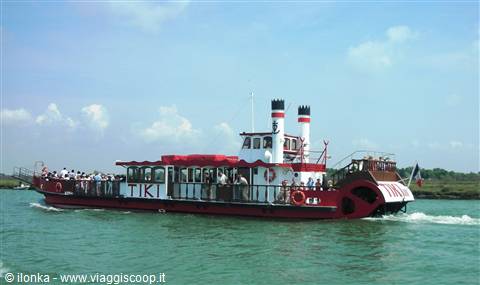
We park at the port and immediately book the noon tourist boat to sail a bit of the Mediterranean, dive into the Rhône, admire the beauties and nature of a wild and enchanting land that contains free-roaming animals and greenery beside the water of an important and vital river. While waiting, we venture into the fairy-tale village, colors, scents, people and sun.....perfect mix! The village of Saintes Maries de la Mer, a land of welcome, tradition and pilgrimage, is built between sky and sea, there where the Rhône embraces the Mediterranean. A place of legend, its shore welcomed, at the dawn of Christianity, Marie Jacobé, Marie Salomé and their servant Sarah, persecuted Christians fleeing Palestine on a boat without a rudder. The village offers the visitor the image of its lofty and protective church and promises a visit rich in emotions under an ever-new light.
In the shadow of its Roman bell tower, the visitor wanders through the cobbled streets, in the footsteps of the pilgrims. From the church roof, gaze searching for something, nose and hair in the wind, one lets oneself be overcome by the emotion of great spaces, future scenes of discoveries and warm encounters with men and women herders who ride on horseback through the pastures for the bulls for which a glorious future is in store. From the village, their steps guide them toward the dunes, the fine-sand beaches, the vast expanses of reeds and the herds. In love with nature and wide-open spaces, one finds pleasure in walks on foot and on horseback, admires the dance of the birds, gives in to the intoxication of sailing and of gliding moved by the great winds.
The village of Saintes Maries de la Mer stands as a capital for those who let themselves be fascinated by the Camargue, wrapped in its wild beauty, its culture and its living and authentic traditions. A few lines on the Camargue region: The Camargue is an island situated between the embanked branches of the Rhône, formed by the deposit of sand, pebbles and silt laid down by the streams. It is a strange fusion of land, river and sea that gives hospitality to great wild spaces interspersed with marshes, clumps of glasswort and fields of sea lavender that surround the Étang de Vaccarès and that make this area an exceptional territory. Far from the most beaten paths, it reveals itself as a wild beauty, a discreet soul and an incomparable poetry that gave birth to the genius of Mistral and inspired numerous artists and writers.
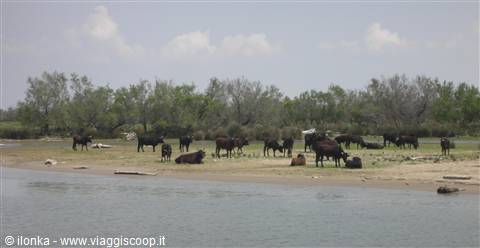
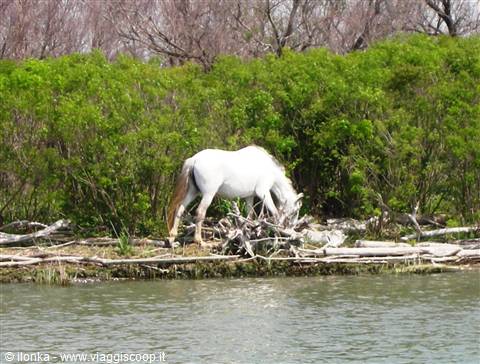
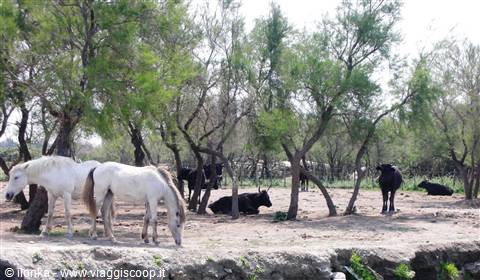
Melancholic, stretched out in a torn immensity, everything is born and everything perishes ceaselessly in the muffled sound of the waves that bathe its sun-drenched shore. A land always in continual contrast, which evokes a serenity the visitor would never have attributed to it and is part of visions of exoticism thanks to the play of varied lights and limitless horizons that reveal an intense life beyond the pleasure of the eyes. On the trip out to sea and then on the river we glimpse dreamlike places and situations, the river flows impetuously and gives life to hectares and hectares of land where horses and bulls graze and live freely together, sharing the spaces and the nature of that enchanted place. Standing on the boat's rail I snap at least 100 photos of bulls, horses, foals, birds, banks and typical houses on the river with fishing nets hoisted up.
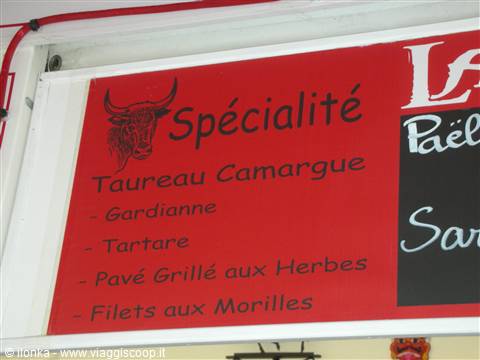
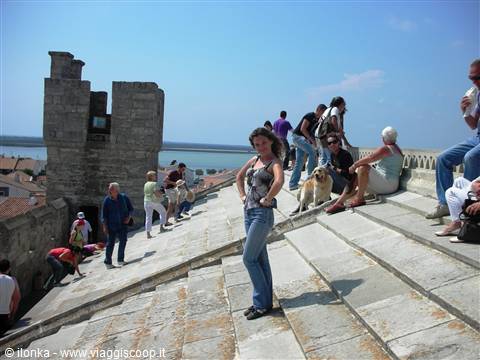
The day is hot and the sun beats down.....On our return we're desperate for lunch and in a typical little restaurant in the center complete with outdoor seating we savor bull meat, side dishes, paella that is cooked in enormous pans placed in the restaurants' outdoor areas, in front of tourists as a tourist attraction....... Right afterward we visit the roof of the famous church and the panorama from up there is breathtaking. The town's church built near the mouth of the Petit Rhône, the Church of Saintes Maries de la Mer had an important strategic position. Because at the time of its construction, pirates were raging along the coast and one had to defend against invasions. The church dominates the village. It is a true fortress. The roof is surrounded by a patrol walkway, with arrow slits and machicolations and served as a watchtower.
The choir and the apse are topped by a semicircular keep that encloses the ancient guardroom hall called the "high chapel." It served as a refuge for the population and there is also a freshwater well there. A few words on the typical Camargue animals: Camargue horse: It is characterized by small size, coarse skeleton and limbs, heavy head, and it is recognized in adulthood by its almost white gray coat. Thus, the foal is born brown, sometimes black and only around 4-5 years does its coat turn white. Of unmatched hardiness, the Camargue horse lives semi-free in the marshes and ponds both in summer and winter. The herds are composed of a number of mares and one stallion; births occur from April to July in complete freedom. At the age of one, the foal is branded by its owner and separated from its mother.
At three, it is captured to be trained; a delicate operation, this, that requires great patience on the part of the herder who must make the horse, day by day, increasingly at ease. It is led with the supporting rein, thus freeing the rider's right hand. In most cases, only the males are trained in the herds while the mares are raised only for reproduction. The Camargue Horse Breed has been officially recognized by the National Equine Stud Stations since 1978. The Camargue bulls: Conditioned by the environment in which it lives, the Camargue bull is a rustic breed animal. Camargue cattle live in herds called "manade" and their breeding and roaming ground is made up of marshland expanses and natural-space territories. Its build is slender, not exceeding 1m30, and the head is thin. Its coat is always very dark.
The horns are the most typical characteristic of the breed since they point vertically toward the sky forming, particularly in the females, a perfect lyre. The Camargue bull has never been able to be domesticated and the maintenance of the breed is due solely to its aptitudes for gaming and running. Hardy and resistant, its breeding today is practiced by 120 breeders who group together about 15,000 head. The breeding of the bull, like that of the Camargue horse, is extensive breeding. It is only at the end of the 90s that bull meat became one of the few beef meats to benefit from the Denominazione di Origine Controllata. It lives in herds, semi-free on lands that are not suitable for cultivation on which only rushes, glasswort, sea clover… grow, which constitute their only nourishment. Like the foal, the calf will be branded (ferrata) at the age of 1.
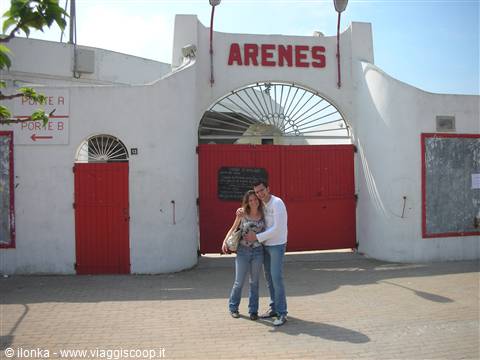
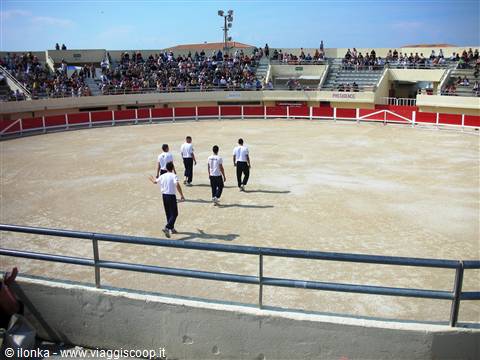
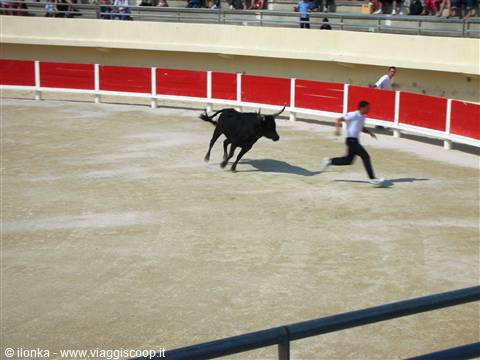
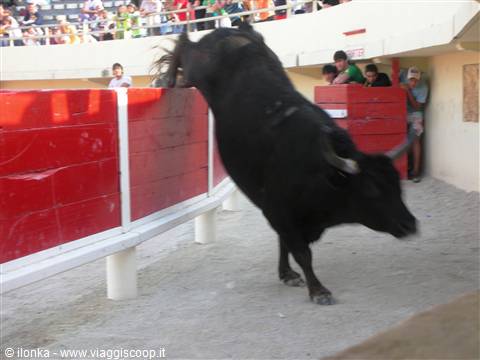
Late afternoon, two hours of Camargue bull-running, beautiful and exciting, with young men running behind an angry bull to grab a cockade
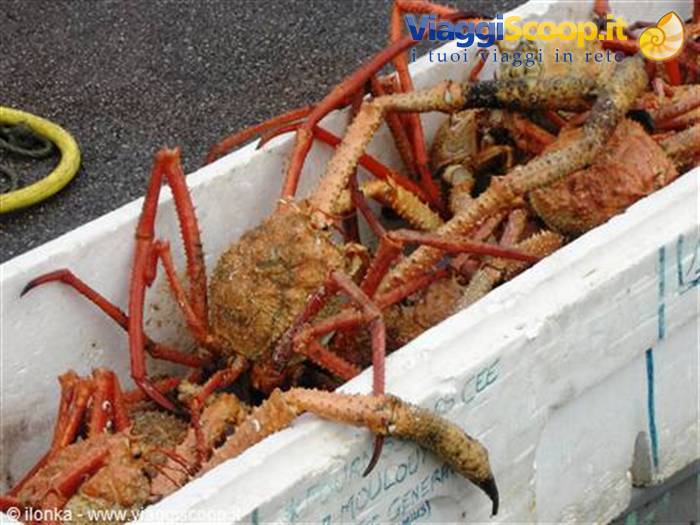
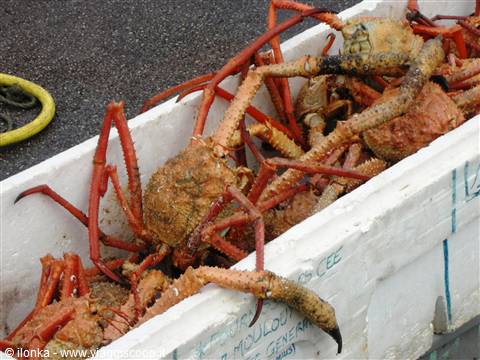
Fresh spiny lobsters piled in a white styrofoam fish crate
Day 41 May 2007
Marseille yes, Marseille no
On the last day of our French stay we wake up to gray clouds and a cool breeze.....we set off in the morning for Marseille and after parking in a paid underground parking lot we go to the port. No comment on the port...... Public holiday, lots of people around, fish market.....stalls with fresh catch, giving off a nauseating smell, and you can admire everything from giant crabs to live lobsters, tuna, rays, turbot, sea bream and scorpionfish on display. We buy tickets for the islands of Marseille and wait for the boat. While waiting I realize how dirty, dangerous and "French" that place is. We stop for ten minutes and fishing boats arrive that wash out their insides throwing rotten fish into the sea right by the dock which will then float, giving off a smell to die from! The seagulls are the only ones happy with the ready meal.
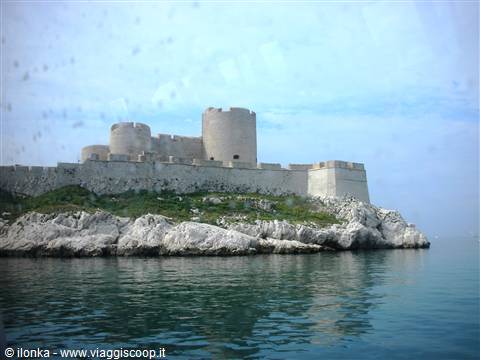
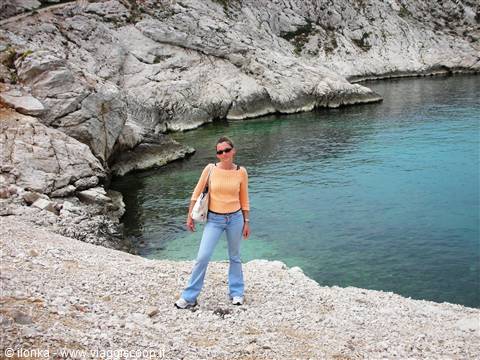
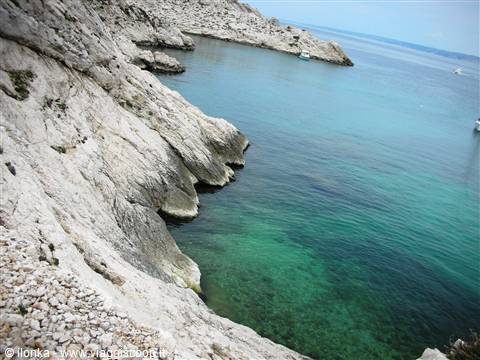
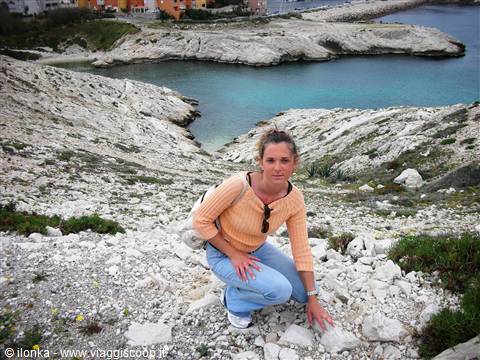
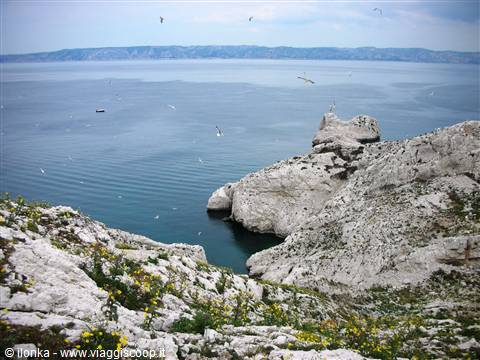
We board after seeing every kind of people, tramps, shady-looking faces wandering around the port. The boat stops at the first island where an imposing medieval castle towers from the top of the rocky hill. We pass on and arrive at the second, beautiful island of Marseille. During the crossing we catch a glimpse of the cathedral of Marseille, beautiful and imposing, the tourist port with cruise ships and the commercial port. The second island of the Frioul archipelago is a little earthly paradise, white rock dotted with Mediterranean vegetation, blue and green sea among cliffs plunging into the water. We arrive and have a coffee in a bar, it's an inhabited island and the little harbor is nice, a few small places wind along nearby with colorful outdoor seating. We venture into the center of the little island to see breathtaking views.
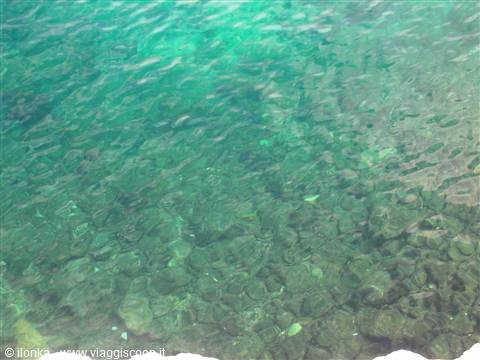
As I walk, the island vaguely reminds me of rocky and rugged Croatia. We find a passage between two high rocks and before us opens the view of the sea inlets. We climb up the hill and the panorama becomes more beautiful with every step, we walk along a bare rocky hill but with bunkers dating back to the war and colorful little flowers. Looking down, the sea is crystal clear and some tourist boats are moored in the natural inlet. Some people are swimming despite the cold air and clouds. the inlets and the colors of the sea are worth photographing, we walk for an hour and on the way back down we decide to have lunch in Marseille returning on the 1:30 pm boat. In Marseille we get off the boat with rain that only lets us run, quickly choosing an ugly and shabby little restaurant in the center near the port, which has meanwhile emptied of the morning's tourists.
The city of Marseille is dirty and desolate on that public holiday and we enter the restaurant to have lunch. The city is the capital of the south of France and its port is the first and most important in the whole country1. The cuisine is based on dishes of fresh fish and for this reason in the restaurant the fish soup was excellent according to everyone.....The famous Marseille bouillabaisse, made with various types of fresh fish. After lunch we didn't hesitate to leave a city that perhaps would have deserved a more in-depth visit, but it was so sad, desolate, dirty and rainy that we resumed our journey to Italy in the afternoon, arriving, after queue upon queue, home at ten in the evening.
Provence, the Camargue, are places that deserve a bit of time and quite a few photos; satisfied with the beauty of France and with the sun we had gotten, now I look back at the photos of the vacation.
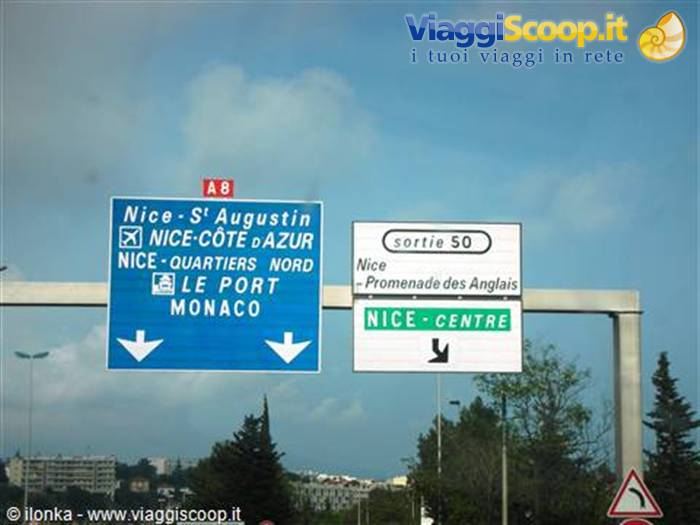
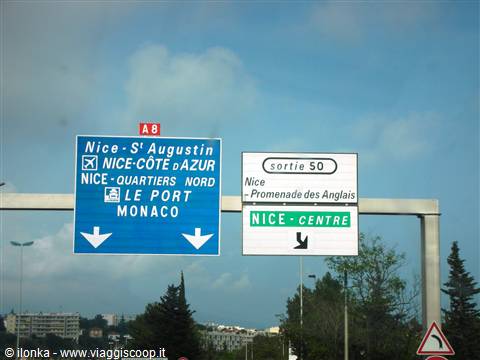
A8 motorway signs directing to Nice city center and Monaco
ahi ahi ahi!!!!! Cara Ilonka non siamo proprio d'accordo su quanto hai scritto ne sulla francia in generale ne su marsiglia!!!!
Io sono di milano ma da sei mesi vivo ad aix en provence e sono spesso a marsiglia e devo dirti che ti sbagli di grosso!!!
Certo che durante il mercato del pesce non puo' esserci profumo di lavanda......!!!!!
Ma la città hai dei posti meno turistici del vieux port che sono davvero mozzafiato....la prossima volta che ci vieni scrivimi e saro' felice di aiutarti a scoprirli!
E poi che stupidate sono quelle che i francesi e le citta' sono sporche??!!
Mai stata nel sud italia!?! Non so che gente hai frequentato tu durante il tuo viaggio, ma io ti posso assicurare che tutta la gente che conosco qui in francia, non gira scalza nei bar e si lava regolarmente !!!!
E ricordati che il water separato si usa in tutta l'europa del nord ,è più igienico, ed è solo questione di abitudine!!
Sei stata troppo frettolosa nei tuoi giudizi su questo meraviglioso paese che è la Francia!!
Viverci per crederci!!
Ahh......complimenti per le belle foto di Aix....mi sento molto orgoglioso della mia nuova citta'!!!!
Ciao max






1 reader comments
ahi ahi ahi!!!!! Cara Ilonka non siamo proprio d'accordo su quanto hai scritto ne sulla francia in generale ne su marsiglia!!!! Io sono di milano ma da sei mesi vivo ad aix en provence e sono spesso a marsiglia e devo dirti che ti sbagli di grosso!!! Certo che durante il mercato del pesce non puo' esserci profumo di lavanda......!!!!! Ma la città hai dei posti meno turistici del vieux port che sono davvero mozzafiato....la prossima volta che ci vieni scrivimi e saro' felice di aiutarti a scoprirli! E poi che stupidate sono quelle che i francesi e le citta' sono sporche??!! Mai stata nel sud italia!?! Non so che gente hai frequentato tu durante il tuo viaggio, ma io ti posso assicurare che tutta la gente che conosco qui in francia, non gira scalza nei bar e si lava regolarmente !!!! E ricordati che il water separato si usa in tutta l'europa del nord ,è più igienico, ed è solo questione di abitudine!! Sei stata troppo frettolosa nei tuoi giudizi su questo meraviglioso paese che è la Francia!! Viverci per crederci!! Ahh......complimenti per le belle foto di Aix....mi sento molto orgoglioso della mia nuova citta'!!!! Ciao max