The story
Curious is the fate of Tarascon, a lovely spot in Provence, about 20 kilometres from Avignon, 25 from Nimes and 15 from Arles, splendidly positioned along the banks of the Rhone, with a historical and architectural heritage of absolute excellence, yet better known in France for the legend of the Tarasque and around the world for Alphonse Daudet's famous book “Tartarin of Tarascon” than for its artistic beauties.
In France it is known as the city of “Counts and legends”, the most famous of which is that of the Tarasque, a monster half crocodile and half winged dragon that lived in a forest between Tarascon, Arles and Avignon. As in all self-respecting legends, this monster too ate men, women and children, so much so that the population asked Saint Martha for help; after sprinkling the Tarasque with holy water, she led it to the nearest village, where it was stoned to death. This legend is commemorated every year in the month of June with a great folk festival.
Aside from myths and legends, Tarascon is a very pleasant town of very ancient origins, inhabited already by the Phoenicians and the Greeks and later becoming an important Roman Castrum protecting the Via Domitia and controlling navigation on the Rhone. In the following centuries it was the land of everyone (Visigoths, Burgundians, Franks, Saracens) and so on until the Middle Ages, when Tarascon had its period of greatest splendour, becoming a very important religious and administrative centre of which splendid historical and artistic testimonies can still be seen.
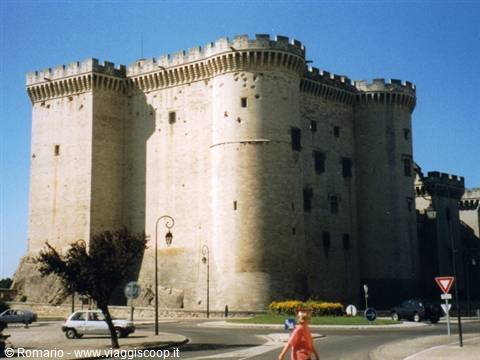
Our visit to Tarascon began at the castle, truly splendid, built where the old Roman castrum stood and which locals familiarly call “King Rene's castle”, after King Rene of Anjou who completed its construction in the mid-1400s. An imposing building and splendid at the same time, considered one of the finest medieval castles in all of France. The exterior is very austere, in keeping with the defensive criteria of the time, but the interior is much softened by a style more Renaissance than medieval.
Very beautiful is the courtyard of honour with its very pleasant ornamental sculptures, and very beautiful is the visit to the hall of festivities, the royal chapel and the chapel of the singers, the king's room (splendid coffered ceiling), the king's apartment, the Council chamber and the audience chamber. Very beautiful and evocative spaces, but which, as I have already had occasion to say when talking about the Palace of the Popes in Avignon, are desolately empty (with a few very beautiful tapestries and few other exceptions), certainly not as we are used to in Italy, where even the smallest historic building is a little museum of period furnishings.
One last effort to climb the stairs of the Artillery Tower and you emerge onto a panoramic terrace that alone is worth the visit: the 360 view is truly exceptional over the Rhone, the plain of Tarascon, towards Arles and the Abbey of Montmajour, over the surrounding heights of the Alpilles and the Montagnette, and further off towards Mont Ventoux. The castle can be visited every day and there are also guided tours at fixed times which, as in our case, it is not always possible to take advantage of because of timing differences. Entry costs 6.00 euros, but the visit is worth every cent.
Not far away is the beautiful Collegiate Church of Saint Martha, one of the loveliest sanctuaries in Provence, with a splendid and ancient portal partly damaged during the French Revolution, built at the end of the 1100s on an old building where the relics of Saint Martha were kept. Very evocative is the interior with its colonnades and side chapels, and moving is the visit to the crypt. A curiosity about the bell tower: it was built later so that its height would not obstruct the view for the sentinels of the nearby castle.
We continue our walk towards the Cloister of the Cordeliers (Cloitre des Cordeliers), which we are told is very interesting, and along the way we come across the Laudun Palace, a 1600s building, a historic monument since 1940, where Cardinal Richelieu used to stay when he was in Tarascon. The building had been badly damaged by a bombing during World War II but has been perfectly restored.
Immediately afterwards we find the Mint Palace, a characteristic 1200s building where from 1300 to 1500 (approximately) coins were struck thanks to an edict of Charles of Anjou. The Laudun Palace and the Mint are the two buildings I thought worth illustrating, but in the centre of Tarascon there are at least twenty equally interesting palazzi which, however, can only be seen from the outside, as they cannot be visited. The Town Hall, on the other hand, is visitable: a fine Renaissance building from the 1600s.
The Cloister of the Cordeliers is, in fact, very beautiful and dates back to 1550, when the Cordeliers, a confraternity of Franciscan friars, so called because they wore a habit fastened with a three-knotted cord, moved there, leaving the old convent they had occupied since 1200 because it was easily subject to flooding. The building is made in a splendid Renaissance style and is used mainly for exhibitions and displays; indeed, it can only be visited on the occasion of such events. We were lucky to happen upon it while an exhibition of Provencal painters was under way.
Not far away, the Souleado Museum is worth a visit; housed in the 16th-century d'Amigny palace, it is a true kingdom of Provencal fabrics, where you can not only learn how they are made and printed but also see many other curiosities of local tradition, from fine terracotta work to room furnishings and traditional costumes.
Another interesting place, likewise used as an exhibition space, is the Chapel of Perseverance (Chapelle de la Perseverance), the only remnant of a larger 17th-century building that at the time served as a women's prison. It was described to me in extremely positive terms, but since there were no exhibitions under way, we did not have the chance to visit the interior.
Returning towards the car park, after the house of Tartarin which I have already told you about, we come across the Convent of the Visitation (Le Couvent de la Visitation), the only religious community now remaining in Tarascon, of the more than fifteen that existed before the French Revolution. The complex is, in fact, very beautiful, but not of particular historical interest, being a construction dating from 1850, the year in which they moved there from the original convent of 1200.
The surroundings of Tarascon are equally beautiful, characterised by the small green hills of La Montagnette and the Alpilles. The pearl of La Montagnette is without doubt the splendid Abbey of St Michel de Frigolet, a monastery founded in 1100 with a little Romanesque-style church, splendidly decorated, dedicated to Notre Dame du Bon Remede, while the abbey church itself is instead from the 1800s. An evocative setting that exudes spirituality from every corner and is one of the best-known pilgrimage sites in Provence.
Tarascon lies in one of the most beautiful areas of Provence, close to places of equally high tourist interest such as St Remy de Provence, the Pont du Gard and Les Baux de Provence, at the centre of an area bounded by Avignon (airport and TGV), Arles, Nimes (airport and TGV) and Aix en Provence, to which it is connected by regular bus services and therefore easily reachable even by those who do not drive.
The journey's photographs
2 photographs · click to open them full screen

0 reader comments