The story
During a recent stay in Helsinki I had hoped to manage a quick return visit to Tallinn, capital of the Republic of Estonia. For various reasons I did not succeed, but in any case I had already been there three years earlier, also then for professional reasons, for four days, and in practice everything there was of interest to see in this beautiful city I had already seen.
Indeed Tallinn lies directly opposite Helsinki, separated by some seventy kilometres of sea, to which it is very well connected with very many daily crossings by ferry (about 3 and a half hours of travel) and fast catamarans (about 1 and a half hours), as well as by air and helicopter links. As the catamaran service was not running that Sunday, seven hours of ferry there and back would have taken up the little time I had available, and it was certainly not worth going by plane or helicopter (20 minutes), considering that one way or another it was a city I had already seen.
Such a substantial connection service is justified by the fact that, in practice, Tallinn is becoming what we might call a "dependance" of Helsinki. In recent years Finnish companies' investments in the Tallinn area have been numerous and substantial, benefiting from the better economic conditions existing in Estonia. This happens not so much because Estonia is a poor country (even if there is a certain difference between the coastal zone, especially the Tallinn area, and the rest of the country), but because it is Finland that is extremely expensive. To give a practical idea, it is enough to recall that many Finns go to do their shopping in Tallinn, buying among other things also very ordinary products such as beer.
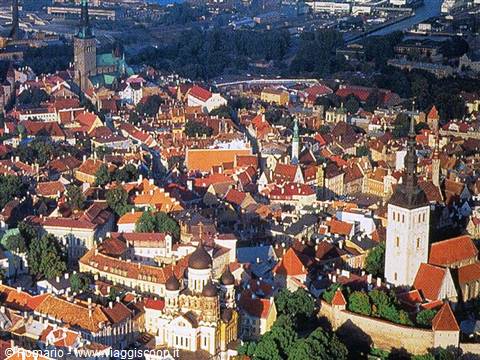
Tallinn is undoubtedly a very beautiful city, which has managed to preserve very well its small and splendid medieval old town (considered by UNESCO a world heritage site) almost as if time had not passed, in practice a small island besieged by the neighbourhoods that sprang up over the last fifty years of Soviet domination, built in such an anonymous way as to create a feeling of sadness that I had rarely felt before. In Tallinn too, as indeed I have also seen done in Riga, a redevelopment is under way both of the areas immediately adjacent to the old town and of the buildings abandoned by the Soviet authorities (in particular military barracks), which are being converted mainly for public or commercial use.
The historical and artistic heritage of this city is almost entirely contained in the medieval centre and is truly splendid. I will limit myself to pointing out just a few absolutely unmissable spots when visiting the medieval city: the Alexander Nevsky Cathedral, Toompea Castle, the Market square with the Town Hall and the Clock tower. Among the very many museums, do not miss the Tallinn City Museum, in which the exhibits on display cover all seven hundred years of the city's life, from 1290 to the present day. Also interesting is a visit to the botanical garden, which covers an area of over 120 hectares with over 8,000 varieties of plants. A substantial saving is obtained by buying the Tallinn Card, which entitles you to travel on public transport, entry to all museums and other places of historical interest, discounts in restaurants and shops and also the city sightseeing tour.
It is an hourly card, available for 6, 24, 48 and 72 hours at a cost ranging from 3.83 euros for the 6-hour one to 20.77 euros for the 72-hour one.
When I was in Tallinn I stayed at the "Hotel Olümpia", situated in what we might call the city's business district, fairly close to the old town, built for the 1980 Moscow Olympics (the Olympic regattas were held in Tallinn) but completely renovated in the mid-nineties. A hotel of at least some twenty floors (if I remember correctly) from the top of which you get a beautiful panorama over the old city and the Gulf of Finland. Undoubtedly a prestigious hotel, where Czech President Havel, UN Secretary-General Kofi Annan and Hillary Clinton have also stayed, with prices in the order of 150 euros for a standard room. In the hotel there is also the "Bonnie & Clyde", surely the best nightspot in Tallinn. In any case, if I were to return to Tallinn purely for tourism, I think I would give preference to a hotel located in the old city.
There are also some excellent local restaurants, even if the best in Tallinn is universally considered to be the Italian restaurant "Casanova". Besides the restaurant "Olde Hansa", I also have an excellent memory of the restaurant "Maiasmokk" at Pikk 16, in the medieval city, perhaps the oldest in Tallinn being open since 1864. From this restaurant I remember a strange but excellent soup, very creamy, made with cheese and prawns, with crunchy croutons, and the roast elk, also with a cheese cream and roast potatoes. We drank good Estonian wine, but I remember that on the list there were numerous labels of Italian wines.
Public transport is satisfactory, taxis are numerous and reasonably priced. The official language is Estonian, but English is fairly widespread (even if perhaps the most spoken language is Russian, considering that, I think, a good half of the population is of that ethnicity). The best way to reach Tallinn from Italy is of course by plane. There are links with Milan and Rome by SAS (and continuation from Stockholm with Air Baltic) and by Finnair via Helsinki. Tallinn airport is only 5 kilometres from the city. In summary, I would feel a little hesitant to recommend a trip for the exclusive visit of Tallinn, but in the case of trips that are already to include cities such as Helsinki or Riga, an extension to Tallinn is not to be missed.
The journey's photographs
2 photographs · click to open them full screen

0 reader comments