The story
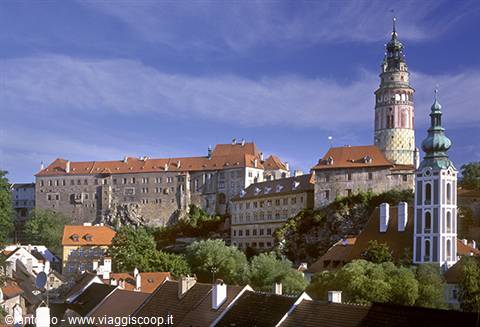
Obviously I haven't included the dates of the trip because I don't remember them. It was in any case the 1990s when I made a journey that also included Austria. On that occasion I was with my Fiat Tipo. I reached Czechia late at night and slept in a spartan hotel, one of those you only find in the former communist countries: large rooms with crystal chandeliers, tapestries, few staff but strictly in dusty uniforms, and cold in the bedrooms. This hotel, the relic of a glorious past but in decline, was however located in a characteristic setting at the foot of a hill, surrounded by trees and along a river. First stop at Cesky Krumlov, an almost intact medieval town with walls and a castle dominating it from the top of a hill. What makes it unique is the river that here forms a bend, making it almost an island. Hilly cobbled streets cut their way between characteristic craft shops.
A place not to be missed. The castle moat houses a couple of bears. Heading west you reach Karlovy Vary, a true architectural jewel in Art Nouveau style. These were the imperial spas, and the Grand Hotel and the buildings that face the river recall it. Unfortunately, in the communist era a few modern buildings were put up to house the nomenklatura, and they really clash with the rest of the setting. Karlovy Vary suddenly appears like a jewel in a casket, because you see it first from the top of the escarpment that overlooks it. Back east to visit the famous Karlstejn castle, which dominates a forest from the top of a hill. It is the typical medieval castle, complete with reconstructed interiors and lacework on the towers. A bit too touristy, but inevitable given that we are a stone's throw from Prague. Prague, the capital, is one of the most beautiful cities in Europe.
The Charles Bridge, which links the two banks of the river, is not only architecturally beautiful with its many Gothic statues on the parapets but is also alive, thanks to tourists from all over the world, young hippies, musicians, jugglers and storytellers. Crossing it you reach Mala Strana, from where you climb the Castle hill, in reality a city within the city, with the royal palace, St Vitus Cathedral (austere and Gothic), historic palaces and the celebrated Golden Lane with its low medieval houses. Descending the castle hill you observe on the right the Basilica dedicated to Our Lady of Loreto, while on the left you climb the green panoramic Petrin hill that dominates the city.
On the other bank of the Vltava you walk along important avenues lined with historic buildings such as the Clementinum Observatory but above all Staromestske namesti, the central square dominated by the dark monument to the reformer Jan Hus and surrounded by colourful buildings that block the view towards the beautiful Church of Tyn, topped by two tall towers. On the square the Baroque church with the dome of St Nicholas puts on a fine display. A short distance from the square is the Town Hall, whose tower houses the famous astronomical-mechanical clock. A few steps from here is the Jewish quarter of Josefov, with synagogues, some of which have been turned into museums, but above all with the cemetery, one of the most interesting places of its kind. A poetic picture of old tombs piled one on top of another.
Prague's recent history is linked to the very long Wenceslas Square, famous for the youth protests of the anti-Soviet “spring”. To the north-east of the capital there are some strange rock formations called Skala, which you can walk through along narrow paths in the woods. You can also do without going there. Further south, however, the old mining town of Kutna Hora is worth a visit, with the imposing Gothic Cathedral of St Barbara, the symbol of a glorious past of which only the memory remains. From Bohemia a transfer to Moravia, and precisely to Olomouc for a brief stop in the central square dominated by a fountain. The first real Moravian stop is Blansko, the starting point for fine excursions in the karst mountains of the “Moravian Paradise”. The impressive Macocha gorge can be seen both from above, after following a mountain path, and from inside, during a visit to a cave.
A further cave is explored partly on foot and partly in a boat that sails along an underground river. A few kilometres away we are in Brno, the capital of Moravia; on the hill that dominates the city the gloomy Spilberk held the Risorgimento patriot Silvio Pellico in its prisons. The rest of the city, however, did not particularly fascinate me. From here I returned to Austria to reach Vienna, where I continued my journey. I found the Czech Republic quite interesting and in any case worth visiting for the presence of Prague, one of the most beautiful cities in Europe. Since one comes this far, I recommend seeing Karlovy Vary, a city unique of its kind, and Cesky Krumlov. The rest of what you see is beautiful but would not alone justify a trip. Besides this itinerary I have been to the Czech Republic twice more: in 1990 in Prague, where I arrived by train from East Berlin.
I spent a day there waiting for the train to Budapest, taking the opportunity to see Wenceslas Square. At that time Prague, which was the capital of a larger country, Czechoslovakia, was a sad and gloomy city. After the tourist trip that is the subject of this description I passed through the Czech Republic, and precisely Cesky Tezin, to reach the Baltic countries via Poland in my Fiat Tipo. Recently (2018) I spent a few days in Prague as a guest of the Italian Embassy, the Italian Institute of Culture and the Russian Cultural Centre for the staging of an exhibition. On that occasion I visited the Church of the Infant Jesus of Prague for the first time.
The journey's photographs
2 photographs · click to open them full screen

0 reader comments