The story
The northern, southern and western borders of Bosnia-Herzegovina touch Croatia, the eastern ones Serbia and Montenegro. A narrow strip of Bosnia touches the Adriatic through southern Croatia.
The Bosnian territory is divided between the Muslim-Croat Federation and Republika Srpska; the Federation occupies a slightly larger share of the area (51%).
The Dinaric Alps furrow the territory, dividing it into three distinct ecosystems: Mediterranean, Balkan and Central European. In the northern part the plains and plateaus are cut by the Sava river. The highest peak is the Maglic in Herzegovina (2385 m); the whole area has seismic characteristics. Before the outbreak of the war Bosnia was inhabited by Muslims, Orthodox, Catholics, Protestants, Jews and followers of other religions and ideologies. Now the Serb Republic is almost exclusively Christian and the Federation almost exclusively Muslim; Serbs, Croats and Bosnian Muslims all have the same features because they all belong to the same ethnic group. Mediterranean, Eastern European and Turkish influences are all gathered in the culture of Bosnia-Herzegovina and there are considerable variations between Orthodox and modern and between rural and urban mentality.
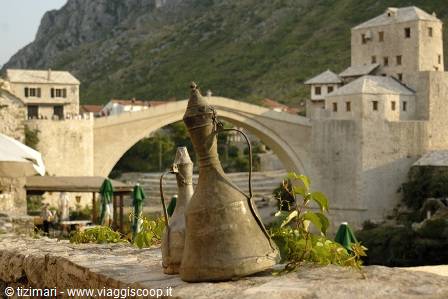
Family ties are close and great consideration is given to neighbourhood and friendship relations. Great importance is placed on hospitality and spontaneity. Bosnia's varied population has made the nation's cultural life of great value. Epic stories, a form of oral literature, were still handed down across the nation until the 1950s. Bosnian love songs, mostly Muslim, were popular throughout Yugoslavia. Ivo Andric, a Catholic Serb raised in Bosnia, won the Nobel Prize for literature in 1961. His stories included Na Drini cuprija, in which an Ottoman-era bridge symbolically united the Bosnian peoples. The novelist Mesa Selimovic was of Muslim origin but said he had written according to the canons of Serbian literature.
The fundamental differences between the ethnic groups are religions: the Serbs are Orthodox Christians, the Croats are Catholics, the Bosnian Muslims with a minority of Jews. Bosnian cuisine has a marked link with Turkish culinary culture; evident especially in vegetable stews, coffee and sweet cakes such as baklava.
The journey's photographs
4 photographs · click to open them full screen
0 reader comments