The story
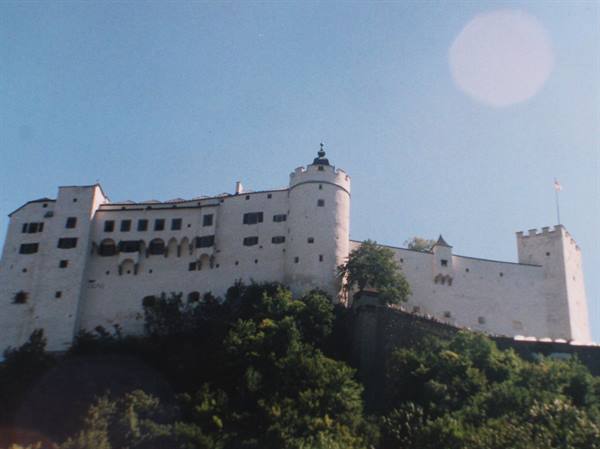
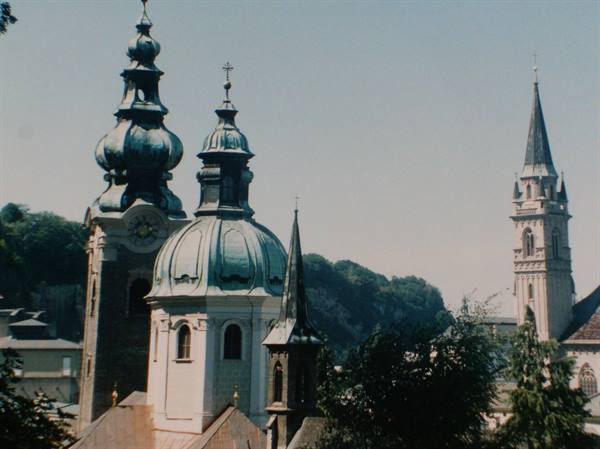
The city is situated on the banks of the river Salzach at the northern edge of the Alps. The peaks of the mountains south of the city also contrast with the gentle plains of the north. The nearest Alpine massif, the Untersberg (1972 m), is a few km from the city centre. The city centre, called the "Old Town", is dominated by the baroque towers and domes of the churches and the sumptuous palaces, designed by architects including Italians on commission from some prince-bishops in the 17th century. Salzburg is surrounded, though it would be better to say that it was built in the hollow, by two small mountains, the Kapuzinerberg and the Mönchsberg. On the latter an imposing fortress (Hohensalzburg) of white stone was built, encircled by thick ramparts. This fortress, in which the bishops took refuge in times of danger, for a long time proved impregnable.
Today you can reach it on foot or by funicular. Salzburg's cultural and artistic splendour is due in good part to the interests of the prince-bishops who governed the city's fortunes between the 16th and 17th centuries. The first of them was the prince-bishop Wolf Dietrich Von Raitenau, who did much for art and very little for the faith, so much so that he was viewed with disfavour in Rome in Vatican circles. Much that includes the order to set two fires that providentially destroyed some areas of the city, leaving the field free for the construction of the Cathedral and the Residenz, the sumptuous episcopal palace.
The son of a Medici, the bishop had grown up between Rome and Pavia and his favourite pastime was drawing Italian landscapes and architecture: as soon as he came to power there came the great demand for Italian goldsmiths, craftsmen, sculptors and architects who arrived in this city and covered it with building sites. For his favourite (Salomè Von Alt, by whom he had 12 children) the bishop ordered the construction of the splendid Mirabell castle just outside Salzburg. Von Raitenau was stopped by Maximilian of Bavaria, with the support of the pope, tried for heresy and condemned to the stake.
Once Von Raitenau's nephew, the prince-bishop Markus Sitticus, came to power, he continued the work begun by his uncle, entrusting Santino Solari with completing the cathedral and commissioning an out-of-town royal residence, the Hellbrunn (clear spring), surrounded by splendid Italian-style gardens, fountains, water features and a zoo, still active today and much visited. Returning to the Old Town, it is particularly interesting to observe how it presents its Gothic character at the same time as the shining baroque of clear Italian inspiration. The city cathedral (Salzburger Dom) is the most shining example: of Romanesque origins (completed in 744), it was destroyed by a fire in the 16th century, rebuilt in 14 years, from 1614 to 1628, by Vincenzo Scamozzi and the aforementioned Solari and frescoed by the religious painter of the Servants of Mary, Donato Arsenio Mascagni.
And furthermore: • the Benedictine Convent of Sankt Peter; • the Petersfriedhof cemetery; • the Franciscan church: appearing in some documents of the 8th century, in the 13th a basilica was raised. Built in Gothic style, then partly baroquised. Around 1220 it became a basilica; • the Hohensalzburg Fortress: a stronghold commissioned in 1077 by a bishop, it was later enlarged (1495-1519) until it became self-sufficient, an armed citadel ready to defend the city and its bishop. At the end of the 19th century it was connected to the city by an extremely characteristic funicular. Today it turns out to be the largest fortress still intact in Europe.
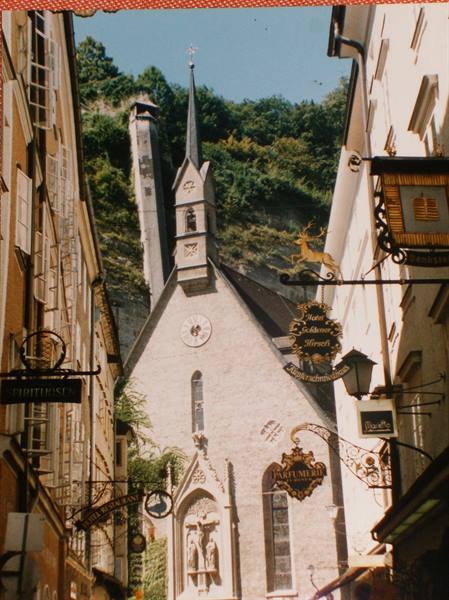
Particularly worthy of interest are the medieval rooms of the prince and the fortress museum; • the Getreidegasse (Grain Lane) with Mozart's birthplace; Salzburg and its city centre were added by UNESCO on 5 December 1996 to the world heritage list. One must not forget that Salzburg is the city that gave birth to Wolfgang Amadeus Mozart who, although he never loved it (he wrote in a letter: "I care very little for Salzburg and even less for its archbishop"), still today receives the greatest honours. Named after him is the Mozarteum, one of the most renowned music academies in Austria and the whole of Europe, which annually dedicates great events in honour of the composer.
The journey's photographs
7 photographs · click to open them full screen
0 reader comments