A journey in Nicaragua between wild nature and political and social aspects. An immersion in the jungle and in one of the hottest economic and political issues of Central America, the construction of a canal that joins the two oceans. A story between past and present that runs along the banks of the Rio San Juan, crosses the rapids, and Lake Nicaragua, the Mar Dulce for the conquistadores. The trip was organised by Le Indie Viaggi, the new tour operator specialising in travels in the American continent and Southeast Asia. I greatly appreciated this tour operator's respect for the local culture, for the environment and for the history of this country. We experienced exciting moments, of true contact with that land. Without giving up perfect organisation. I had already been to Nicaragua, in 1990. Today I felt the same, strong, emotions as then. A strong country.
For its nature, for its people, for its political history. A trip I would recommend to everyone.
Day 15 Jun 2012
Across the great Lake Nicaragua
The news is from a few days ago: the Nicaraguan congress has resolved to build a canal, dreamed of for centuries by gold prospectors, by fanciful entrepreneurs of the 1800s, by the Japanese only 20 years ago. The cost of the operation is estimated at 30,000 billion dollars and it is estimated that between five and six years will be needed to complete the work. If the news is confirmed the canal could be inaugurated in 2019. All this shook me and projected me into the world of personal memories. In 1990 I made the first of a series of trips to Central America and since then, with ever increasing frequency, I have continued to go there. The first trip made me fall in love with it, a bit like I've fallen in love with almost all the places I've visited. When the plane opens its doors, now I know, the impact with the humid heat is the same, but that time it was violent.
I thought it was the heat of the engines. This is also a first time. That time, many years ago, I also had a close encounter with the elections that were to be held a few days later. The even international importance of the event and the passion with which it was followed by the citizens, after 11 years of Sandinista revolution, cancelled any other tourist or journalistic project. In the end, perhaps behind hidden funding and fraud, perhaps because the government in office wanted to pull itself and the country out of the dead end it had ended up in, Violeta Chamorro's opposition won.
Nicaragua, as I was able to verify on my subsequent trips, slowly normalised itself and after a short while happily became the same as the other Central American countries, with the big shopping malls, private guards equipped with pump-action rifles, children at traffic lights, colourful night streets and every other good of modernity. Then as now someone was planning to build a canal that, passing through the Rio San Juan and the enormous Lake Nicaragua, would commercially unite the two oceans. Then it was the Japanese, today no one knows who will be capable and what interests such a work will stir up. The fact is that this was the reason for my first trip: to see, photograph and write about this project that appeared bizarre like all great projects, for better or for worse, not yet completed.
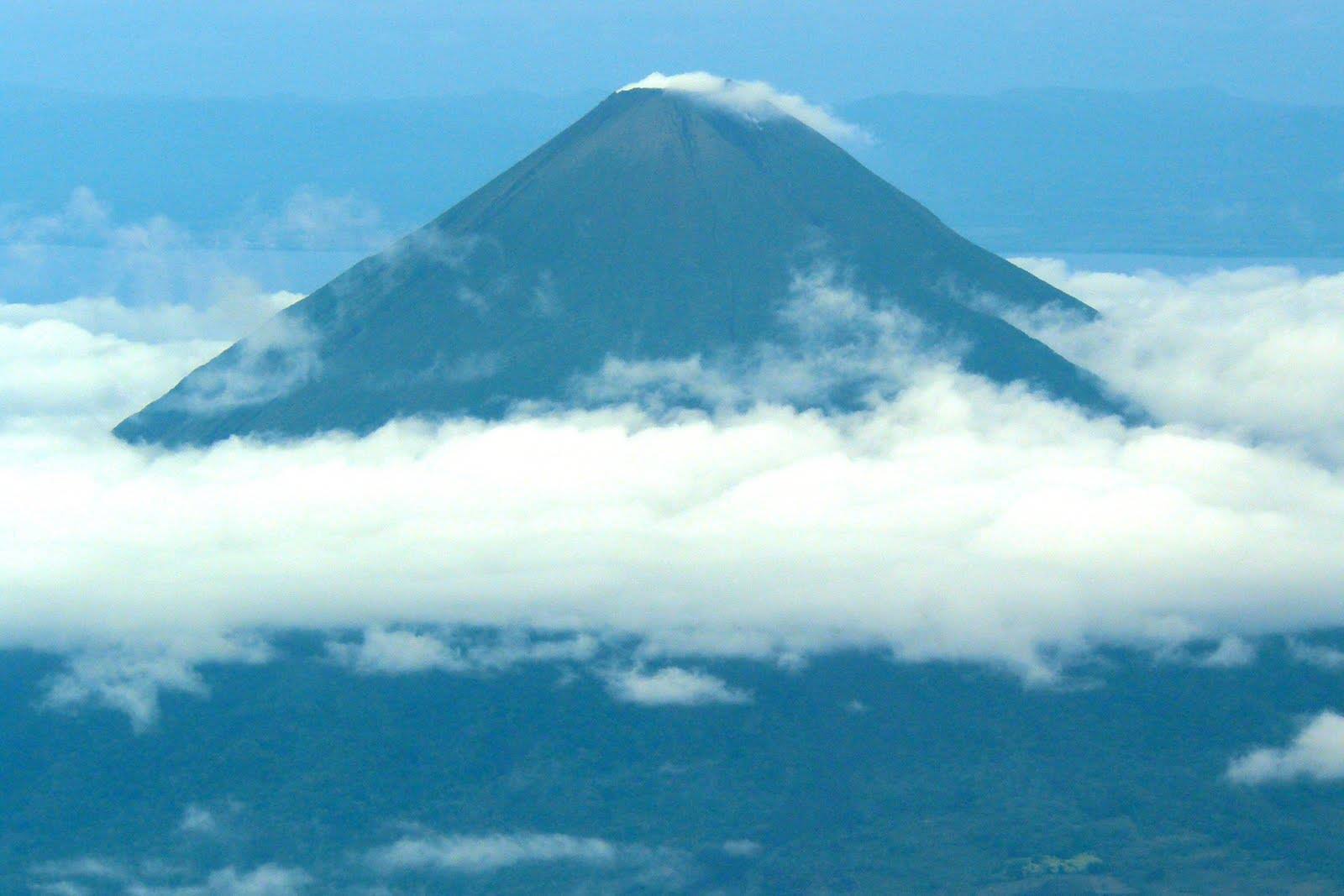
Conical volcano with snowy peak emerging above white clouds
Day 27 Jun 2012
El Canal
After a few years I had fun retracing the journey that, at the time and once the red-hot fumes of the elections had passed, I was about to undertake. A journey that, although perfectly organised ( has kept all its adventurous flavour, just like then. Of course, there's no more war: now there's an "almost" regular ferry service and at San Juan de Nicaragua, formerly San Juan del Norte, formerly Greytown, they've now built a modern airport. If you go with the Ferry take it easy: a few extra days to absorb any schedule changes is to be expected.
But then, since the river was in a border zone, we went with two boats of the UN agency for refugees (UNHCR), escorted by armed soldiers and with camping equipment Fitzcarraldo style Today the skirmishes with Costa Rica continue, and they are linked precisely to the ownership of the river which with its course marks the border with its neighbour, but which by ancient diplomatic agreements, belongs entirely to Nicaragua. It would be a trifling detail without the project, evidently not implausible, of a canal destined to shake up the political and economic balances of the area. Not to mention the environmental ones, which take a back seat in the face of the prospect of a bit of well-being for many, and enormous gains for a few. Today the Panama Canal can no longer handle the traffic of the large merchant ships that shuttle between the two oceans.
I saw them from the hotel, in a very long line waiting for their turn.
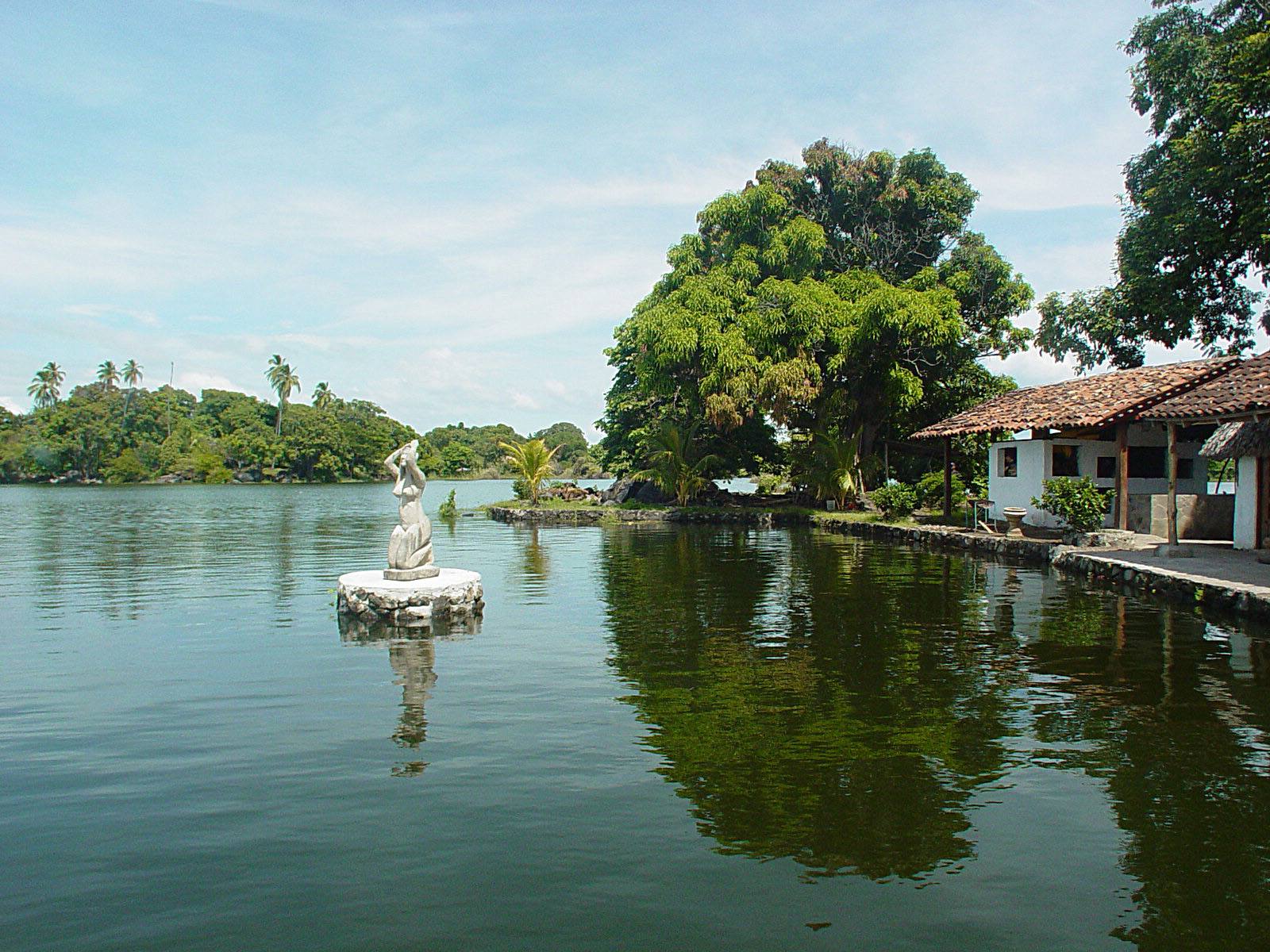
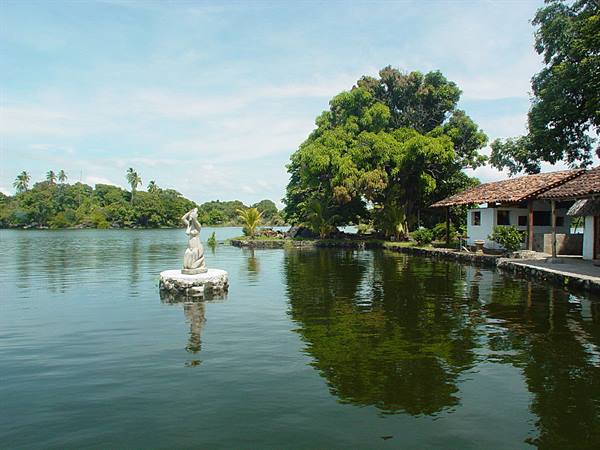
White statue on tiny islet, tiled-roof house and lush trees by the lake
Day 39 Jun 2012
I give in to memories..
I abandon myself for a while to the memory: the departure is set from San Carlos, where the Rio San Juan begins its journey towards the Atlantic fed by the waters of Lake Nicaragua. The Mar Dulce, as the conquistadores called it, is enormous, when the wind blows the waves rise just as if it were a sea and it is inhabited by an endemic species of freshwater sharks, proof of its ancient link with the ocean. To the north there is Granada, a delightful little town that has preserved its sleepy colonial style intact. In front of Granada, like stones thrown by an angry volcano, the Isletas, little more than rocks, gardens of the houses or villas that host them.
Further south, and near the only presumed large excavation necessary for the construction of the canal, Rivas, in front of the island of Ometepe, made up of two twin volcanoes, and where you can find, if accompanied by local guides, precious graffiti left as a testimony by the ancient inhabitants. Finally, to the south of the lake, the Solentiname archipelago which hosts a community of naive artists.
We arrive at San Carlos after a long car journey, on unpaved and remote roads, along the eastern coast of the lake. In the morning at dawn the boats are loaded. The hotel wasn't up to Western standards, but it was welcoming, and the people were friendly. Between worried and amused, as always, we help in the hand-to-hand passing of packages, equipment, ropes and finally our luggage, the only ones packed in very technical and modern backpacks. What intrigues us is the almost absence of food, of water and the presence of very long wooden poles, with a mysterious function. The first stretch fascinates us, the navigation is relatively calm despite the din of two 200 HP engines and the presence, at the stern, of as many drums with 200 litres of petrol each. They say we'll need them and that no, there's no danger.
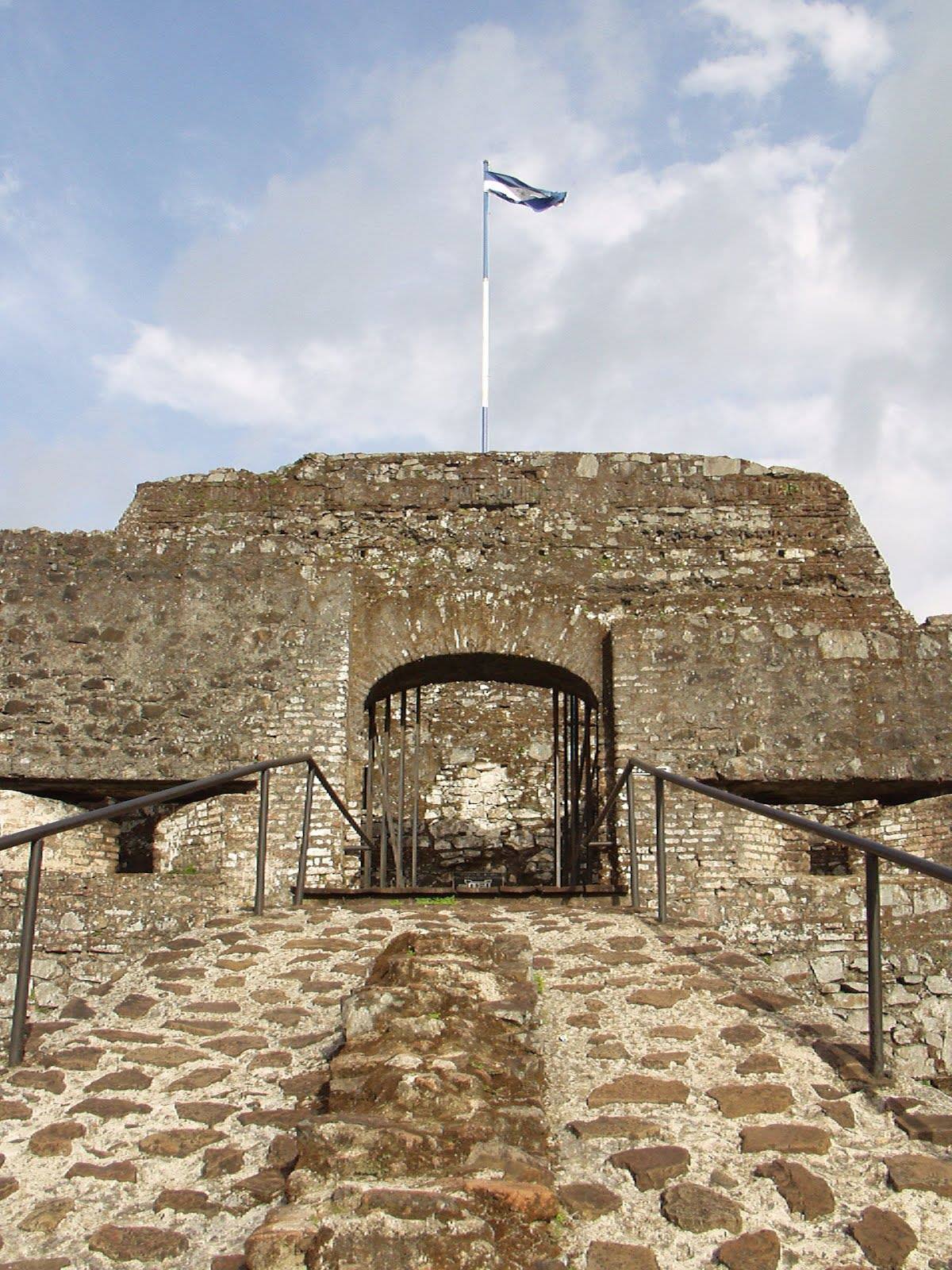
We arrive at the Castillo where we experience various emotions: the remains of the railway that Cornelius Vanderbilt had built for the ruta de transito, which brought gold prospectors from the east coast of the USA, all the way to California passing through here; the collection of bullets of various calibres, which the friendly hotelier, who also provides us with lunch, keeps in plain sight in a display case on his counter. You go from small friendly casings like derringer ones to disturbing tracer bullets, which are fired from a machine gun that the innkeeper absolutely wants to show us, despite our declarations of pacifism. The last emotion is reserved for us in the afternoon, when we set off again. I've done a bit of canoeing, rapids don't particularly scare me, but with the boats, 15 people, 800 HP of engines and 400 litres of petrol on board they make me a bit anxious.
Even from the look of the boatman, who is the owner of the boat, a certain apprehension shines through: the level of the river is low and many stones emerge. My small canoeing experience suggests to me that the outcome of a collision, provided there's no damage to the keel, could make the boat tilt, and therefore capsize it. I imagine in my mind the packages, the backpacks, the camera, floating in the middle of the rapids or worse disappearing swallowed by the whirlpools. But I don't have time to finish my catastrophic film before, after a few collisions, we're past, faces relax and everyone laughs happily. From which I understand that my anxieties were widely shared.
White statue on tiny islet, tiled-roof house and lush trees by the lake
Day 410 Jun 2012
Along the Rio San Juan
The long hours of descent to San Juan del Norte, or Greytown according to the old English name, or San Juan de Nicaragua according to the new name, give the idea of the river as the only communication route flanked, on the Nicaraguan side, by a wall of seemingly inextricable vegetation. On the Costa Rica side the clear signs of the timber industry are visible, and its effects on soil erosion. Then, every now and then, the small forts, placed at the top of hills and surrounded by sandbags remind us that a muted war is still ongoing.
We continue. As we approach the bar, the lagoon that forms between the river and the sea, the alligators appear, eating their prey on the banks. Finally we disembark, or maybe not, it's just a stop for dinner... dinner? The panguero (pilot of the boat also called panga) grabs a stick and the rifle, disappears into the vegetation for a while, a shot is heard. He returns triumphant with two poor garrobos, large iguanas that here they consider edible. The second one, he explains, was faster than his stick and required the artillery. Watch out for the pellets, tonight. Mercy is not given in these places. We arrive at the designated place for the camp and can finally discover what the long poles that we've been carrying around since this morning are for. They are the uprights of the heavy camp tents, probably Soviet war surplus.
We prefer our little igloo tent, but only until shortly after dinner, when the noises coming from the jungle suggest a more reassuring sleep together with everyone else. Dinner, as you can imagine, is not the best: rice with beans is fine, but we feel a certain pity for the poor garrobo roasted on the fire. We still get some boiled vegetables and the greenish water of the river. We purified it with silver tablets, but we don't drink it serenely. To celebrate, the inevitable rum, which Nicaragua produces with great pride. The night passes peacefully under the mosquito nets, and the next day we visit Greytown. The houses, of wood and sheet metal, have been swallowed by the vegetation, therefore collapsed. Today the little town has been rebuilt, together with the modern airport.
And together with the sheet metal houses you can see the characteristic stilt houses that the Rama Indians still build in the jungle. It is to the Rama communities that Le Indie viaggi turns to organise guided visits to the Indio Maiz Reserve.
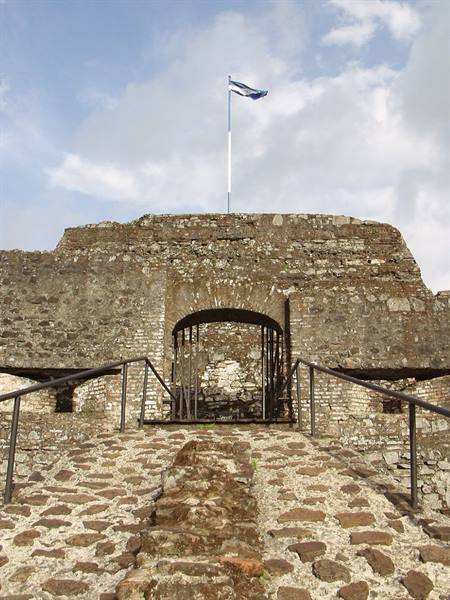
Honduras flag flying over an old stone fort with an arched gateway
Day 511 Jun 2012
The travels of the adventurers
But then the cemetery was the only thing left visitable, still making one's way with machete blows. It reserves for us the emotion of tombstones from 100 or 200 years ago in English, Spanish, Dutch, which make us imagine this place, when rubber was an important commodity, and there was a flourishing industry: it was collected, worked and shipped by sea. Then, still here, the brigs that had set sail from New York docked. The journey of the Gordon's Passenger Line was not safe, it cost 130 dollars in 1850 and brought gold prospectors to California. It went back up the Rio San Juan, crossed Lake Nicaragua, as far as Granada, then to the port of El Realejo, on the Pacific where the company guaranteed a refund of 75 dollars and food for 60 days to passengers who didn't find a berth on one of the Pacific Mail steamers for San Francisco. Roger S.
Baldwin Junior tells us about his journey: he set off with the brig Mary on 20 February 1849 together with another 130 adventurers, the last of whom, after various vicissitudes, arrived in San Francisco on 4 October 1849, seven months and 14 days after setting sail from New York.
Our journey is at the halfway point, we still have to go back up the river and go to Rivas, to see where the Japanese imagine cutting the strip of land of a few kilometres that divides the Pacific from the Mar Dulce. I like to think that the name given by the Spaniards to the lake came to mind while they were watching the sunset from Ometepe and not already because of the fresh water. The fact is that we need a 4x4 to get to the beach and the coconut plantations, guarded by soldiers of the Sandinista people's army in boots and with Kalashnikovs. And here, as in much of the Pacific coast, the waves break incessantly on the beach and the turtles lay their eggs in the wild intimacy that tourists no longer allow. Many of the eggs ended up, and still end up, despite the ban, in the local diet, as well as turtle broth and meat.
And I wonder if it's a greater harm than the modern malls, the jeeps with tinted windows and a fanciful array of lights, an opulence for the few to be enjoyed in houses surrounded by barbed wire. And of the children at traffic lights.
Honduras flag flying over an old stone fort with an arched gateway
Day 612 Jun 2012
Will we see children at traffic lights here too?
Let's return to today and to the news of the decision of the Congress of Nicaragua to build the famous canal, dreamed of and yearned for over the centuries by gold prospectors, by fanciful entrepreneurs of the 1800s, by the Japanese in 1990. I can't help but think of that great cross-border park that in the 1980s was called SIAPAZ, the Indio Maiz reserve, which from the great forest of the Rio San Juan was to reach Tortuguero and the Cano Negro reserve, in Costa Rica. Going back there many years later I wonder: will we see, here too, children at traffic lights?
Honduras flag flying over an old stone fort with an arched gateway
0 reader comments