The story
HOLIDAYS IN SOSUA – Dominican Republic (22/2 / 08-03-2010) (Purpose of the trip: to check whether the conditions exist to spend the winter there) Travellers: Enrico and Gilda from Pisa (Tuscany) - aged 61 and 59
Milan Malpensa - 2:25 pm on 22 February. We've taken our seats on the plane, just behind the right wing, me by the window, my wife Gilda beside me. The seating layout is 2-4-2, the airline is Livingston. We're late. At last, after an incomprehensible hour of waiting (who knows why on planes no one ever tells you the reason for the delay... though it wouldn't help much, seeing as they could "invent" all sorts of things), we take off. All for the best. Perfect acceleration and lift-off. About 10 hours of travel lie ahead. On our flight, in business class, there's Raoul Bova with his team. We land at "La Romana" airport and, disembarking, we see another showbiz figure: Edoardo Bennato. The time it takes to get out of the airport terminal (if it can be called that) is rather long, because of the inefficient organisation.
And here, first rip-off: at the exchange we're told the landing tax is paid exclusively in dollars, only to then, 5 metres further on, where the collector is, read a sign saying: "payment 10 euros or 10 dollars"! … So the advice I can give is not to change much money at the airport but only a few euros; I'd consider 50 enough, part in dollars, about twenty, and the rest in pesos (the euro is worth more than the dollar; the exchange rate at the time was about 48.50 pesos per 1 euro against 36.40 per 1 dollar).
DON'T TRAVEL BY CAR AT NIGHT – I'd been given advice about this, and also, reading here and there reports by those with previous experiences, the invitation to the reader was not to venture on night-time car journeys! Anyway, though of a mature age, but with a good dose of "childish recklessness" still in me, at the airport we get into the car rented online before departure, heading for Sosúa (expected travel time, about 7 hours). I must say straight away that I didn't find the roads we travelled quite as disastrous as they'd been described to me. What I did find, instead, was a lack of road signs, and the same goes for lighting. We also encounter some closures or diversions for roadworks, but these are signposted, though not with luminous signs, which, in the dead of night, would be essential.
Another danger, given the vehicles the Dominicans, and not only them, use to get around (cars, motorbikes, vans, trucks, minibuses etc., real wrecks) can indeed arise from these: many don't have working rear lights or reflectors; the headlights, for those who have them, are kept permanently on high beam, most don't use indicators at all, and so on. And again, you might find oil patches on the road surface or some animal crossing the carriageway (not by chance do you see many vehicles with sturdy "cow catchers"). In the Dominican Republic driving is on the right, but there no one knows which is the driving lane, since people travel indifferently on the right, left or in the middle….
You therefore overtake on the left or the right, depending on where the vehicle ahead of you is! I forgot: bear strongly in mind that a very high percentage of drivers drive without a licence and without insurance… So, in the event of an unlucky accident, the consequences for whoever suffers it are easily imaginable! Along our journey, shortly after the capital Santo Domingo, we're stopped a first time by a police patrol who, after greeting us cordially and noting that we don't know the language and that we're tourists, let us go. But when it's time to set off again, the car (check the state of the vehicle carefully before leaving), gives no further sign of life. The policemen gesture to us to open the engine bonnet and, once the problem is identified, one of them, picking up a stone from the ground, bangs it violently on the battery terminals, and the car starts up again.
At that point they ask us for a "tip"… I'm taken aback, but anyway, I leave them a few pesos and we set off again. After a few kilometres, as if the first policemen had alerted their colleagues further on, we're stopped again. Same scene: cordial greeting and a request for money! To the latter, though, I make it clear that I don't have any and that previously I'd handed some to their colleagues. They don't object and let us go on our way. A piece of advice: don't give money to anyone!!! They won't say or do anything to you! For them it's a form, though deplorable and condemnable, of supplementing their meagre salary (they tell me about 200 euros a month); but if you refuse to comply with their requests, you risk absolutely nothing! Do be very careful, though, because at night, and only at night, fake policemen lie in wait along the roads with the aim of stopping those passing through.
We too met one of these who, with a small torch in one hand and a big fine pump-action shotgun in the other, waved at us to pull over. Not seeing a car with Police logos (but I know some put fake lettering on), I first slow down and then accelerate and speed off. I can't tell you the purpose of the actions of these "characters", but I don't think it's hard to imagine. Finally, thoroughly exhausted, we arrive at the hotel around 4:30 in the morning. The following afternoon, still dazed from the long flight and the drive, we take a short walk along Sosúa's main road to head to the beach.
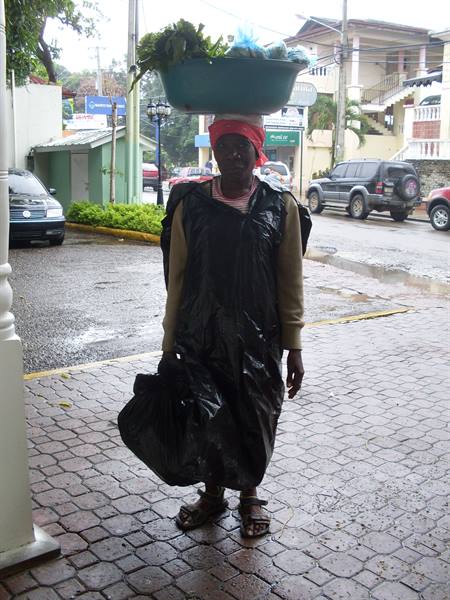
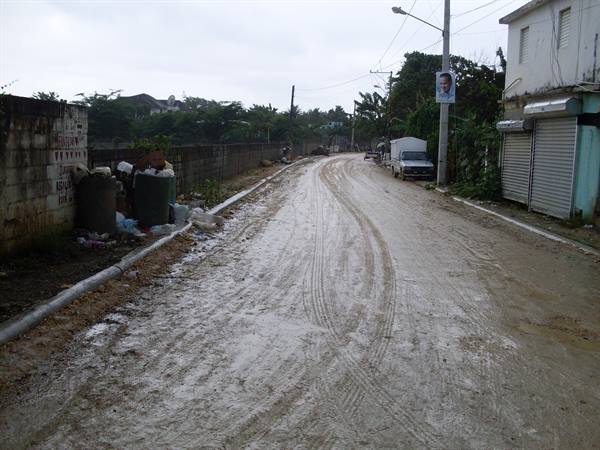
The impact is as raw as it gets: dirt everywhere, undisciplined traffic, very loud music coming from every direction (houses, shops, bars, cars); roads broken up and full of potholes, many of them still dirt, incomplete pavements, leaning power poles and dangling electric cables, farm animals, cows and dogs, many dogs along our route; the latter, though, which we also find on the beach, evidently used to people, cause passers-by no bother at all.
Before reaching the playa, we're literally set upon by all sorts of characters; they realise we're the "new tourists" and so ask whether we want to change money or whether we're interested in visiting hotel establishments; others invite us to use their motorbike as a means of transport (these, I must say, are very useful for short trips; for just 25 pesos by day and 50 by night they carry us - two or three of us even on the saddle - anywhere in the city). Along the whole beach, lush vegetation shelters from the sun picturesque, colourful "shacks" where, besides the most varied dining spots, the classic souvenir products of the place are displayed (… made-in-China rules supreme there too)! You can't help but notice, however, the poor cleanliness and the total absence of any hygiene regulations inside the premises.
Along the beach there are several "managers" of the sand, offering loungers and parasols. Always haggle over the price (for two loungers you pay 100 pesos a day, just a little more than two euros). Don't expect to stretch out on the loungers we find on our beaches… You'll immediately notice how badly kept, dirty, dilapidated and roughly repaired they are. Just think that one day, between one lounger and another, as a little table they put a plastic crate, of the kind used for the
The journey's photographs
9 photographs · click to open them full screen






0 reader comments