The story
From the airport we take the Las Américas highway, a very fast-flowing road that leads directly to Santo Domingo in just 25 kilometres, but we miss the exit for the Colonial Zone. So we end up caught in the chaotic traffic of the Mercado Modelo. We crawl forward amid a confusion of pedestrians and frantic hawkers. Motorbikes, cars and trucks move along to the sound of horns, gua gua (shared taxis) forcing their way in everywhere, helped by the arm-waving and cursing of the ticket collectors. Tired, and after a good ten hours of flying, finding ourselves in the middle of the congested traffic of Santo Domingo is hardly ideal; nevertheless, in the end we reach the Hotel Palacio, an old colonial mansion now converted into an elegant hotel.
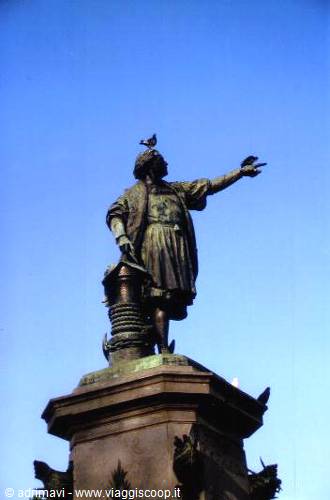
The visit to the capital's "colonial quarter," declared a UNESCO World Heritage Site, is a must. Santo Domingo, the first capital of Latin America, was founded in 1496 by Bartholomew, Christopher Columbus's brother, and named in honour of his father Domenico. In the Parque de Colón we find the statue of Admiral Columbus: impossible for us Italians not to be moved before the outstretched arm pointing ideally towards the land just sighted. The area between the Ozama fortress and the Iglesia de las Mercedes has remained authentic: you can breathe the air of those times, and the light is still that of the colonial world. In front of the Alcázar I imagine the powerful men of the day making the decisions inside for the colonisation of the rest of the Americas.
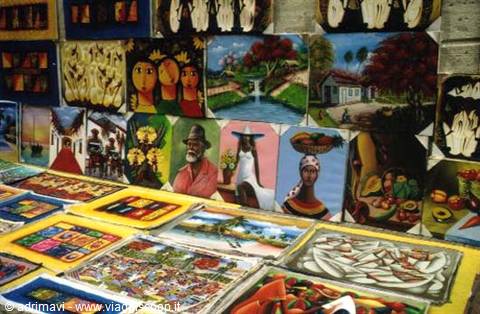
During the visit we meet shoe-shiners and hawkers, lottery-ticket sellers and naive painters — they are everywhere, like the pseudo-guides who constantly offer their services, pestering us annoyingly. We leave the historic quarter to see, no longer on foot but by car, the other Santo Domingo, that of the dictator Rafael Trujillo. We visit the Columbus (Colón) Lighthouse, the personification of the Generalissimo's totalitarian regime. The mausoleum dedicated to the great navigator is so kitsch and megalomaniacal that it has earned a place of honour among the city's monuments. We then see the Altar of the Fatherland, the presidential palace and the enormous statue of Saint Anthony, and drive the full length of Avenida George Washington, the Malecón, which runs along the sea.
We see what I believe is the largest gallery in the world: on the pavements many artists display works in strong, warm, cheerful colours, so that it's impossible not to buy at least one canvas.
We leave the capital taking the Autopista 1, the country's only motorway, which links south to north. We drive along it for barely eighty kilometres to Piedra Blanca — just enough to make us tear our hair out, proverbially speaking. On the Dominican Republic's main road network we see every means of locomotion passing by, and besides the obvious articulated lorries and cars, we see bicycles, ox-drawn carts and even people who, indifferent to danger, walk along the central reservation dividing the lanes of the two directions. That seems like enough until we notice motorbikes speeding along the hard shoulder… but in the opposite direction! We continue the journey towards the Samaná peninsula.
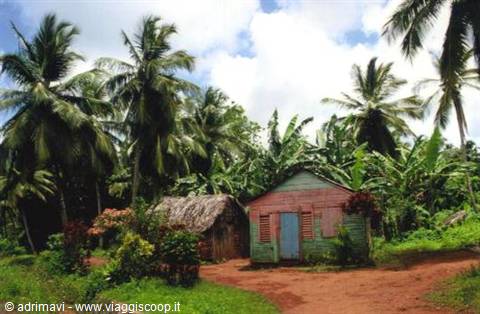
We cross quiet, sedentary country towns whose peace is shattered by the volume blared at full blast from the antediluvian speakers of bars and discos playing the notes of the whole merengue repertoire. The people are warm and smiling despite the poverty in which they live. Groups of children play "baseball," young people play "billiards," old people play "dominoes" — these are the Dominicans' favourite pastimes. In every town, moreover, there is at least a small arena for cockfighting. Among the various scenes of daily life we witness, what stands out are the women in hair curlers and slippers strolling along the roadside to go about their daily errands. The houses are painted pink, brown, red, yellow and blue, sometimes soft and sometimes gaudy, breaking up the greens of the rice paddies, tobacco plantations and banana groves.
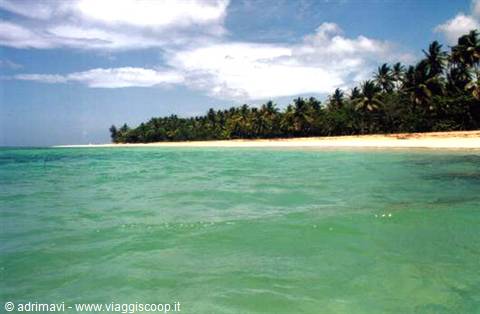
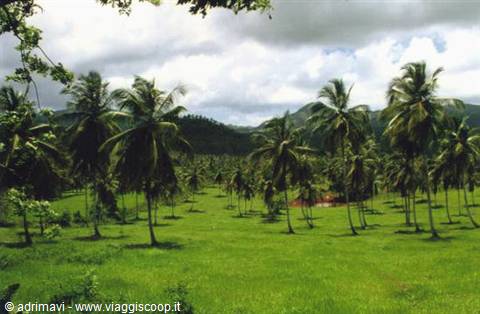
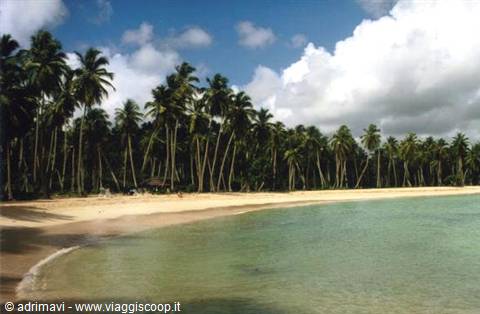
How far away Santo Domingo feels… The north coast of the Samaná peninsula is a succession of practically deserted sandy crescents framed by thick stretches of palms and crystal-clear sea. At Las Galeras it isn't the sea and sand that draw attention so much as the rustic tables of a spartan trattoria and the adjoining bar, renowned for making excellent cocktails. We order a "cocoloco" and a "piña colada." The next day we cover twenty kilometres to reach Playa Rincón. The road is a continuous up and down through the greenery, until the final stretch of just five kilometres of dirt track, but in terrible condition. The sea can't be seen but can be sensed; only at the very end do we see the water, the waves and the sun on the horizon. The beach, said to be among the ten most beautiful in the Caribbean, has no facilities, and only at the two ends do some shacks offer a meal.
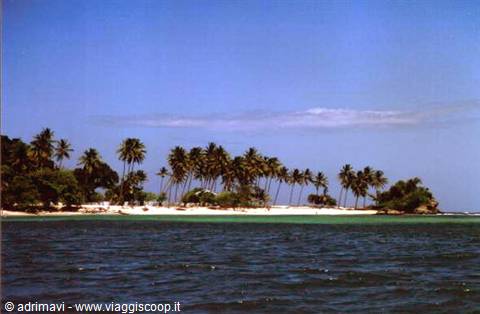
Until late morning we are the only living beings enjoying this slice of paradise. Then come the owners of the run-down restaurants, a first group of tourists by sea, then a second, then some quad bikes from our own road. Having left Playa Rincón, in the afternoon we board for Cayo Levantado from a jetty located a few kilometres before Samaná. We set sail in a small boat, without life jackets, even though the sea is rough. The Cayo is a sort of Maldivian atoll in the heart of the Caribbean. Early in the morning we visit the small, characterful market of Samaná. At first we wander among the stalls a little timidly, being the only tourists, then our apprehension fades between a fishmonger who calls us over to proudly show us the big fish he has caught and a pretty, smiling girl selling fruit that is even prettier.
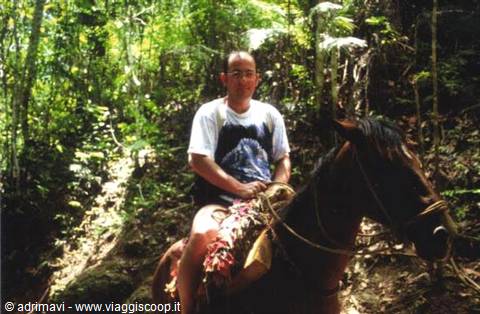
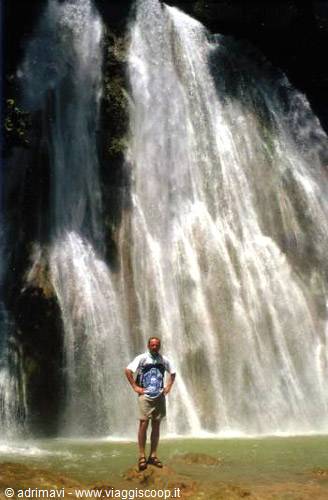
Before leaving we buy from a friendly young man a CD of the greatest merengue hits, which, once back in the car, we blast at high volume. When we reach El Limón, the locals seem amused to see two gringos listening to their music, and at such high volume. From here we reach the famous waterfall on horseback. The trail to get there is muddy from the rain of the previous days and literally bathed in dazzling nature. Along the path, amid a forest of plants and fruits we don't recognise, it feels as if we're riding in a timeless age. The waterfall announces itself with a thunderous roar: the adventure is really worth it! We return to the coast and stop at El Portillo beach, with a beautiful green-blue sea. Roughly in the middle of the beach, a coral reef emerges from the sea. Exactly on the opposite side, two kitesurfers hover in the sky, colouring it.
We continue along the coast to Las Terrenas, which no longer preserves the authentic atmosphere praised in the guidebooks. Tourism is gradually spreading. The same can't be said of the beaches in its immediate surroundings: Playa Bonita and Cosón are in fact deserted and wild, with nothing to envy in the more famous Playa Rincón. On the way back along the ugly potholed dirt track we meet a woman with a tray of doughnuts on her head. We stop and take the opportunity to taste a typical local product: coconut-bread doughnuts. We reach Río San Juan when it's already dark, accompanied, needless to say, by the usual evening drizzle. On the last day we return inland to Jarabacoa, famous for its many waterfalls, such as the Salto de Jimenoa. Along the way, between one sugar-cane plantation and another, men with machetes walk along the road.
They are Haitians going to work, like us the day after tomorrow.
The journey's photographs
15 photographs · click to open them full screen




0 reader comments