Unusual dinner in the miserable Cuban countryside
Of Cuba, where I only had a beach holiday, with a few excursions to Havana and the southern part, I wanted to tell just one episode:
"Don't accept dinner invitations from the Cuban people you meet on the beach." This is the first thing you hear from the usual escort who "accompanies" you on the armoured tourist buses on arrival from the airport to your hotel. The suggestion is given, in their opinion, because of the poor hygiene and safety and the different quality standard we are used to.
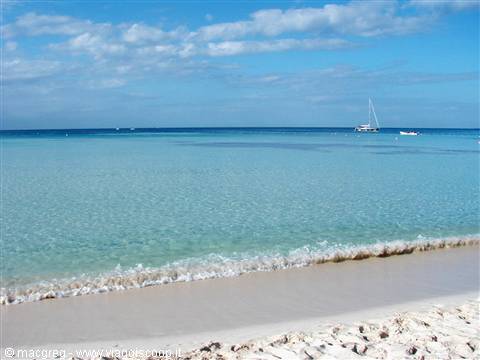
And naturally this is the first thing I wanted to do during my stay in "Varadero", and which to this day I consider one of the indispensable experiences for anyone intending to laze on the Cuban beaches. While you're lying on the white Caribbean beach, it can sometimes happen that you're "approached" by a friendly Cuban, whose kindness and hospitality will remain one of the best memories of the holiday, who stops to chat about various topics, from the politics of his country to curiosity about yours, until finally arriving at the proposal to spend an evening at his home with a lobster-based meal.
We arranged for an evening; Pedro (I don't remember his name, I'll call him that) explains that the place we're going to isn't a 5-star restaurant, you have to make do with the furniture, the houses where he lives are poor, so poor that he can't host us at his own home, because there's no water or electricity, so we'll go to eat at his father's. In that country of course a car is a luxury good, so he'll have us picked up by the doctor from the nearby village, one of the few who owns one. We agree on the price: 10 dollars per person (at that time, 1993, the dollar was about 1,300 lire).
That evening the doctor was punctual, we get into his vintage car (cars in Cuba are very old, but kept like jewels). Practically on the back seats it feels like sitting on a sofa, and with our legs stretched out we enjoy the scenery. As soon as you leave Varadero you enter a centre with brick houses, few of them finished, many left half-done. We continue, and the brick houses become fewer, until they become increasingly rare; the first village ends, followed by a stretch of countryside, then a village with houses made of wood. The further we go, the more poverty seems to increase....And we keep going! Finally, after about fifteen minutes, we arrive at our destination: entering the village feels like being catapulted into a book set in the 1800s.
The little streets are unpaved, sometimes you walk on wooden planks to cross a stream, on the sides you see electric cables strung haphazardly on little wooden posts or on the ground. We arrive at "our house" and meet our friend Pedro, who greets us with open arms, flanked by his young wife and his parents. The water and the kitchen are outside, under a straw roof, his mother is washing the dishes practically in the middle of the dirt ground and is finishing cooking our lobster. We go in: a light bulb hangs from the centre of the ceiling, barely lighting the room, which consists of a table, a few chairs, an old cupboard, a sofa. Dinner is ready: six enormous pieces of lobster arrive, already ready to eat (just the flesh), so exquisite that I'll never forget it. All accompanied by excellent vegetables, fruit, beer, Coca-Cola, water.
Needless to speak of the freshness, and even the impression of cleanliness seemed satisfactory. So much so that we had absolutely no problems afterwards.
After dinner we take a tour of the village: we see a few houses, the children come out to stare at the curious visitors. Pedro invites us to visit his house too...we continue on foot into a field with the help of a torch, until we reach a hut, mud walls, straw roof. Inside just an old mattress, a small table, a dirt floor. No light. No water. Yet our friend's description is one of immense pride, he explains that he built it himself together with his father, and with time he'll manage to improve it, he's only recently married, the money will come with time. We go back to the little village and sit outdoors with other people, chatting a bit, with a glass of rum; a guitar plays a few songs.
The time has come to go back, the doctor is waiting for us. Our journey into the Middle Ages is over, we say goodbye to Pedro and his family, pay the bill (the 10 dollars requested seem an insult to us, we leave 20), and return to our hotel with a veil of sadness and melancholy, but happy to have at least been able to verify for a few hours that in the world people don't only live the way we do.
But that's just a memory, the next day we're on the beach having fun with our Mojito in hand, while Pedro is at work trying to find someone to help him finish his dwelling!
0 reader comments