The story
Itinerary put together independently, taking in Cambodia (Siem Reap and Phnom Penh) for five days, then crossing the Mekong into Vietnam, which we visit from south to north, doing the Mekong Delta, then Saigon, Hué, Hanoi, Halong Bay and finally Bangkok. Budget for three weeks, flights included, for two, around 3500 euros. 8 February 2009 After a few months spent preparing a rough itinerary for our trip to Indochina, with some anxiety about the unexpected things we might run into, the day of departure has finally arrived. At around 11.30 we have the plane from Malpensa. Andrea drives us there, arriving at our house punctually at 7. This year we're travelling on our own, we're truly reckless, or maybe, given the kind of trip, left a bit to improvisation, it's the ideal number. But, given our ignorance of any foreign language... All right, we're in it now, so...
It's not a nice day, but the view of the snow-covered Alps is a fine sight: never seen them so laden with snow. The flight to Abu Dhabi goes without surprises. We have a couple of hours' stop before the direct flight to Bangkok. Sergio takes advantage of the Internet to check the match results: Genoa lost 3-0. We'll get over it! We also wrote to the kids and to my brother. On the flight to Bangkok I gladly skip dinner because I want to sleep. The time difference is 6 hours. In practice we arrive (by our internal clock) at 1.30, local time 7.30 a.m. I'll manage to sleep about 4 hours. 9 February 2009 At the airport, while waiting for the flight to Siem Reap, we spend a couple of hours in the Bangkok Air lounge, where breakfast is offered and free Internet for 15 minutes each.
There are also little sofas, air conditioning, small tables and a peacefulness that makes you forget you're even in an airport. The plane is on time, a few formalities for immigration and customs, but nothing much. At the exit we find the driver with the tuk tuk waiting to take us to the hotel. The Kool Hotel turns out to be nice, new and clean. We freshen up quickly, dress lightly and immediately (2 p.m. local time) take another tuk tuk and have ourselves taken straight off for a tour of the city and then to Angkor Wat, the temple that has become the symbol of Cambodia and appears on the national flag; it's certainly the country's most visited site, in fact there are swarms of Japanese. Too many. The whole temple site is truly majestic.
Almost incredible how they could have built so much in those centuries: the Khmer empire in three centuries (between roughly 900 and 1200) built several capitals, each king moving a few kilometres and building his own city, giving rise to what is today called Angkor, a collection of masterpieces in different, though similar, styles, set in a stunning environment, reclaimed by the forest, which is one of the main attractions of the place. Angkor has been declared a UNESCO World Heritage Site, and thanks to this many countries are contributing to restoring one temple or another. We wander far and wide around Angkor Wat all afternoon. It's immense. Towards sunset we have ourselves taken to the foot of the hill from whose summit you should be able to see Angkor Wat (haze permitting) and we enjoy the sunset after climbing to the top of the Phnom Bakheng temple.
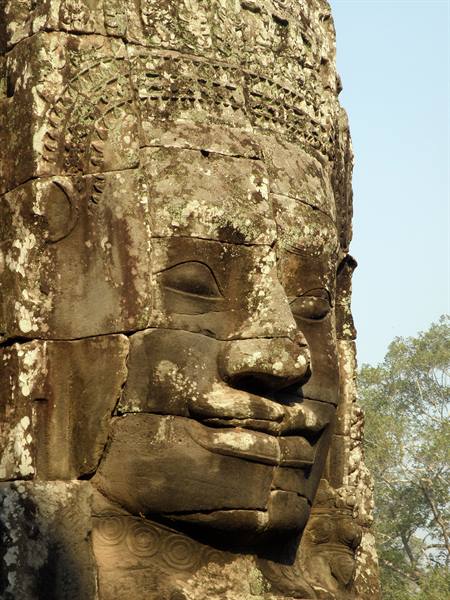
We go back to the hotel and arrange with the tuk tuk driver for him to pick us up tomorrow morning at eight. We go out again for dinner, eat plentifully and have a beer each for a total of 6 dollars. We're happy with everything, but we're exhausted: maybe by 8.30 we're already asleep. 10 February 2009 Slept loads of hours! Shortly after seven we're already at breakfast: a bit disappointing. Not a buffet, but a menu, so a choice of eggs, bread, bacon and coffee or tea. Nothing else. We'll make do! So we set off towards Angkor Thom, where there are a great many temples to see: the Bayon, the west Baphuon, the Terrace of the Elephants, the Phimeanakas and the royal palace, the Terrace of the Leper King, Tep Pranam and Preah Palilay; the Prasats Suor Prat, the Khleang, and Preah Pithu. Angkor Thom in the Bayon style is very striking.
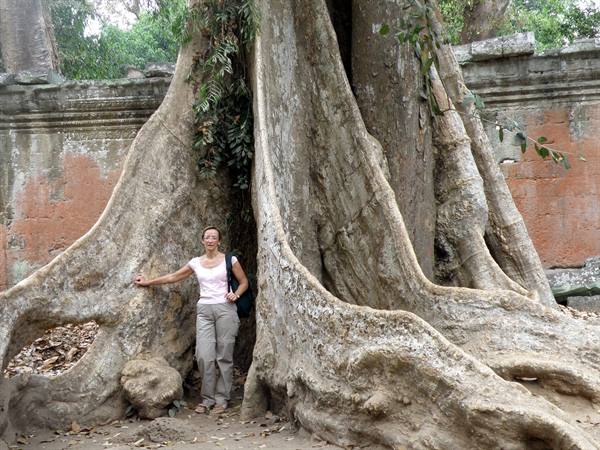
It's built in brick with face-towers dominating every entrance to the city. It's very large, you find labyrinths of rooms, long corridors, walkways positioned to allow passage in particularly critical points. The trees, an integral part of the temples, so much so that at times you can't tell whether it's the tree holding up the walls or vice versa, are gigantic. Passing among branches, roots and lianas you feel very small. Again, I think one of the attractions of these places is precisely the setting, this wild nature that seems to engulf temples and visitors. Here an accident happens. At the Bayon Sergio slips on two steps and, falling, bangs the camera, which starts playing up. Every now and then it doesn't work, it freezes and switches off. I think that before the trip is over we'll be forced to buy a small spare one.
We then move on, still with our powerful vehicle, to Ta Keo, a Hindu temple, and then to Ta Prhom, in the Bayon style. After this last visit we have lunch with Lay, the tuk tuk driver, and then carry on visiting a couple more sites, Banteay Kdei and Prasat Kravan. Once these visits are over Lay suggests a boat trip on Lake Tonle Sap, to the floating villages and fish farms. We accept, for an outlay of 30 dollars for the two of us. We cross a very poor area, with wooden stilt houses (calling them houses requires a certain amount of imagination), most of them rather dilapidated. This makes you reflect on what a privilege it is to have been born (with no merit of our own) in a country like ours, with all the flaws we notice every day.
Also because people who live deprived even of the essentials as here (in our view) are the majority of the world's population! Arriving at the lake we board one of the many boats and here the accident happens to me: I trip getting on and the boatman, perhaps because he was right behind me, perhaps trying to hold back my fall, unintentionally gives me a blow, I think with his elbow, on my cheekbone. I carry the pain for the whole day; luckily it leaves no marks. During the visit to the fish farm we see crocodiles and catfish and also a python, with which I have a photo taken holding it in my hand (I'd been offered the chance to put it round my neck).
We also go to deliver notebooks and pens as gifts to a floating school where Cambodian children have lessons in the morning and Vietnamese in the afternoon: double shifts! We then go back to the hotel, where we freshen up (the shower really was urgent given the dust we'd accumulated), rest a little and then go out for dinner. 11 February 2009 This morning we find a different and less friendly driver. In any case we do the prearranged tour, which is over by lunchtime. The temples visited today were: Preah Khan, which has barely been restored at all, with numerous trees and vegetation grown up among the ruins. Neak Pean, a temple on an artificial island, East Mebon, Pre Rup, Sras Srang. Back at the hotel we book the bus for tomorrow morning to Phnom Penh (11 dollars each). They'll pick us up at the hotel at 7 and departure is scheduled for 7.30. Estimated travel time 5 or 6 hours.
The bus company we've found seats with is Paramount Express. Once the practical matters are sorted we go out looking for a stall selling fruit. We take two mangoes, a red pitaya (which Sergio calls the stracciatella fruit, because of the white flesh with black dots), a...
The journey's photographs
33 photographs · click to open them full screen



1 reader comments
Ciao Liliana, ti faccio i miei complimenti per i tuoi viaggi...mi interessava avere la continuazione del viaggio in Vietnam ma la pagina è interrotta...puoi farmela avere? Un grazie grande.