Day 110 Mar 2003
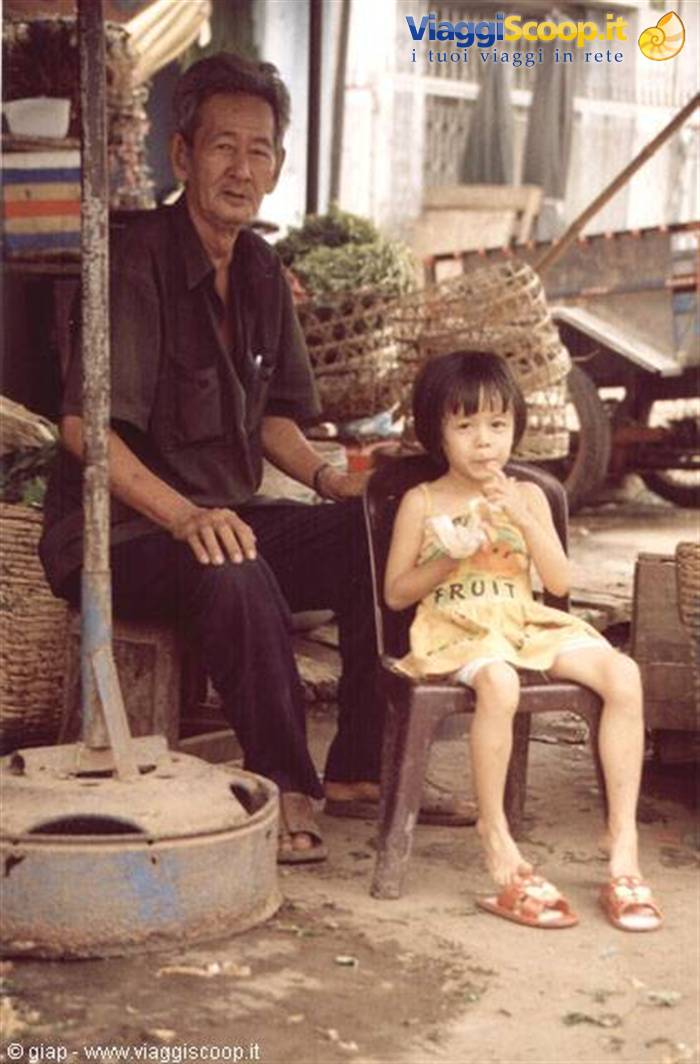
QUANG NGAI TEXT BY LORENZO MAZZONI PHOTOGRAPHS BY TOMMY GRAZIANI
Pain matures our humanity Ho Chi Minh
The Reunification Express, the train linking Ho Chi Minh City to Hanoi, pulls into Quang Ngai station at four in the morning after nine hours of travel. Only we get off. We're rested, since foreigners (in truth we saw none on our carriage) are granted the privilege of travelling first class. In Vietnam first class means comfortable berths that unfortunately can't dispel the agony of the hot air stirred by the fan bolted to the ceiling. We've left behind us the coastal city of Nha Trang, the West's first timid and sad attempt to appropriate Vietnam's tourist potential: pot dealers, special masseuses, beach bars run by tanned Australians.
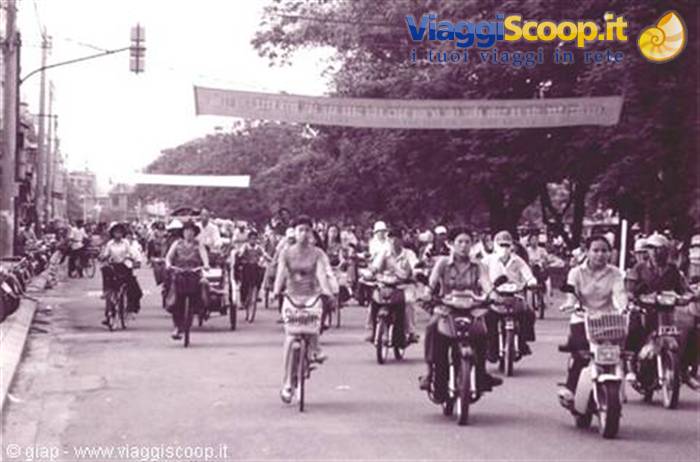
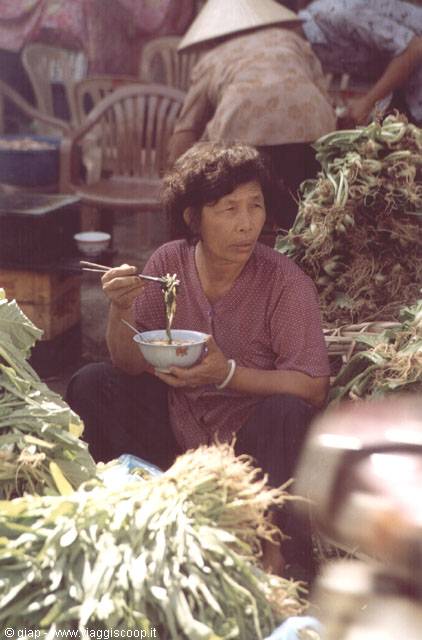
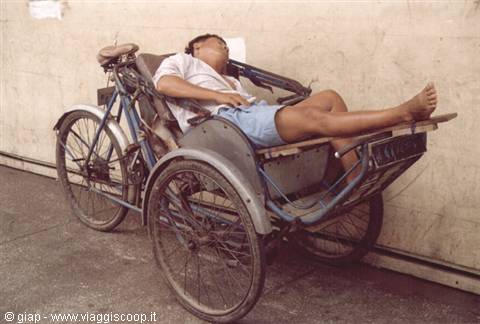
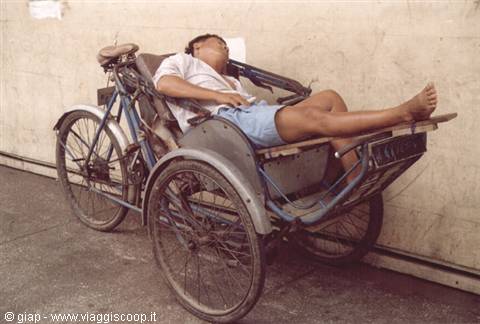
Outside the railway station the Honda om (do-it-yourself motorbike-taxi drivers present in every populated reality of Vietnam) aren't used to seeing foreigners, they speak neither English nor French: we communicate with gestures. We're picked up by two skinny and silent motorcyclists who lead us, through dark streets, in front of a lowered roller shutter. Five minutes later the owner will raise it, showing us his complete work of the theorists of Marxism-Leninism, the bust of Uncle Ho and, finally, our room. We unpack the few bags, take a four-hour nap and start storing the first sharp images of the city: from the window we watch a couple of elderly people practising tai chi under the trees. Some schoolgirls in ao dai pass by laughing. In front of a restaurant, some workers have breakfast with ph?, the delicious noodle soup, a fundamental dish of the Vietnamese diet.
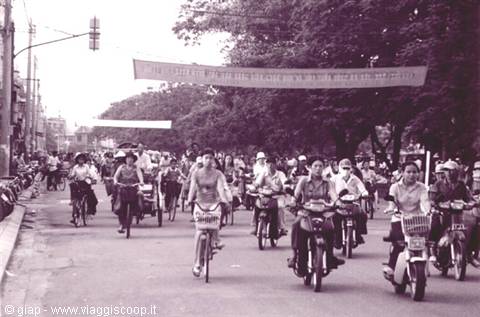
The traffic on the main street wakes up but can't overcome the very loud chorus of crickets, thousands of them, in the trees. Quang Ngai (sometimes abbreviated to Quangai or mangled into Quang Nghia) is the capital of the province of the same name. Cut in half by National Highway 1, which here takes the name Ð Quang Trung, it was built on the southern bank of the Tra Khuc River, known throughout south-central Vietnam for its gigantic water turbines. Quang Ngai is also famous for the local delicacy, Com Gà (chicken cooked together with yellow rice and garnished with egg soup, coriander, mint leaves and onion), which can be eaten in the popular canteens and in all the city's restaurants.
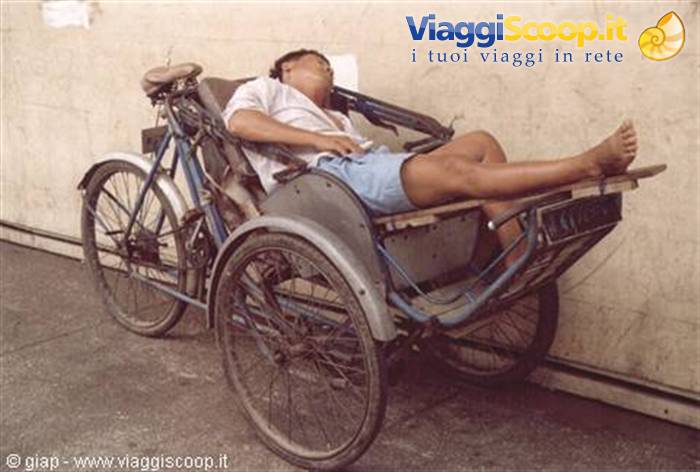
The province of Quang Ngai is one of the most populated in the nation thanks to its mostly flat hinterland, which has made it a destination, sometimes sought and sometimes forced, of an internal exodus of farmers. Villages have sprung up everywhere, forming a capillary network of self-sufficient settlements but strongly linked to one another that have a typical elongated shape, with houses clustered along the roads and waterways. Bình S?n, Bình Châu, Sa K?: clusters of shacks where wild pigs and buffaloes roam. As we cross them aboard a Honda Dream lent to us by the hotel owner, we glimpse small rooms painted light blue open onto the street: the private overlooks the public. We greet a barber who, with the help of a mirror tied to a tree trunk, is cutting a young customer's hair. Along the dusty streets children in school uniforms shout happily.
Not far from Bien Khe K? beach, a long white stretch covered with pines, the inhabitants of Son My farm shrimp. Villages constitute the socio-economic foundations of Vietnamese identity. Thanks to them, Vietnam takes on its basic historical structure. For centuries the Vietnamese have exerted themselves in building a flexible and dynamic system: one village after another; one rice field after another, with its dams and its little canals. They have built a socio-economic system that imposes a well-defined place for each person. The Vietnamese way of life translates into the immense collective effort of transforming a landscape of forests into a miniature of squared-off crops. The socialisation and political organisation that derives from it constitute for the Vietnamese peasant a strong element of identity, capable of becoming the very meaning of his life.
The village provides him with a familiar, emotional and cultural climate, it builds his character. In this unity, in this cohesion, the Vietnamese people have found the strength, over the centuries, to resist aggressors: Chinese, Japanese, French, Americans.
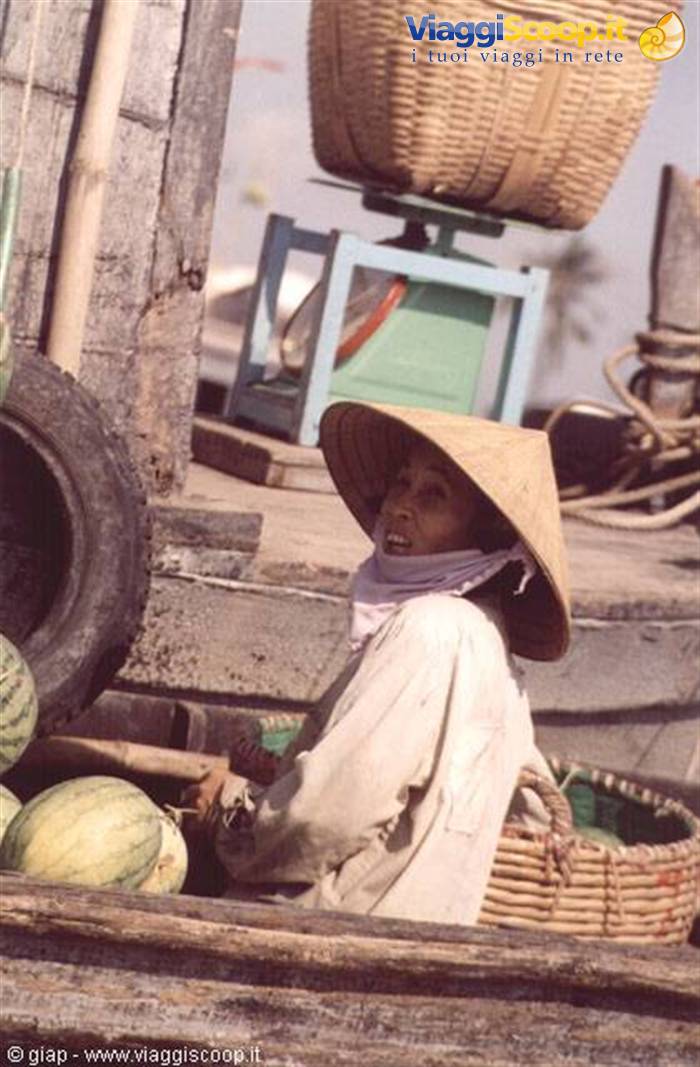
In 1962 the pro-American government of Diem chose Quang Ngai province as the place to implement the agrovilles programme, later called Strategic Villages. The inhabitants of rural areas were forcibly taken by the military and, with the complicity of the first American officials (like the humanitarian Mr. Wolf Ladejinsky), "moved" into fenced-off villages, under control. These first acts of violence, of forced sociality, these aggressive uprootings of entire communities, definitively pushed the population of the province to the side of the National Liberation Front or, more vulgarly, the Viet Cong. The consequences were terrible, the attachment to the cause of independence was paid for at a high price.
13 km from Quang Ngai, there is Xom Lang, where, amid the vegetation and silence, a commemorative monument has been erected to the victims of the massacre commonly known as the My Lai massacre. In truth My Lai is only one of the four villages where the marines unleashed their blind violence on civilians. The commemorative monument was built at Xom Lang because there the massacres were most ferocious. In the museum house, it's striking to note that no American names appear in the visitors' guestbook. It seems strange that no one feels obliged to come and see. Maybe they don't know? None of them has walked in the places where Captain Ernest Medina and his henchmen, Lieutenant William Calley (who became a celebrity), Lieutenant Jeffrey LaCross and Lieutenant Stephen Brooks, unleashed their men.
That day in '68 Uncle Sam's big boys entered the villages and dismembered, raped, machine-gunned perhaps two hundred, perhaps three hundred people. The number remains unclear because when they put an end to the slaughter, the killers threw hand grenades onto the bodies to hide the massacre. Lieutenant Calley, the only one accused in the sham trial set up in the United States, apologised by saying that it wasn't easy to distinguish a swaddled newborn from a Viet Cong guerrilla. They gave him life imprisonment but after four years he was set free with impunity. There's a photo of him in the museum house at Xom Lang. He has an unpleasant, snobbish face.
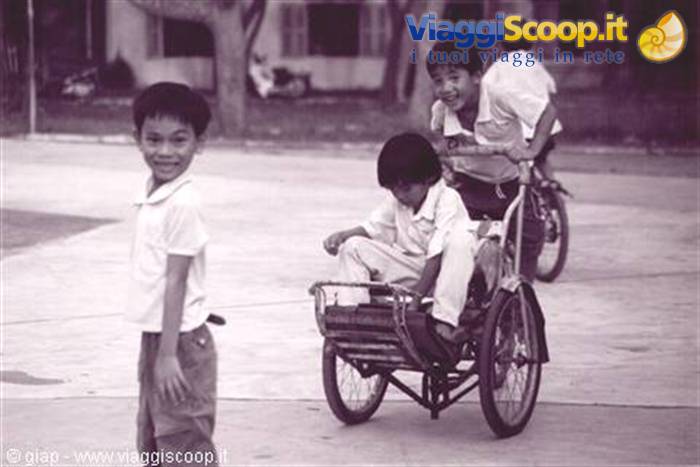
Outside the fenced area of the museum two children are playing, chasing each other. Hanging from the trees, the names of the people who were massacred are written on little wooden boards. The Khoi family, the oldest was 16, the youngest 3; Mr. Chinh, 91 years old, surely a subversive; the Loy family, father, mother, children, grandchildren: 84 years old, 78 years old, 32 years old, 12 years old, 6 years old, 4 years old, two months... two months. It gives you chills. Coming out I look at the shacks on the edge of the road; in the rice fields the farmers are working: it seems that collectivisation has succeeded. The gap with the comforts of the cities is evident but the social differentiations that exist within the large urban agglomerations of Hanoi, Ho Chi Minh City, Da Nang, due to the first losing openings to the international market, are missing.
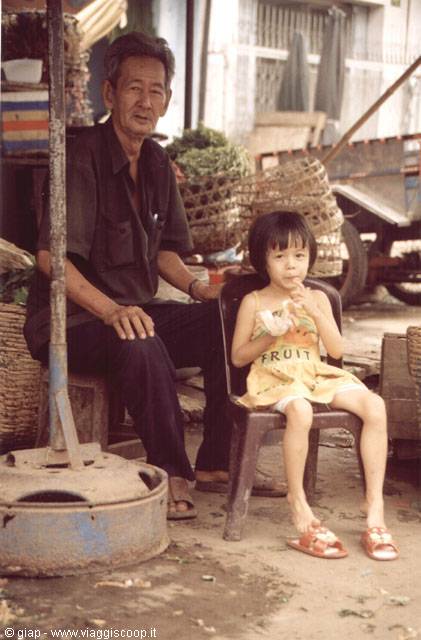
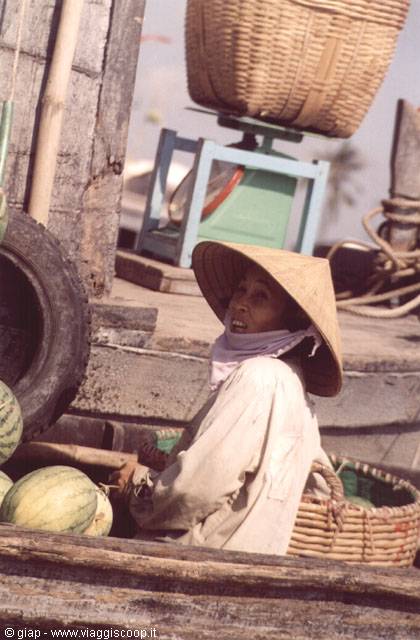
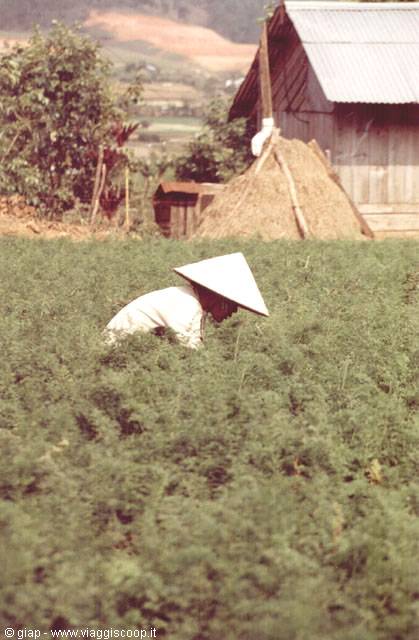
In the villages there are no poor children on the street. Everyone cultivates the land, they have little but they have enough to live on, they are bound by a strong sense of community; deep down, they have everything. The miracle of collective and rural Vietnam survives, perhaps also thanks to that horror, witnessed by the monument at my back, that the Western aggressors brought to try to impose their "freedom" and their "democracy". I observe thousands of shades of green falling into ochre yellow and straw yellow. I observe the light palms and the granitic dark red of the roads. Buffaloes. Along the road, slowly, a farmer on a bicycle overtakes us and continues toward the sea. The usual, proud, dignified conical hat pulled down over his face.
Born in Ferrara on 20.12.1974 Graduated in DAMS Cinema. Currently working toward a degree in Contemporary History. Profession: badly paid usher in a futuristic cinema.
Born in Ferrara on 26.3.1975 Perpetually working toward a degree in Foreign Languages Resident in London for several years Profession: badly paid barman in a retro little restaurant on Portobello Road
10 photographs · click to open them full screen



0 reader comments