The story
It was a rather varied trip. We arrived by plane via Singapore with only one fixed point: the booking of the first night in a hotel in the capital. Mimmo and I always travel like this. You define a destination, usually a country (sometimes not even that), and then you book a hotel for the night of arrival and for the one before departure. Everything else is improvised on the spot. We are two very in-tune travellers and for years our wives have let us give free rein to our craving for adventure, leaving us the freedom of a 'wild' trip. Our tour of Vietnam unfolded through a visit to Hanoi and the surrounding areas, a three-day excursion to the marvellous Halong Bay, a trek in the mountains on the border with China in search of the hill tribes. We then took a local flight, moving to Ho Chi Minh City (Saigon), from where we organised a visit to the Mekong Delta by bicycle.
This first part concerns only Hanoi. It's hard, for someone like me who was a student in those years, to think of Vietnam without recalling photographs with scenes of war, helicopters dropping soldiers into the rice paddies and faces marked by horror. In fact, a case more unique than rare, this people lived with a practically uninterrupted conflict from 1939 to 1979, the year of the Chinese invasion. But what effects can a forty-year war have on the spirit of a people? And how can a country appear where about 70% of the inhabitants are under 30, as a result of the baby boom generated by the end of the war with the USA and the almost total disappearance of the previous generations? These were the things I was thinking as the Thai plane landed at Hanoi airport on a bright January morning. It would have taken me very little to give an answer to these questions.
It may seem strange but, in fact, the characteristic of the Vietnamese that most strikes those meeting them for the first time is their gentleness. From a people who defeated the French, the Americans and the Chinese on the battlefields, this is an anomalous virtue to say the least, but, believe me, it really is their hallmark. The name Hanoi is made up of two words: Ha which means 'river' and Noi which means 'inside', so the full name equals 'in the middle of the river'. This city is, in fact, surrounded by the Red River, which forms some little lakes within the city itself. The first impact with Hanoi's traffic is the typical one of all the main cities of 'poor' Asia. Four-wheeled vehicles are the least widespread. For the most part the streets are clogged with bicycles, mopeds, hand carts and a plethora of other strange means of transport.
No rules exist and the concept of right of way is unknown, as is that of direction of travel. Crossing the road in these conditions is an undertaking. Finding yourself in the middle of the street you are immediately surrounded by dozens of vehicles coming from every direction, honking non-stop and, above all, for no reason. The best way to survive, perhaps the only one, is to move forward without hesitation, leaving to the others the task of dodging you. Along the streets the artisans have occupied the pavement in front of their dark workshops to display their goods. Here you see a great many women at work. They make up over 50% of the workforce and this is another legacy of the war, which engaged the men at the front and left the wives the burden of keeping the country running. The old city of Hanoi is known by the name of 36 Pho Phuong, that is, the thirty-six streets.
Each street is characterised by a particular type of activity or guild. There is the street of the cobblers, the one of the goldsmiths, the district of the plumbers and that of the butchers, and so on. It strongly recalls the medieval contrade where the arts and crafts found mutual benefit in gathering in a limited area. Hanoi is one of the most polluted cities in the world. Besides the fumes coming from the exhaust pipes of antiquated motor vehicles and the reddish dust pushed into the city by a constant wind, the perverse habit of using coal dust for heating also makes its own good contribution to the city's pollution. It is sold everywhere in the form of cylinders of pressed dust weighing about a kilo. Almost all the people you meet on the street wear a surgical mask to protect themselves from the dust and smog.
The youngest use handkerchiefs tied over their nose and mouth like so many bandits in the middle of a robbery. The 36 streets border Lake Ho Hoan Kiem, in which stands a little island with the beautiful Temple of the Jade Mountain. Ho Hoan Kiem means 'Lake of the Restored Sword' and is linked to a legend. About 500 years ago the emperor Le Thai To was returning to Hanoi from a military campaign against the Chinese Ming invaders, which he had won thanks to a magic sword. As he crossed the lake in a boat, a golden turtle suddenly appeared, snatched the sword from him and disappeared into the waters of the lake. The emperor interpreted the event as a demonstration of the gods' will that the war should end. He therefore decided to make peace with the Chinese. The temple commemorates the event. Curiously, in 1968 a gigantic turtle two metres long and weighing 250 kg was stranded on the islet.
Zoologists estimated the animal's age at exactly 500 years…… Its enormous shell is displayed in the temple. After a general survey of the city to define the photographic programme for the following days, we get on a cyclo to return to the hotel. The driver, about sixty, decides on his own to give us a tour of the capital, telling us in Vietnamese all the war anecdotes that each single place brings to his mind. Not understanding a single syllable of his language, we deduce the meaning of his words from his producing the sound of bombardments and from mimicking the rain of bombs by tapping us on the shoulders and head. As often happens, the food market is one of the most interesting areas to visit in the whole Old City. The space is exploited to the utmost with stalls on both sides of the street and also in the middle of it.
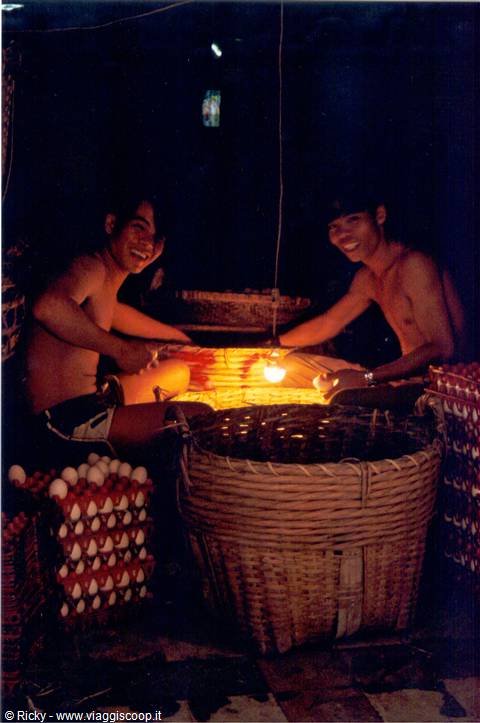
The two narrow walkways that advance are jammed with people bargaining, others walking, carts replenishing the stalls with goods and mopeds making their way through this crowd carrying three or four passengers. Like every self-respecting oriental market, this one too assaults the visitor with an almost solid wave of smells, noises and colours. You have the impression of being immersed in this sea of sensations. The typically Asian taste in arranging the merchandise makes every stall an Impressionist painting. In this whirl of colours exotic fruit plays the leading role. Here you can find every kind of foodstuff. Vegetables and fruits of every type, spices, white meats and red meats, very fresh fish often kept alive in tubs of water, hens', geese's, quails', pigeons' eggs and others from birds of breeds unknown to me.
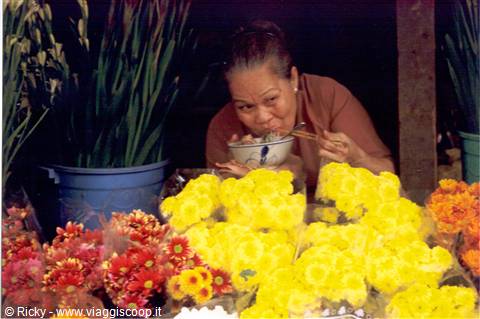
Further on, stalls offering bread in the typical baguette shape show that the French influence did not end with the loss of the colony. At the end of the market the flower stalls have found their place. An explosion of colours and shapes that leaves you dumbfounded. In the few spaces left free on the pavement, some women have lit fires between two bricks and there they cook the Pho for their customers. Continued in the next instalment....
The journey's photographs
8 photographs · click to open them full screen



0 reader comments