The story
Marco Polo in the Milione described those distant civilisations, discovering and revealing them, for the first time, to Europe. Until then the West had limited the history of the world, ignoring these cultures, different but no less civilised. The conviction thus vanished of those who thought they had written the history of their little world with the conviction of writing the history of the world. From the historical point of view the "Silk Road" was a route of cultural exchange even before commercial exchange. The term was coined at the end of the 19th century by the geographer F. von Richthofen, who, with the name "Silk Road", meant to identify the whole of the routes that connected China to the West. Silk because it was precisely the precious and costly fabric that allowed commercial, but above all cultural, medicinal and scientific exchanges to begin to flourish.
In the past the "Silk Road" was travelled, besides for commercial reasons, by adventurous explorers; today, instead, it is travelled only for tourist purposes: the commercial aspect no longer exists, it would be an absurdity, but there is no less desire for adventure than in the past, …indeed. The journey evolves, yes it evolves, because the unknown that still exists, and always will, unlike what happened in antiquity, constitutes less and less a threat and more and more an opportunity.
Our journey begins at the Shavat border, where Shuhrat, our Uzbek guide, is waiting for us. We get into the suitably rented vehicle, a Volkswagen Transporter, and after seventy kilometres we are in Khiva.
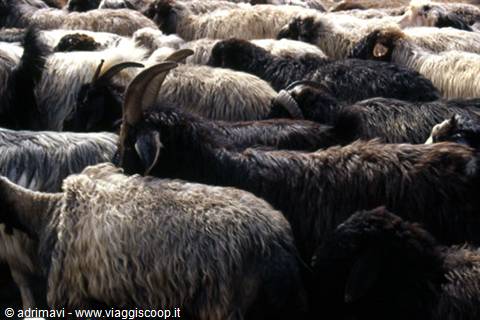
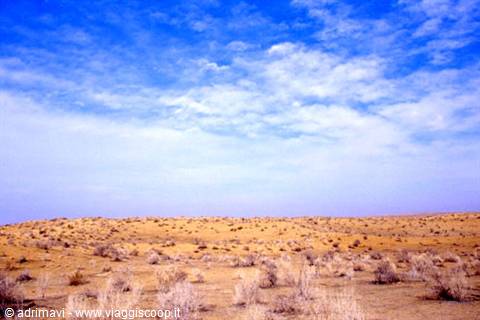
KIZIL-KUM DESERT The next day it is our turn for the "crossing" of the Kizil-Kum Desert. Once the term was more apt than ever. To cross it, the caravans took several days of travel, following the pole star at night, the sun by day and the compass in bad weather. Today, instead, thanks to the good condition of the A380 road, which links Khiva to Bukhara, it takes no more than seven hours to cross the almost 500 km of asphalt that cut straight through the desert. Along the way we stop three times. The first, just after Urgench, to have a fleeting lunch of grilled fish, caught in the waters of the Amu-Darya, the river that became famous for the Aral Sea disaster. A second time when we meet a herd of sheep grazing right in the middle of the roadway. The last at a police checkpoint.
Here we run into dishonest officials and thus get to experience the notorious corruption to which the Uzbek police are subject. To continue we are forced to leave a bribe of 200 sum. During the long journey Shuhrat tells us about his own wedding ceremony. As used to happen here, in Uzbekistan the families still decide the consorts of their children. The man's dowry consists of a camel, two sheep, a sack of potatoes, one of flour and one of sugar. We thus learn about the customs of Uzbek weddings, or rather of the Fergana Valley, where Shuhrat comes from, having been born in Margilan. Our curiosity drives us to take up more demanding topics such as the condition of women and the political situation. Women are forbidden from doing certain jobs, and in public matters their ideas are recognised only in part, and only within the family sphere.
It's easy to guess that the women of the Fergana Valley are socially backward! Shuhrat asserts almost with pride the complete submission of his wife. Adultery, for example, is still punished today, rightly, according to Shuhrat, by stoning. The Fergana, I think, fortunately, is an anachronistic reality compared with the rest of Uzbekistan. On the delicate political subject Shuhrat says he hates the Uzbek government that crushes the Fergana Valley. The government manages to guarantee control only by force. He speaks of human rights violations and the absence of democracy. He praises the Fergana Valley, the epicentre of Muslim fundamentalism, the one and only threat to President Karimov's power. Shuhrat's words fill me with unease and bring back to mind the Beslan school massacre, since the commando, made up of about thirty men, included Uzbeks as well as Chechens.
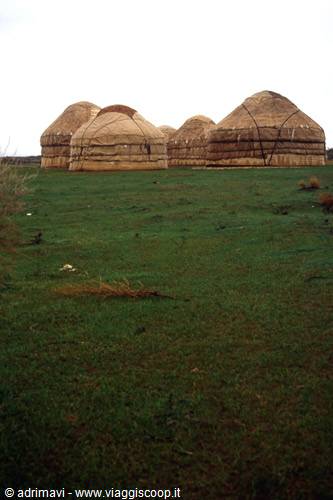
CAMP IN THE KIZIL-KUM DESERT We leave Bukhara, but instead of heading straight for Samarkand, at Nurata we go north towards Lake Aidarkul, near which they have set up the camp of yurts that will host us. In this place we will abandon civilisation for a day. Finding it was not easy. The yurts, circular tents made of a wooden frame and covered with felt, have always been the refuge of the nomads of the Kizil-Kum. Once they were so both in winter and in summer, today only in the warm season. Winter yurts are by now rare in the Kizil-Kum Desert. The first ones are usually put up at the beginning of spring. The place is surprisingly green; the rain, the little that falls precisely in this period of the year, has softened the landscape, covering the sandy ground with an unusual layer of grass.
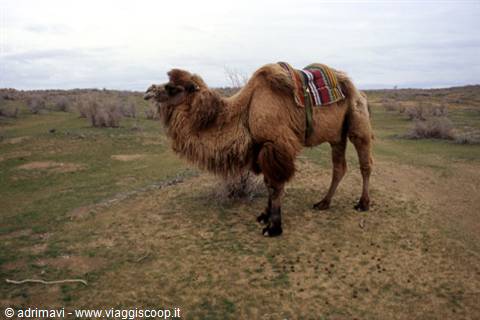
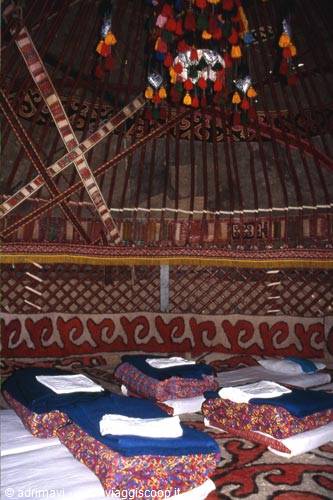
The phenomenon is visible only in March and April, because of the climate: harsh in winter and scorching in summer. Here life cannot be easy in any period of the year. The yurt is a unique environment, lit by an oil lamp, with the floor entirely covered with carpets, and that's all. We lay our sleeping bags on the mattresses placed on the ground, over at least three layers of blankets. Not far from the camp graze enormous hairy camels with big humps that seem about to burst. Camels are used not only for transport, but for obtaining milk, meat and hides. The camel is, as in every other desert, a real force. We go out for an excursion, not so much for the ride itself as to not disappoint the insistence of the nomad whose guests we are. The elderly man saddles two of the camels that seemed to be grazing in the wild, which evidently are not wild.
Having made them kneel so we can mount them, we get on the saddle, made of a carpet, from whose straps pom poms hang. Pulling the reins, through a wooden peg stuck in the nose, you transmit the commands you want to give the camel so as to control it. A cold wind blows over the desert. The path follows an always identical route that the rain of a few hours earlier has hardened. The camel moves slowly between the sandy track and the bushes. During the march it groans and grinds its teeth, letting out hoarse cries. We return to camp frozen. The nomads are proud to be free men, they have archaic values, but don't expect anything exotic… by now they dress like us. After eating dinner we chat and drink vodka, all together, in front of the fire. The dry branches of the aryk burn, raising enormous flames, while an imposing man plays with unexpected grace a dutar (two-stringed guitar).
Some accompany the music with strange, very expressive mimed movements. The moment is the right one to try "Noz", a finely chopped tobacco, sometimes mixed with spices and ash, but above all cut with opium. The green paste placed under the tongue dissolves, so the active ingredients pass into the circulatory system. Neither the vodka nor the noz distract me from the pleasure of the music and the splendid evening around the fire, dancing and talking, until a faint flame lights up the darkness of the desert. During the night a heavy rain wakes me and I hear, from inside the yurt, in the distance, the braying of the camels. A strange feeling comes over me, similar to that of being safe inside the house when a strong summer storm breaks out.
The journey's photographs
6 photographs · click to open them full screen

0 reader comments