The story
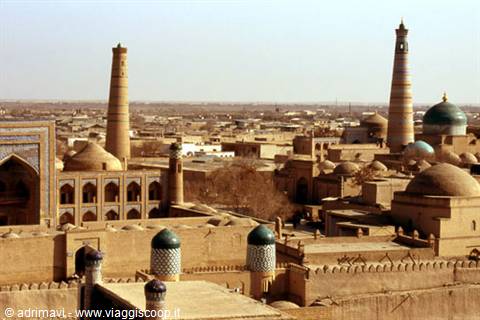
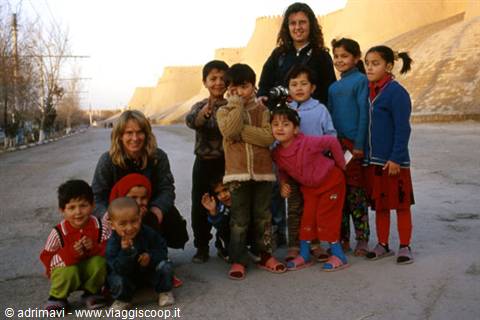
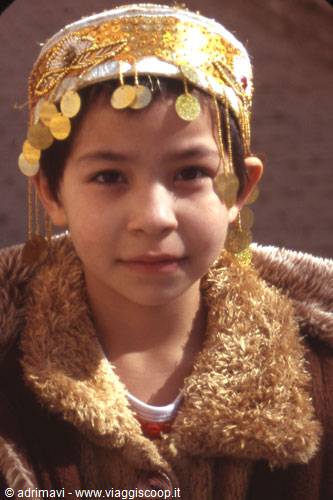
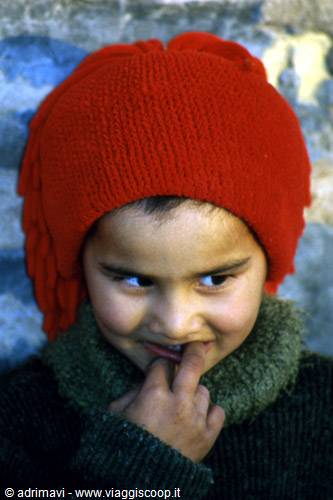
KHIVA We arrive, accompanied by a wonderful sunny day, on the eighth of March, the day of the women's festival which here in Uzbekistan is so important that it is a public holiday. - Women's emancipation has become established - and since that epochal turning point it is customary to burn piles of cador... certainly a very different reality from neighbouring Afghanistan. Wandering through the city we will meet many women, especially young ones, elegantly dressed and all eager to be photographed with us. Given the low season there are few tourists and consequently we are often stopped to oblige them. The little girls wear the tiubetejka, the typical headdress adorned with little coins. Our tour takes place exclusively inside the walls of the old city, that is, of the Ichon-Qala. The children who live there roam the streets unsupervised, with no control on the part of adults.
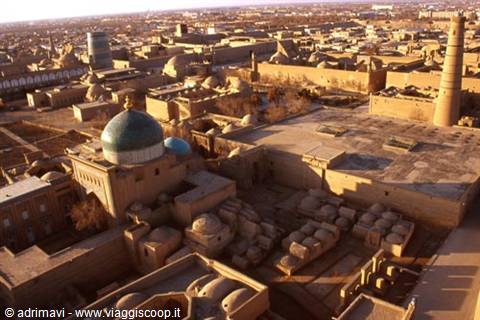
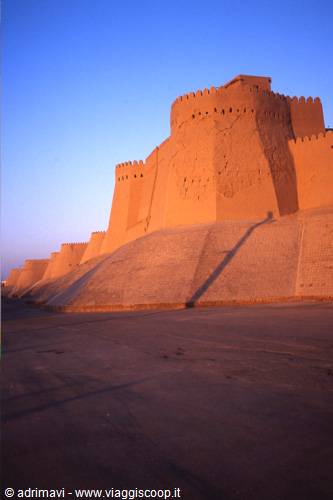
They amuse themselves in the most varied ways, but their favourite game seems to be sliding down the walls, as if these were a big slide. As soon as they see a tourist they run towards him: the older ones to sell something, the younger ones to ask for bon bons and pens! - Old Khiva is a city within a city - it's enough to think that the inhabitants can marry only among themselves. In fact, anyone who marries a person not resident inside the walls is forced to leave the city and go and live outside. The old city is an open-air museum! It has not been penetrated by the typical architecture of the Soviet regime, thus remaining an authentic Central Asian city.
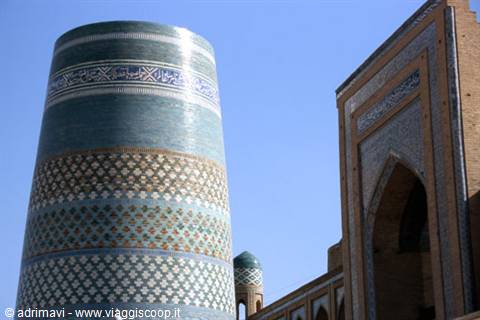
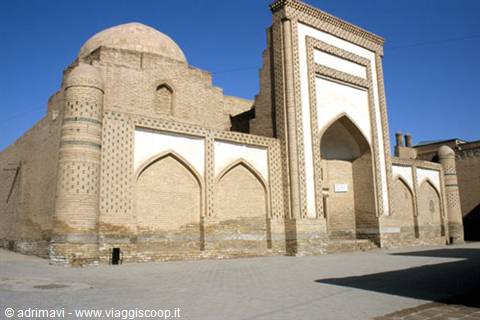
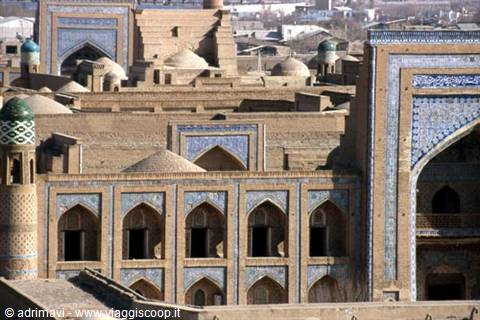
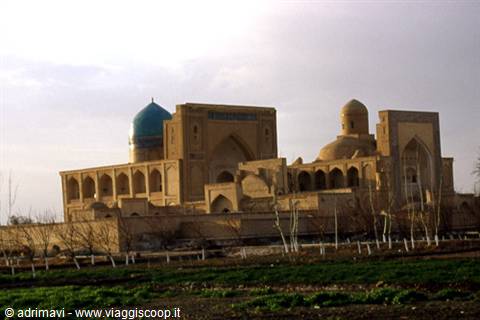
We therefore venture into the Ichon-Qala, walking its winding alleys all day, visiting minarets, madrasas, palaces and mosques until sunset, when from the top of the Islom-Huja minaret, from where you enjoy a superb view, Khiva, in the light of the sunset, really seems the most beautiful city in the world. BUKHARA Before entering the city we visit the Chor-Bakr complex, whose two imposing buildings, the Friday mosque and the khanaka, rise visible from afar. A sort of preview of what Bukhara will offer us. Here is what the Polo brothers wrote of the city. "[…] you arrive at a city called Bukhara, which is great and very noble. Here there is a market where all the costly goods of India and China converge, with many precious stones, with many coarse and good fabrics, and there are also abundant spices.
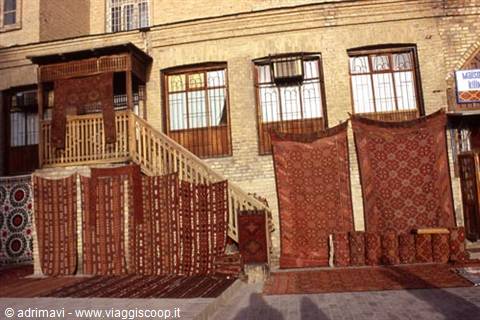
In short, in that place there is such a coming and going of goods that it is a marvellous thing to see. On every market day all the squares are overflowing with men. Everything is sold. The merchants are numerous and the goods abundant. […]" Bukhara has remained the same as in that time! Strolling through the old city you come across a veritable tangle of commercial alleys and mini-bazaars. In the characteristic covered markets (the Taqi) tiny shops open in cramped spaces where artisans work in the half-light. In the courtyards, of incomparable beauty, of the madrasas, besides the little shops, daily markets are held. In every corner pleasant Eastern melodies spread, from who knows where, and accompany our frantic purchases to buy one of the famous Bukhara carpets.
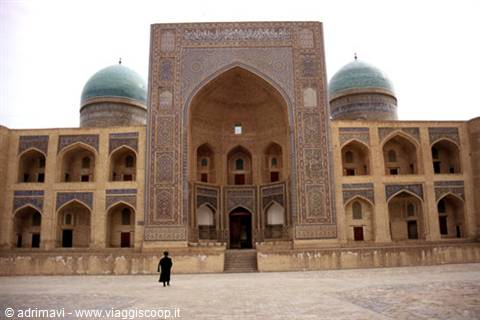
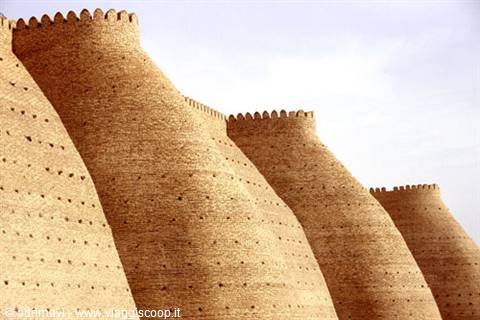
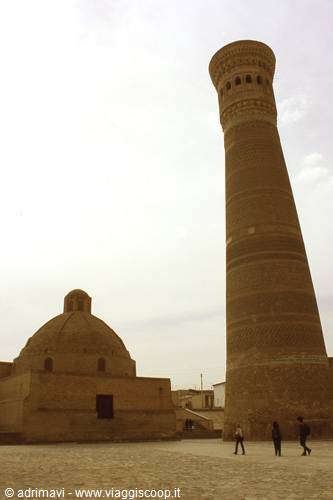
Wandering between a bazaar and a madrasa, between a square and a mosque, we are continually chased by children, urchins like the Paul Street Boys, thrown early into the whirlwind of life so that they may learn the trade. They run after us until they close some sale, foisting any trinket on us. From the architectural point of view the most beautiful area is that of the square where the Kalon minaret, the Kalon mosque and the Mir-i-Arab madrasa stand; the latter, still active today, is an important Quranic school. Continuing the visit we reach the fortress, which strikes you for its high walls but whose interior is now in ruins. Finally, at the prisons (Zindon), you cannot help but be indignant at the photos of the tortures suffered by the prisoners, and shudder at the sight of the horrendous well infested with cockroaches and bugs bred specially to torture prisoners.
In this well Stoddart and Conolly were locked up and languished. We return to Lyab-Hauz square, characteristic for the huge water tank there and for the three buildings that rise there: the Nadir Divanbegi madrasa, the khanaka and the Kukeldash madrasa. Near the statue of the wise fool, the elders play dominoes; the atmosphere is exactly like that of a gathering of our own elderly when they play bowls. We have been here barely a day and two people stop us in the street asking about Cris. All of Bukhara, given the absence of tourists, knows of our presence in the city. Especially after having toured all the shops in the centre in search of the food and the right ingredients to let them taste, as far as possible, a real Italian dinner. Pasta and sauce are indispensable, but we brought those directly from home.
The Amelia hotel, where we are guests, becomes, at least for one evening, the best Italian restaurant, if not the only one, in all of Bukhara. Shuhrat, his friend Mansour and Back, the hotel owner, keep us company. Bach is not his real name, but that's what we nicknamed him because of his unpronounceable Uzbek name. He knows some Italian, at least what he learned watching Rai sat. SAMARKAND Its mythical resonance, made immortal by poets, writers and travellers, is perhaps unique in the world. Samarkand calls to mind the "Silk Road" like no other Asian city and, more than any other city in the world, calls to mind travel. The fame of the city is linked to that of Timur the lame, that is Tamerlane, who was born in Kech, a few kilometres from Samarkand, in April 1336. Tamerlane then, in 1369, chose it as the capital of his kingdom.
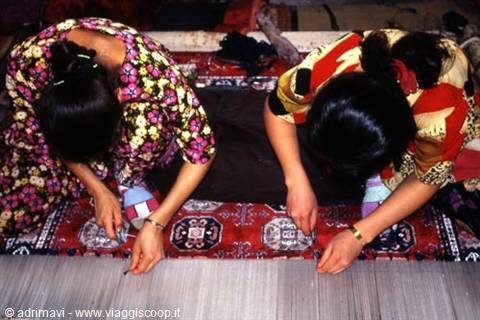
When we arrive a strange feeling comes over us, that of visiting a legendary city, but known only for the magic of its name and in reality completely unknown. From the first impression you immediately sense, however, that Samarkand is no longer the mythical one of former times. It's pouring with rain so we decide to postpone the visit to the city to tomorrow, hoping for better weather. Shuhrat takes us to visit a carpet factory. The workers there are very young, with their hair tied up, and some with a scarf on their heads. They move among invisible threads with impressive speed and, while weaving, they kneel in front of the looms, chatting and joking, so much so that it seems they are here for pleasure and not out of duty. The following day, the gloomy weather doesn't dim the "Registan" at all.
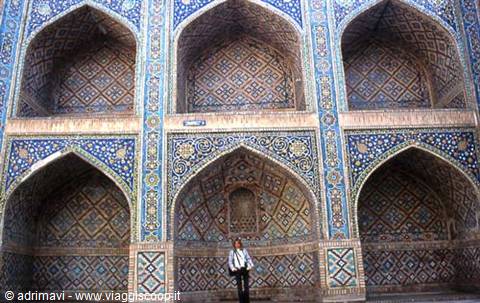
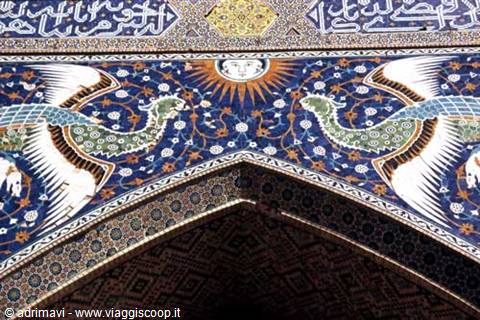
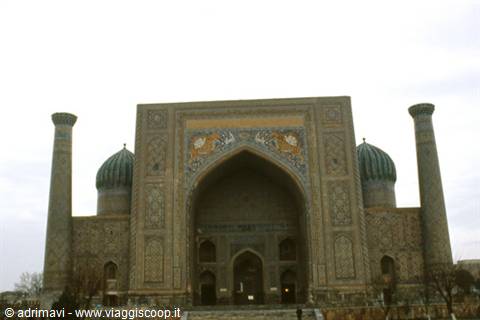
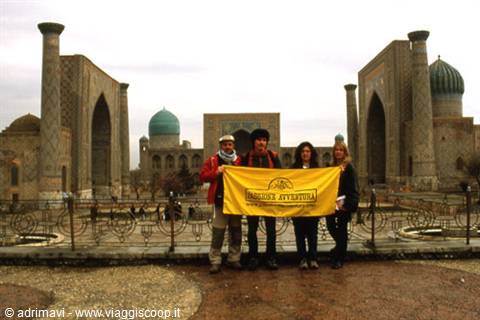
Registan Square is superb, with three of its four sides occupied by the Ulug-Beg, Shir Dar and Tilla-Kari madrasas. The symmetry of the façades and the elegance of the proportions, together with the green and blue glazed tiles, create an apotheosis of colours. The geometric motifs are only partially interrupted by the mosaics on the façade of the Shir Dar madrasa, on which an animal, a sort of lion, is depicted. Everywhere, then, decorative motifs reproduce phrases in Arabic script, refined mosaics and arabesques. Samarkand is the Registan and the Registan is Samarkand; the clamour of the legendary city is all contained here. Retracing the "Silk Road" at the beginning of the third millennium means returning in memory to the teeming cities of Khiva, Bukhara, Samarkand, to the customs and habits of different peoples, but above all savouring again the culture of Tamerlane's kingdom.
The journey's photographs
26 photographs · click to open them full screen






0 reader comments