The story
Sunday 5 March, at three in the morning, we arrive in Ashgabat, not like the ancient travellers after months of indescribable journeys because of the dangers escaped and the thousand hardships overcome, but on a comfortable flight that left Milan seven hours earlier. Nevertheless we feel a certain unease when we carry out the customs procedures. Obtaining an entry visa from Italy is impossible given the lack of Turkmen diplomatic representations in our country. So we present ourselves armed only with a special invitation letter that is completely incomprehensible because it is written in Cyrillic. A customs official asks us for our passports and the invitation. We watch our documents pass from hand to hand and from one office to another, hoping for more than an hour that everything is in order. Luckily it is: we enter Turkmenistan! The nocturnal impact with Ashgabat is astonishing.
On leaving the airport the night envelops us, the sky is pitch black, but it becomes streaked with white after a few kilometres, as the city comes into view, a galaxy of lights when we are in the centre. These are not stars, but powerful floodlights that light up pharaonic buildings and fanciful monuments as bright as day. The unexpected spectacle fascinates and disenchants us, hard to understand,...maybe tomorrow in daylight. We go to sleep and, with the drone of the plane engines still in our ears, we ask ourselves: what can one expect from the capital of this forgotten Central Asian republic, located in the middle of the desert? Nothing, would be the obvious answer, were it not for the personality of its first citizen, as we will discover the following day.
Ashgabat reflects the eccentric temperament of President Niyazov, father and master of the nation, named hero of the Turkmen people by Parliament. Next to the sumptuous, and useless, buildings and monuments scattered throughout the city, one can read in huge letters the sinister inscription, with Hitlerian echoes, “Halk, Watan, Turkemenbashi”, that is “People, Nation and I”. Portraits of Niyazov dominate everywhere, as does the propaganda advertising of the Ruhnama, “the book of the spirit” written by Niyazov himself, whose introduction is more than enough to sum up the man. «My dear Turkmen Nation! You are the meaning of my life and the source of my endurance. I wish you a healthy and strong life.
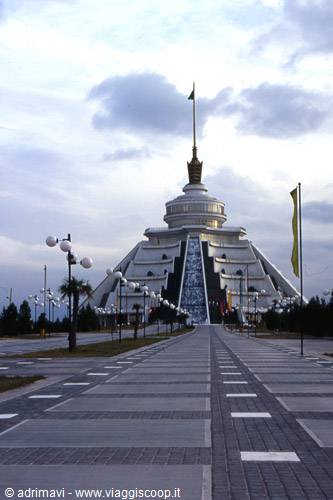
This book, “Ruhnama”, written with the help of the inspiration transmitted to my heart by the God who generated this wonderful universe, I write.» After the terrifying earthquake of 6 October 1948 that caused the death of 110,000 people and the dark years of the Soviet regime, today Ashgabat lives again and day after day seeks a new identity, at least in the eyes of the foreigner, though at the expense of the population. The city's face changes continually because of the many works commissioned. The areas demolished to make room for these grand projects cost the destruction of hundreds of houses and the consequent eviction of thousands of people. Today, almost ruined dwellings alternate with new or under-construction buildings, some of which even have a certain architectural charm, such as the “Arch of Neutrality”.
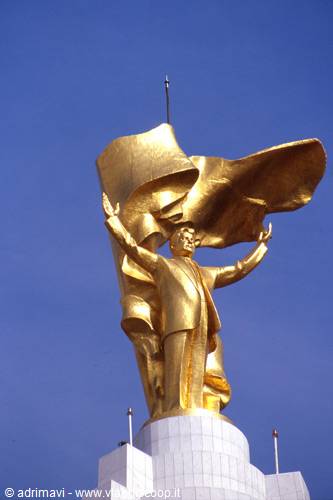
On the summit stands a gold-covered statue of Niyazov, 12 metres tall with arms outstretched towards the sun, which rotates according to the path of the star. What then to say of the buildings of Independence Square, among which the “Turkmenbashi” one with its golden dome stands out, and of the “Azadi mosque” imitating the Blue Mosque of Istanbul? The overall result is something anachronistic. The cliché of a city in the middle of the desert persists despite the endless fountains commissioned and the many lush green gardens, today an indelible sign within the cityscape. In Ashgabat is the largest fountain in the world, a veritable 70-metre-high pyramid down whose flanks thunderous waterfalls plunge. Anyone coming to Ashgabat for the first time will therefore be forced to change their mind, since they will not find a city in the middle of the desert.
At certain times of year one can even admire the snow-capped peaks of the Kopet Dag on the border with Iran. A gem, right behind the new National Theatre, on a typically Central Asian plinth, still sits in the middle of the square one of the last statues of Lenin left standing after the break-up of the Soviet Union....until when? Who knows? Before leaving Ashgabat we try in vain to change money, but the closed banks force us to use the black market. We find, in a young man with a sly, cocky look, the man for us. He enters the courtyard of a building and at a simple whistle of his we see a bag stuffed full of bundles of manat fly from a balcony. In the outskirts, finally, the buildings are all the same and resemble so many beehives, because of the multitude of satellite dishes mounted on the balconies or windows.
The reason is simple: in Ashgabat there are no cinemas, since Niyazov declared films not part of Turkmen art. Nightlife is almost non-existent. The trendy pubs can be counted on the fingers of one hand and come alive only on rare occasions, when some local band plays, but at eleven everything ends. The venues close. For those who want to continue the evening, there is nothing left but to slip into one of the city's three nightclubs, which have special licences to carry on until dawn. Such, in our opinion, is the shell of this megalomaniac capital, which we could emphatically call a fault in modernity and which in some ways preserves many aspects of its Soviet past. On the northern outskirts of the capital, after just a few kilometres, one is already in the middle of the desert.
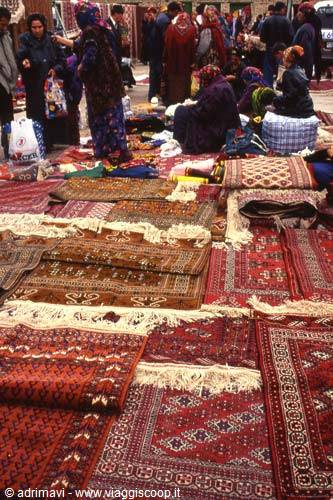
On an open lot, recognisable by the hundreds of parked cars, vans and buses, the Tolkuchka market is held every Sunday morning, described as “the last corner of a teeming Asian world that was”. Thousands of faces cross it, endless merchandise enlivens it and a multitude of hues colour it. We reach it around nine o'clock, when the intense commercial activity is at the height of its fervour. The abundance of products means the market is a very lively meeting point. We park our Nissan Terrano, a real jewel, among the old Lada 2107s, then walk up the road leading towards the arch of the entrance gate. And if here the crush is such as to prevent walking, past the entrance it is even worse. Outside the immense fenced area of the bazaar we meet crouching women selling their wares by resting them on the ground, on sheets of newspaper.
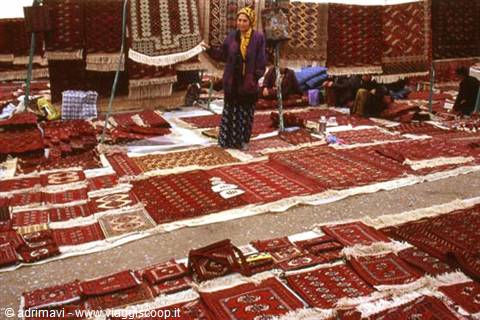
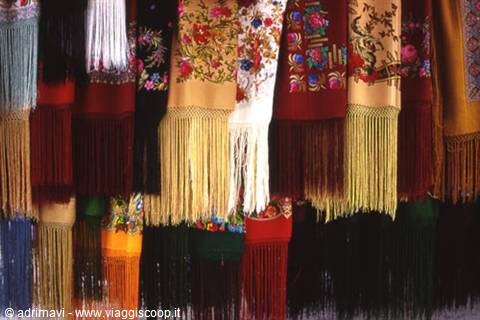
Improvised stalls follow one another, most of them consisting of great piles of onions, which in Turkmenistan come in every colour - white, green, red - then, as far as the eye can see, sellers of carrots, tomatoes, vegetables, spices and veritable expanses of car parts. Beyond the gate, on the left, is the area reserved for carpets, where a colourful crowd moves about and, together with the predominant red of the carpets, creates all around a harmony of colours that is enchanting. There are thousands of carpets: large and small, on the ground or hung on special racks, rolled up and unrolled. The same harmony of colours is found in the silk area: threads, shawls, clothes. Walking through the market, the men are recognisable by the hats they wear: the colbacks.
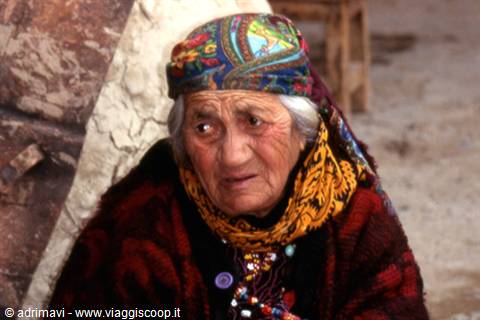
The elderly, especially, still wear the telpek, a large black sheepskin headdress, together with the khalat, a dark-coloured tunic. The women wear brightly coloured shawls and long jumpers.
The journey's photographs
9 photographs · click to open them full screen



0 reader comments