A fascinating tour, leading to the discovery of ancient Siam and the beauties of its capital Bangkok, chaotic but fascinating, disorderly yet with breathtaking monuments, noisy but at the same time silent in its temples. The City of Angels, as it is called, is full of contrasts, made of shacks next to enormous shopping centres, and where life still flows slowly on the Chao Praya, the river that crosses it. Also worth visiting is the archaeological part of the ancient capital Ayutthaya, where majestic temples once stood. Don't miss the floating market, unique of its kind. Northern Thailand, on the other hand, strikes you with its lush vegetation and the way of life of the tribes in its villages, a lifestyle that takes you back a few centuries. Peoples bound to ancient traditions and religions, heedless of the technological development that surrounds them.
The sea in Thailand is exceptional, from my point of view decidedly better than the Caribbean, both in its colours and for the wild environment that surrounds it, a feature that stands out especially in the area around Phi Phi Island, where forest-covered mountains plunge into the waters of the Andaman Sea, forming intact and fascinating bays.
Day 116 Jan 2003
Bangkok - Day 1
A fascinating tour that leads to the discovery of ancient Siam and the beauties of its capital Bangkok, chaotic but fascinating, disorganized but with monuments that leave you breathless, noisy but at the same time silent in its temples. The City of Angels, as it is called, is rich in contrasts, made of shacks next to enormous shopping centers, and where life still flows slowly on the Chao Praya, the river that crosses it. Also worth visiting is the archaeological area of the ancient capital Ayutthaya, where majestic temples once stood. Don't miss the floating market, unique of its kind. Northern Thailand, on the other hand, strikes you with its lush vegetation and the way of life of the tribes in its villages, a lifestyle that takes you back a few centuries. Peoples bound to ancient traditions and religions, unconcerned with the technological development that surrounds them.
The sea in Thailand is exceptional, from my point of view definitely superior to the Caribbean, both in terms of colors and the wild environment that surrounds it, a detail that stands out especially in the area around Phi Phi Island, where forest-covered mountains plunge into the waters of the Andaman Sea, forming pristine and fascinating bays. Ventaglio has chosen a private island an hour's boat ride from Phuket for its Ventaclub: an exclusive island, with an exceptional sea and first-rate services, far from the glitz and confusion of Phuket.
Thailand is a country that lends itself very well to do-it-yourself tourism too: we opted for an organized tour because, having only two weeks available, we wanted services already booked so as not to waste too much time; moreover, since we intended to spend the beach stay at Maiton, the most convenient solution was to book all the services with Ventaglio. The tour was well organized and, apart from the visit to the floating market, by coach with quite a few people, for the rest we visited Bangkok in a minibus with another 10 people, Ayutthaya in 4, while we were only two in the north.
Bangkok - Day 1
After a long flight via Frankfurt, we finally arrive in Bangkok around 1:00 pm. Waiting for us is a car just for us, included in the tour, which takes us directly to our hotel, the Novotel in the middle of Siam Square. The traffic is heavy but not as chaotic as I would have imagined; only in the last stretch do we slow down a bit. The impact is immediately that of a very modern city; near our hotel there's a coming and going of people strolling around, shopping centers, music videos on huge screens at full volume. Enormous concrete elevated roads built with little attention to environmental impact, very wide streets, modern cars, carts and the typical "tuk tuks". Given the time, we immediately take the opportunity to nose around the surroundings, and with a 20-minute walk, we pass the Siam Center, an enormous shopping mall, to reach the typical Pratunam market.
Along the way we observe the numerous restaurants, which have their tables on the sidewalks and cook meat and fish outdoors practically a meter away from the cars stopped in traffic. The air is unbreathable, and soon it even burns your throat. We decide to go to dinner at the buffet of the Baiyoke Sky hotel, a very tall skyscraper with a restaurant on the 80th floor from which you can see the whole city. Here we dine for about 10 euros, a well-organized buffet ranging from Italian cuisine to Japanese, Thai and international. Not bad for a first day!!!
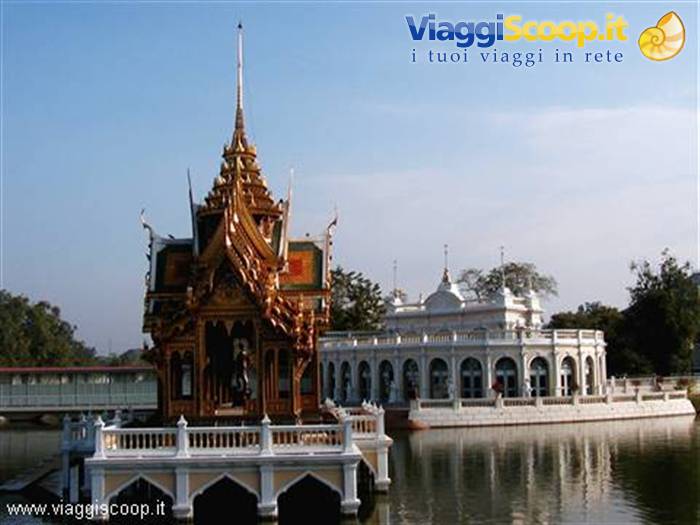
Bangkok, Summer Residence
Day 217 Jan 2003
Bangkok - Day 2
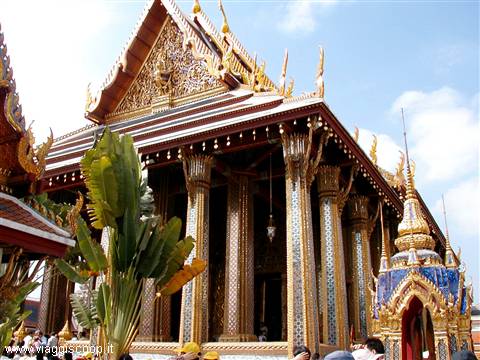
Today we have the guided tour of the city, with the main monuments. A minibus picks us up with another 10 Italians, who will do a tour entirely by coach up to the north. In fact, we'll meet them again later. To visit the city's temples it is necessary to wear long trousers and a half-sleeved shirt that isn't low-cut. As a first stop we stop at Wat Traimit, a temple that houses a statue of the solid gold Buddha, 3 meters tall and weighing 5 tons. Then we head to the Royal Palace, the most important destination in the city, where inside is the Wat Phra Kaew, the royal chapel. The Royal Palace represents a city within a city; the confusion and pollution remain outside it. It feels like entering an enchanted city, made of golden pagodas, orange roofs, courtyards, porticoes and temples decorated with beautiful golden stuccoes and fascinating multicolored glass.
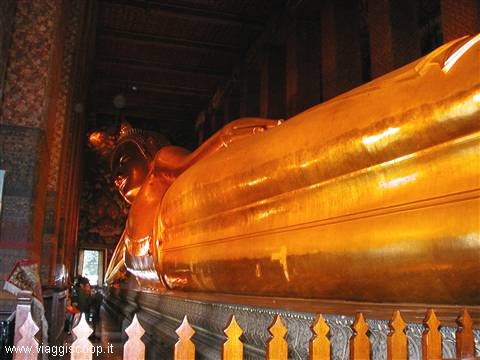
Guarding the temples are enormous and impressive statues. It really is a unique marvel in the world. We enter barefoot to visit the Wat Phra Kaew, where inside is kept the statue of the Emerald Buddha, the most revered in Thailand. The king himself, at the changing of the seasons, changes the statue's robes. We continue to Wat Po, a temple that houses an enormous statue of the reclining Buddha, 45 meters long, where at his feet the cycle of life according to Buddhism is represented, with mother-of-pearl inlays. This temple is the school par excellence of the famous Thai massages
On leaving the temple we leave the group, which would have returned to the hotel, to wander around a bit on our own; near Wat Po we cross the flower market; from here you can see in the distance, beyond the river, the Wat Arun, the temple of dawn. At this point we stop a taxi to reach China Town, but after a quarter of an hour we've only moved about a hundred meters, so we pay and continue on foot. China Town is the area least frequented by tourists; no tour brings people here, so there's the chance to visit a truly authentic part of the city. The whole area hosts a permanent market, but the streets are so narrow that we are almost carried along automatically by the crowd. The air is filled with the scent of incense alternating with that of their food cooked on the street.
The two of us eat for 1 euro, some super-sweet mini bananas and a couple of meat skewers that came from who knows where. The prices in the market are also very low, and although the guides said there wasn't much to buy, we found quite a few nice things, clothes, leather crafts but above all silk at a great price. So we head back by taxi, and this time it goes better because the traffic is smoother. Taxis are really cheap; half an hour costs around 3/4 euros. After a refreshing dip in the pool, we take the Sky Train to reach the best-known area of Bangkok: Patpong. Many describe it as a hell, between fakes and prostitution, but I found it quite characterful, even though what is said about prostitution is true. Here you can truly find anything, naturally fake: watches, belts, t-shirts, shoes, etc. and haggling is a must.
Ayuttaya
Day 318 Jan 2003
Bangkok, trip to Ayutthaya - 3rd day
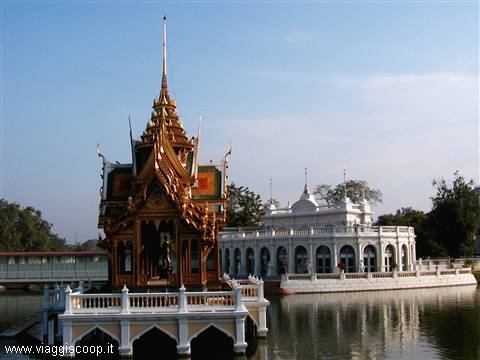
We leave early in the morning by minibus for the ancient capital of Siam: Ayutthaya Along the way we stop at the king's summer residence, Pang Pa, a quiet spot only about thirty minutes by car from Bangkok, but light years away from the noise of the capital; in fact it's a pleasure to stroll through the wonderful, beautifully kept gardens, and in the various small lakes there are various little temples, one in particular is very characteristic and is the most photographed in Thailand. There are also various pagodas, including one in perfect Japanese style. And so we arrive at the ancient capital of Siam, from 1300 to 1700: at that time it was a prosperous city, rich in temples built by the various sovereigns who succeeded one another, until it became one of the most beautiful cities in Southeast Asia and one of the most populous with about a million inhabitants.
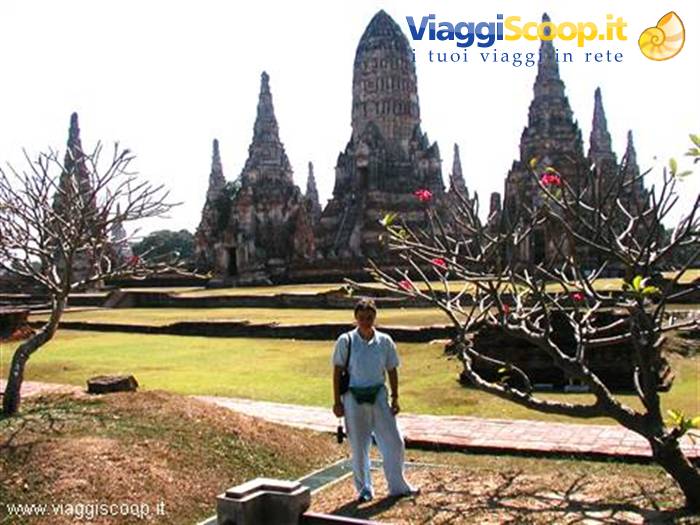
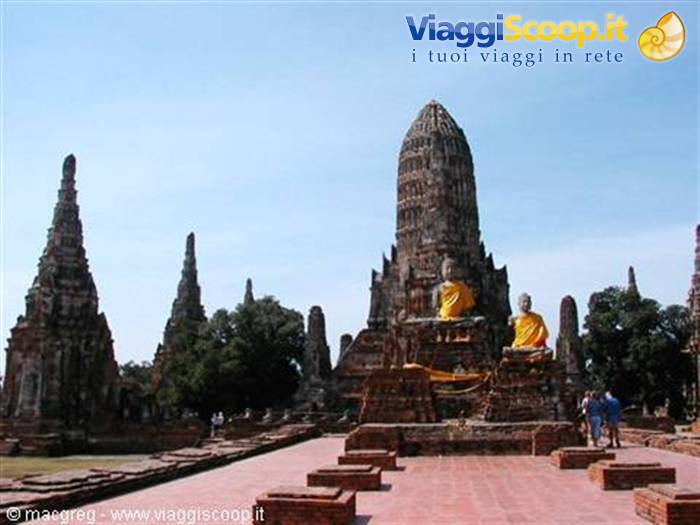
Indeed the city must have been enormous, because we move from one place to another by car. The ruins are imposing and of great historical interest and give a glimpse of what must have been a unique spectacle in those centuries: everywhere rise towers in the Khmer style; the last temple visited is the most spectacular, and by climbing the steep staircase you can reach the top of the building, with a great overview of the entire archaeological site. Among the remains there is also a reclining Buddha even larger than the one in Bangkok at Wat Pho. It is said that during the city's period of greatest splendor, London, by comparison, was nothing but a small village.
The excursion, perhaps the most beautiful you can do from Bangkok, ends with a cruise along the Chao Praya to Bangkok, and allows you to see how life unfolds along the river, as well as giving a beautiful overview of the whole city.
Floating market
Day 419 Jan 2003
Bangkok, trip to Damnernsaduak floating market - 4th day
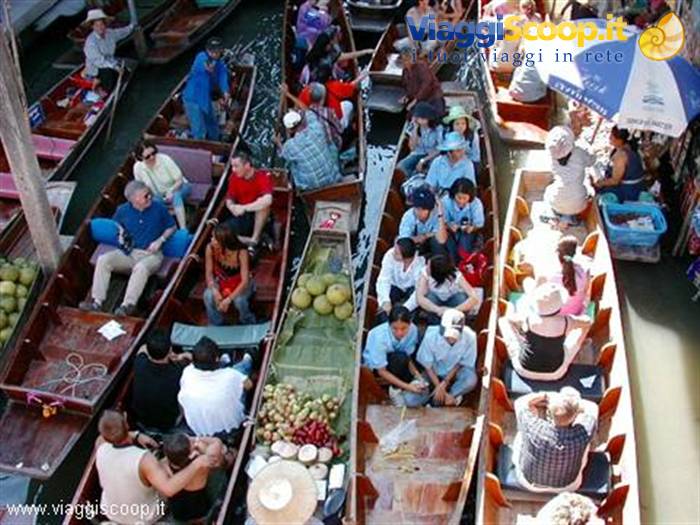
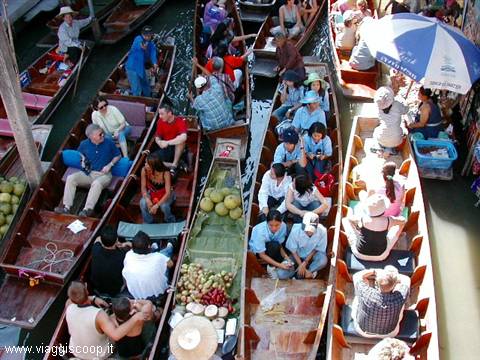
For the only time on this tour we leave by a large coach, but on the other hand this is the most requested excursion from Bangkok. First stop a coconut processing center, reasonably interesting, then a visit to an orchid plantation and finally a teak processing center, where some artists create true works of art. Once at our destination, we board very fast motorboats along canals immersed in vegetation, and after passing a couple of villages with dwellings right up against the dirty canals, we reach the market. The market, unlike what I expected, is not visited on boats but on foot; then, if you want, you can rent a local boat but it's not worth it because there are so many of them that they barely move. Moreover, the best view is from the top of the embankment and from the little bridges that cross the canal.
The first part of the market is very touristy, and is divided between a covered part and a part on the river. Continuing, however, you reach a less touristy area, where real bargaining still takes place, where locals buy food cooked directly on the boats, fruit and other everyday things. The whole thing is very impressive. The excursion continues with a stop at the largest pagoda in the country, Nakkhon Pathom, and ends with lunch and a visit to the Rose Garden, an estate set in a very pleasant context, with well-kept gardens and small lakes, and where a performance of classical Thai arts takes place, including various dances, boxing and the wedding. However, the whole thing is staged for tourists, and if this stop hadn't been included we wouldn't have missed much.





0 reader comments