The story
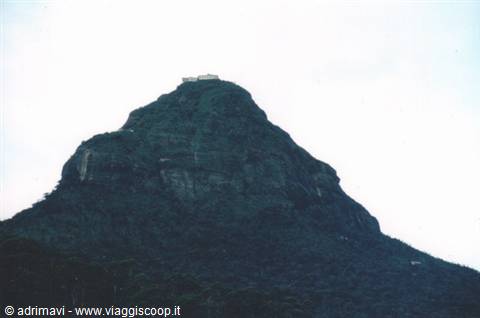
"…you should know how […] on the island of Seilla there is a great mountain, with the monument of Adam our father. Who, having settled to live up there, then left his own remains, so much so that his teeth were found there, and the bowl from which he ate…" - With these words Marco Polo described Adam's Peak. The English writer Stills even called the summit: « the vastest and most venerated cathedral of the human race ». I had personally read books describing how pilgrims risked death just to reach the summit and secure the benefit of their vow, and how many were found along the way from exhaustion or cold. Thus was born in me the desire to manage to climb, one day, this singular peak and live the atmosphere of its mystic pilgrimage. The moment I set foot on the island, like an illustrious predecessor of mine, the famous traveller Ibn Battuta, my only wish was to climb it.
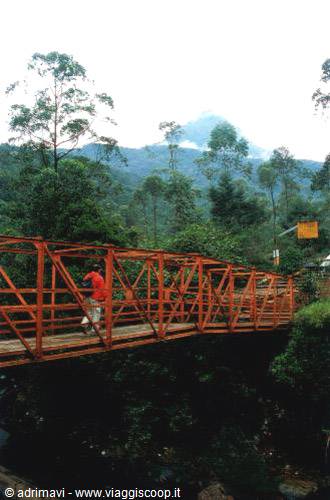
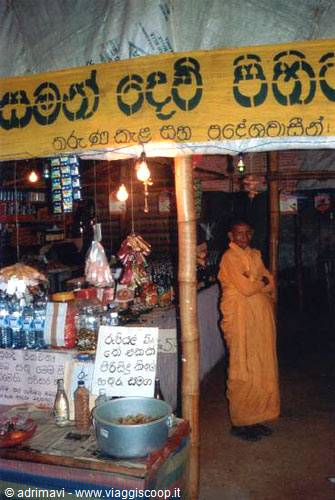
So it hardly seems true that I'm right at its foot. I gaze enchanted at the summit, I examine it and scrutinise it, from about 1,000 metres below, comfortably seated under the awning of a decrepit bar that looks out onto the only road crossing the small village. Together with my travel companions, I'm waiting anxiously for it to stop pouring! I'm worried because the ascent is at risk. As usual, I have the spirit of the traveller but not the time, and tomorrow we must set off again according to the rigid travel programme. After about two hours the rain is still falling. There's no more time: either we leave now or we give up the climb. We leave! In uncomfortable company with the rain, the excursion begins along a cart track occupied, on both sides for about a kilometre, by shops selling mostly creature comforts for pilgrims: from blankets to raincoats, from torches to votive objects.
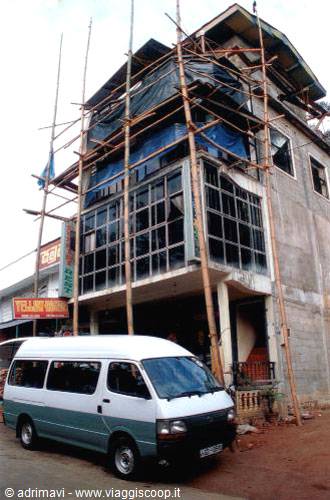
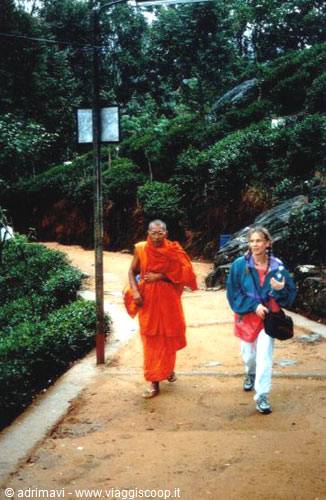
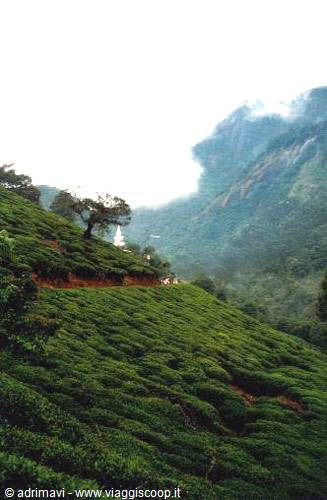
At first nothing hints at anything exotic, and yet there are rows and rows of buses and minibuses parked in the square, which I'd noticed because of strange bundles of grass placed on their windscreens. According to a local superstition, doing this makes your vehicle immune to accidents. Curiosities aside, where has everyone gone? After about fifteen minutes we meet a Buddhist monk, with whom we'll walk for a good half hour. He says he's surprised to see two Westerners venturing out in the rain. On this stretch the path, in excellent condition, rises almost imperceptibly and now and then dips literally into the tea fields. From here on we'll meet, as we get closer to the summit, an ever greater number of people. That explains my earlier question. The route is so long that pilgrims distribute themselves evenly along the whole way.
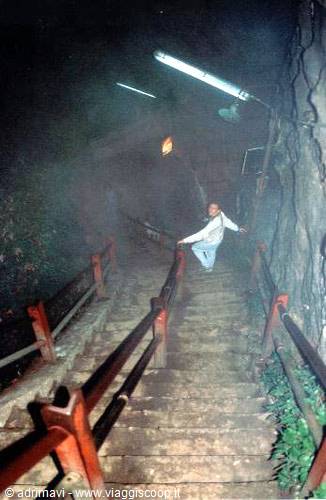
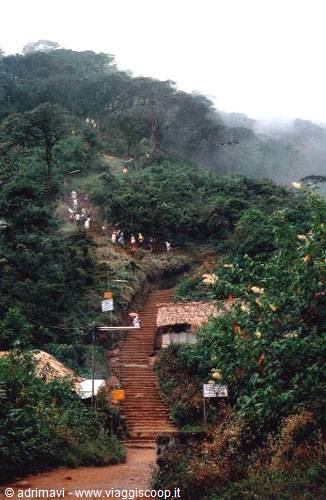
Crowded, instead, are the ambalama, the resting places built along the route to give shelter to pilgrims. We find the first one near the Japan-Sri Lanka Friendship dagoba. These staging posts resemble small villages where, besides the dormitories, there are little shops, always open, selling everything, and small kiosks where you can refresh yourself. About halfway the route becomes more demanding and tiring because it turns into a continuous, steep flight of steps. Moreover, the steps are irregular in height and width, which breaks your pace even further. If we add that they're worn by the passage of millions of people and made slippery by the rain, it's inevitable that you reach the summit, if not exhausted, at least tired. The most impervious stretch comes when the stairway (about 3,500 steps) climbs up through the forest.
The humidity becomes unbearable! It's pointless to look for support in the signboards that, throughout the climb, mark your progress, counting down to number zero, because when you reach the last one you haven't arrived at all, and you keep climbing. The arrival is signalled by the end of the steps, when you find yourself at the summit, on the small plateau that hosts the sacred temple. At the top it's cold, though in the meantime the rain has stopped. A thick fog and the darkness of the night wrap us in a sort of Dantean circle. We pay homage to the sacred footprint — whether it belongs to Adam, the Buddha, Saint Thomas or Shiva doesn't matter — we're wrapped in an almost palpable mysticism. Unfortunately, because of the weather, we won't be able to appreciate the extraordinary panorama that could otherwise be enjoyed from the summit. We watch some pilgrims touch a bell.
We try to do the same, thinking of it as a sign of reverence, but the temple guardian stops us, explaining that only those who have already been to the summit have the right to ring it. On the way back, at several points, we're forced to use the torches we brought from home. The lamp posts along the route are sometimes so far apart that without batteries you'd literally be walking in the dark. Striking, despite the hour and the bad weather, is the unstoppable flow of people, young and old, continuing undaunted to climb up from the valley floor. We meet three elderly women we had overtaken on the way up who, recognising us, ask us how much further to the summit. Almost everyone climbs carrying heavy blankets to protect themselves from the cold, so much so that it looks like a procession of fairy-tale figures.
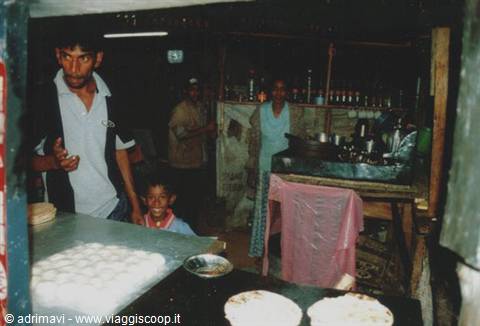
Having finished the roughest stretch, that is, the one with the steps, we stop to rest and eat something in a little restaurant. We sit next to three Buddhist nuns and order a sort of Bolognese flatbread, very good, and a Coca-Cola. I jump with surprise on hearing on the shopkeeper's radio a song by Gautam Gupia, whose cassette I had bought four years earlier in India. We set off again for Dalhousie, where Cece and Ila are waiting for us at the Yellow House. The path is now well lit. The darkness of the night together with the tedious religious drone coming from the loudspeakers placed along the route make the end of the pilgrimage more moving than ever. Turning round and looking towards the summit, the path looks like the lava flow of an erupting volcano. By the time we've arrived we meet several young people climbing, all together.
They look like groups on a parish outing and, amazed to see two Westerners coming down from Adam's Peak, they give free rein to their curiosity, showering us with questions. The pilgrims are the most extraordinary aspect of the climb to Adam's Peak. The encounters made during the ascent are numerous and astonishing. You walk side by side with the pilgrims, and sharing the effort creates a sincere solidarity, regardless of race or creed. We met strapping youths, panting old folk, people climbing while singing, others while praying. Many were barefoot; some were ill or even dying, carried on shoulders, stretched out on a litter, by rope-teams of young people. Here and there, clusters of pilgrims sat resting, many sleeping on the benches of the dormitories. Throughout the climb the feeling of going to visit something sacred, of living something ascetic, was tangible.
Everyone greeted us, even just with a nod, a bit like back home in the mountains when you meet people on the trails. The climb up Adam's Peak, which for Sri Lanka reaches the remarkable height of 2,243 metres, makes for a strange mountaineering undertaking. The experience lived is a journey within a journey. Adam's Peak is an unusual destination, in a Sri Lanka different from that of the plains of the historical-cultural triangle, of the hill country of tea plantations and of the tropical sea coasts — a true "world apart."
The journey's photographs
10 photographs · click to open them full screen

0 reader comments