I arrived at Kathmandu airport on an Air India flight from Varanasi. I was with a friend and we got here after visiting part of northern India (Rajasthan, Agra, Fatehpur Sikri, Sarnath and Varanasi). We organised the tour of the Kathmandu Valley through the Nepalese correspondent of an Indian agency in Jaipur.
Day 13 Mar 1992
Kathmandu
Having landed in the early afternoon at Kathmandu Airport, dealt with the visa formalities (cost 21 Euros) and collected the suitcases, a young man with a sign indicating my name is waiting for us at the Terminal exit. We reach the vehicle placed at our disposal by Four Season, a modern and elegant minibus with its own driver. Compared with the vehicles used in India, this one is functional and clean; we also have bottles of water available. The guide outlines the programme to us, but it does not match the one agreed with the Indian agent, which I show him. The guide clarifies that he will stick to my programme, and indeed that is how it will be, though with chronological variations. For example, today rest at the hotel would be scheduled, and instead we find ourselves straight away in Durbar Square to see the numerous temples around the old Royal Palace.
The buildings are almost all pagoda-style, sometimes preceded by large bells. Our attention is drawn to the terrifying version of Shiva, where the faithful smear on a reddish buttery substance and light candles. We are also drawn to the house of the Kumari, the little living goddess, secluded from the age of 4 until she reaches menstruation in this dwelling. The child occasionally appears for a few seconds at the window overlooking the courtyard, but photographing her is absolutely forbidden. We then climb the monumental staircase of a temple to briefly watch a musical performance that clashes a little with the surrounding architecture. But today the Nepalese are enjoying themselves because it is Saturday, the day of celebration (like Sunday for us), and the parks are full of families, the Ferris wheel turns, the traffic is limited. A real tonic after about ten days of chaos in India.
It feels as if you are not in the most polluted city with under a million inhabitants in the world, pollution also favoured by Kathmandu's altitude of almost 1,500 metres. Coming from that unmentionable filth that is Varanasi, Nepal appears to us almost clean, certainly tidier, with acceptable traffic. We go to the hotel, the Yak and Yeti, probably the most beautiful in the city, a 5-star a stone's throw from the new Royal Palace, which in reality is no longer royal because the King, though keeping his priceless possessions, was dethroned a few years ago. The hotel room, although smaller than those used in India, is nice and functional. We rest a little; this morning we woke up at 5, then we go to a nearby little restaurant to have dinner with a kind of pizza, basically undercooked pasta dressed with cheese and ketchup. We return to the hotel for the night.
Bodhnat
Day 24 Mar 1992
Bodnath, Pasupatinath and Bahtapur
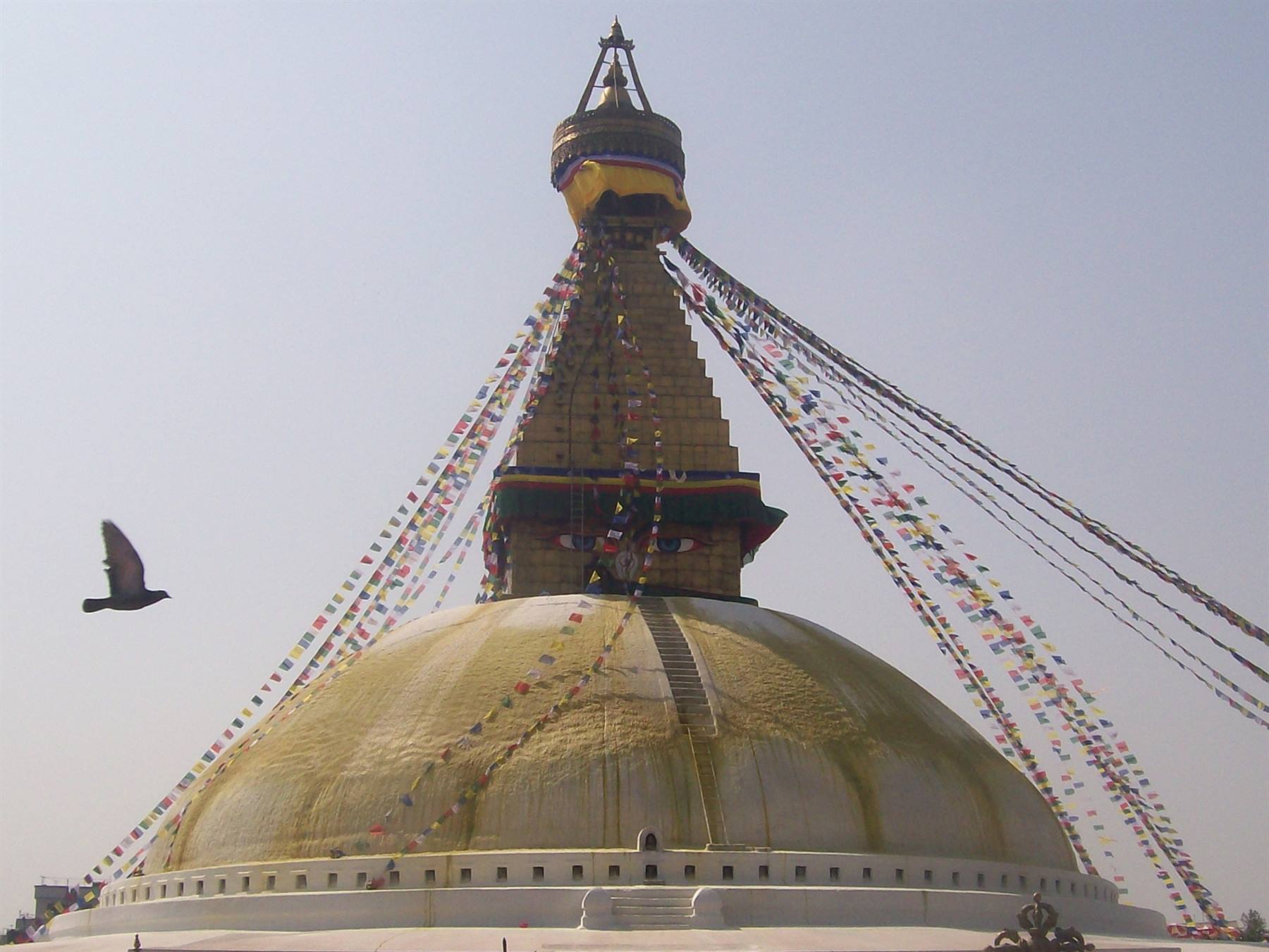
This morning, buffet breakfast in one of the Hotel's restaurants, nothing exceptional but less spicy than in India and therefore acceptable. Punctually, as agreed, the people from the Agency come to pick us up with the minibus. First stop Bodnath, where there is an enormous Buddhist stupa surrounded by temples and shops. It is the centre of Tibetan culture in Kathmandu; here the refugees who fled after the Chinese occupation of Tibet have rebuilt their lives, keeping their religion and traditions. We walk around the Stupa in a strict clockwise direction, spin the prayer wheels, enter the surrounding Temples, observe monks and faithful prostrating themselves before images of Buddha shrouded in the smoke of candles and incense.
We go up onto the terraces of the Stupa; the dome is being sprinkled with curves of ochre colour by some young people who trace them in regular geometric designs near the tower where the eyes of Buddha are imprinted, surmounted by a crown from which depart dozens of rows of coloured little flags that are prayers read by the wind. On the way to Pasupatinath the traffic in the streets is much heavier than what we saw yesterday in the Capital; today is Sunday, a normal working day for Nepalis. It is quite difficult even just to cross a street on foot avoiding cars and motorbikes. On top of that there is also a political procession with numerous vans full of communist demonstrators waving red flags. On the street many pedestrians are equipped with anti-smog masks, worn also by the policemen trying to direct traffic.
Pasupatinath is famous for the golden Temple dedicated to Shiva where only Hindus may enter, and for being considered the Varanasi of Nepal. Here flows the Bagmati, little more than a muddy ditch whose waters flow into the Ganges and which for this reason the locals consider sacred. People flock here from all over Nepal to cremate their dead along the Bagmati. The pyres give off a strong smell that pervades the air, more noticeable than in Varanasi given the confined environment. Having crossed the little bridge over the stream, we climb a hill from which we enjoy a nice view of the Temple of Shiva, into which it was not possible for us to enter. We come down from the hill, cross the bridge again and, back at our minibus, continue to Bahtapur. Among the cities of the Kathmandu Valley that in the past held the role of Capital of the Kingdom, Bahtapur is the best preserved.
Once past the Gate it feels like taking a leap into the Middle Ages, a great leap in time in sharp contrast with the smog, the heavy air and the traffic of the roads travelled to reach it. On Durbar Square look out numerous pagoda Temples, statues, bas-reliefs and palaces with dozens of windows whose wooden grilles are finely decorated. But beyond the Square too the whole city is a splendid open-air museum still fully lived in by its inhabitants. Between one narrow alley and another, scenic squares rich in monuments open up. Impressive is a Temple with a Pagoda with five sloping roofs, one above the other. You can go up it via a monumental staircase flanked by colossal statues and, once at the top, enjoy a fine panorama of the Square.
Passing beside characteristic shops of knick-knacks and artisans' workshops, we reach the Potters' Quarter where terracotta has been worked for centuries in the same way. Back at Durbar Square we get back on the Agency's minibus and go to the Hotel. We have the whole afternoon to relax between the room and the garden. In the evening we have dinner at Pizza Hat on the most fashionable street of the Capital, where numerous brand-name shops, airline offices and the former Royal Palace look out. Getting there is easy since our Hotel is very close. After this short walk we go back to our room for the night.
Bodhnat
Day 35 Mar 1992
Swayambunath and Patan
After a good breakfast in the Hotel Restaurant we ask at the front desk if we can leave our luggage in storage until late afternoon. Punctual as always, guide, driver and minibus come to pick us up for today's tour. We go to Swayambunath, a Buddhist Temple set on a hill dominating the city and famous for the numerous monkeys that wander freely there. More than by these likeable primates, we are drawn by the stupa with its small tower and eyes, very similar to the one seen yesterday at Bodnath but much more contained. Here too there are numerous votive shrines, little shops of knick-knacks, prayer wheels and statues of Buddha continually incensed. Many are the faithful and the monks, easily recognisable by their colourful robes. Unfortunately the view from above of Kathmandu is limited by a thick blanket of smog.
We get back on the minibus, coming down from the hill, cross the Capital and head for the famous Patan, another former Capital. You pay to enter the large Durbar Square, where the Royal Palace and about ten pagoda Temples and more look out. Often the wooden cladding shows bas-reliefs of scenes from the Kamasutra. In the Royal Palace, of considerable size, there is an interesting Museum on the city's history. The areas bordering the Square are also rich in monuments; the city is everywhere well preserved and has not suffered modern architectural intrusions. The delightful Golden Temple is rich in engravings and chiselling that do justice to its prestigious name. Not far away, the Temple of Shiva has a pagoda with five roofs, one above the other, as imposing as the one seen yesterday at Bahtapur, even though it lacks such a monumental staircase.
Near the Museum we witness prayers and rites of the faithful and religious, accompanied by offerings, food and lit lamps. The Tour Operator takes us back to Kathmandu; we get off their vehicle almost in front of the former Royal Palace and on foot reach the Thamel district, famous among tourists for its cosmopolitan liveliness. We go back to the Hotel, waiting for the evening in the garden. When they come to pick us up to take us to the Airport, we collect our luggage. We leave the beautiful Kathmandu Valley and Nepal with a flight to Doha in Qatar.
0 reader comments