I leave from a cold and gray Milan to arrive in a hot and chaotic Bangkok, much improved since the last visit in 1990. Now you can easily get around with the new metro, the sky train, which intertwine with the vaporettos along the river. I get the visa for Burma the same day, buy the Bangkok Airways ticket on Kan Sung Road for Yangon and gladly see again the Royal Palace, the Wat Pra Keo and sail along the Chao Praya before the flight to Burma. I share the taxi with a German couple and arrive in the center, lots of people on the sidewalks selling everything, crazy horns and a good guest-house (Beautiland Hotel) in the center for 10 USD. I immediately go to visit the Sule Pagoda a few steps away and remain enchanted by this construction dating back a good 2500 years ago. I meet two Burmese with whom I talk about Catholic and Buddhist religion.
The younger one offers to be a free guide for the city. He only wants to learn English. I accept. He takes me by taxi to the Shwedagon Pagoda, an incredible work, with imposing entrances, lots of gold, spires, temples and little temples and lots of people praying. Later I will visit another temple with a giant seated Buddha and another with the reclining Buddha. Then the park on the lake, Chinatown where we eat and then the monastery where he lives. He had tried to become a monk but it wasn't for him. The head monk whom he introduces to me doesn't make a good impression on me: he chews betel and answers the cell phone, which in Burma has prohibitive costs. We ride local buses to save money and to have more immediate contact with the Burmese. Lots of people packed in, no one who smells despite the great heat. I give him advice on how to earn money with tourists by being a guide.
He comes from Mandalay where his family still resides and whom he hasn't seen for years. He is 25 and says he is still a virgin. I also offer him dinner in a brewery restaurant karaoke where some girls perform singing on a stage at the back of the room. Ky (this is the guide's name) drinks his first beer and gets drunk. He lets himself go with confidences about his life. I walk him back to his monastery and promise him that we will meet again on my return to the capital at the end of the trip. In fact I will never see him again and I am sorry about it even though even today I wonder if the attempted scam with the black exchange saw him as an accomplice. He had taken me to a bar where a strange guy had offered to change my dollars into the local currency.
After a first exchange the guy had reappeared saying that my hundred-dollar bill was fake, showed it to me and demanded the return of the Kyats. Naturally that wasn't my bill, but his!! I literally told him to go to hell, aggressively. His retreat and offer to change the remaining dollars, which I refused. The next morning I left by bus with air conditioning for Calaw, about 800 km north, 18 hours of travel for about 7 dollars. Off I go
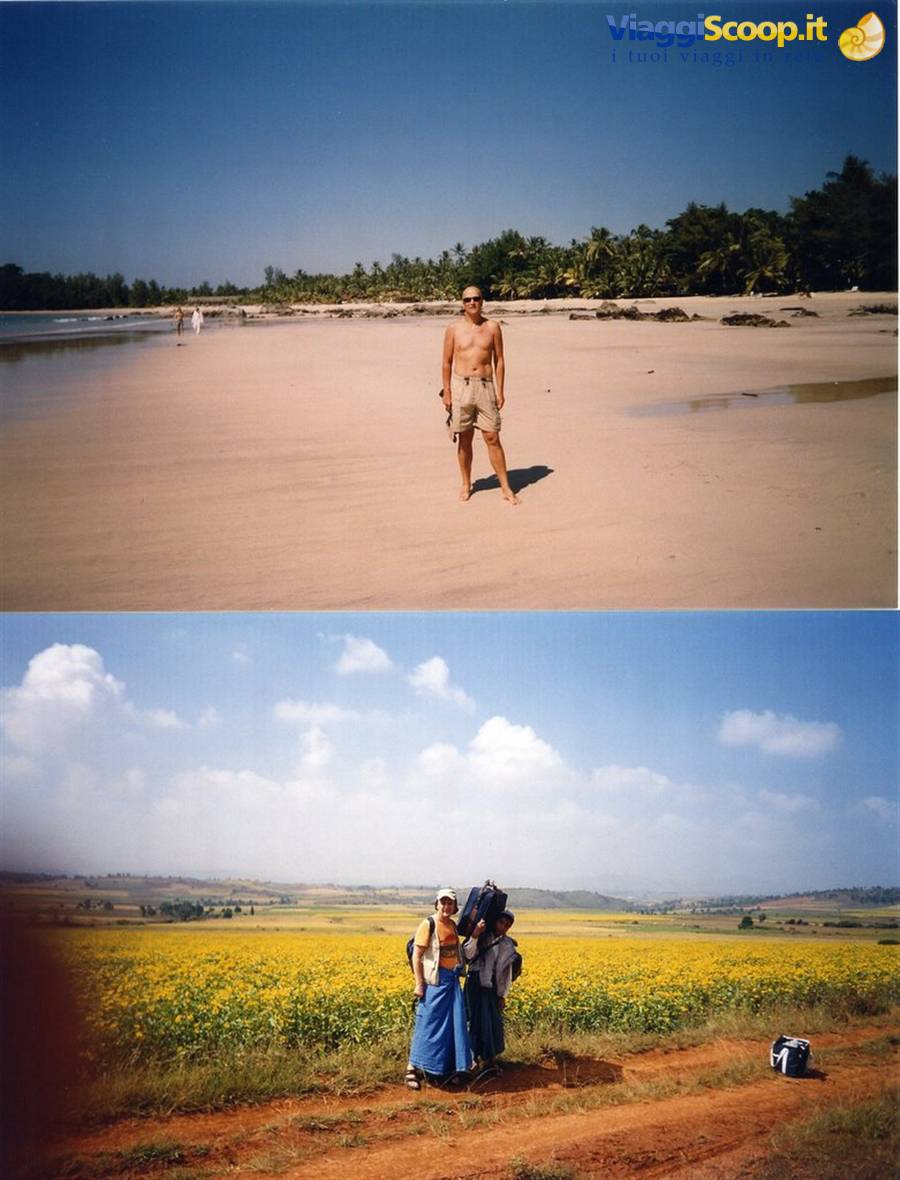
Tourist on beach and two backpackers posing beside yellow fields
Day 227 Oct 2004
During the bus trip I meet a group of thirty-year-old Burmese women who offer me food and drink (I am starving and the bus doesn't decide to stop). They are singers, dancers and photographers at wedding parties. I call them Burmese Spice Girls, they have fun and take a liking to me. A relative of theirs offers me a balsamic cream that, rubbed on the hands and inhaled for a long time, opens up the breathing. I will later buy two jars of this cream which I still use, having a deviated nasal septum that makes nighttime breathing difficult for me. We arrive in Calaw, a mountain locality in a beautiful valley, with a typical market where I will begin my unrestrained shopping and a scenic pagoda on the hill, at 4 in the morning. I find a good guest-house for 3 dollars and immediately ask about possible trekking.
They even offer it to me departing at 08.00, two days with arrival at Inle Lake with an English-speaking guide, meals and overnight stay for only 10 dollars. I accept and make the acquaintance of a likable 35-year-old Burmese who often chews betel, in the company of a young guy acting as a "porter" for my 20 kg suitcase. Incredulous, I protest and suggest sending the bulky suitcase by pick-up directly to the lake. No way! The porter is more than happy to do his job and grabs the suitcase from me, loading it on his shoulder. Only halfway through the journey does the guide find a bamboo pole, puts the suitcase on it and helps him with the carrying.
We encounter 7 peasant villages, carts with enormous oxen, young people carrying stones, fields of yellow flowers, paths in the shade of tall bamboo fronds, children to whom I give colored pencils, peasant women in traditional costumes with children in slings. In the evening we arrive at the monastery where we will spend the night after a stop for lunch in an intermediate village. The houses have thin bamboo walls and structures of heavy teak beams. The people are friendly and despite the language difficulty I manage to communicate with gestures and drawings. Someone repairs my broken umbrella that I will never use and that I will give away later. The guide turns out to be an excellent cook and prepares me a good lunch based on noodles, cooked vegetables, scrambled eggs and tea. I go haywire on the last climb and the guide offers me betel. I hesitate then accept.
It must have been the placebo effect, the fact is that I did the climb like a rocket, spitting out the disgusting red mixture after a couple of minutes of chewing. The monastery is ancient, made of solid wood, on stilts with a dark and fascinating interior. There are some young monks watching television in a corner and other young guys from the nearby village. The old head monk doesn't speak English, greets me laughing and orders his second to prepare my bed at the foot of the hill of the seated Buddha. I will have a duvet that smells of mold that will protect me from the nighttime cold with the guide and the porter at my sides and the old deaf monk who channel-surfs at full volume, preventing me from sleeping. Fortunately he stops after a while. In the morning the route is all downhill to Inle Lake.
We get on a long wooden motor boat and cross half the lake, passing through floating fields where they grow vegetables and tomatoes, houses on stilts, villages in the water and finally the town with many guest-houses, a pier, a beautiful silver pagoda and some small restaurants. I stay in front of the pier at the Gipsy Hotel for 5 dollars. I say goodbye to the guide and the porter whom I reward with a nice tip and some gifts that they accept very willingly. After a refreshing shower I go to discover the village, I find a beautiful floating monastery and talk for an hour with the head monk who speaks good English and gives me information on Buddhism that intrigues me so much. I intend to embrace the philosophy/religion of Roberto Baggio that makes him so serene despite the many disappointments that teams and coaches reserve for him.
I spend the evening in a strange restaurant of the 4 girls, they are volunteers who prepare excellent meals and who at bill time invite you to pay at your own discretion, specifying that the earnings go to the association that helps young people in difficulty. I eat and pay well, feeling good. I meet Franziska, a German woman, and I notice with pleasure that I haven't forgotten the German I studied forty years earlier. That same evening I approach a Spanish couple from Barcelona to share the cost of the boat to explore the lake the next day. They accept, so we spend a splendid day together visiting temples, pagodas, markets, craft shops, a wooden temple where the monks perform by making trained cats jump through iron hoops raised in the air. We luckily witness the folkloric procession on the lake: it is the last day they perform it.
Lots of people, music, boats decorated with dancers and musicians, floating market, races in very long boats with many rowers standing. The specialty of the place is rowing with one foot and having your hands free to fish. That same evening I take a bus to Mandalay and already I miss the beautiful lake and the likable Spanish couple.
Tourist on beach and two backpackers posing beside yellow fields
Day 328 Oct 2004
I arrive in Mandalay early in the morning and find an excellent guest-house for 10 dollars. the Royal Guest House right in the center. At the station I agree with two guys who will be my guides the following day. They have a very battered Mazda older than me and they rack their brains to take tourists around for a few dollars. The guy who speaks English barely walks: he drove the rick-shaw (bicycle taxi) for 10 years and had to change profession, risking paralysis. He has to support his young wife and two children. I feel sorry for him, he is an extremely sensitive and intelligent guy. He could have been a person with a career in our world instead he risks a wheelchair at under 30. I'm not lucky that day either. I have an infection in the middle finger of my right hand that has swollen enormously, it hurts and worries me.
After the three excursions on November 1st I decide to have myself taken to a clinic where a surgeon who graduated in Edinburgh will remove the nail after local anesthesia. I will pay a good 60 dollars, but my pain and worries will end. I will think about getting reimbursed by the green Globy policy that I had taken out before departure for 80 euros. I visit Ammarapura, former capital, with a monastery of 1000 monks all in line at noon for the only meal of the day and the longest teak bridge in the world. Then Inwa island, also a former capital with a beautiful yellow palace from the 1500s and a clock tower. We take a ferry boat and then a Sicilian cart to visit this strange place. Finally Sagain with its kitsch pagoda at the top of the hill. I reach it by climbing laboriously in the midday heat up a long slope, fortunately covered.
The next day I will take an excursion to Mingun to see the largest and unfinished pagoda in the world and the largest bell. At the pier I will make friends with an English couple who will invite me in the evening to climb Mandalay Hill for the classic sunset. In Mingun I go wild, willingly and not, in an unrestrained shopping of Burmese clothes that I will give to colleagues and relatives. At a certain point, unable to resist the crazy heat, I will undress behind a gigantic Buddha tree and put on the famous longyi, a sarong worn intelligently by all Burmese men who look handsome, comfortable and cool compared to our sticky pants. For the rest of the trip they will be my favorite clothing. At the local restaurant after an excellent lunch I will have my face made up with the strange paste obtained from a branch that is rubbed against a wet stone.
Women, men and children use it to protect their skin with this strange concoction. The following day I will visit the city of Mandalay, the second city of Burma, about a million inhabitants, with an enormous royal palace and park surrounded by very long walls and an enormous canal. At the end the famous hill with the pagoda, just as kitsch as the one in Sagain. I will ride around in a rick shaw with a likable driver who speaks the best English I have encountered so far. I will also visit the most beautiful monastery from the 1500s in inlaid wood with incomparable art and skill. The Burmese are the best woodworkers.
Tourist on beach and two backpackers posing beside yellow fields
Day 42 Nov 2004
PagaN OH Pagan!
Early in the morning I take the famous boat along the great Irawaddy river that after 8 hours takes you to one of the most important archaeological sites on the planet: the valley of Pagan. There are 2500 temples and pagodas of every shape and style plus as many destroyed by recent earthquakes and that are being restored by Unesco. I will stay at the spartan but likable guest-house New Park Hotel for 5 dollars, with air conditioning, fan and abundant breakfast as in all Burmese guest houses. I will rent a Chinese bicycle for 1 dollar a day and cross the valley far and wide for 3 days, visiting and photographing hundreds of temples and pagodas, with breathtaking views at sunrise and sunset. Certain temples are superior to our cathedrals in terms of imposingness and beauty; some pagodas like the Swezigon are incomparable especially when they are illuminated at night.
In the middle of the valley there are also peasant villages to visit between one temple and another for a bucolic break. In the evening you dine in small restaurants by candlelight, next to an illuminated temple, drinking excellent Burmese beer and choosing between Chinese, Indian and....Italian cuisine, since Burmese isn't great. They also offer you a puppet show for free. You can also afford a Burmese massage for 2 dollars an hour: be careful though, it is quite painful or at least annoying. Hours later you feel reborn and rejuvenated.
Tourist on beach and two backpackers posing beside yellow fields
Day 56 Nov 2004
Mount Popa
For a break after hundreds of temples, I decide to take a hike to the famous sacred mountain Popa, once a place of animist worship, now with Buddhist shrines and a not-impossible staircase of about a half-hour climb, among annoying monkeys and boys carrying heavy stones as penance. The entrance gates are spectacular, with enormous colorful statues at the foot of markets and craft stalls, small restaurants, and bars. I arrive in the company of Sandrine and Pauline, an Englishwoman who lives in Singapore, a marathon champion, and a French-Swiss woman from Geneva. We split the cost of the minivan, 15 dollars. The excursion lasts half a day, one hundred km round trip, and it's worth it. We stop at a nice refreshment place that offers us coconuts, sweets, special liqueurs, sugarcane rum, and the inevitable pistachios and Chinese tea.
In the evening I have dinner with a Burmese guide who speaks excellent English, as well as Chinese and Japanese. The young man is very knowledgeable about his country and clarifies many things for me about it. He also follows international politics and tells me about the re-election of Bush Jr.
Tourist on beach and two backpackers posing beside yellow fields
Day 68 Nov 2004
SEA, SEA, SEA....
After two weeks of gallivanting, I decide to spend the last week at the beautiful Ngapali Beach. The name comes from Naples, since a Neapolitan arriving there said: "it looks like Naples to me!!!" It's a beautiful long, wide sandy beach with rounded stones emerging during low tide. I stay at the Linn Thar U hotel for 10 dollars for the usual room this time in a bungalow in the second row with a sea view and a stunning sunset. I rest on the hard wooden lounge chairs in the shade of the coconut palms above a teak walkway. Restaurant with a terrace over the sea, a well-kept garden, kind staff, and 5 small restaurants where you eat excellent fish and more: lobsters, crabs, scampi, Cuban cocktails for half a dollar, always by candlelight in pleasant wooden settings.
You fall asleep to the singing of crickets, a sky with millions of stars, after a breathtaking sunset, sipping the usual Myanmar beer. I meet Didier, a Frenchman from Paris, with whom I'll have dinner the first few evenings. There are pairs of girls, little families, pairs of friends, and Didier and me. I take a boat excursion for 10 dollars to reach a beautiful lonely beach, go snorkeling among colorful fish and corals only slightly inferior to those of Sharm el-Sheikh. I have lunch in a poor hut as the guest of a family that I become friends with. I'll reach them the next day by land, after 4 endless hours, using taxi, bus, motorbike, and finally the most logical and simple boat, since the roads are full of potholes and make you jolt every moment. They offer me their land for sale at 5000 dollars.
It's more than 1000 sqm on a hill planted with pineapples, coconut palms, bananas, and a lonely beach in front. Unfortunately the road is a bit far, the sea is shallow, no electricity, only a small water spring for cooking rice. I'll give it some thought. You need to find a trusted front man and build yourself a nice house in teak and bamboo for 3000 dollars.
Tourist on beach and two backpackers posing beside yellow fields
Day 710 Nov 2004
FISHING VILLAGE
It's nice to be at the sea, resting, swimming, tanning, but after a while... There's an intriguing fishing village very close by. The men go out in boats all night (you can see the lights of the boats) and return at sunrise with their catch of various fish. Especially sardines, which the women spread on the sand over huge plastic tarps to dry for a few days before shipping it all to the various markets of the country and even to China. The bigger fish are divided and sold to local restaurants. There are leech fish that attach themselves to big fish and suck their blood until they make them die from blood loss. They also fish from the shore with enormous nets that they drag slowly to shore for....three big barrels of a kind of beige-colored plankton that is eaten raw with the hands and is exquisite.
In the poor huts under the tall palms, their hard life unfolds, made of so much sea (in the fishing months) at 30 dollars a month. The younger boys play a kind of volleyball with their feet and head. There are also masonry houses with tiled exteriors: they belong to the boat owners. On the beach, many children doing their poo, women carrying garbage that the sea will sweep away, dogs happily chasing each other, and carts pulled by big buffalo. Who knows whether these big villages will be able to keep living on their beautiful beaches or will have to move out to make room for the bungalows of tourist resorts, as has already happened? They say no, that the government now protects them.
The town of Tandwe, namesake of the nearby airport, is a big city with many tree-lined avenues, lots of shops and bars, some pagodas, a big river and its bridge, and a beautiful surrounding countryside of rice fields and farmers' huts.
Tourist on beach and two backpackers posing beside yellow fields
Day 814 Nov 2004
Return to Yangon
A sad return to the big capital of 5 million people. All the wide sidewalks are occupied by small restaurants and bars. The tables are low, level with the pavement, and the chairs are....the ones from our kindergartens. You have to walk.... in the street, risking ending up under something because here the pedestrian has no rights and every mechanical means of transport has priority. Fortunately they warn you by strumming on the horn. a concert. They sell everything, even CD Roms that teach you everything in various languages. Too bad that few Burmese have a computer and the Internet is semi/prohibited. You can still manage to send an email home for half a dollar, phone calls cost a lot, much more. The dictatorship isn't perceptible, people are busy and think only of working and praying in the temples.
Who knows how much ugliness and how many full prisons, in any case it apparently seems a free and tranquil country, few police and it seems, many overseers, corrupt inspectors who take advantage and live well by not seeing and not reporting. They live better than in China, India, almost all of Asia, tigers excluded, all of Africa, and a large part of the Americas, in spite of international statistics that rank it fourth from last. Stuff from many years ago, certainly before 1992, that is, since they opened up to the private economy, before being dragged along by the neighboring and great friend and supplier China.
I visit the interesting National Museum on 5 floors with many ancient statues of the Buddha, many paintings, traditional costumes of the various ethnic groups, stone steles with their strange round alphabet, jewels and ornaments, even prehistoric artifacts as befits a great national museum. I'll spend the last evening at the restaurant on the big boat on the lake, enormous, kitsch, with ceilings like Versailles, all of Burmese cuisine available in a gluttons' buffet, a show of traditional dances and music with strange instruments. Finally the traditional puppet show.
All for 10 dollars, expensive for the average of Burmese prices, but it's worth it as the conclusion of a rich and exciting journey in a country that, paradoxically, has preserved its traditions thanks to an ugly dictatorship and will probably lose them in a few years thanks to the new imminent liberal and globalized democracy that is already pressing the poor Burmese with enormous billboards and endless television ads. Aung San Su Kyi, Nobel Peace Prize laureate, opposition leader, under house arrest after years in prison and probable future leader of the country, will also have to contend with this fundamental problem, and I hope she will manage to guide her country to freedom and democracy without making it lose its splendid characteristics and turning it into a new Thailand.
Tourist on beach and two backpackers posing beside yellow fields

0 reader comments