Mandalay, Sagaing, Amarapura, Mingun, Bagan, Mount Popa, Kalaw, Pindaya, Inle Lake, Yangon · Mandalay,Stato Shan,Yangon
When
20 Dec 1994 – 28 Dec 1994 9 days · trip of 1994
Who
antonio · @antonio ·
How
Travel diary
The story · 9 days
A tour made as part of a trip that also included a short stop in Bangkok, Thailand and an add-on in Malaysia. I reached Myanmar with a friend on an Air Asia flight from Don Mueang Airport in Bangkok, Thailand, landing in Mandalay. I left Myanmar on an Air Asia flight from Yangon to Kuala Lumpur in Malaysia.
Day 120 Dec 1994
Mandalay
We arrive in the late morning at Mandalay Airport, a medium-sized terminal a bit dated and very neglected. The interior environments are dusty, air conditioning is completely missing and an aluminum profile placed on the floor of the arrivals area is almost detached so much so that a tourist ends up tripping. Fortunately the customs formalities are quick despite the fact that I feared for the visa applied for at the Embassy in Rome consisting of a double stamp practically indecipherable. After collecting the luggage, waiting for us at the exit with a conspicuous sign in hand with our names indicated is the boy who will act as our driver for the next few days. The guy says his name is So, he doesn't speak a word of Italian and knows a very limited number of English words, moreover made incomprehensible when he chews betel nut.
Communicating will be very difficult but we will almost always manage to make ourselves understood. A deserted and dusty road leads us to Mandalay, a fairly chaotic city but nothing compared to the traffic of India or the streets jammed with mopeds of Vietnam. It is a city of buildings very similar to those of the communist era in Eastern Europe. We stop at the Maha Myat Muni Paya Temple which preserves one of the most venerated Buddha statues in Myanmar. Unfortunately we have not yet changed the local currency so we cannot pay the ticket that would allow us to take photos. The entrance, however, is not paid and this allows us to see the faithful praying cross-legged in front of the statue. The security staff are very intransigent with tourists, we were simply sitting on the ground and they pointed out that we had to cross our legs.
It went worse for a tourist who was sent away because his pants did not have an appropriate length, they covered the knees but not the ankles! Only men are allowed to approach and climb a staircase to reach a platform close to the Buddha. Here the faithful apply very thin layers of gold on the statue. Walking along a long corridor overlooking numerous shops of sacred articles (it is a characteristic of all Temples) we return to our vehicle. The means of transport made available to us is a fairly new and well-kept minibus, the driver is courteous, he often offers us bottles of fresh water and wet wipes to clean our feet, indispensable since in the sacred areas one can only walk barefoot and not even socks are allowed. We stop to change currency in a silverware shop.
Here they only change US Dollars and Euros but they must be in perfect condition, they are not accepted if written on or torn and must be issued after 2007. Euros are converted at par with Dollars, which is why we change the American currency. At the Hotel we meet the representative of our tour operator from Yangon who hands us the accommodation vouchers and puts us in telephone contact with Teo, the owner of the Agency. The Hotel is elegant and clean, the room is also well-kept, it has two spacious single beds, a stocked minibar and a large bathroom with bathtub. We have available a kettle, tea bags, sugar, instant coffee and two bottles of water. The driver takes us to a small shop where the gold leaves are produced that we saw shortly before being applied by the faithful on the Buddha statue.
Three young men hammer violent blows with a mallet on a stone that acts as a press for the gold reducing it to a layer so thin as to make it impalpable. The lashes are so powerful that the stones become scorching hot. We also visit the show room where to our great pleasure we discover that, unlike other neighboring countries, in Myanmar merchants are not insistent in wanting to sell their products. We then go to see the Shwenandaw teak Monastery that escaped the devastation that the Royal Palace suffered: It is just outside the rectangular walls that surround the current center of power of the city, practically off limits for tourists since our driver passes far from it. Moreover I don't think it is very interesting as it is the result of a recent reconstruction. The walls are crenellated, interrupted by some small towers, they surround a vast area.
We move to the Kuthodaw Paya Temple famous for containing the largest book in the World. It is a sacred text written on large stone slabs each of which inserted in a chapel plastered white. Since the "pages" are many, the chapels are also numerous. The thing that stands out most in the Temple enclosure, however, is the golden stupa. Our vehicle goes up Mandalay Hill making its way among numerous pick-ups loaded with tourists who arrived at this hour like us to wait for the sunset. We reach the top of the hill with three long ramps of escalators. As was predictable more than the Temple itself what is interesting is the panorama over the city and the surrounding countryside over which the sun slowly sets. We are getting used to walking barefoot and in this condition we return to the minibus dodging numerous pick-ups.
It's dinner time and the driver takes us to a Chinese restaurant, an absolutely spartan environment with a concrete pour instead of tiles and dusty tables. With great difficulty I manage to swallow something apparently edible and I think that like in India I will have to go hungry. Among other things So left us here pointing out the hotel which is just around the corner. After dinner (so to speak) we return to our accommodation. There is a powerful wi fi that allows us to communicate with the families. Apart from the food it was a positive day even though we didn't see anything exceptional.
Amarapura
Day 222 Dec 1994
Around Mandalay
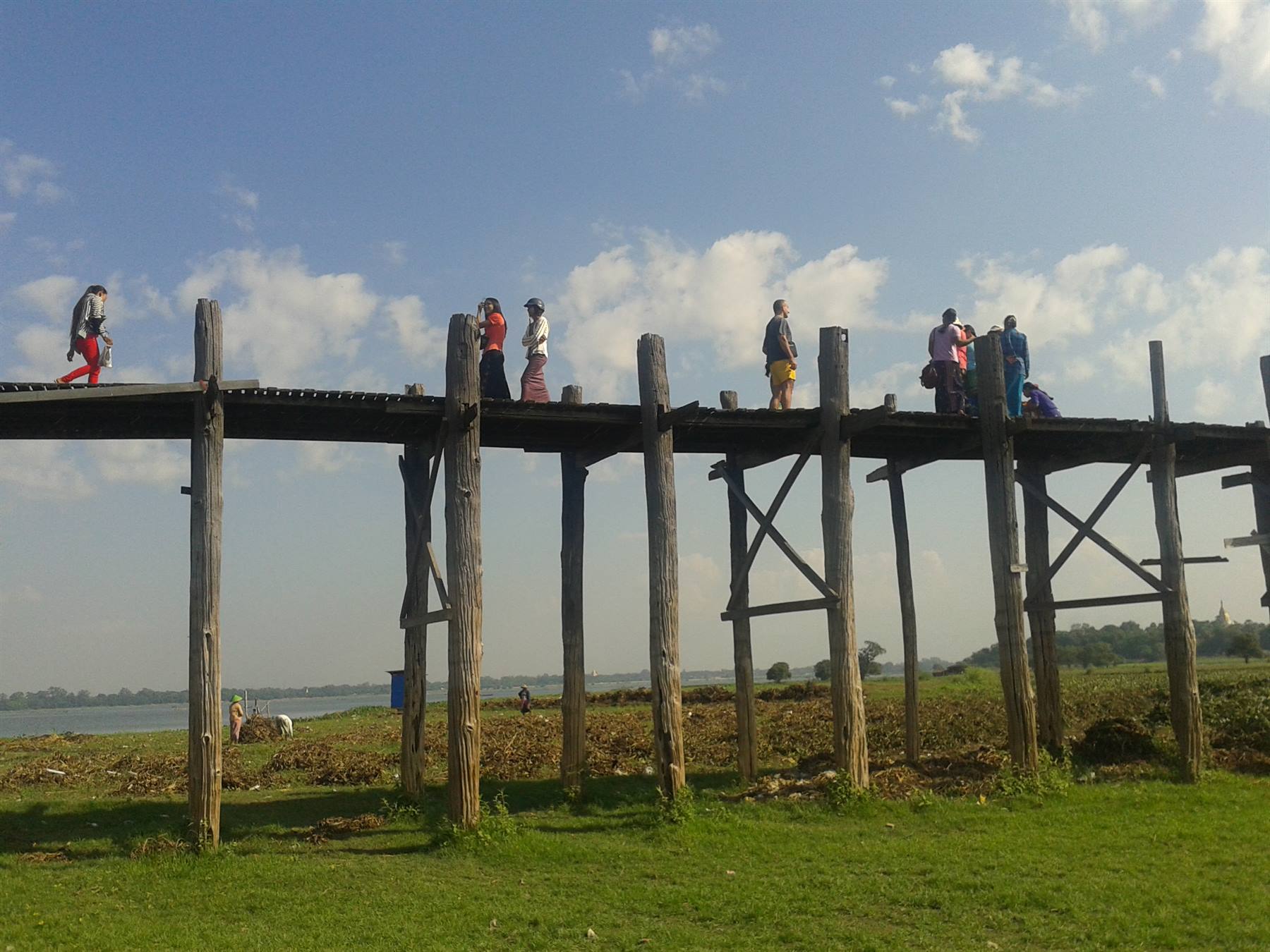
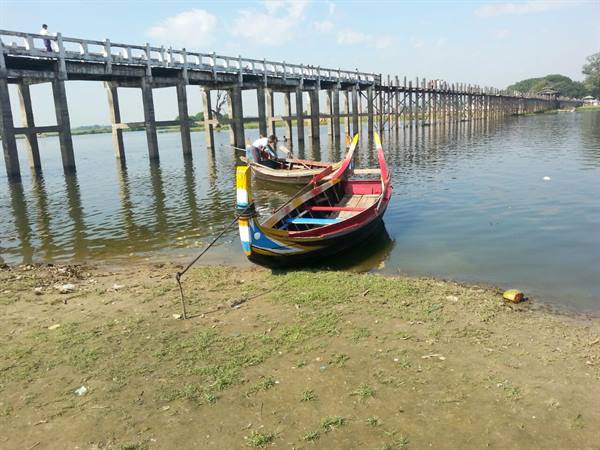
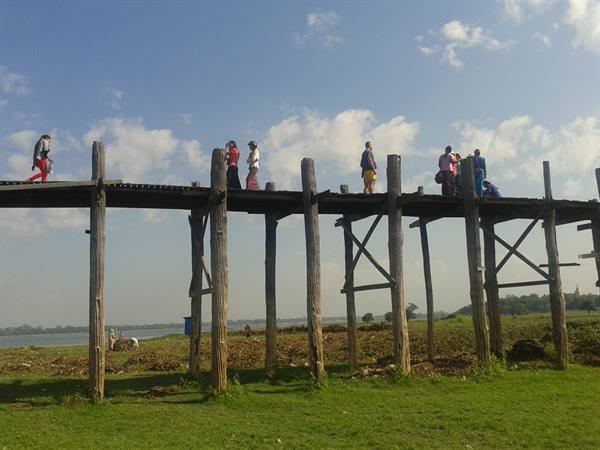
After the abundant buffet breakfast at the hotel, we go down to the lobby, where the driver is waiting for us. So is thoughtful; he hands us bottles of fresh water and takes us to the wooden bridge of Amarapura. The pedestrian bridge is more than a kilometre long and connects two banks of a lake. In the rainy season the water comes close to the walkway, but in the dry season the wooden pillars are almost completely exposed. The small lake is plied by characteristic multicoloured little boats, while on the shores agriculture is practised as it was hundreds of years ago. Farm women with the characteristic conical hat typical of this region and ploughs drawn by pairs of oxen dot the surrounding fields. Part of the lake is fenced off as a fish farm. The bridge is travelled in both directions by farmers, tourists and monks. All on foot, even those who have a bicycle, who merely pull it along.
We cross it in both directions, observing the surroundings and the humanity around us. We return to Amarapura just in time to witness the long procession of monks collecting offerings, making their way among the faithful and tourists armed with cameras. Into the monks' bowls go offerings of money, handfuls of rice and sweets. Near the monastery they receive a bowl of rice, which their fellow monks scoop with a ladle from a large copper container. Once inside the dining hall, they sit at the tables to consume the offerings while numerous tourists continue to follow them to take photos. We leave Amarapura and, after crossing one of the two large bridges over the Irrawaddy, we go to Sagaing, climbing the hills around the city, which are dotted with temples and pagodas. On the way to this place we stop at a monastery, attracted by numerous children playing in the large courtyard.
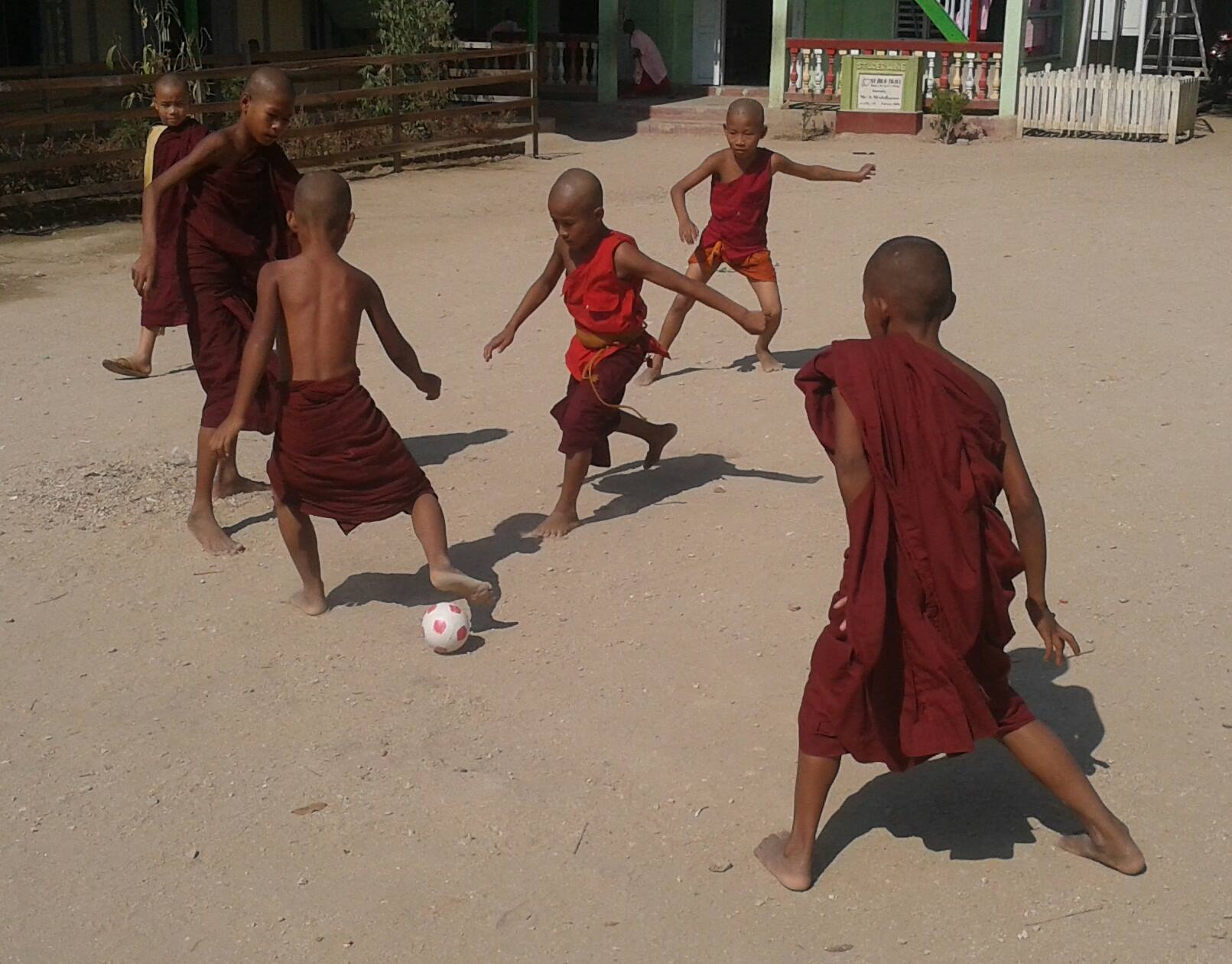
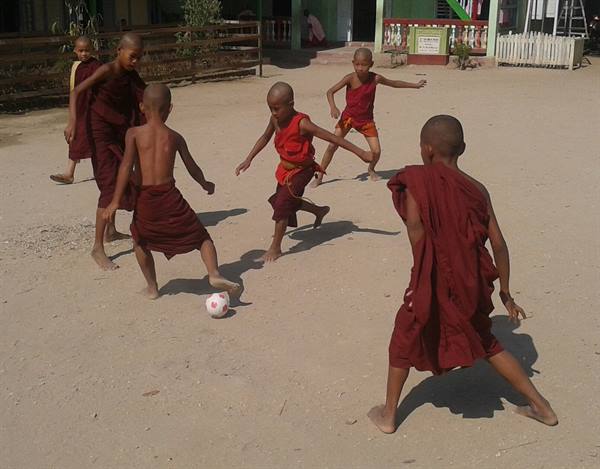
The boys and girls are dressed in the typical robe of Buddhist monks and have their heads shaved. The girls play elastics or skip rope; the boys are engaged in a rudimentary football match in which a small ball rolls in the dust. You shouldn't be misled by their clothing; here the children come to school and it's not a given that they'll become ministers of worship. Myanmar is steeped in religiosity, and people, regardless of age, spend periods of meditation in the monasteries. Most then go home and resume their normal daily activities; many stay, and that's why a good percentage of Myanmar's inhabitants are monks. In any case, the vast majority of people are deeply Buddhist. Having climbed the hill of Sagaing, we stop to observe from above the course of the Irrawaddy and the numerous golden pagodas emerging from the vegetation of the surrounding hills, including the one where we are.
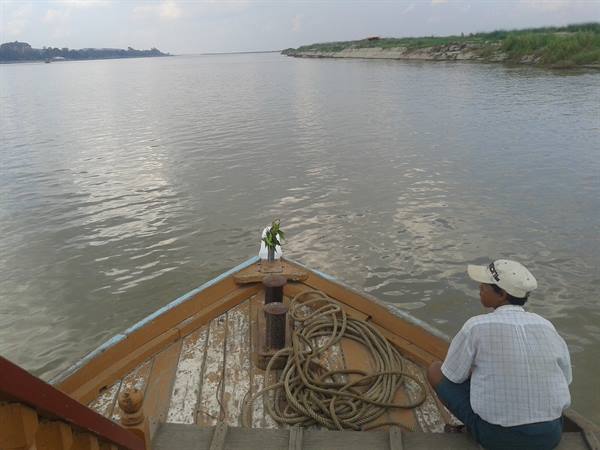
Among the many temples, we choose the one famous for a long, semicircular row of Buddhas. The temple follows the slope of the hill, rising to the top with a series of votive shrines and statues of various sizes. From Sagaing we return to Mandalay, reaching a boarding point on the Irrawaddy, where a large wooden barge awaits us, all to ourselves. The boat slowly plies the waters of the river on a sightseeing cruise that lets us see the bare surrounding landscape. We have two wooden deckchairs available and a small table with some dried fruit to nibble on. In about an hour we're at the village of Mingun, which stands out on the horizon with the tall platform of an unfinished pagoda that was supposed to be the largest in the country. We disembark on a sandy bank where the anchor (a kind of arrow) is thrown. A covered ox-drawn cart with the conspicuous word TAXI welcomes us.
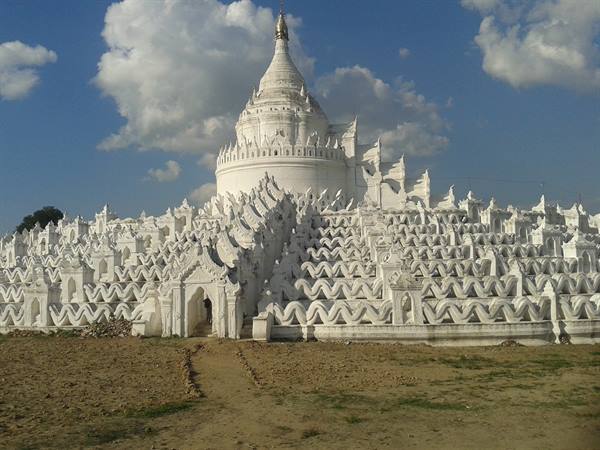
We decide to take it, and so we're jostled along the dirt road full of stones and potholes, which causes some discomfort to our backsides. The elderly driver first stops us at the small temple that houses the largest working bell in the world (the Tsar Bell in Moscow is bigger but it's cracked), then near a fantastic, very white pagoda. This is a tall structure plastered with lime that has a strange architecture of symmetrical waves. We climb to the top, accompanied by two nice little girls who offer themselves as guides. We set off again with our rudimentary animal-powered vehicle and stop in front of the enormous base of the unfinished pagoda. There would also be the possibility of climbing the staircase that leads to the top, but we give up. We return instead to the landing stage, where the boat we hired awaits us, complete with crew.
A glance at the course of the river, travelled by a few barges carrying goods, and then the return cruise, which in about an hour takes us back to Mandalay. It's been an intense day; all that's left is to return to the hotel to rest.
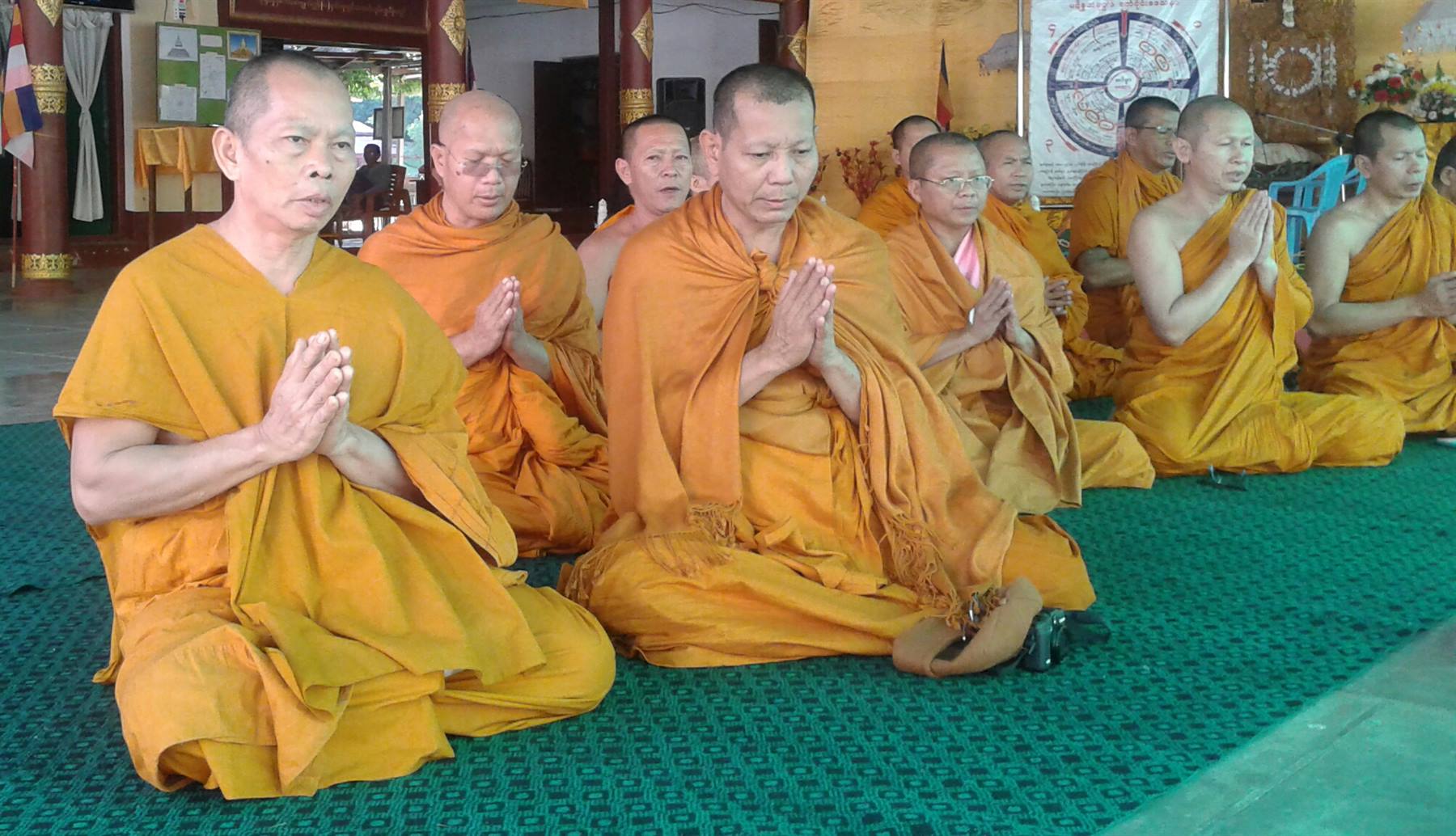
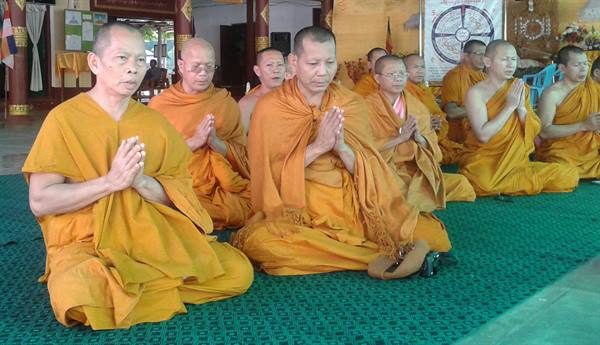
Buddhist monks in orange robes pray with joined hands inside a temple
Day 323 Dec 1994
From Mandalay to Bagan
After breakfast at the Hotel we transfer with our vehicle to Bagan. The road passes in front of poor villages of farmers who practise subsistence agriculture without mechanical means. We overtake ox-drawn carts in which the whole family finds room on the way back from the fields. We do a short stretch on a secondary dirt road to see up close the huts in which they live. We make a brief stop at a service area where our driver has a betel nut made for himself to chew, wrapped in a leaf and dressed with lime. This is the vice of all the men of Myanmar, who are always seen busily chewing with one side of the jaw swollen, and when they open their mouths they show teeth the colour of fire red. Once we set off again we arrive in Bagan and, having dropped our luggage at our accommodation, we begin visiting some of the famous thousand pagodas.
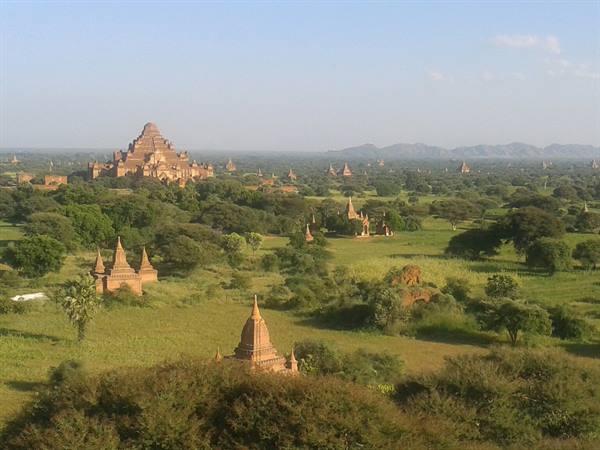
There probably aren't a thousand, but there are certainly many, scattered over a vast area furrowed by the river, they stretch as far as the eye can see. We have tried to visit the most significant ones. Inside they are bare, with statues of Buddha of all shapes and sizes, dressed in yellow tunics or not, gilded or not. In any case the faithful apply very thin gold leaf to their surface. We try to visit the temples while respecting the prayers of the faithful. The transfer has taken up a lot of time, so today we limit ourselves to seeing only a few of them, including one overlooking the river banks. In all of them we have to take off our shoes, which in any case we always find where we left them. More than the beauty of the individual Pagoda, it is their ensemble that makes this place wonderful.
For this reason, at sunset we climb onto a Temple to see this immense plain dotted with Pagodas. On the way to Bagan we saw the sign of an Italian Restaurant, we ask the driver to take us there and it will be a good choice. The Restaurant actually belongs to a lady from Canton Ticino, but the food is divine. We don't know where the driver went for dinner, but he comes to pick us up and takes us to the Hotel for the night.
Inle Lake
Day 424 Dec 1994
The Thousand Pagodas of Bagan
After breakfast at the Hotel our driver begins a long tour among the numerous Temples of the Bagan plain. We will spend the whole day in this vast area visiting the most interesting Pagodas, including the great Ananda. The intensity of the light changes hour by hour, always giving different shades and reflections to the ancient ochre-coloured architecture or to the golden domes. Often inside we find the faithful busy praying or gilding the statues of Buddha. We interrupt the visit only for a brief stop in the only urban centre of any real size in the area of the thousand Pagodas. In Nyaung-u there is a Monastery whose courtyard features a golden Pagoda. Here we witness the choral singing of a group of monks. It must be pointed out that it is difficult to distinguish those who are ministers of worship from the people who wear the tunic anyway.
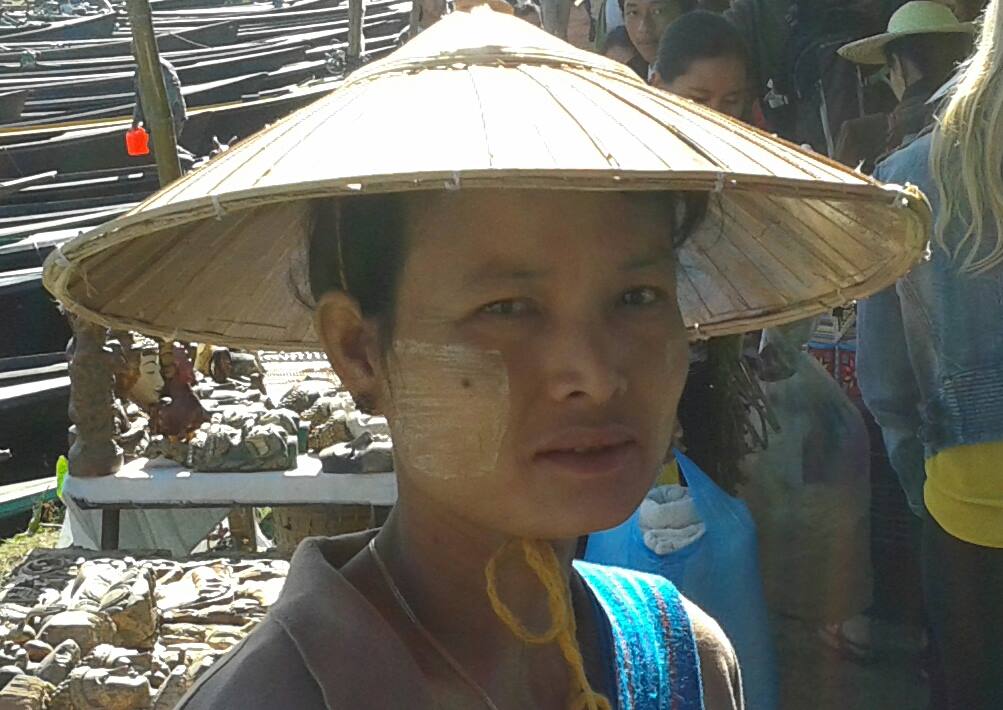
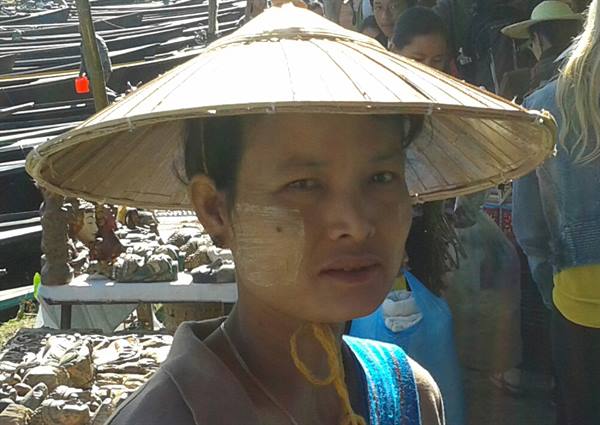
At least to us non-Buddhists they appear seemingly dressed alike. Indeed, Burmese people from childhood spend periods in Monastery and then return there years later to spend a few months of monastic life of purification. In practice it happens as with Swiss soldiers, who after completing their course return home and then periodically put the uniform back on during the course of their lives. Moreover, in Myanmar the monastic tunic is also worn by the boys and girls who attend the Monasteries or go to school there. Returning to the choir about which we have been holding forth, these distinguished gentlemen obviously pray with legs crossed, as is the custom in these parts. Near the Monastery there is the local market, where we observe many women with thanaka smeared on their cheeks.
Thanaka is a powder obtained by grinding the bark of a plant, it has the colour of face powder but is not used solely for aesthetic purposes, it seems to protect the face from sunburn. Just like the betel nut for the men, it is a distinctive mark of this Country. Moreover, the women, much more than the men, wear the conical Chinese-style head covering. Having left the town, we resume the tour of the Pagodas. I must admit that from seeing so many of them we have become a bit bored, but there is nothing else to do here. Since we liked this place above all for the ensemble and not for the individual architecture, at sunset we once again climb onto the roof of a Temple to enjoy a fine spectacle like that of the previous evening. Watching the sun slowly give way to darkness in this magical place will be the must of this trip.
The thousand Pagodas actually also include numerous Temples that are not Pagodas, but the overall impression is exceptional. Yet this place is not included in the Unesco world heritage list because the military dictatorship did not restore it in accordance with the standards imposed by this international body. We climb down from the roof of the Temple with some difficulty, both because it is almost dark and because there are no protections and the path is dangerously uneven. We invited our kind driver to dinner with us but he refused. He takes us again to the Restaurant of the previous evening, where we dine divinely. The Swiss-Italian owner advises us to return to the Nyaung-U Temple to witness a religious ceremony. We follow the advice, witnessing the sermon of a Monk in front of a large audience seated on carpets and a small procession that circles the golden Pagoda in the courtyard.
We then return to the Hotel for the night.
Woman with thanaka on her face
Day 525 Dec 1994
Mount Popa and Kalew
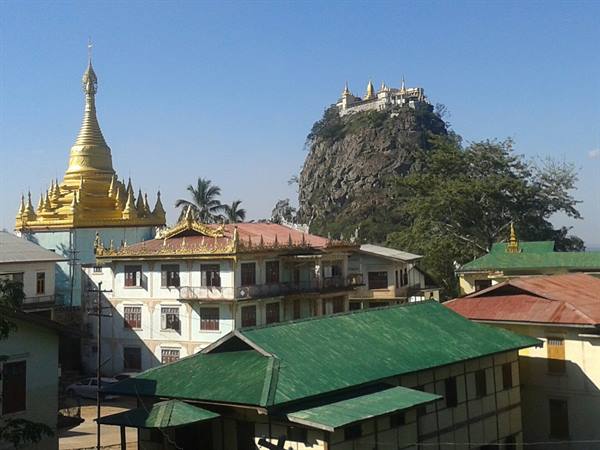
After breakfast we leave Bagan and its Pagodas for a long transfer. The road separating us from our next destination, Inle Lake, is so long that we have decided that tonight we will sleep in Kalaw. Having left Bagan, we stop to watch the production of coconut-based gummy candies. The pulp is ground with stone mills driven by mules. The preparation then undergoes a long boiling and a subsequent cooling. The entire processing cycle is rudimentary but effective. Of course the hygienic conditions leave much to be desired, here they don't even know what tiles and washable floors are and on the ground there is only sand. The product of the processing is then displayed on wooden stalls covered by a roof of dried leaves. We resume the journey and stop at Mount Popa, a steep cliff at the top of which sits a fantastic Monastery.
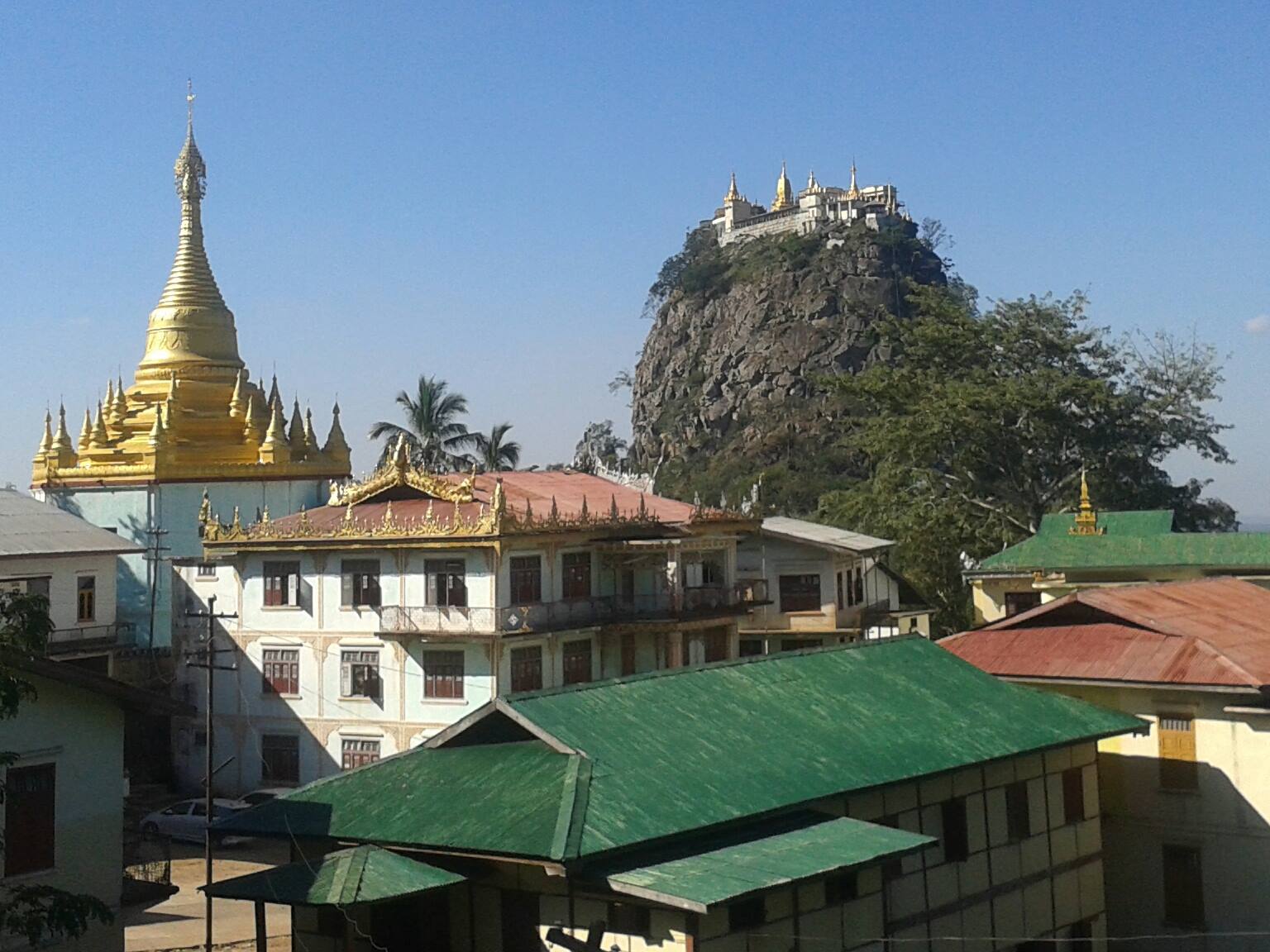
Apparently unreachable, it is in fact accessible by a long flight of steps that winds among votive shrines and shops of knick-knacks or religious objects. Because of its location it recalls the Meteora of Greece, but only for that, because here everything is very kitsch. The colours of the statues and the Temples are bright, the sacred figures lit by flickering lights like those put on fir trees at Christmas. The Monastery is certainly more beautiful seen from afar than inside. To get there you have to take off your shoes and dodge dozens of monkeys that clamber everywhere along the stairway. Once back down we resume our vehicle, where the driver is waiting for us, and continue towards the south-east. We take one last look from the valley at the golden Pagodas rising from the Temple on the cliff, which looks fairy-tale-like.
In the evening we stop at Kalaw, a mountain locality that resembles the other centres of Myanmar very little. Among other things, with the setting of the sun it is also cool, and that doesn't hurt after days of heat. The Hotel where we stay has many wood inserts and would not look out of place in the Alps. In the evening we dine by candlelight in a typical tourist restaurant in Alpine style. The meal is pleasant and abundant, and we end it with a banana flambé. We then return to the Hotel to sleep.
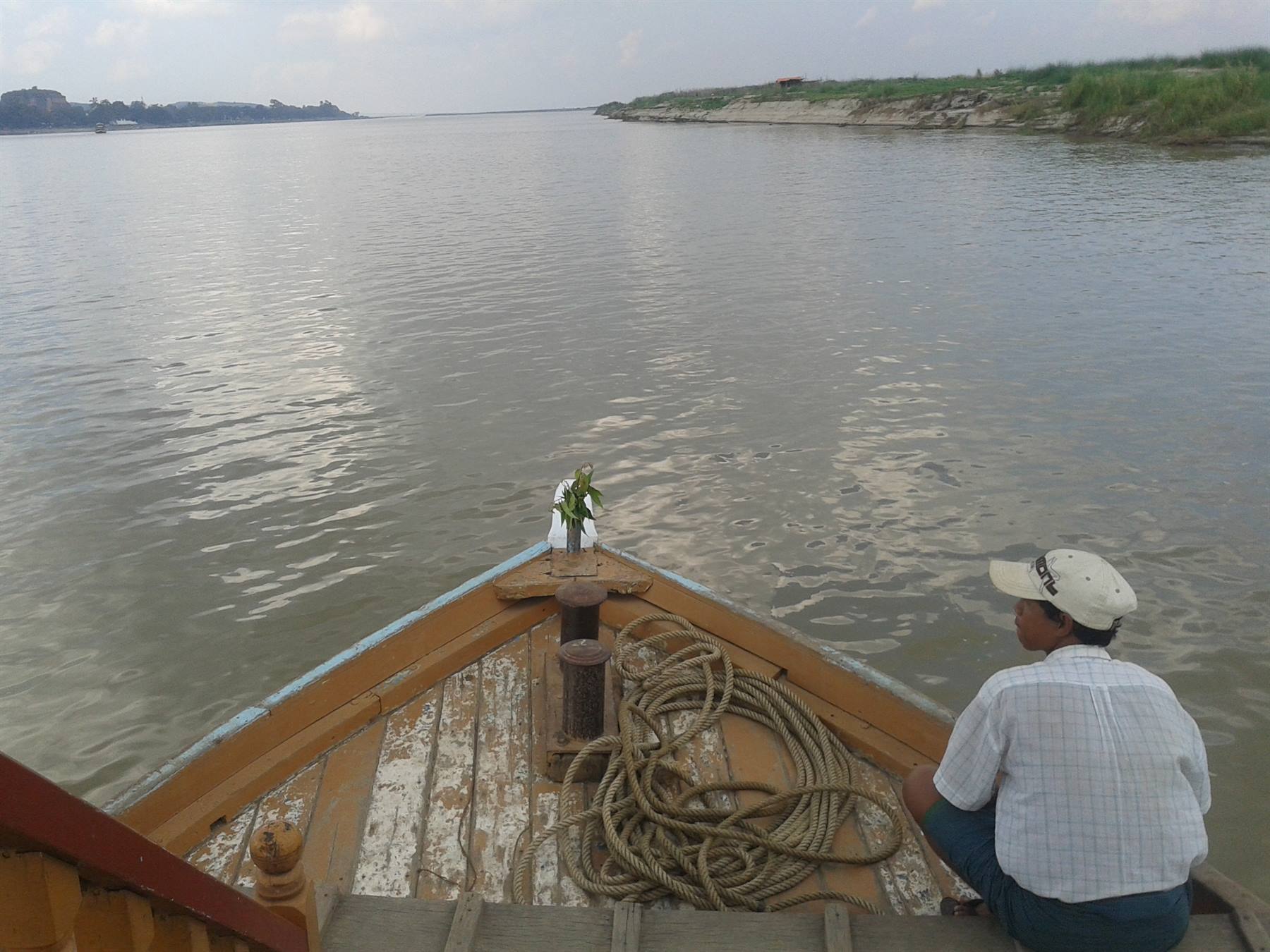
On the Irrawaddy river
Day 626 Dec 1994
Pindaya and Nyaungshwe
In the morning we set off from Kalaw and along the way we stop at Pindaya to visit some caves inside which a Temple has been built that houses thousands of Buddhas of various sizes. Many of these statues have been donated by Buddhist communities of other Nations. It is a labyrinth of golden statues. To reach the Caves you go along a stairway and then go up by lift. After the visit we continue to Nyaungshwe, the town near the northern shore of Inle Lake. A brief stop at the travel Agency that will organize tomorrow's lake tour for us and where I decide to replace the flight to Yangoon that we will take in two days with a bus transfer. I am afraid of Burmese planes, which are often involved in accidents. Our kind driver, with whom unfortunately we have not been able to converse due to language misunderstandings, takes us to the Hotel and then returns to Mandalay, where he lives.
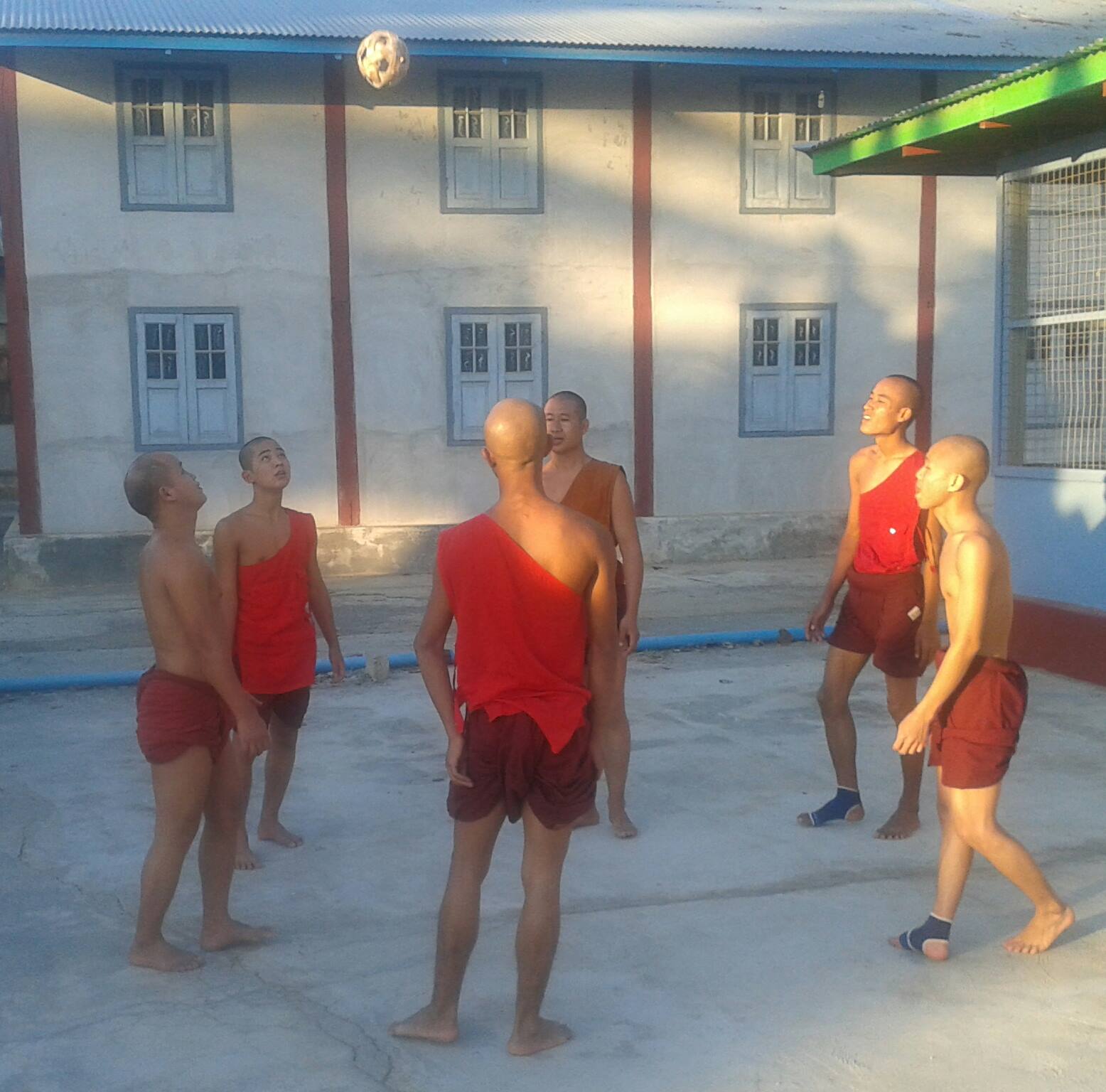
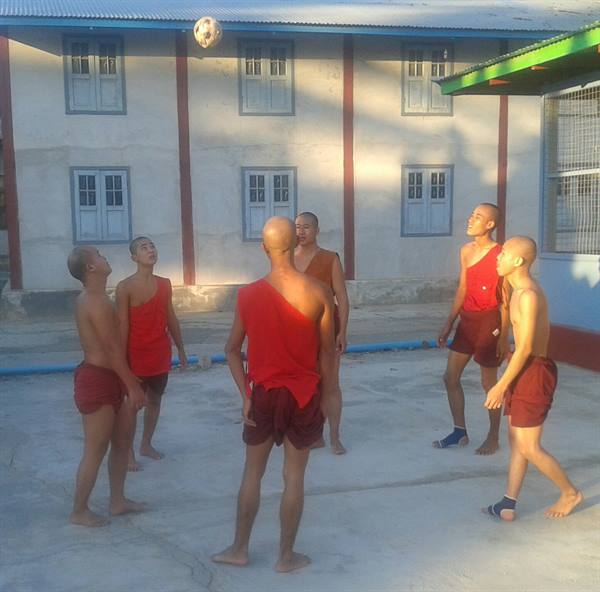
We thank him with a well-deserved tip. We, on the other hand, once our luggage is settled, stroll around the town, also entering a couple of Monasteries to see the young people busy praising the Buddha in their yellowish robes. They are probably not full-time Monks but are here for the periodic spiritual retreat. Many are boys and as such, besides praying, they play. The typical Burmese game consists of passing a ball made of woven bamboo cane, throwing it with any part of the body except the hands. They are jugglers; a monk overtaken by a lob, without even turning around, strikes the ball with a flick of the heel and puts it back into play. At dusk we wander along the main street, being careful not to trip in the chasms that open up on the uneven pavements and avoiding ending up in open manholes.
We watch a puppet show for the tourists, then return to the Hotel for the night, also because tomorrow morning we will get up early for the tour. Although the place is scruffy there are many tourists, as this is the hub for Inle Lake.
Monks playing
Day 727 Dec 1994
Inle Lake
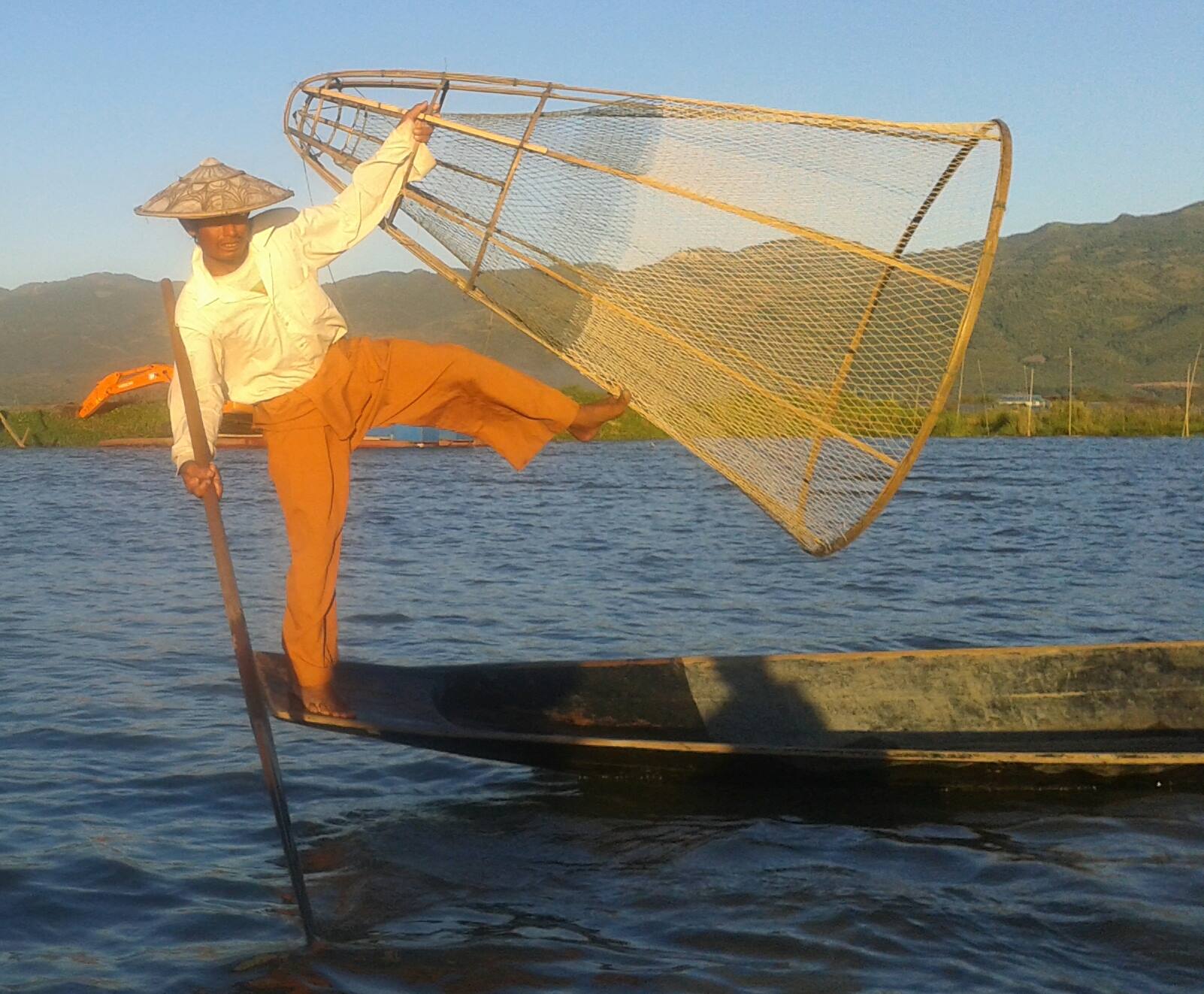
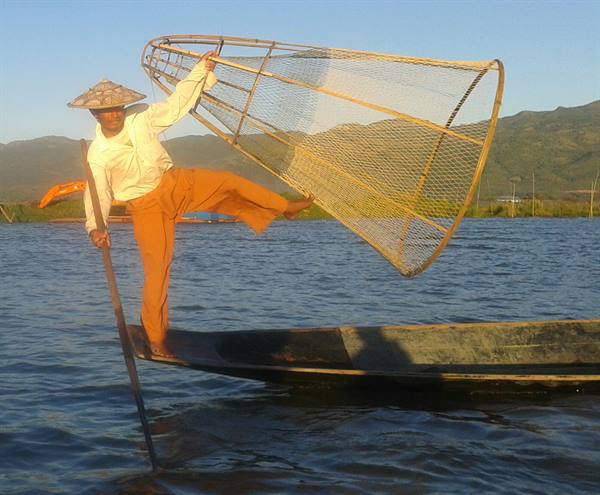
We have an abundant breakfast in our Hotel, full of Western tourists. Then a vehicle from the local travel agency comes to pick us up and takes us to the city port, located on a canal tributary of the Inle, where we board a motor launch all to ourselves. The early-morning haze makes the surroundings surreal; the canal is very busy with boats and launches carrying people and goods. At the mouth of the lake the sun has taken over; we see the first fishermen moving their little boats by rowing with one leg. They wear the characteristic conical head covering and catch fish with conical traps. They are the main characteristic feature of the Lake, which, however, has much else to offer. Another characteristic are the floating gardens.
The Inle is squeezed between the mountains, so the locals, having not much land available to cultivate, have adapted by cultivating directly on the surface of the Lake. We get off in a village where it is market day. Here representatives of various ethnic groups gather in their costumes. Everything is sold; the peasant women display their produce on the stalls, then weigh it with a steelyard balance. Some cook in big pots placed on a wood fire, some fry panzanelle and there is even a barber! We set off again with the launch, we watch women rowing rudimentary little boats carved by hollowing out a tree trunk, we pass alongside stilt villages and stop at a floating "shopping centre". We get off to see the production of fabrics with bamboo cane fibre, from how the thin fibre is obtained to the working with the loom.
We then move to two other floating surfaces where a cigar factory and a blacksmith are located; he forges by blowing on the wood fire with a piston, then shapes the iron by hammering it on the anvil. A good lunch based on lake fish in a stilt restaurant, and a visit to a large Temple, then transfer to a small village to visit an archaeological area where there are very numerous pagodas from the past, some gilded, others in brick. The lake environment is varied: you go from large stilt villages to isolated stilt houses where the women go down to the shore to wash clothes, from narrow canals brushed by luxuriant vegetation to expanses of floating gardens. All very beautiful and unusual. We return to the port of Nyaungshwe, retrieve our luggage and reach the travel Agency, from where we board the bus headed for Yangoon. During the journey we will stop for dinner in a large restaurant.
We resume the long transfer; the seats are comfortable and allow a relaxing sleep. The bus is modern and comfortable.
Mount Popa
Day 828 Dec 1994
Yangoon
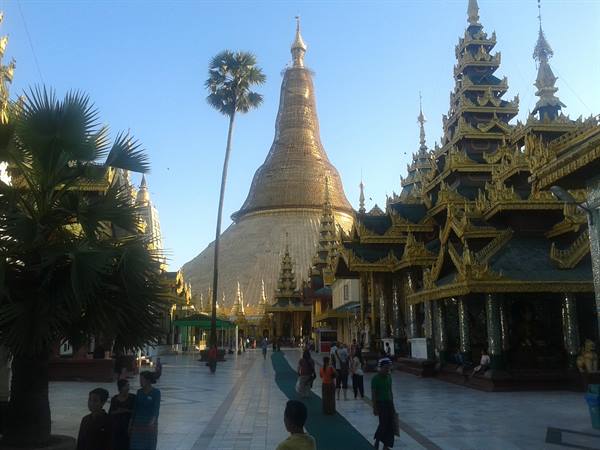
In the morning we are at the bus station in Yangon, in what until a few years ago was the capital of the country. It is still the largest and most modern city in Myanmar. Waiting for us with a vehicle is the driver sent by the travel agency we booked through from Italy. With him we first go to the hotel to drop off our luggage, then into the centre to visit a golden pagoda and a temple where turtles splash about in a pool. We reach the nearby bank of the Irrawaddy with its river port, where an old barge is moored and some men are unloading it, carrying heavy sacks on their shoulders. Colourful little fishing boats cut through the waters of the river; they are similar to those we saw near the Amarapura bridge, with their bows jutting upward. We then stop in an elegant public park with a small lake, from which we observe the golden outline of the Shwedagon Pagoda.
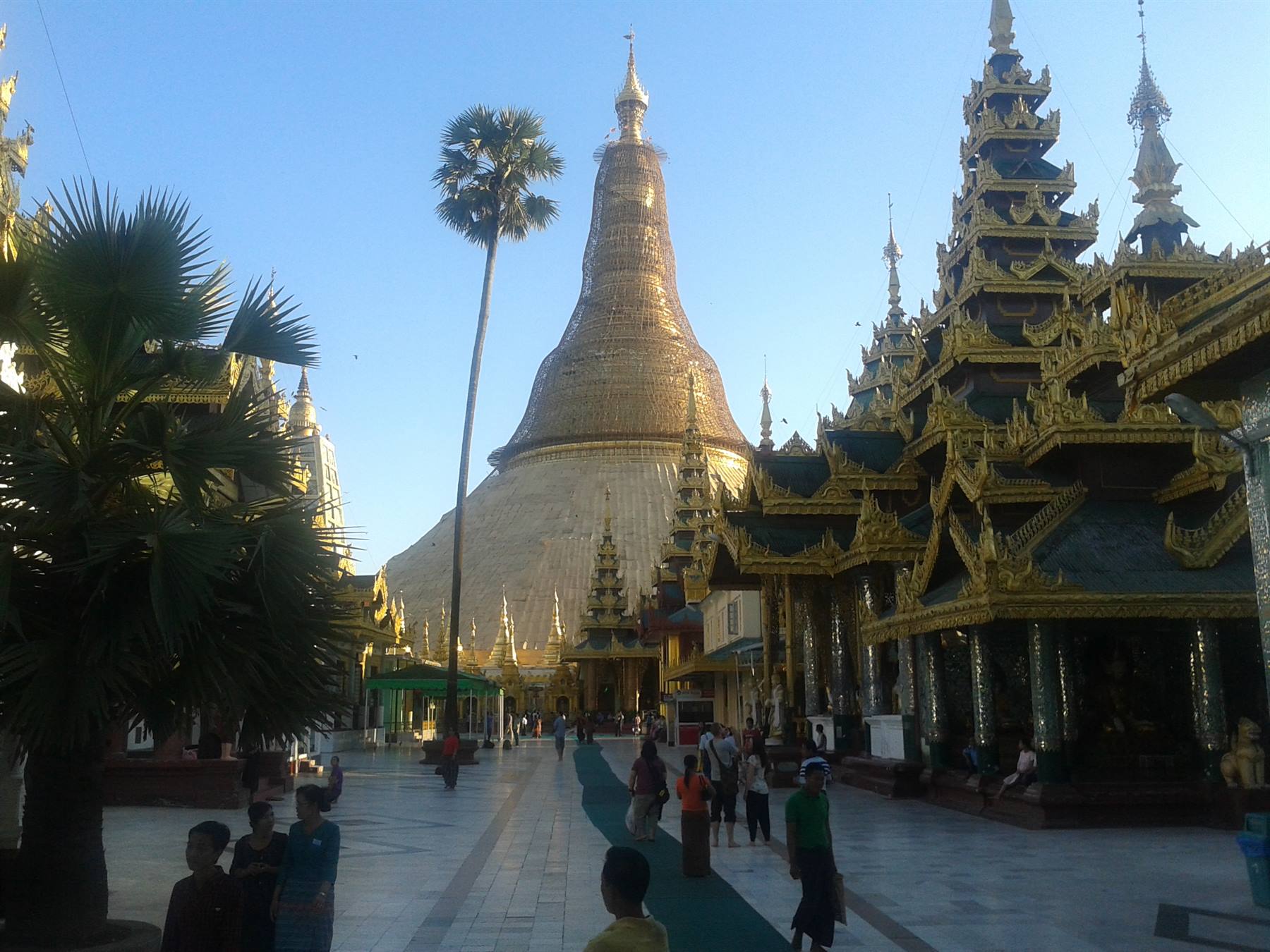
The little restaurants in the park don't have menus that appeal to us, so we ask the driver to take us to the city's renowned Italian restaurant. Located in a residential area, the restaurant is housed in an elegant building; the dining rooms are elegant and clean, the food excellent, the best of the tour. The price, of course, is also decidedly higher, but it was worth it. The afternoon is entirely devoted to visiting the Shwedagon, the golden pagoda considered the largest in the world. It stands on a hill and is indeed very large; unfortunately it is covered in bamboo scaffolding because it is being renovated. This does not prevent us from appreciating its grandeur. We visit the temples that open along its circumference and on the four sides that enclose it. The faithful pray on their knees or sprinkle water on the sacred statues. In the evening they light fires and sing.
There are countless monks and also young people wearing robes of purple-red, orange or saffron yellow. After sunset we return to the hotel with the driver for the night.
Football in the Monastery
Day 929 Dec 1994
Yangoon
Free morning; we visit the streets near the hotel, lined with numerous shops. We then go to visit the Catholic Church, buy something for lunch and wait for the vehicle that will take us to the airport. Along the way we stop at the office of the travel agency that organised our tour to meet the owner. Surprisingly, we are refunded a good part of the cost of the flight we had booked but did not take to get to Yangon from Inle Lake. We weren't expecting that. The agency's vehicle drops us at the airport, from which we depart on an Air Asia flight direct to Kuala Lumpur in Malaysia.
0 reader comments