I arrived in Bangkok with a Lufthansa flight coming from Frankfurt and found lodging, paying 200 Baht, in a guesthouse in the Kao-san road area. At a travel agency I bought both the bus ticket for Chiang Mai, in northern Thailand for 250 Baht, and the visa to enter Myanmar for 1500 Baht, 24 days of validity from the date of entry. The price of the visa varies based on the days within which the issuance is requested. The bus for Chiang-mai leaves at 7 in the evening and arrives at its destination at 7 in the morning the next day. In Chiang-mai I settled in a guesthouse in the evening market area, 250 Baht. In the morning I bought directly at the bus station (Arcada bus station) the ticket for Mai-sai, the border town with Myanmar. There are several scheduled buses a day, price 70 baht, 5 hours of travel.
From the Mai-sai station, with a collective taxi (10 Baht) I arrived in the center and stayed one night in a guesthouse on the main street, 300 baht. In the afternoon I had time to visit the city, it is very small, practically life takes place along the main avenue. You begin to see the first Burmese who cross the border to come to work in Thailand and return home in the evening. Many shops of precious stones. It is worth climbing on foot up the hill on which the Wat Phra That Doi is located to enjoy the sun setting behind the hills that overlook the city of Tachilek, which is located immediately beyond the border in Myanmar. Early in the morning, backpack on my shoulders and passport in hand, I left Thailand and entered Myanmar, the destination of my trip. Having crossed the bridge that joins the two borders, I stopped at the last office.
Under the control of a Burmese official I filled out some forms, paid 20 Thai baht as a tax and received the clearance to enter Thachilek. In Thachilek I bought, at the black market exchange rate, my first kyats, for one dollar 1100 kyats. A tuk-tuk took me for 40 baht to the taxi/bus station, where I made arrangements with a taxi driver, 400 baht for a ride to Kengtung (Kyaingtong) the city that is located in Shan state, in the center of the golden triangle. Under a shelter, I waited 3 hours while the taxi driver looked for at least a second passenger to load besides me. I believe the best thing to do is to go to the taxi station as early as possible, so that one can leave with the first one that fills up.
With the taxi driver I returned to the immigration office at the border and we filled out an additional form in which the names of the passengers and their document numbers were specified. The form then, during the trip, will be presented at every checkpoint. The trip to Kengtung is very beautiful, the road climbs up the hills, and from there you can see fantastic panoramas. It was during the trip that I became acquainted with Betel. All Burmese, or almost all, tuck on the side of their gum a mixture composed of betel root (a tree similar to the coconut palm) cut into pieces, a pinch of tobacco, lime and lemon. All wrapped in a leaf and closed at both ends. It is a mild stimulant, the driver tells me he chews it to keep himself alert while driving. Besides keeping you awake and turning the teeth black, it causes salivation. It is quite disgusting but one has to get used to it.
On the route to Kengtung there are several checkpoints. The driver gets out, presents the filled-out form to the immigration office, my passport, pays a tax, says thank you and sets off again. Each time the same routine, at least 5 times.
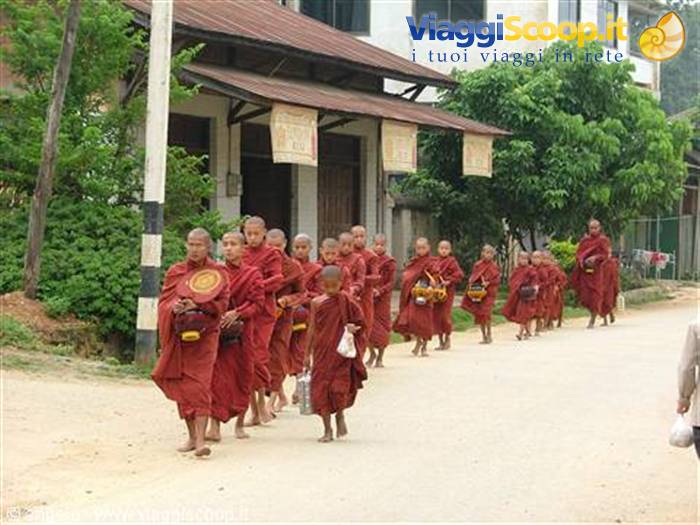
Line of Buddhist monks in red robes with alms bowls walking on dirt road
Day 229 Aug 2005
I arrived in Kengtung in the late afternoon and found a bed in a guesthouse for 4 Usd. (In Myanmar flights and overnight stays are paid in American dollars, while the rest is paid in kyat) From Kengtung it is impossible to continue by land, unless you go back. To continue the trip I had to buy the plane ticket to Mandalay, the second largest city in Myanmar. (72 usd). I made arrangements with a mototaxi driver who acted as my guide. (1500 kyats). The city is built around a beautiful lake, interesting are the wats around the center and the morning market in which members of various tribes from the surrounding hills also take part. The flight with Yangon Airways leaves at 15 and arrives, after a quick stop at Heho, in Mandalay around 16.30. From the airport, which is about 20 km from the city, I split the cost of the taxi trip to the center with another passenger (9000 kyats).
I had myself dropped off in front of a guesthouse where I took lodging (4 usd with breakfast). In the guesthouse I met people with whom I split the cost of the taxi driver who, for a few days, accompanied us on trips outside the city. I visited many places, villages and temples. Not to be missed are Amarapura, Inwa, Sagaing and the Monywa caves. After visiting the fort, Mandalay hill, the covered market, and various temples, a visit to a tea house is a must. You can drink a tea in which very sweet condensed milk is diluted and eat pastries while chatting with the locals, a good moment to socialize. The Burmese are very cordial, polite and willingly talk with a foreigner (kalabwa) especially about sports, and if you then have some knowledge of the most important European football championships it is even better.
In the evening there is often no electricity, so if you intend to go out on foot it is better to equip yourself with a flashlight, the streets are completely dark. To get around the city I rented a bicycle and took public buses. In the guesthouse where I stayed, I bought the bus ticket to continue the trip to Kalaw. (4200 Kyats) Departure at 6 in the evening to arrive at 5 in the morning the next day. Here too I found lodging for 4 dollars with breakfast. Kalaw is small, you can easily get around on foot. Various treks with local guides allowed me to visit some of the villages in the area. An excursion to the Pindaya caves, perhaps as a day trip, is something you have to do. To get there, since they are about 50 km away, you can rent a taxi or use a public bus. From Kalaw I continued, again by bus, towards Nyaungshwe, the city that is located on the shores of Inle Lake.
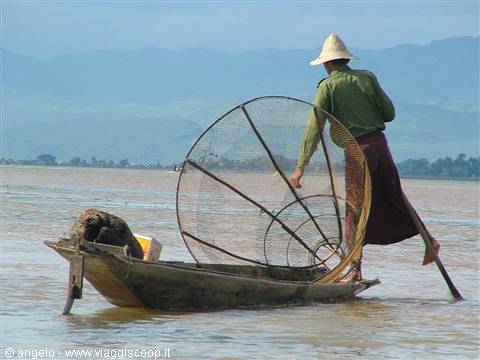
I rented a boat and visited the lake and some markets of the villages that overlook it. To access the lake you pay three dollars. The lake is very beautiful, a mirror of crystalline water surrounded by mountains. The floating crops are to be admired. Having rented a bike, I toured the city and the surroundings for a few days. For 7000 kyats I bought the bus ticket from Nyaungswe to Nyaung-U, the city you reach if you want to visit the temples of Bagan. Departure at 5.30 in the morning and arrival at 4.30 in the afternoon with a public bus. Along the way, around Meiktila, a stop for lunch, 800 ks. The bus stops in front of a police post where you have to pay the 10 usd that allow you to visit the temple area. A trishaw driver left me in front of the guesthouse (7 dollars with breakfast) where I had decided to stay.
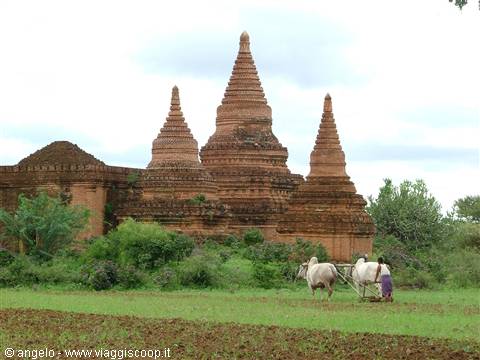
I found it very convenient to reach the temples by bicycle, rather than on foot since the distances are great. Bagan is a wonderful place, the temples are in the hundreds and cover a plain of 40 sq km. I stayed a few more days than planned, it was worth it. From Nyaung-u you can participate, relying for the organization on the guesthouse where you are staying, in a short one-day trip towards Mount Popa, home of the Nat (nature spirits). If you want to deepen your knowledge of the cult of the Nat, you must visit the Shwezigon Paya which is located just outside the city. In fact it is here that the statues of the 37 spirits are kept, the one protecting travelers is Ko Myo Shin. Going to visit the Shwezigon Paya you can notice that although the official religion is Buddhism, many Burmese believe in the cult of the spirits.
Many are those who, with reverential fear, go to pay them homage by making offerings in money or flowers. The bus ticket for Yangon, for a trip that began at 3 in the afternoon and ended at 6 in the morning the next day, cost 6500 kyats. The taxi to the Sule Paya area cost 3000 kyats and the guesthouse 8 dollars with breakfast. The Sule Paya area is excellent if you want to visit the most important temples and some markets on foot. The places to visit are many. There is only the embarrassment of choice. It depends on the time you have available. After a few days spent in Yangon, with a Biman flight (86 usd), I returned to Bangkok from where I continued to Frankfurt and then Italy.
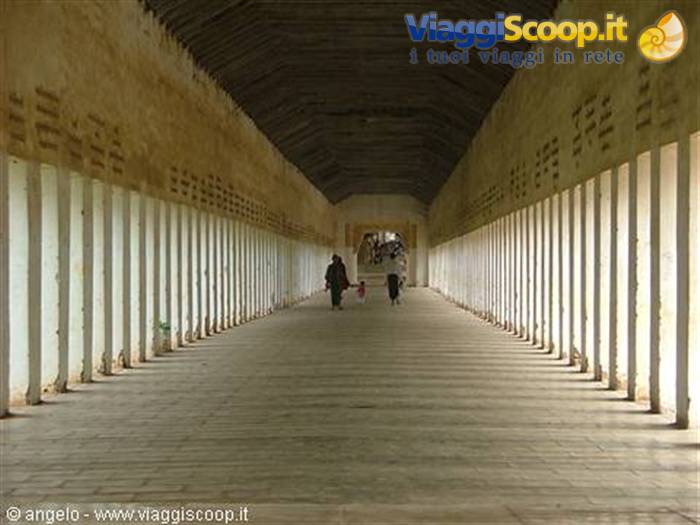
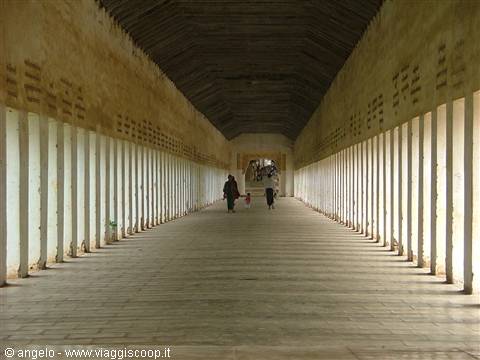
Long corridor with rows of white columns, ochre walls, few walkers
Day 330 Aug 2005
Over the course of the trip I changed money several times, always on the black market. The rates varied from 1100 Kyats to 1250 kyats for a dollar. In Yangon avoid changing in the area around Sule Paya; even if apparently favorable rates are promised, the possibility of being cheated is high. Internet access is not always easy. Many of the most frequented sites are censored. With a hotmail.com address you have no problems checking and sending emails. Phoning is expensive, from 4 to 8 dollars a minute. I phoned from the guesthouse and from the communication centers of Mandalay and Yangon. Before leaving and during the trip I followed the antimalarial prophylaxis. Eating is very cheap, an average of 1.5 dollars for lunch. Overnight stays start at 3 dollars for a room with fan, shared bathroom and breakfast.
Bus tickets can be bought either directly at the departure station, at least one day before, or in the guesthouse or hotel where you are staying. In this case you pay a small commission. Renting a bike costs 1000 kyats for a day. It is a cheap country to travel in, where getting around is slow and tiring. If you don't have great demands and skip the visits to sites where you pay an entrance fee, a budget of 5 dollars a day can be enough, domestic flights are best bought on the spot. From the point of view of safety I had no kind of problem, only in Yangon the police checked my camera. I was in an off-limits area and they thought I had taken some shots.
Unfortunately it is a country strangled by a despotic military regime that leaves no room for any form of democracy and freedom of opinion (every type of communication is filtered and censored), going so far as to trample on and despise human rights. It is good to know this. I believe that a form of "intelligent" tourism can help a population among the poorest in Asia. You can stay in family-run establishments, for getting around use private companies, when negotiating a price maybe don't dig in your heels for a few cents but give in, for us it's 10 cents of pride, for them it could be the only earnings of a day and, when you go out, don't insist on finding the place that the tourist guide we have in our hands praises so much, extolling its quality and convenience, but look around, there are many others that deserve to be visited and have the misfortune of not being mentioned.
The Burmese love to talk a lot, both because they are curious, and because in this way they get practice in a foreign language, so granting them a chat could please them very much. Myanmar is a country to be lived in a spiritual manner, immersing yourself completely in the daily life of the cities and villages. Interacting with the locals and stopping to listen, exchange opinions, curiosities, anecdotes, is the true wealth that can be gained from a trip to this country, because it is precisely the people who make it one of the most fascinating places in Asia. If anyone were interested in other information of a general nature or specific to a topic or place, or in a simple exchange of opinions, please write to me; I will be very happy to answer. For now, greetings and happy travels.
Angelo
e-mail: taggl@iol.it
Useful links:
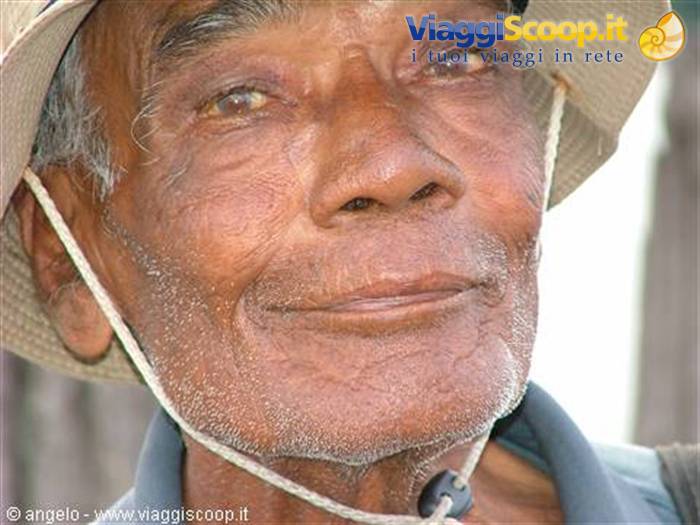
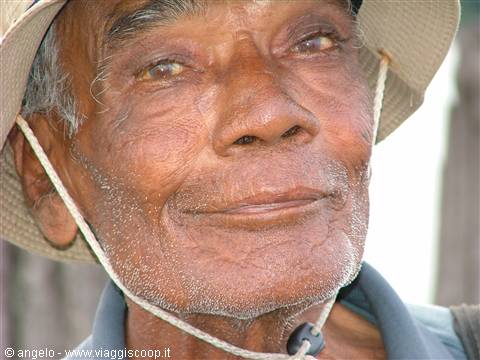
Wrinkled face of an elderly man wearing straw hat, natural light


0 reader comments