Kuramathi, Kandholudhoo, Ukulhas, Veligandu, Male · Ari, Rashdoo,Male Nord
When
13 Jan 1999 – 21 Jan 1999 9 days · trip of 1999
Who
antonio · @antonio ·
How
Travel diary
The story · 9 days
For a person like me who has seen many places around the world, it's difficult to get as enthusiastic as over a trip to the Maldives. No adjective does justice to the spectacle of nature in which I was able to immerse myself for a week. Of course, having hit on the right atoll for my holiday in a vast roulette of offers was also decisive. Luck then had it that, with the help of the internet, I came up with a very interesting price despite the high season, and here I am flying from Bologna to Male.
Day 113 Jan 1999
the departure
I leave behind a particularly cold winter and the snow found on the Apennines during the transfer to Emilia. The night flight prevents any view from the window; a shame, because we fly over Croatia, Serbia, Bulgaria, Turkey, Syria, Saudi Arabia, Qatar and Oman. Dinner and breakfast on board, friendly staff but not all the monitors work. On the plus side, this flight is half empty, so we fly more comfortably, although I won't manage to doze off. Tomorrow morning dawn will catch us over the Indian Ocean.
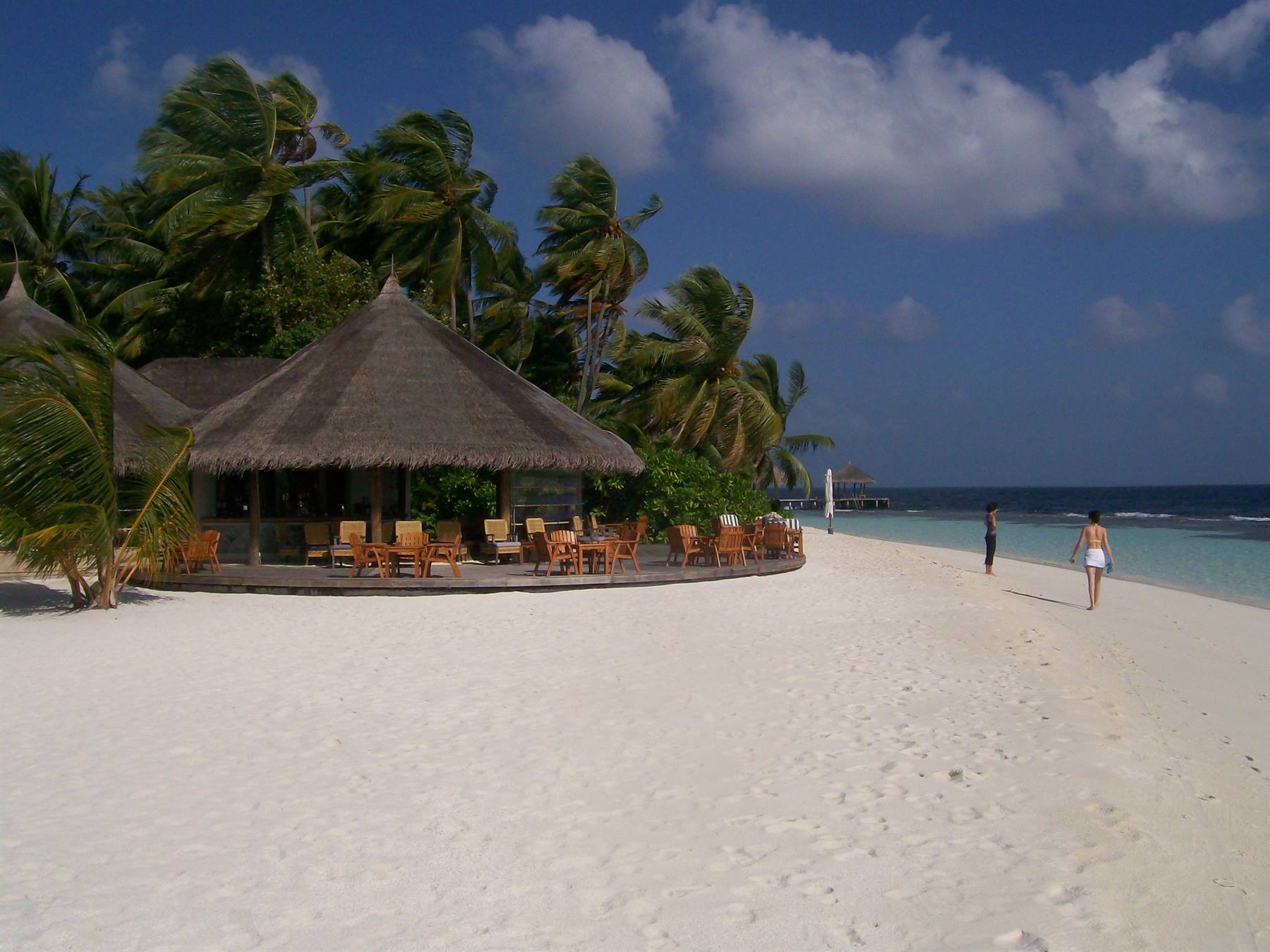
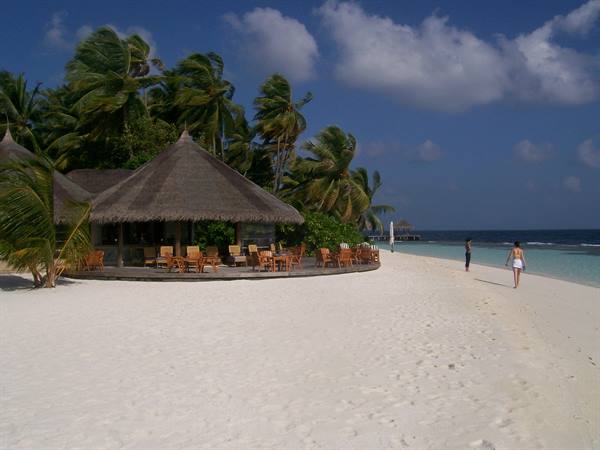
Kandholudhoo restaurant
Day 214 Jan 1999
Arrival in Kuramathi
As expected the sun rises while we fly over the Indian Ocean then, after a few hours, we spot the first atolls which from here appear as little dots scattered across the immensity of the sea. The northern islands are sunny but as we proceed the sky becomes increasingly cloudy. To land we pass through a thick blanket of clouds that precedes the landing at Male. In fact the capital's airport is located on an island opposite, Hulule, which it occupies entirely. A narrow stretch of sea separates it from the city, the only one in the archipelago, which completely occupies an island of 2 km by 1 with multicoloured buildings. After the quick check-in we ask at the Universal Resort desk about the transfer to Kuramathi, an island I know very little about.
After an hour, with a fast ferry we set off for the Rashdoo atoll, one of the smallest among the 26 that make up the Maldives, an archipelago that extends over the Ocean for more than 800 km from north to south. During the transfer we pass in front of the islands of Male's hinterland whose seas are plied by large cargo ships, the sky is cloudy and when we leave the North Male atoll to head to the Rashdoo one it even starts to rain. I even manage to sleep, waking up near Kuramathi. The weather is bad but the island looks beautiful despite the gloomy day. At the reception we are welcomed by the Italian staff member with an aperitif and a small refreshing towel, we are given the island map and an information booklet, then an attendant leads us to our bungalow.
The accommodation looks like a circular hut with masonry walls and a thatched roof, the furnishings are colonial style, it is spacious, has a good double bed, fridge, numeric-code safe, ceiling fan, air conditioning, bathroom with shower and hairdryer. The entrance is preceded by a small terrace with two plastic armchairs and a small table, the sea is literally two steps away and so is the reef. Once we've put our things away we go to lunch, we are on full board and our restaurant is the Haurage. The long dining room overlooking the sea is made up of two large semicircular wings covered by a wooden hut-style roof separated by the two common areas where the buffet is served. The first buffet area offers starters, bread, fruit and desserts, the other first and second courses.
We are assigned the table that will be ours for the entire duration of the stay, the waiter assigned to us will take care of the drinks which are not included in the package and which we will settle at the end. Our intention is to drink only water even though it costs almost 5 euros a bottle, it is the best thirst-quencher. The food is good and varied, alternating international cuisine dishes often reworked with oriental flavours alternated with specialities from this geographical area. There are various types of bread, numerous starters, a vast assortment of side dishes and salads. You can choose between at least three second courses, there is always a type of pasta, tropical fruit from the region, a good tropical fruit salad and some decent desserts that can be topped with vanilla, red berries or chocolate. It can definitely be said that the meals are good, varied and abundant.
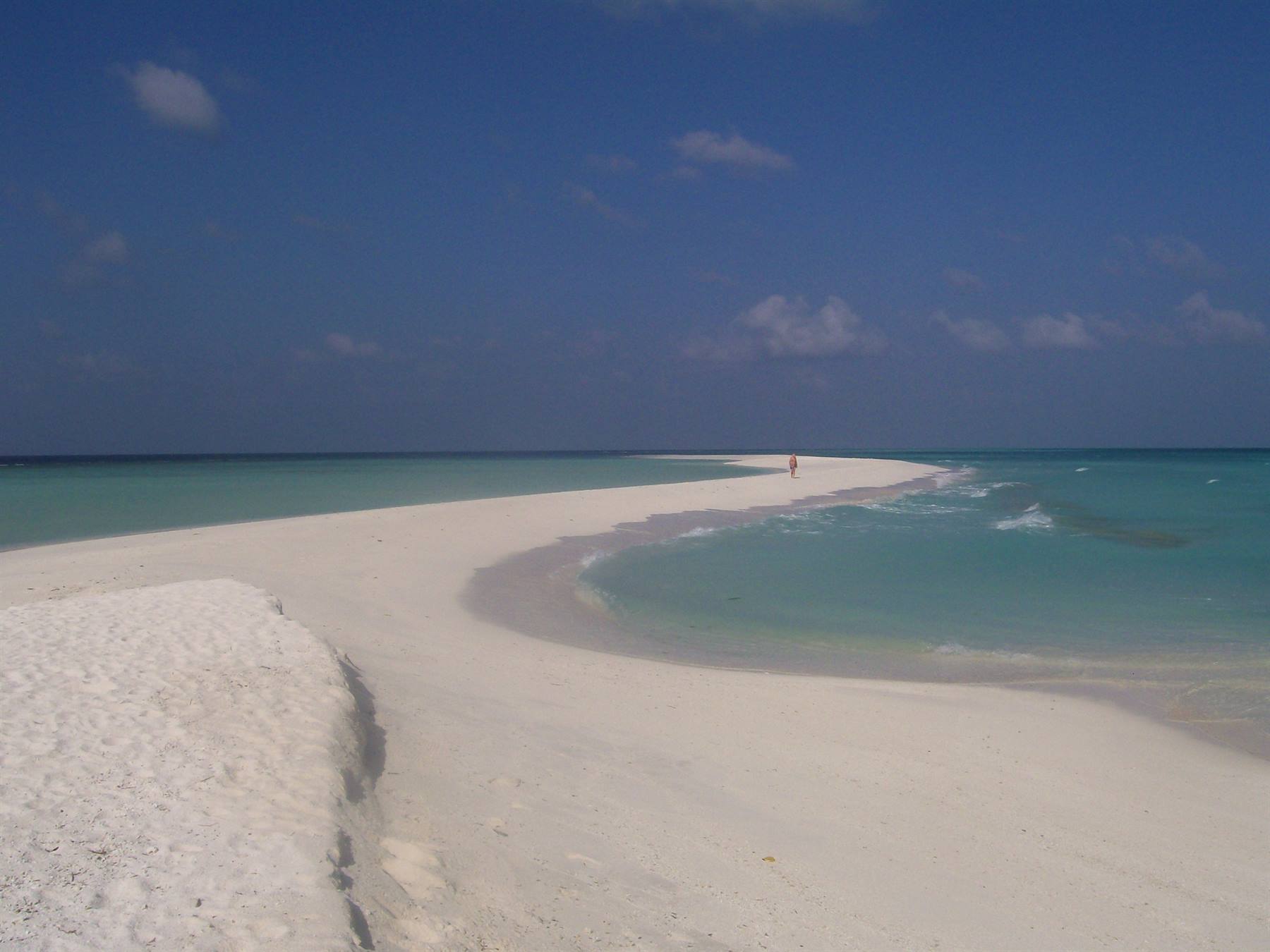
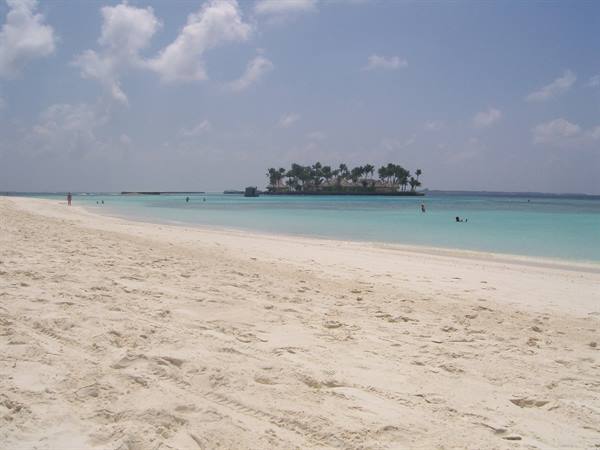
After lunch we return to the bungalow for a nap then we do a reconnaissance of the island. Kuramathi is not the classic circular atoll but an island that occupies a small part of the coral reef that forms the Rashdoo atoll which, with its 10 km diameter, is among the smallest of the Maldives. Its territory stretches for 1 km and 700 metres and at its widest point measures 500 metres then thinning out more and more until the strip of sand that projects into the sea and whose dimensions progressively increase during low tide.
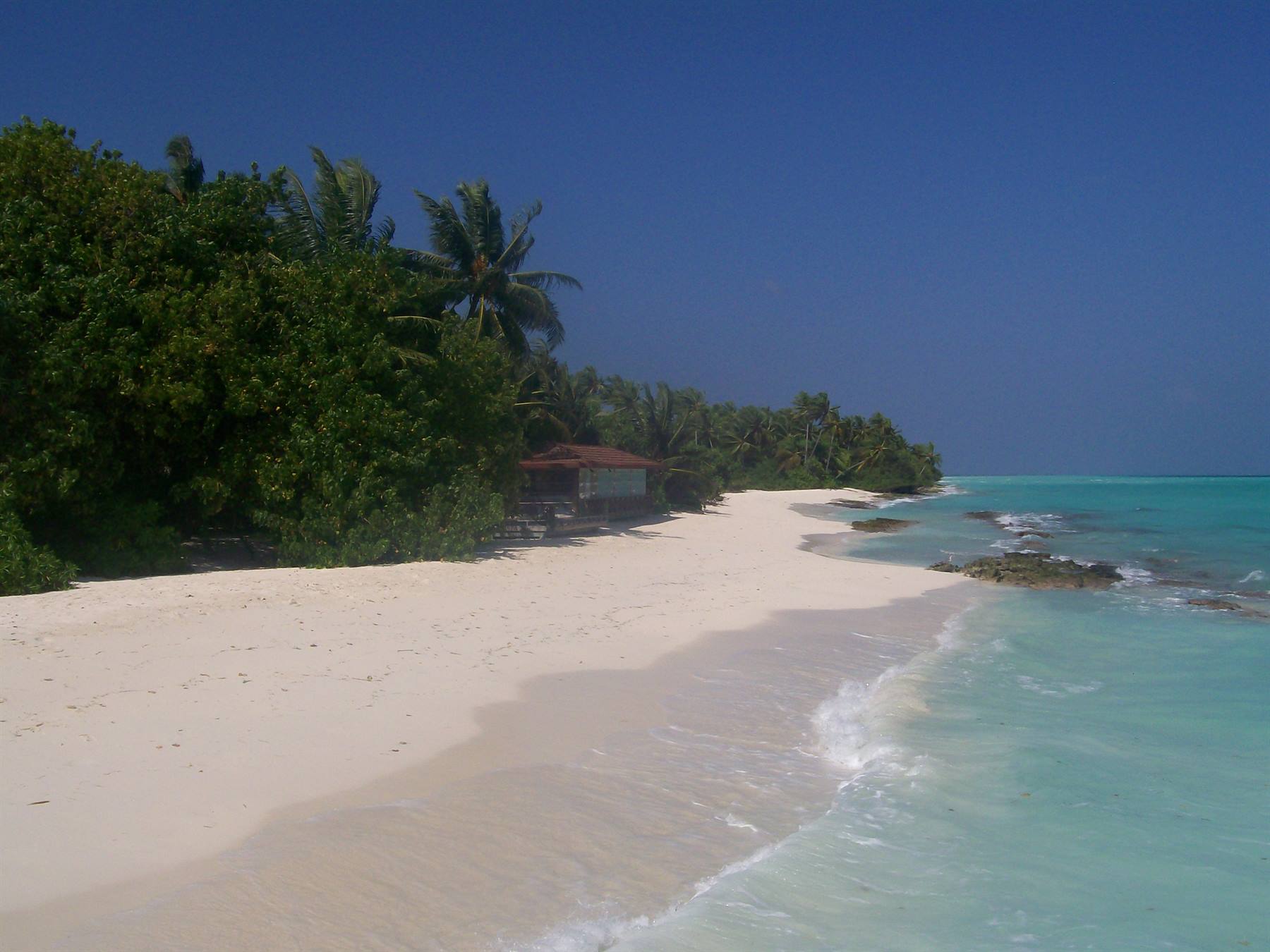
Despite these limited measurements Kuramathi is one of the largest islands of the archipelago!! To the south the island is washed by the Indian Ocean whose waves break on a reef located a few metres from the coast, to the north the beach is wider and lapped by the internal lagoon which however does not have important coral formations, to the east where it reaches its maximum width it faces the channel that separates it from the island of Rashdoo, to the west it thins out into the narrow sandbank. The interior has rich tropical vegetation, a veritable botanical garden with coconut palms, banana trees, lianas and multicoloured flowers. Immersed in this jungle are the bungalows of various types, from one like ours to the cottage.
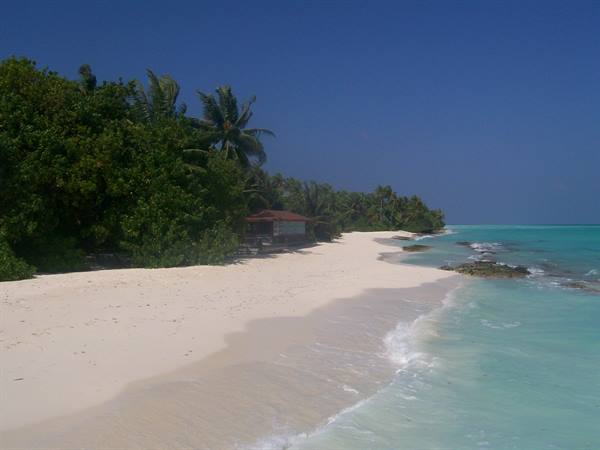
Kuramathi is so "big" that it can host three resorts, the Village where we are staying, the Cottage & Spa equipped with a sea terrace for massages and the luxurious Blue Lagoon. We have free access to all three but the services offered by the package refer only to the Village. During our exploratory walk a few rays of sun also manage to make an appearance but it is windy, we nevertheless reach the famous sandbank which we walk all the way to the end. We come back via the beach on the lagoon which appears more wild with the towering palms swaying in the wind and the vegetation brushing against the sea. Despite the gloomy day and a bit of rain the reconnaissance is complete and the island fully satisfies us even though it is not the classic coral atoll that we expect to see on one of the excursions offered by the resort.
For this reason at the reception we immediately book the Island Hopper for the following morning, a mini-cruise to discover three islands. After an excellent dinner at the restaurant we go to the room with the umbrella they provided us and which kept us company all day. We were expecting tropical sun but we are less than 400 km from the equator and these disturbances are predictable. Also due to the latitude the hours of day and those of night are equal, there are no seasons and at 18.30 it gets dark. Once at the bungalow we find the letter informing us that due to bad weather the excursion is cancelled. In fact during the night a heavy downpour pours over the island but we are too tired to be distracted from sleep.
Kandholudhoo
Day 315 Jan 1999
Kuramathi
After the overnight downpour even the morning isn't among the best, throughout the day we will witness brief clearings, timid rays of sun, wind and rain. Also for today it is essential to use the umbrella provided by the resort. A positive note is that with this weather the photos of the vegetation and the beaches come out decently because the sun doesn't interfere. The small jungle is alive, you hear strange cries of exotic animals louder than the rustle of the wind that shakes the tall palms and you see unusual animals. Even the fauna I know here takes on other appearances, large geckos have particular colours, harmless snakes roam among the leaves, with the falling of the evening bats of considerable size hang from the branches of the trees and small crabs climb up from the waves to dig deep holes in the sand.
On the shore strange birds similar to seagulls observe the sea moving gracefully while other birds similar to woodpeckers flutter among the vegetation that juts out over the sea. All these animals don't pay too much attention to us humans and don't flee at our passing. The jungle is very well cared for, early in the morning the numerous staff of the island rake the sandy little roads that cross Kuramathi, prune the plants, pick the coconuts. We also experience breakfast, an abundant and tasty buffet where you can savour continental, Anglo-Saxon and American specialities. There are scrambled eggs, hard-boiled ones, bacon, green beans in ketchup, cold cuts, wurstel, croissant, donut, plumkake, various types of bread, classic and tropical jams.
Exceptional the exotic fruit such as pineapple, papaya but also watermelon and small bananas as well as a very good yoghurt with fruit, not the creamy one eaten in Italy but the one made with live lactic ferments. During the morning between one downpour and another we find the time to spend a bit on the beach and have the first swim in front of our bungalow. After the abundant lunch we rest in bed for a couple of hours then we move to the other side of the island, onto the large beach that
Ukulhas
Day 416 Jan 1999
from Kuramathi to Kandholudhoo
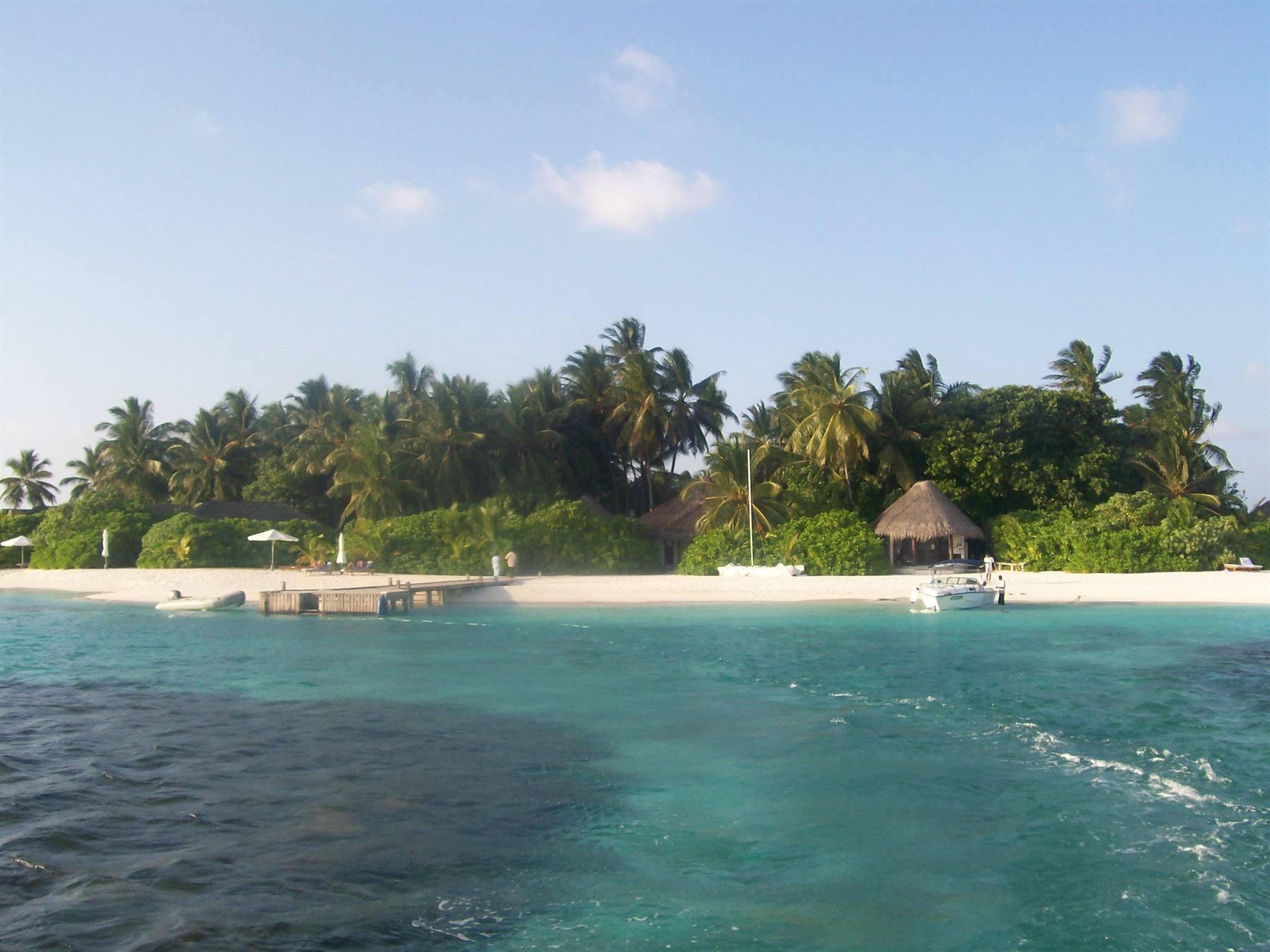
We finally wake up to sunshine, pack just the bare essentials into a small backpack, have breakfast at the restaurant and head to reception to wait for our departure on the excursion to Kandholudhoo. We board a motorboat along with two Russian couples; the sea is calm and the sky is clear. Along the way we spot some islands in the distance and pass close to a sandbank in the middle of the Ocean. Without realising it we have entered Ari Atoll and we head straight for our destination, one of the many islands it encloses, themselves enclosed by a reef and therefore atolls in their own right. As we get closer the outline of the island takes shape, finally a classic Maldives atoll, the way people generally picture the tropics.
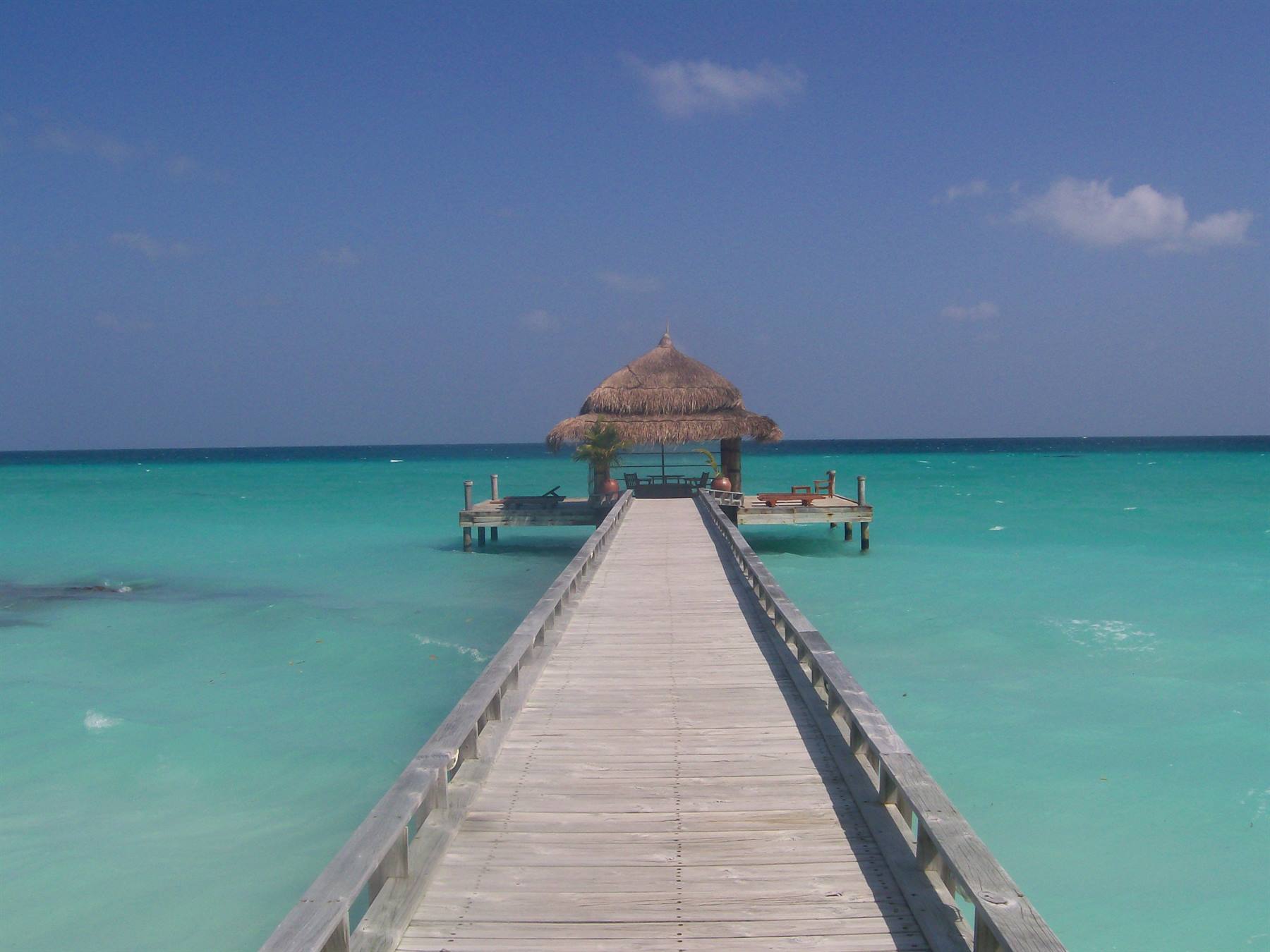
We land on a wooden jetty that straddles the reef and are welcomed into the tiny reception with a delicious exotic fruit ice cream and the usual water-soaked towel to freshen up. An attendant shows us the massage room overlooking the sea, then leads us to our accommodation. The bungalow is very elegant: it has a comfortable bed, the minibar that we won't use, the instant coffee machine, a large plasma television showing satellite channels, beach towels and soft bath towels. The bathroom with shower is outdoors, as in all luxury Maldives accommodations, and the beach really is just a couple of steps away. Reconnoitring the island is extremely quick; Kandholudhoo, also known simply as Kandholu, is a tiny island entirely surrounded by a very close coral reef with two artificial passes.
The narrow interior is covered with palms and not very varied vegetation, and everywhere there is nothing but sand. Despite its very small size, you can walk the whole way around it in five minutes; you only need to move about twenty metres and the environment and weather conditions change: on one side the sea is perfectly calm, on the other there is wind and rough water; on one side the sand is impalpable, on the other the beach is made of very fine coral grains. The whiteness of the beaches, the lush tropical vegetation, the emerald sea enclosed by the reef make Kandholu a paradise island, one of the most beautiful places I have seen in my many travels. But that's not all: the atoll's reef is one of the most beautiful in the entire archipelago and you only need to set foot in the water to find yourself among manta rays, small sharks and other multicoloured fish.
I walk around this island several times; it delights me with its splendour. Kandholudhoo, more than a resort, is a spa: there are only 16 bungalows, the massage room, the reception and a restaurant with a bar next to it. My excursion package includes full board and the restaurant offers elaborate à la carte dishes served by friendly waitresses in a characteristic setting with sand instead of a floor. Here there is nothing to do but enjoy sweet idleness, strolling on the beach or watching a splendid sunset enriched by a large boat moored offshore. On the island energy is scarce, so it must be used sparingly; there is no hairdryer in the room, we are given a torch and dinner at the restaurant is by candlelight. We go back to our room fully satisfied with the place, the weather and this splendid day that is drawing to a close.
Veligandu
Day 517 Jan 1999
magnificent Kandholudhoo and back to Kuramathi
A splendid sunny day awaits us; it's as hot as it is at home in August and the sea around at least half the island's circumference is like a millpond. A couple of steps bring us to the restaurant, which sits right on the boundary between the dry zone and the one where, as yesterday, a bothersome wind blows. In practice, within the very small space of the restaurant it's enough to choose the right table facing the non-windy part of the island to be perfectly comfortable. Breakfast is a buffet and our very kind waitress simply brings us tea and coffee. On a boat converted into a display stand there are fresh fruit, tropical juices, pancakes with maple syrup and other treats. I don't stuff myself because late in the morning I've booked snorkelling with the kind German lady who runs the small Dive Center. To help digestion I take my umpteenth short walk around the island.
The two Russian couples who arrived on the island with us also join the snorkelling. Once we've put on the masks, snorkels and fins rented at the Dive Center, we go to the jetty where we landed yesterday to tackle the outer reef, but the sea at that point is too rough so we are forced to give up. We reach the reef from one of the two artificial passes and before our eyes opens the spectacle of a living barrier with colourful corals and multicoloured fish. Unfortunately the sea, which isn't exactly calm here either, doesn't allow optimal visibility. Back on shore, we return the equipment and spend the day lazing on the beach, dipping now and then into a crystal-clear sea where we often spot manta rays and other fish. Of course our sweet idleness is interrupted by lunch at the island's lovely restaurant, with a thatched roof and sand floor. At 5 p.m.
we board the boat from the jetty for Kuramathi; the sea is rough, so with the outward-bound boat we simply reach a very fast vessel that will take us back to our resort in less than an hour. We arrive just in time for dinner, enthusiastically tell the people we've become friends with at the resort about our wonderful excursion, and after the meal we go to visit some of them in the cottage where they are staying. We return to our bungalow happy after an unforgettable day.
Madivaru
Day 618 Jan 1999
snorkelling day
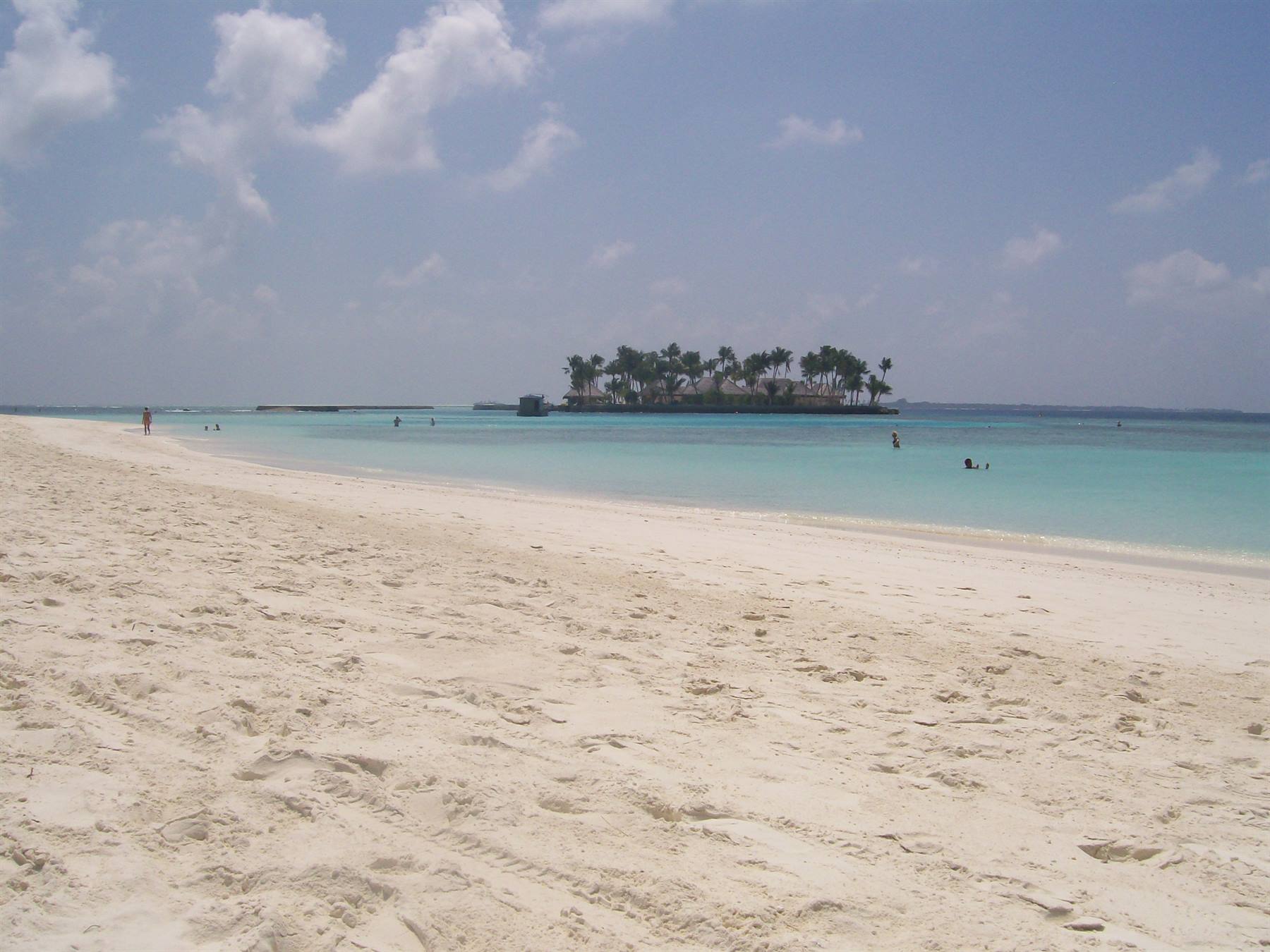
Today is another splendid sunny day; I take advantage of it and get up early to go and see the phenomenon of the low tide that extends the island's sandbank. After a long walk through the beautiful botanical garden that forms the interior of Kuramathi I reach the sandbank. The sun reflects so strongly off the pale sand that it's almost impossible to keep your eyes open. The clear waters of the Ocean and of the inner lagoon meet where this tongue of soft sand ends. The gentle motion of the waves visibly narrows the stretch of beach reaching out towards the sea, now isolating a part of it that later, as the tide rises, will certainly swallow it up. Rolling up my trousers, I walk in the water until I reach the part of the sandbank already separated from the rest of the island. I retrace my steps back to reception; this morning I skip breakfast because the "Snorkelling Safari" awaits me.
After renting the equipment at the Marine Shop I board a motorboat with numerous other people; it takes us in front of the uninhabited islet of Madivaru. Here, together with the others, I dive in, not without difficulty because the sea is rough and the waves end up letting water into my snorkel. I manage to see the seabed with corals and fish, but when I get back on the boat I feel ill; perhaps having swallowed salt water, certainly the rough sea, makes me nauseous, so I prefer to lie down and close my eyes, giving up my place in the second part of the snorkelling in front of the island of Rashdoo. After lunch, taking advantage of the rented equipment, I snorkel in the waters near our bungalow, where plenty of fish anyway swim among the corals. Towards evening we walk to the Blue Lagoon resort, where every day a Maldivian boy has trained the rays to take food from him.
These strange diamond-shaped fish, which generally flee if you approach them and which have a venomous tail, come up to this boy as if they were little dogs, literally jumping all over him. In the evening, after dinner, we go with some friends to the beach bar facing the island of Rashdoo to drink a fruit cocktail by candlelight. There is a black lady playing a keyboard, and we take the opportunity to dance. We have reached the end of this very pleasant day too, and we return to our accommodation.
Kuramathi,sandbank
Day 719 Jan 1999
relax
No excursions today; we'll devote ourselves entirely to the island. After breakfast I take my usual walk to the sandbank; it's good for shedding a few pounds, seeing how much and how well one eats here. Indeed, there and back is about 3.5 km, not counting the many other walks during the day. Besides, I don't like sprawling out sunbathing; I prefer a good walk surrounded by nature. Once I reach the beach in front of our bungalow I go in to repeat yesterday evening's snorkelling; today, helped by the low tide, I reach the artificial pass that leads onto the reef, but I can't go any further because the water is too shallow to swim. So I watch the fish swimming among the corals near the shore. Unfortunately, besides the beautiful marine life there are many "sea jerks", which frankly are a bit disgusting.
You also have to be very careful of the stones and corals because they can cut you, so even where the water is very shallow I walk with the fins on my feet, which I've decided to keep, along with all the equipment, for today as well. After lunch, another walk around the island for a full immersion in the lush tropical vegetation, then on the beach in front of reception where we have arranged to meet some friends of ours. Here I do better snorkelling than in the morning; there is another artificial pass where the deeper water lets me observe a good part of the reef. The fish are numerous and I also spot some harmless little sharks. We laze on the beach for a while, take a walk to the water bungalows, then go to dinner. Today has been a beautiful day too; tomorrow another excursion awaits us, the one that had been cancelled due to bad weather on our second day at Kuramathi.
Kuramathi
Day 820 Jan 1999
Island Hopper
Today also promises to be a splendid summer day, and at last we can do the Island Hopper, the excursion I was really keen on. We are just above the equator, and at these latitudes there aren't the seasons as we know them; the temperature, both in the sea and on land, is more or less constant, and although the sun beats down hard it is tempered by the wind that blows over the islands. In practice, the difference between one day and the next is made by the downpours, like the ones we witnessed on the first two days, and by the strength of the wind. Today there is only a very light breeze, which makes the day perfect for the excursion but not for our skin. With the breeze you don't feel the real strength of the sun's rays, which end up tanning us excessively.
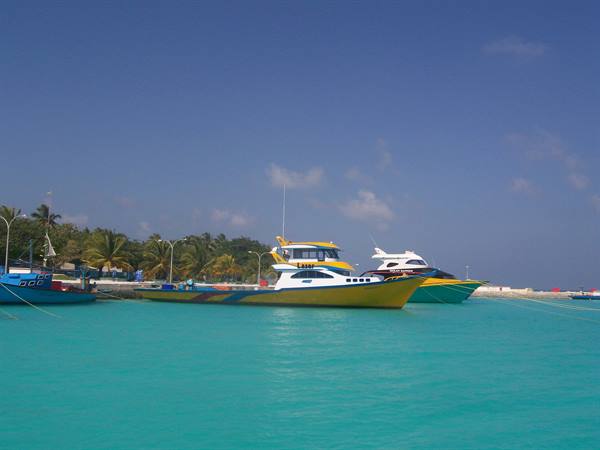
After breakfast we set sail from the main jetty on the same motorboat as the snorkelling safari; we are 37 tourists of different nationalities, 3 crew members and an Italian guide who speaks at least four languages. We leave Rashdoo Atoll for Ari Atoll, making a stop, after passing close to an isolated sandbank, at Ukulhas. This is one of the 200 islands inhabited by the Maldivians, a cordial people of short stature and dark complexion mainly devoted to fishing and boatbuilding. They speak a language derived from Sanskrit written in incomprehensible characters, and they profess the Muslim faith, which is why the women, even though not obliged to, wear the veil and long garments. The women in our group also cover their shoulders and knees as a sign of respect.
We stroll along the dirt streets of the village, where only a few scooters circulate; a few shops face the harbour and the main street. The houses look shabby on the outside, but peeking through the windows you can glimpse that they are well kept inside. It seems they live their miserable condition with dignity; the women are busy sweeping these dusty streets, tending their sparse courtyards from which some breadfruit or water fruit, a local fruit, sticks out. On the island, which is home to about 400 people, there is a small first-aid medical post, a tribunal that deals with minor disputes and a well-kept school, because it seems great interest is taken here in education and the Maldives is the South Asian country with the fewest illiterates. That is why they are proud to show us the neat school, where the children are all in uniform, attentive to their teachers.
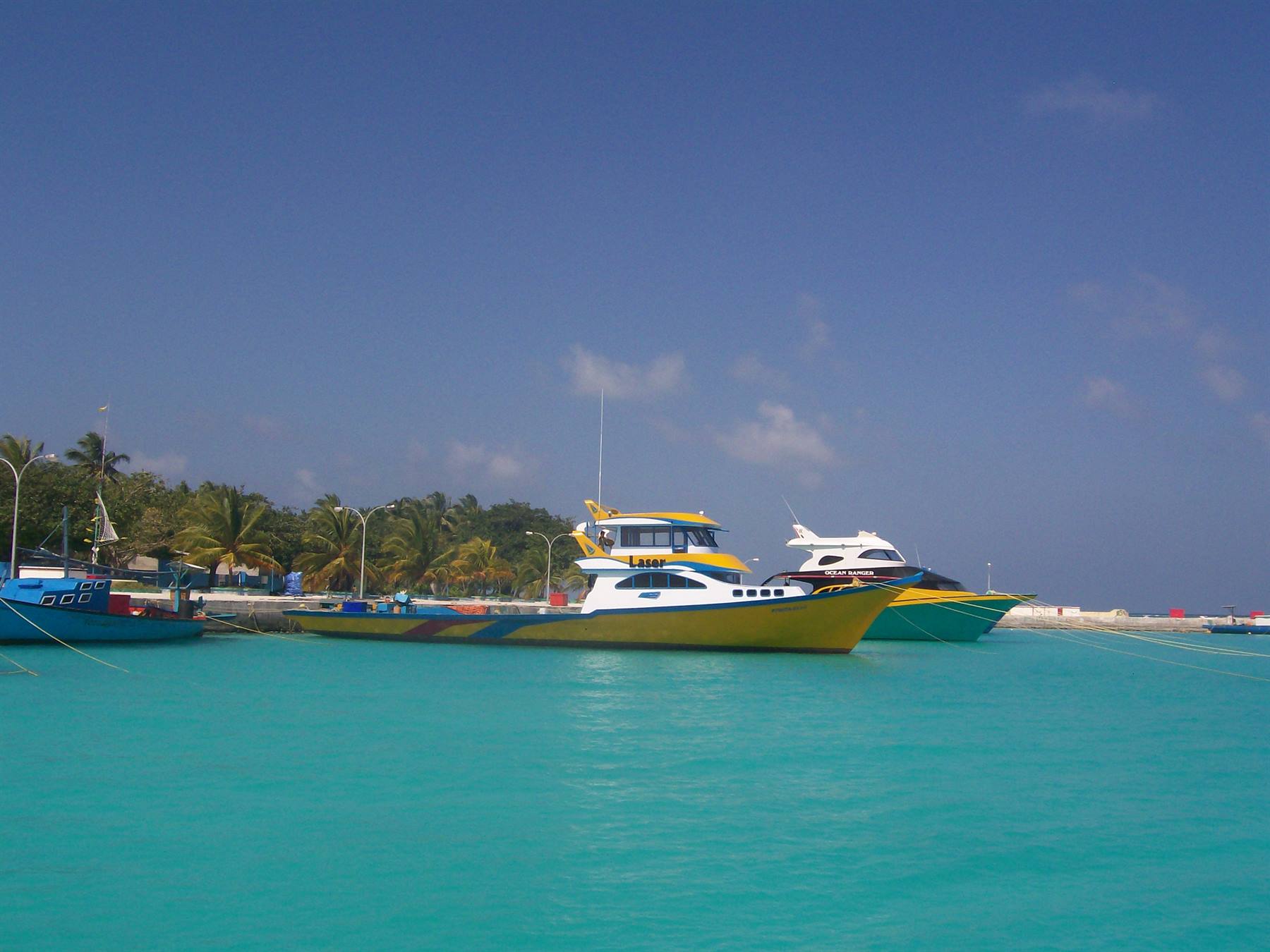
We also go to see the shabby shipyard where brightly coloured fibreglass yachts are built, apparently costing around 400,000 dollars, an enormous sum considering that the average wage of these people is 150 dollars. On the dusty road leading back to the harbour, a sweet little girl of about a year and a half first watches my partner attentively, then runs up to her and hugs her, a gesture that melts our hearts. One last look at the little harbour, where brightly painted fishing boats contrast with the emerald sea. We leave Ukulhas with the memory of that tender little girl and with the awareness that the Maldives is above all this, and not just the 82 polished resort islands. We continue our mini-cruise, passing in front of Kuramathi to reach the island of Veligandu in Rashdoo Atoll.
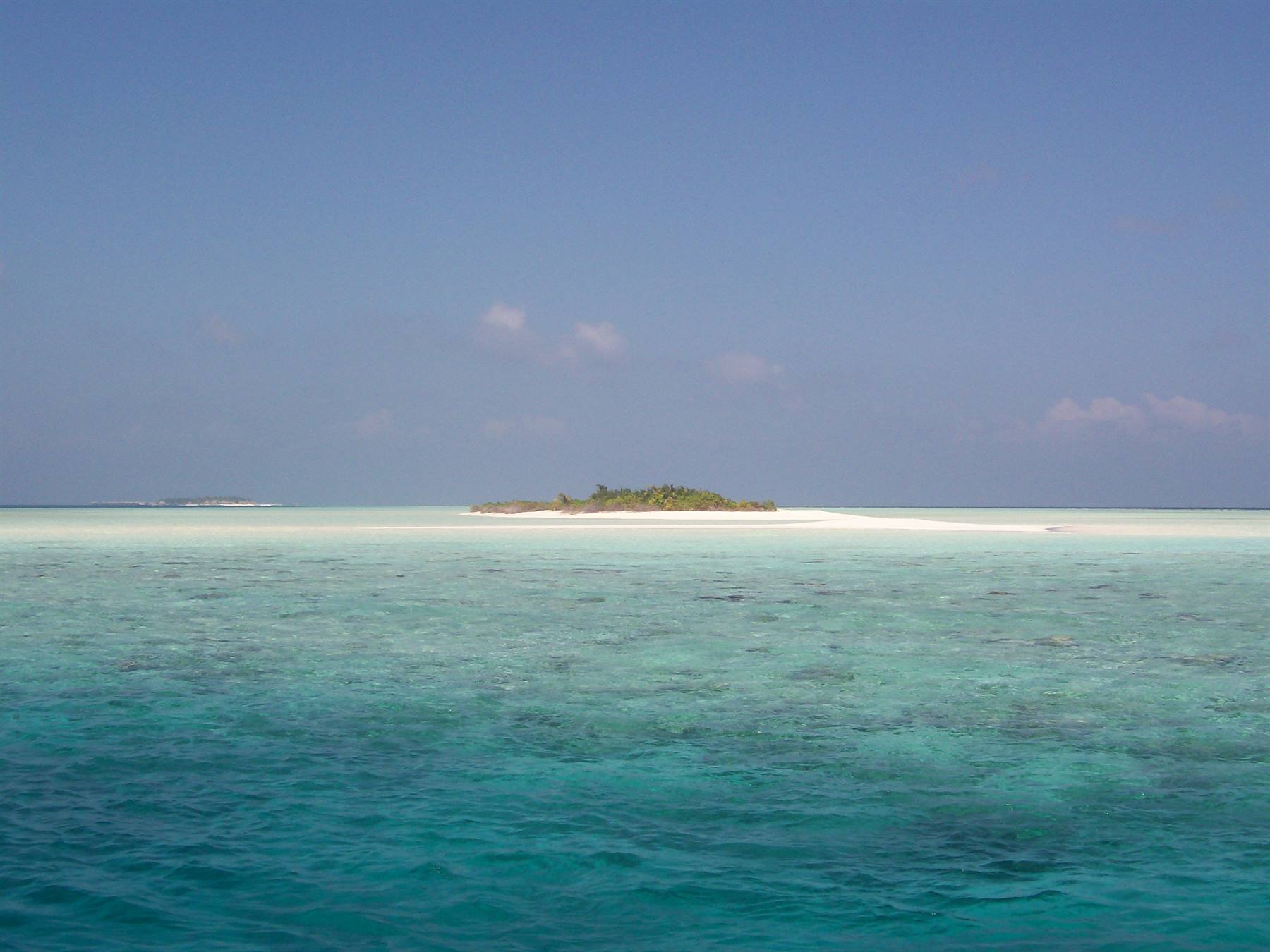
Here there is a recently renovated five-star resort, a sandbank covered by a few centimetres of water stretching for tens of metres in front of the water bungalows, a beach of delicate white sand lapped by the turquoise waters of the lagoon and a beautiful pool overlooking the sea. I swim in the lagoon; yesterday evening I returned the fins to the Marine Shop but kept the mask and snorkel, so I can enjoy a swim in the shallow waters that offer extraordinary views of corals and fish, especially since the sea is perfectly flat and clear. From the jetty where our boat is moored we see a pod of dolphins heading out to sea. From Veligandu we set off again for the tiny uninhabited island of Madivaru, around which the water is so shallow that we have to anchor offshore and be picked up by a small donhi, the traditional Maldivian boat.
But even the donhi can't take us ashore, so we cover the last metres on foot with the water up to our knees and our backpacks on our shoulders. The island is really tiny: there are a few bushes, a little beach curving around it, a transparent, warm turquoise sea. Waiting for us is a chef from our resort with a barbecue of fish and tropical fruit. After refreshing myself I reach the even smaller twin islet a short distance away, walking with my feet in the water and using plastic flip-flops so as not to cut myself on the many stones in the sea. Once I get to the other side I walk the entire beach of the little islet, then go back to walking in the water on the opposite side.
Following the others, I walk on foot through a good stretch of sea that gradually gets deeper, until I'm forced to swim to reach three wonderful coral rocks rising from the seabed almost to the surface, where a great many fish swim around: an exceptional spectacle, the best snorkelling I have ever done, the cherry on top of this trip to the Maldives. Doing the route in reverse, I leave the twin islet and, again walking in the water, reach the small sandbank emerging from the sea between the two Madivarus. Back on the barbecue island I find a pleasant surprise: our chef has found a large crab that doesn't seem to be at all afraid of us humans; it walks along the beach among the backpacks and beach towels. A really nice little creature. I go into the very shallow, warm sea; it feels like stepping into a bathtub.
What a paradise!!! To return to Kuramathi too we have to follow the same route: on foot to the donhi, with which we reach the motorboat for the trip back to the resort. Along the way we observe strange little fish in the sea that leap in schools on the surface as if they wanted to take in air. Satisfied with this lovely excursion, I return the snorkelling equipment to the Marine Shop and we go to dinner. Before heading back to sleep, we stop at the bungalow of a couple we have met here; over the past few days he has collected the coconuts that have fallen spontaneously to the ground from the island's many plants. Strangely, although there are many palms on Kuramathi, we have rarely been given coconuts at the restaurant. Our friends gladly serve us a couple of these tropical fruits, from which we suck the very sweet nectar straight from the shell; then, once opened, we eat the flesh too.
Unfortunately the holiday is drawing to a close; tomorrow morning we'll have to get up early, so we go to sleep.
Kuramathi
Day 921 Jan 1999
heading home
At 5:30 in the morning the phone in our bungalow rings to let us know that within 15 minutes we must leave our luggage outside the door and then go to the restaurant, where breakfast will be served. Day breaks early because here at the equator the hours of day and night are equal all year round. Once we've eaten, we set off on a fast boat for Male airport. Passing close to some islands of no tourist interest and skimming the capital, which shows itself before us with its colourful buildings topped by the golden dome of the Islamic Centre, we land at Hulule. The island is entirely occupied by the airport; time for check-in, a quick visit to the duty-free shops, then on board the Eurofly flight to Bologna via Milan.
The plane is almost empty, so I can move from one seat to another to see through the windows the artificial palm-shaped islands of Dubai, the Qatar peninsula, the deserts of Saudi Arabia, the coast of Syria, the island of Cyprus, the mountains of Turkey, then a blanket of clouds that prevents us from seeing any part of Europe. We land in Milan, where there is snow and it's cold; a stop of about three hours, and then on the same plane we fly to Bologna. The trip is over, but it was a great holiday in one of the most enchanting places on earth.




0 reader comments