The story
Maldives! Here I am at Hulhule international airport, located on an island not far from Malé, the capital. Here everything stands on an island — the airport, the capital, the villages and the factories… after all, there are only islands! To understand the nickname "Kingdom of the Islands" (the way Maldivians like to call their own country) we need to take a step back. I'm comfortably seated on the plane, reading an article in the in-flight magazine entitled The Kingdom of the Islands, when I look out of the porthole and see appearing, in the sea below me, at more than 8,000 metres, the myriad islands that distinguish this archipelagic state the world over. I sense that the title couldn't have been more apt, so much so that I borrow it for this travel account of mine.
Seen from above, the Maldives are even more beautiful: endless rings of coral, green, turquoise and pale blue, and… all around, tiny islands. Officially there are 1,192 islets, but new ones often emerge and old ones disappear, so it is practically impossible to define the exact number. Exactly 26, however, are the atolls over which the islands are distributed. For about an hour the spectacle is guaranteed, until we land. Coming out of the airport there is a long row of small counters with the sign of each specific tour operator, where they gather the groups of their own tourists. We go on towards a jetty where we see some dhoni moored, the traditional boats of the place, still used today to transport goods and people and for fishing. In English, we turn to a boy at the helm of one of these dhonis to ask for information. To our surprise he answers us in Italian.
To take us to our resort, the Giravaru, located in the southern part of the North Malé atoll, he asks 15 US dollars per person. Based on the information we gathered before departure we find that the price is fair, so we accept, for once without haggling. We'll have to wait, though, for the boat to fill up with people. We wait thirty minutes before leaving. With us there are only Maldivians, all heading for the capital. After just ten minutes the dhoni stops at the island of Malé. Leaving Malé we glimpse the dome of the Grand Mosque, entirely covered in gold leaf, able to hold up to 5,000 worshippers. Along the way we see here and there, more or less close, small islands. Then we pass in front of a larger one entirely occupied by a factory. From Malé it takes us 30 minutes to reach Giravaru Island. We rush straight to our room to put on our swimsuits and go for the first of many swims.
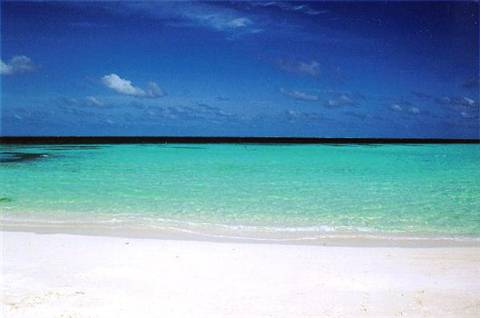
After splashing about for about an hour in the water and after another hour of absolute rest on the sun loungers, someone is already feeling a sense of claustrophobia. We opt for an exploration of the island we've ended up on. After ten minutes we're back at the starting point. Were it not for two excursions we'll make during our stay, the trip would already be over… There's nothing but the sea — but what a sea! The water is incredibly crystal-clear and transparent. For five days we live in charming bungalows just ten metres from the sea, on a beach of the whitest sand, thanks to the microscopic corals that make it up. Our days pass in the water: before breakfast, in the morning, in the afternoon, ending with idyllic swims at sunset. For anyone looking for relaxation, for anyone in love with the sea, the Maldives really are paradise.
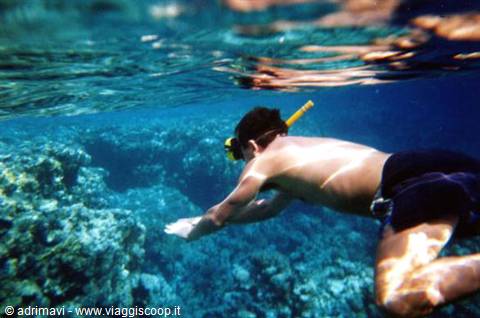
The sea temperature is ideal: a constant 26° all year round. For me and Mavi the best pastime is snorkelling. Armed with mask and fins we explore at the water's surface the seabed along the ring of the atoll on which our island sits, towards the horizon. These seabeds are less spectacular than those we enjoyed in the Red Sea. The coral is less colourful because it is largely dead, and as far as the fish are concerned they seem more or less the same. In any case the seabeds are, all the same, nothing short of fascinating. We snorkel for two hours keeping always where the sea is green, a sign that the water isn't very deep. Back on shore we realise we're not exactly burnt, but almost! Over the following days Mavi and Simona will cover themselves in protective creams, while yours truly will constantly wear a T-shirt, even while swimming.
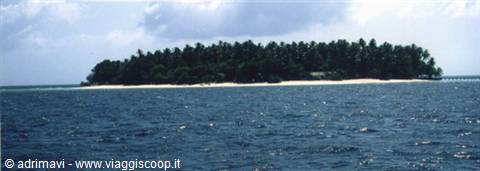
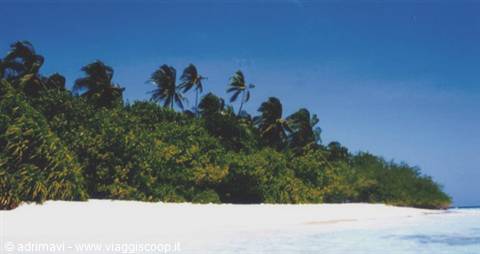
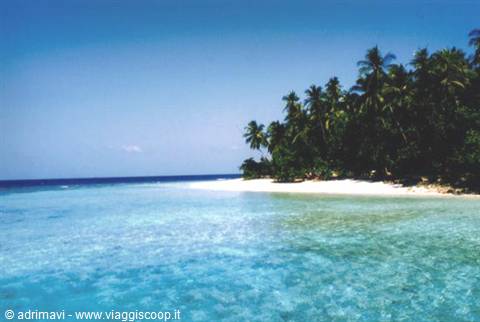
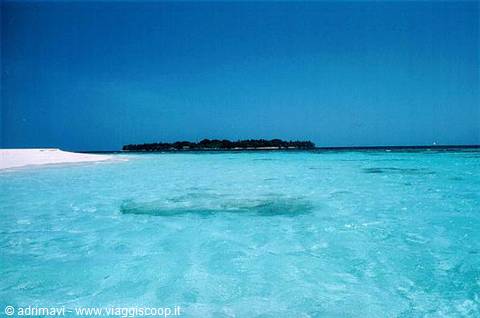
The next day we take the half-day excursion to an uninhabited island. From afar we can barely see it emerging from the ocean. Not by chance are the Maldives in the Guinness records for being the flattest country in the world. The maximum elevation is 3 metres above sea level! The island is a delight, nothing but palms, sand and sea, an untouched place with no traces of human presence that inspires, at the same time, serenity and fear: serenity for the extraordinary beauty, fear for the lost solitude. As we draw near with the dhoni we see the white of the spray of the waves breaking on the coral reef, then the green of the palms and finally the beach. The island is even smaller than our resort's, the beach even whiter, the water even more crystal-clear. Looking to the horizon the sea blends with the sky. The palms seem to fall into the water, almost as if wanting to caress it.
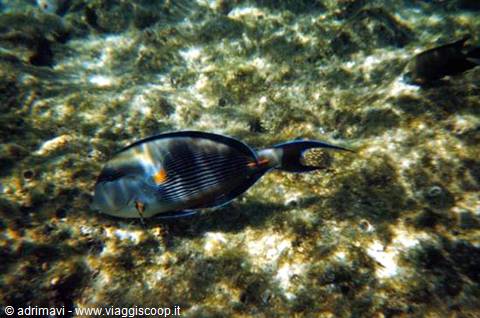
We're in paradise! The next day we take an excursion in the open sea, near a beautiful coral reef, where some guests of the village told us they had seen turtles. The reef is indeed very beautiful, the seabed colourful thanks to the still-living corals. We see Napoleon fish, clownfish, emperor angelfish, then groupers and very dense shoals of gleaming glass fish, but not the sea turtles. There's no need, anyway, to venture far out to admire the marine world. We saw a moray eel swimming sinuously just a few metres from the shore. At six in the evening on our last day of holiday we're on one of the characteristic jetties of Giravaru, built with blocks of madrepore and coral, waiting for the sun to set. While waiting we spot gigantic crabs. Almost as if nature knew it had a fantastic sunset in store for us.
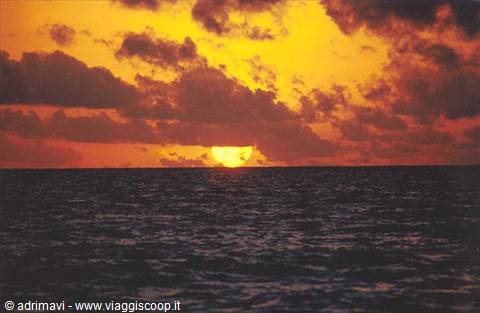
The setting sun radiates an orange light as far as the eye can see; our bodies are wrapped in it; we witness one of those unforgettable sunsets that remain indelibly in the memory. It becomes night, but not dark: a great full moon and a galaxy of stars give enough light. As we advance along the beach, ahead of us swarms of "paciugo" scurry lightly over the sand in all directions. The Maldives are the "republic of holidays". A place for tourists, certainly not for travellers. The place is exactly like the photos the various brochures advertise, a place out of a fairy tale, as it said on a sign at the airport: paradise on earth for those seeking tranquillity and rest, and for those in love with the sea. That's the Maldives explained briefly. Mavi and I, more used to moving about and travelling, feel like prisoners in the evening, even if in paradise.
My brother and Simona, on the other hand, enjoyed the treasures of this Eden: endless horizons, the silence of great open spaces, night skies studded with stars, sun and tropical heat, transparent waters of blue, pale blue and green, white beaches of the finest coral, scenic palms leaning towards the sea, wonderful seabeds and brightly coloured fish. Maldives, a gilded cage or an earthly paradise? Or perhaps just the kingdom of the islands
The journey's photographs
12 photographs · click to open them full screen




0 reader comments